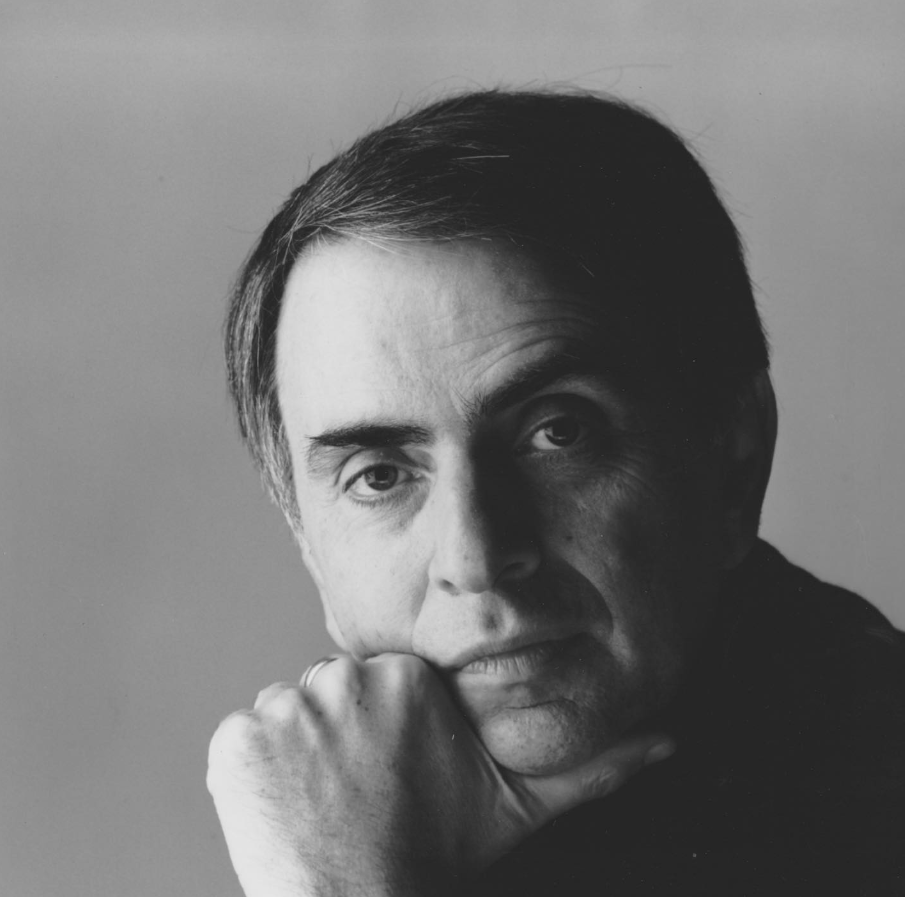
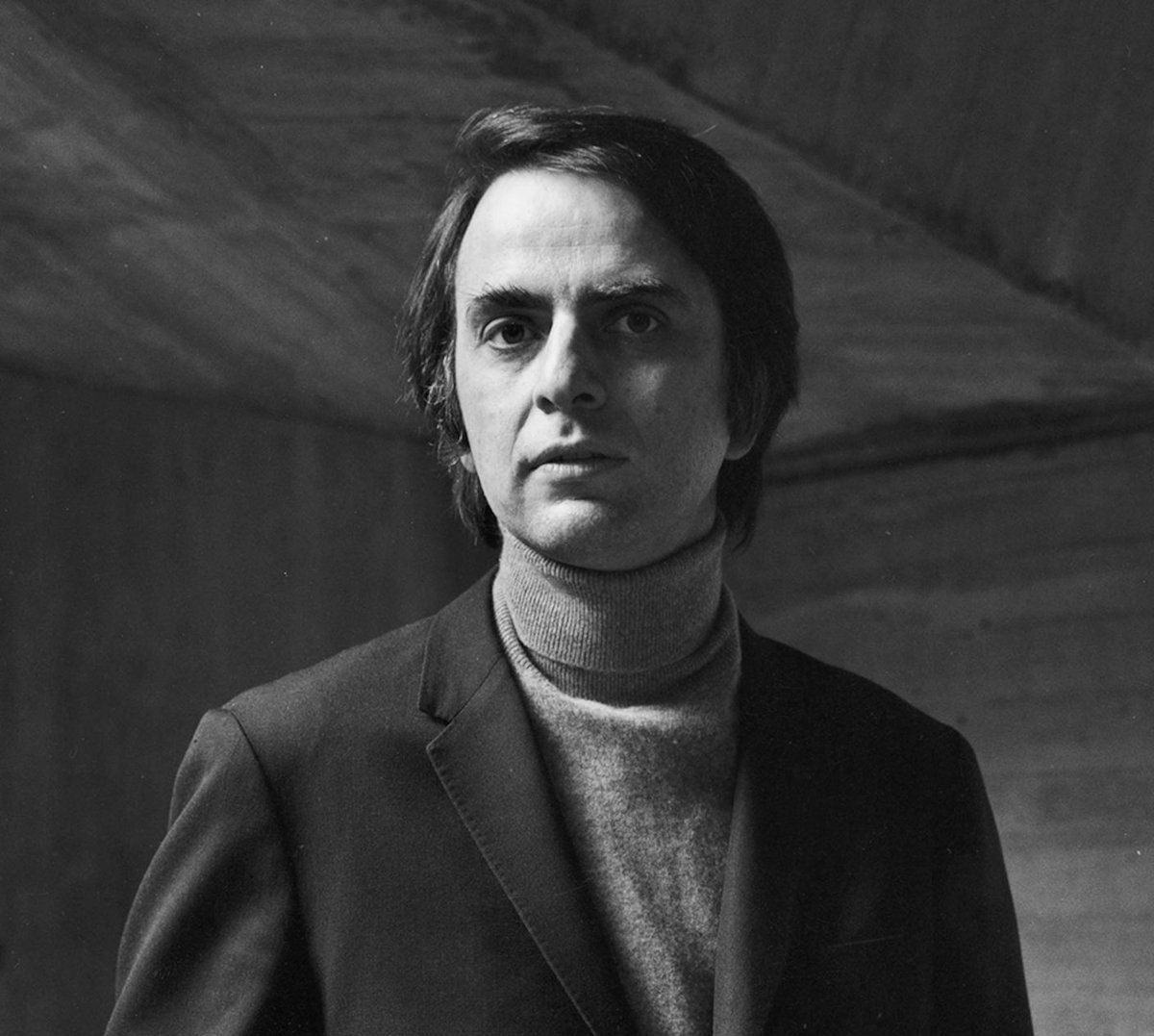
When I was just a boy growing up in Brooklyn, my parents knew very little of science. But they gave me an invaluable gift: an open door to curiosity.
I remember walking into the public library on 86th Street, trembling slightly with a question that had consumed my mind. I asked the librarian for a book about stars. She smiled and handed me a thin volume filled with pictures of actors and actresses. I told her, politely, that this wasn’t what I meant.
She returned with the right book. I sat down, opened the pages, and read a phrase that took my breath away: Stars are suns, only very far away.
- Carl Sagan
"I meet many people offended by evolution, who passionately prefer to be the personal handicraft of God than to arise by blind physical and chemical forces over aeons from slime. They also tend to be less than assiduous in exposing themselves to the evidence. Evidence has little to do with it: what they wish to be true, they believe is true."
— Carl Sagan
“Since, in the long run, every planetary civilization will be endangered by impacts from space, every surviving civilization is obliged to become spacefaring—not because of exploratory or romantic zeal, but for the most practical reason imaginable: staying alive”
— Carl Sagan
“If we continue to accumulate only power and not wisdom, we will surely destroy ourselves... If we become even slightly more violent, shortsighted, ignorant, and selfish than we are now, almost certainly we will have no future.”
— Carl Sagan
“Every one of us is, in the cosmic perspective, precious. If a human disagrees with you, let him live. In a hundred billion galaxies, you will not find another.”
— Carl Sagan
In the last interview of his life, Carl Sagan gave an uncannily prescient warning of the dangers that arise when you cannot ask skeptical scientific questions of those in authority.
Precise timing measurements of close-in gas giants have revealed that some “hot Jupiters” are gradually spiraling inward toward their host stars. These planets orbit so closely that tidal forces raise large bulges on the star itself. As the star’s interior dissipates this tidal energy, angular momentum is lost from the planet’s orbit, causing it to shrink over time.
In a few well-studied systems, the orbital period has been observed to shorten by milliseconds per year, a tiny but measurable effect. The rate of decay depends on the star’s internal structure and how efficiently it dissipates tidal energy, providing a rare probe of stellar interiors that cannot be accessed directly. Eventually, the planet may be torn apart or engulfed by the star.
Orbital decay reshapes understanding of planetary system lifetimes. It explains why ultra-close giant planets are rare and shows that planetary systems can remain dynamically active long after formation, with tides continuing to alter their architecture on astronomical timescales.
Source
NASA, Hubble Space Telescope, Nature Astronomy, Astrophysical Journal
I would love to believe that when I die I will live again, that some thinking, feeling, remembering part of me will continue. But as much as I want to believe that, and despite the ancient and worldwide cultural traditions that assert an afterlife, I know of nothing to suggest that it is more than wishful thinking.
I want to grow really old with my wife, Annie, whom I dearly love. I want to see my younger children grow up and to play a role in their character and intellectual development. I want to meet still unconceived grandchildren. There are scientific problems whose outcomes I long to witness—such as the exploration of many of the worlds in our Solar System and the search for life elsewhere.
I want to learn how major trends in human history, both hopeful and worrisome, work themselves out: the dangers and promise of our technology, say; the emancipation of women; the growing political, economic, and technological ascendancy of China; interstellar flight.
If there were life after death, I might, no matter when I die, satisfy most of these deep curiosities and longings. But if death is nothing more than an endless dreamless sleep, this is a forlorn hope.
Maybe this perspective has given me a little extra motivation to stay alive. The world is so exquisite, with so much love and moral depth, that there is no reason to deceive ourselves with pretty stories for which there's little good evidence.
Far better, it seems to me, in our vulnerability, is to look Death in the eye and to be grateful every day for the brief but magnificent opportunity that life provides.
- Carl Sagan, Billions & Billions: Thoughts on Life and Death at the Brink of the Millennium