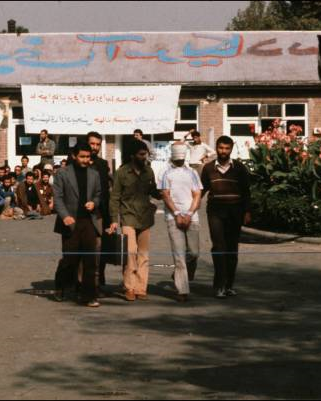
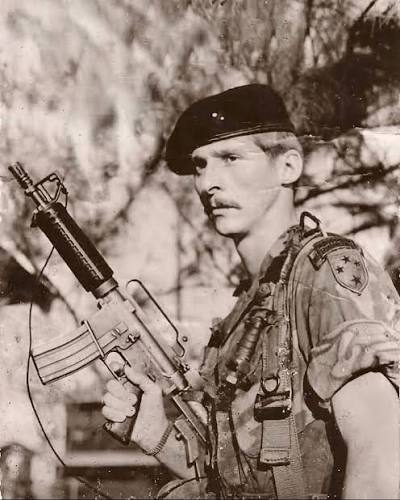
Sergeant Major Clem Lemke, known as the “Mad German” led a handful of men into Tehran, Iran in 1980 to gather intelligence for a planned hostage rescue mission.
Iranian students stormed the US embassy in Tehran in November 1979, taking more than 50 Americans hostage. Although the hostage crisis played out for more than one year, the Department of Defense began developing rescue plans immediately. One of the most critical requirements was up-to-date intelligence on the ground in Tehran.
Lemke was a Sergeant First Class assigned to Det A in Berlin at the time, following service in Vietnam as a Ranger team leader and later as a Ranger instructor. Det A was a unique unit trained to work as a stay-behind team in Berlin in the event of a Soviet invasion and occupation. They knew how to blend in while carrying out sabotage and reconnaissance operations, among other skills.
He and another Det A soldier named Scotty McEwan traveled to Tehran posing as German businessmen. They split up and spent days gathering intelligence on the US embassy, the Ministry of Foreign Affairs compound, security and defenses, and routes in and out of Tehran. McEwan even talked his way into a tour of the interior of the MFA, where three hostages were being held separately. The intelligence they gathered was critical for mission planning.
The other two men on the ground were Richard Meadows, an Army Special Forces legend who’d come out of retirement for this mission, and a young Iranian-born Air Force sergeant named Fred Arooji, who would go on to a long career in clandestine operations.
After the hostages were finally released in January 1981, Lemke continued serving in a different special operations unit, followed by many years with CIA. He was inducted into the Ranger Hall of Fame in 2021.
For episode 154 of the Spycraft 101 podcast I spoke with James Stejskal, author of Mission Iran. We discussed the plans and preparations for one of the most daunting rescue missions ever devised, the men who carried it out, and the fallout from its tragic failure. The episode is available now.
#iran #deltaforce #sfodd #eagleclaw #rescue
https://t.co/NTNbhyMCIM
America’s infrastructure needs a major upgrade and a fail-safe backup that can’t go down. Modernizing air traffic control is critical, but we need hardened, unhackable redundancy so one glitch or cyberattack never grounds the nation again.
6/6
The biggest barrier isn't a lack of policy; it's political will. Because lawmakers must vote to restrict themselves, achieving this demands sustained public pressure and coalitions.
1/6
How can the US realistically become one of the least corrupt governments in history? It requires structural legal reforms and serious accountability. A quick thread on the key pillars.
5/6
Binding Ethics Rules: Enacting enforceable ethics codes for the Supreme Court with independent investigation mechanisms. Accountability must apply to all three branches.
4/6
Fixing the "Revolving Door": Enforcing strict multi-year cooling-off periods (4–5 years) to stop former lawmakers and officials from immediately lobbying their ex-colleagues.
3/6
Stock Trading Bans: Prohibiting members of Congress, spouses, and dependents from trading individual stocks. Real-time digital disclosures prevent conflicts of interest.
2/6
Campaign Finance: Curbing "dark money" and corporate influence. Solutions include small-donor matching systems to help politicians rely on everyday voters instead of mega-donors.
@USNatArchives 6/6
Democracy dies in darkness. Democratizing access to @USNatArchives doesn’t just preserve our history; it restores public trust by making government transparency the default, not the exception. #Accountability#History
1/6
Why do you still have to fly to D.C. to dig through paper boxes of history? @USNatArchives and U.S. declassification systems are trapped in the 20th century. Here is how we open government records to the digital world #FOIA#OpenGov
@USNatArchives 5/6
Smash #FOIA Gatekeeping: Right now, you file a request and wait years. If a record is released to one citizen, it must instantly become public for everyone via an open API and central portal. #OpenData#PublicRecords
@USNatArchives 4/6
AI-Powered Search: Archival research shouldn't require knowing obscure government filing codes. Modern AI transcription can turn millions of messy historical memos into fully searchable databases. #AI#GovTech
@USNatArchives 3/6
Digital-by-Default at @USNatArchives: Stop forcing people to visit a physical reading room. Every declassified or #FOIA record should be automatically scanned, OCR-processed, and uploaded online instantly. #DigitalArchives
@USNatArchives 2/6
End Reflexive Overclassification: Millions of historical documents stay locked away not for security, but to hide bureaucratic embarrassment. The burden of proof must shift back to the government. #Declassify#Transparency
7/7
Give Watchdogs Teeth: Internal privacy boards are currently toothless paper tigers. If we don't give independent oversight bodies real enforcement power, mass surveillance will quietly erode constitutional rights.
1/7
America’s spy agencies are fighting 21st-century cyber warfare with a 1950s playbook. It’s bloated, overly secretive, and dangerously outdated. Here is how we tear down and rebuild the U.S. Intelligence Community
6/7
End the Classification Scam: "National security" is too often a cover-up for bureaucratic failure. Fast-track declassification lets America weaponize the truth against foreign propaganda and earns back public trust.
4/7
Put a Leash on Spy AI: Agencies are racing to use AI to predict global crises, risking mass automated surveillance of Americans. Without hard legal guardrails and bias audits, algorithms will shred civil liberties.
3/7
Kill the Secrecy Addiction: Spies ignore goldmines of public data (OSINT) because it isn't "classified." Most crucial intel today is sitting on open servers and commercial satellites; not locked in a vault.
2/7
Fire the Clueless Watchdogs: Lawmakers overseeing cyber and AI ops barely understand basic tech. Congress must smash outdated committee turf wars and put cleared engineers in the room to hold spies accountable.