Author | Professor | Legal Writing Director @MiamiLawSchool | Former journalist | Book no. 3: The Supreme Guide to Writing is now available from Oxford Press!
I'm grateful to @frohock_c for this thoughtful review of The Supreme Guide to Writing—and always happy to be part of the ongoing conversation about modern legal writing and grammar.
Do exclamation marks have any place in legal writing? #SCOTUS justices use them rarely. My take: skip the loud punctuation and let your words do the work.
Thanks to @rumpfshaker for the shoutout!
This ruling had 26 (!!) of them:
https://t.co/6vUNkuyJgC
Letter No. 5 creates a majority! Most #SCTOTUS justices skip gender-based courtesy titles (like Mr. and Ms.)—though they still use professional titles like Dr., President, and Governor. #JusticeGorsuch shows that here. #lawtwitter#legawriting
@Citi Your goal is to run the bank more efficiently but at the expense of longtime clients. I canceled two accounts today because of abysmal customer service and a flat-out refusal to provide promised benefits that I already paid for.
@Citi It's absolutely appalling to brag about earnings while cheating customers out of benefits and fees. I canceled two Citi cards today and will never do business with this awful company again.
The Supreme Court’s writing style is changing. This week on NPR’s Academic Minute, I discuss why the Court’s shift toward a more conversational tone is more than just a stylistic choice. Listen here: https://t.co/lamEmGV4eb
#LawTwitter#SCOTUS#TheSupremeGuideToWriting
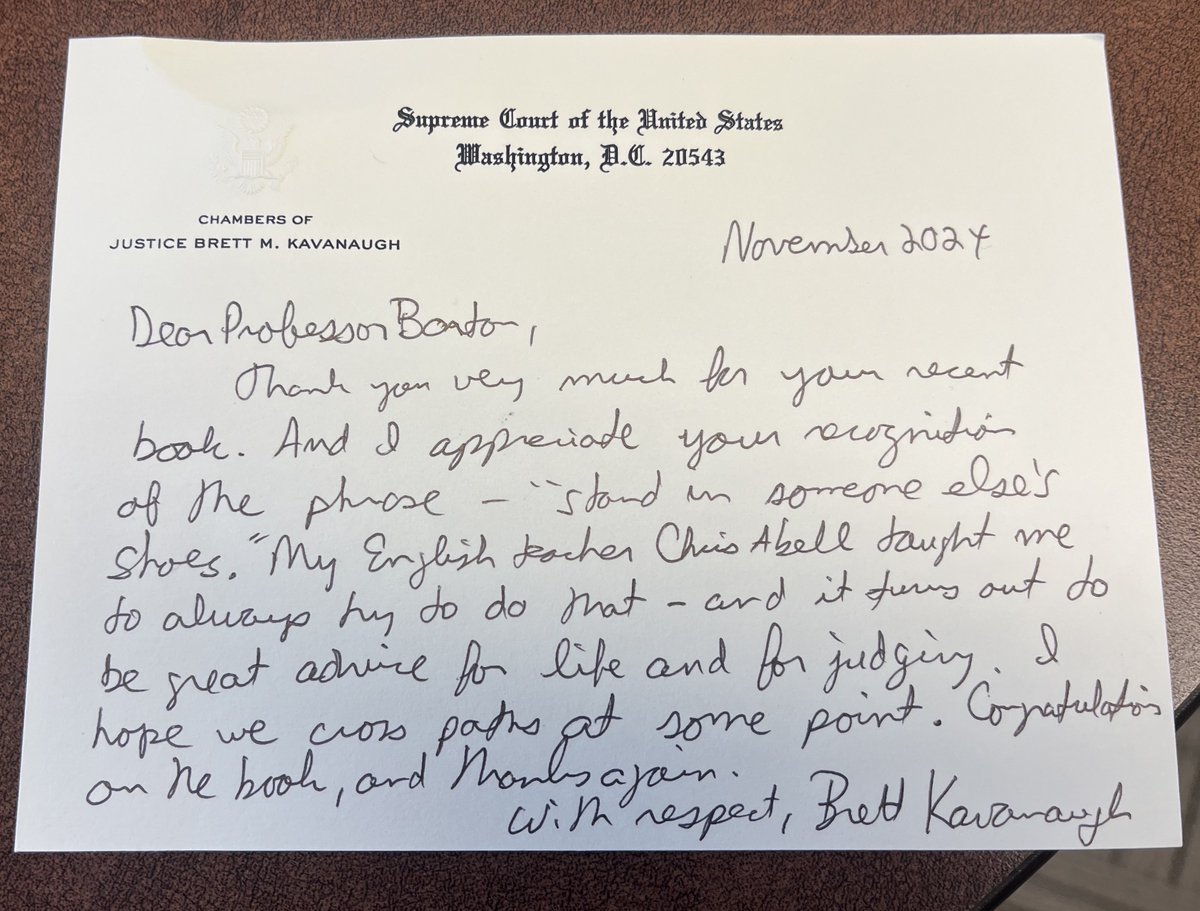
I’m honored to share that Justice Brett Kavanaugh sent a congratulatory note about The Supreme Guide to Writing! He mentions a quote, "Stand in someone else's shoes," which also also opens my chapter on names and titles. #WritingTips#LegalWriting#SCOTUS https://t.co/fxIuSZBWIX
Looking for ways to elevate your legal writing? I shared some of my favorite tips this week with @WGNLegalFaceOff and discussed what makes Supreme Court opinions shine—and why great legal writing matters now more than ever. 🎙️
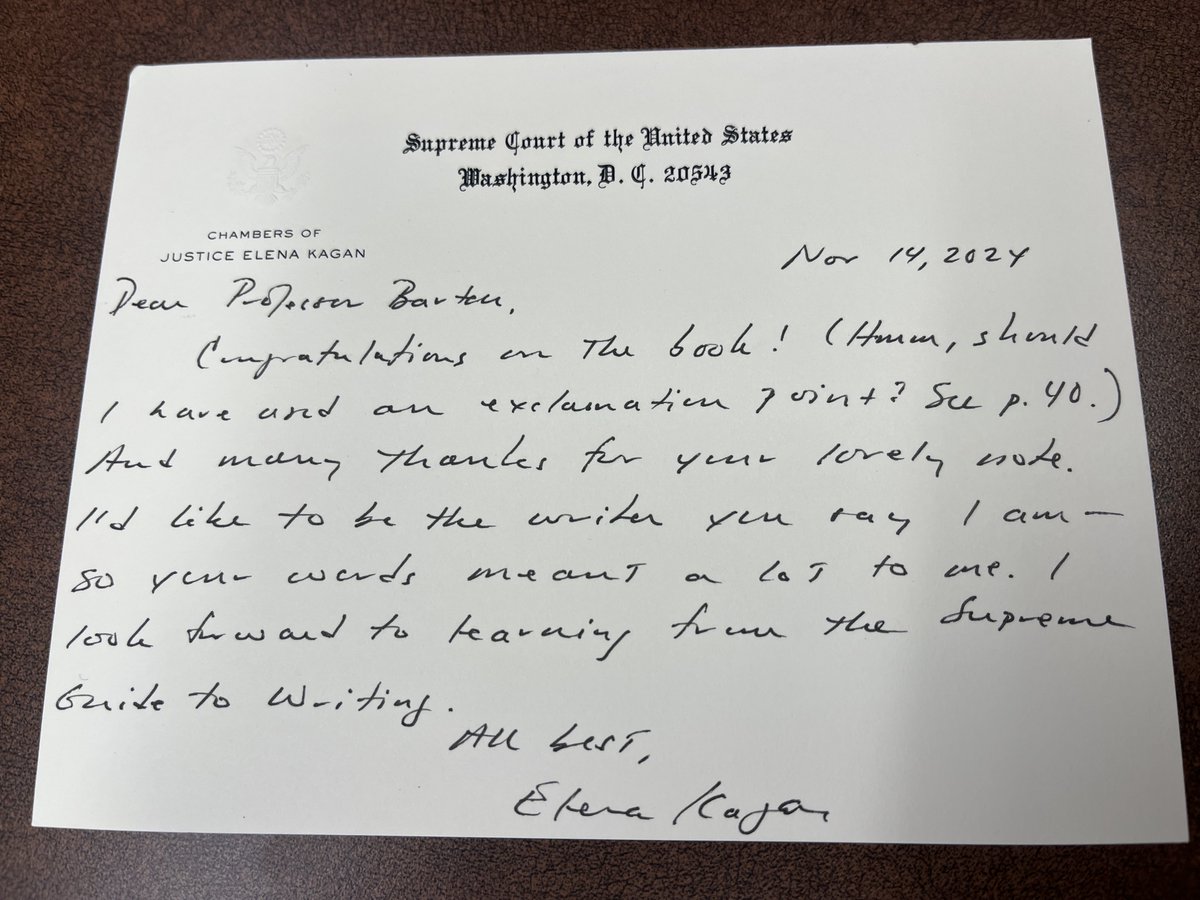
I was thrilled to receive a note from U.S. Supreme Court Justice Elena Kagan congratulating me on my new book. True to form, she shared a witty remark about an exclamation mark. Curious if you write like a Supreme Court justice? Take a pop quiz at https://t.co/nxW0BuX6uz.
I’m thrilled to announce my book The Supreme Guide to Writing is out from @OxUniPress! I dove into 10,000+ pages of #SCOTUS opinions to settle all the tricky grammar debates. The book is packed with tips on making your writing more natural, engaging, and concise. #lawtwitter
Is it Harris' or Harris's? The Supreme Court justices can't agree on this possessive rule either.
#greatlegalwriting#lawtwitter
https://t.co/P0kXz2QWY1
Find more #SCOTUS#grammar splits here: https://t.co/mPTSsnb28Z
https://t.co/IMUOgIzQCc
#Greatlegalwriting by #SCOTUS Justice Jackson: "Snyder’s absurd and atextual reading of the statute is one only today’s Court could love. . . . . The Court’s reasoning elevates nonexistent federalism concerns . . . and is a quintessential example of the tail wagging the dog."
A rare spotting of the singular "they" in a #SCOTUS opinion. An "individual may elect to receive educational assistance . . . if they meet two criteria. First, they must fall into one of six categories . . . . Second, they
must “mee[t] the requirements for entitlement . . . ." #
"The proper response to this case is not to throw up novel roadblocks enabling South Carolina to continue dividing citizens along racial lines. It is to respect the plausible—no, the more than plausible—findings of the District Court ...." #SCOTUS#greatlegalwriting#JusticeKagan
A 7-page #SCOTUS opinion with pictures--now that's concise, #greatlegalwriting. #JusticeThomas keeps ancillary issues out. For example: "But, this case does not require us to resolve that question." https://t.co/mF6g6cqwIJ