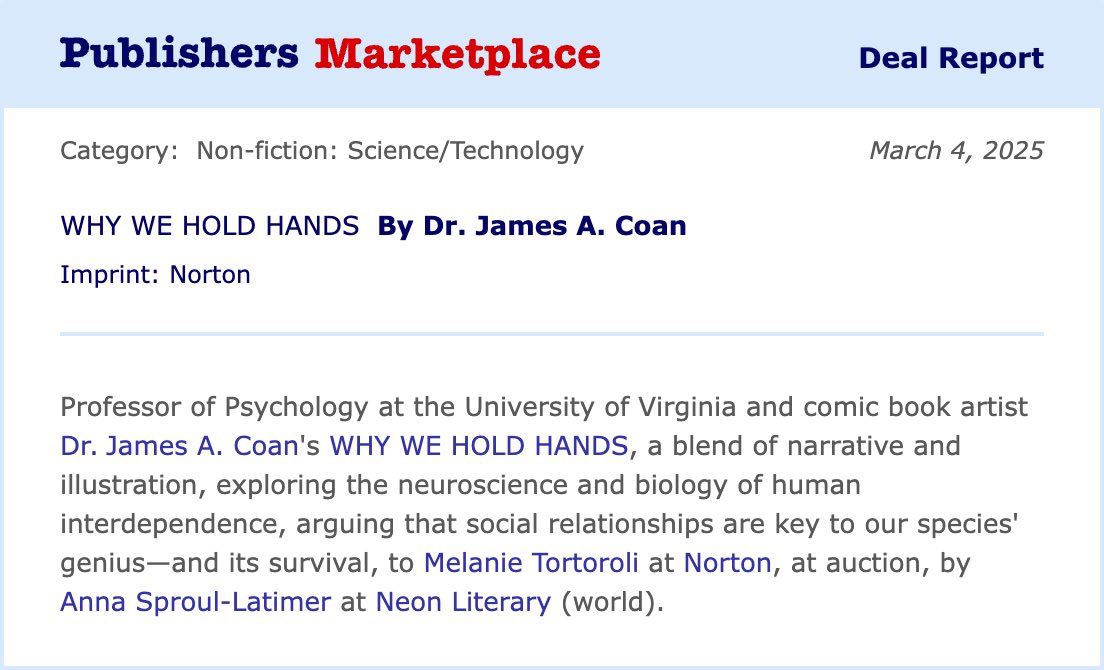
Just signed with @wwnorton to write *Why We Hold Hands*! With narrative prose, and illustrations by moi, it will change your view of human relationships. Thanks to my editor Melanie Tortoroli, and my amazing agent, Anna Sproul-Latimer, for shepherding this! #WhyWeHoldHands
5 books to get to know me better
1. Adventures of Huckleberry Finn, by Mark Twain
2. Slaughterhouse Five, by Kurt Vonnegut
3. Gilead, by Marilynne Robinson
4. The Dispossessed, by Ursula K. Le Guin
5. The Demon Haunted World, by Carl Sagan
5 books to get to know me better:
1. Sixteen Ways to Defend a Walled City, KJ Parker.
2. Fahrenheit 451, Ray Bradbury.
3. Catriona, Robert Louis Stevenson.
4. Inside Job, Connie Willis.
5. Small Gods, Terry Pratchett.
Have we learned nothing???
Universities, academic journals, and the knowledge-making / disseminating apparatus of academia DEPEND ON TRUST.
Our job is the pursuit of truth. Politicians will occasionally threaten that pursuit: By saying false things, by threatening freedom of speech. In those cases, we should loudly and clearly oppose what they say and do.
Endorsing candidates is a totally different and completely counterproductive move. It destroys trust, and makes our job harder in every way.
Fucking disgusting how deceptive con artists have been given carte blanche across the political spectrum by spineless colleagues and ascended to the highest levels of all our institutions.
Don't think trans sports stuff is gonna be major in most 2026 races, but holy hell is this a demoralizing albatross for Dems to be dragging around. GOP knows they can ask any Dem this and 80% of the time it will generate cringeworthy oppo footage. Rank political malpractice.
People use jargon, acronyms and legalese to efficiently communicate and signal group membership. But they also use it to compensate for low social status.
Nine studies found that being put in a position of low status increases jargon use. Similarly, analyses of 64,000 dissertations(!) found that authors from lower-status schools included more jargon than authors from higher-status schools.
The reason is that low status are concerned more with audience evaluations over conversational clarity. So they use jargon to sound impressive.
Speaking clearly is a sign of someone who feels secure in their social status. In turn, they can communicate clearly and command a much larger audience.
https://t.co/YQBqNKkQWj
“I’m a fan of respecting the sun, having the sun do what it does… If you keep Daylight Saving Time the entire year, in NYC the sun won’t rise until 8:20am. There’s safety issues with that.” —Dr Neil deGrasse Tyson
I did an interview with the The New York Times about a new trend going viral on social media: Travel accounts that feature risky, cross-continental journeys
These accounts go viral because they are shocking and out of the ordinary, which encourages increasingly risky decisions. But also because viewers develop parasocial bonds with the influencer that deepen over time.
"Daily updates drive engagement and can cause viewers to build a psychological bond with the travelers, since they feel intimately involved in the highs and lows of the journey", said Jay Van Bavel, a social neuroscientist at New York University.
The content from these journeys can feel more accessible to people than the “Kardashian knockoff influencers” that were famous on Instagram in the 2010s for living a highly curated life (e.g., flying in first class or a vacation in the Maldives), which helps people develop a deeper connection.
If you want to spread a message or build a fanbase, it helps to understand a bit of the social psychology behind these dynamics.
https://t.co/5BJhCBv8ay
Real Community Requires Dealing with People who are Pain in the A**
We know "how good community is for us, how it fosters joy, health, and well-being," writes @UVA social psychologist @jimcoan. "All of that is true."
But in real communities, friction with other people is a "feature, not a bug" because "other people—and you are “other people” to somebody—are a pain in the a**."
"The brain is always looking for evidence that it is embedded in a predictable and reliable social network, a community. The question is, what counts as evidence? It certainly isn’t someone just telling you that you belong. To the brain, words are weak sources of evidence. We have a well-worn aphorism for this: actions speak louder than…
No, real evidence of belonging comes from the daily friction of lives in contact. It’s the proof that you’ve worked for your community, been inconvenienced by it, given it as much as it’s given you. Yes, the good times count. Laughing and loving, eating together, holding hands, singing at concerts, worshiping together, travel, all those photo albums…that’s all real and good.
But is it proof? Maybe. You know what plants you into a community? Civic infrastructure, for one thing, and speaking of pains in the a**: taxes, helping your elderly neighbor in a crisis, staying up late with your depressed friend to talk."
"The challenges ahead—technological, political, cultural, ecological—are not ones any of us can face alone. The answer to genuine, unpredictable hardship is not going to be some kind of well-prepared bunker. It's going to be a deeper, richer, larger, maddening, exasperating community of people ready to be there when you need it, when it counts. Ample research shows that when real disaster hits, your community is likely to be there for you, no matter what you look like, prefer, voted for, believe in, or what.
So, resist the temptation to cultivate an easy and validating community. Persons are not playlists. Take part in the social world that is actually around you. Know your neighbors. Answer your phone. As you go out into the world, and as you face the many challenges and opportunities ahead of you, let other people be a pain in the a**. Just like you." https://t.co/Ur6KezmMsT @FamStudies
Real Community Requires Dealing with People who are Pain in the A**
We know "how good community is for us, how it fosters joy, health, and well-being," writes @UVA social psychologist @jimcoan. "All of that is true."
But in real communities, friction with other people is a "feature, not a bug" because "other people—and you are “other people” to somebody—are a pain in the a**."
"The brain is always looking for evidence that it is embedded in a predictable and reliable social network, a community. The question is, what counts as evidence? It certainly isn’t someone just telling you that you belong. To the brain, words are weak sources of evidence. We have a well-worn aphorism for this: actions speak louder than…
No, real evidence of belonging comes from the daily friction of lives in contact. It’s the proof that you’ve worked for your community, been inconvenienced by it, given it as much as it’s given you. Yes, the good times count. Laughing and loving, eating together, holding hands, singing at concerts, worshiping together, travel, all those photo albums…that’s all real and good.
But is it proof? Maybe. You know what plants you into a community? Civic infrastructure, for one thing, and speaking of pains in the a**: taxes, helping your elderly neighbor in a crisis, staying up late with your depressed friend to talk."
"The challenges ahead—technological, political, cultural, ecological—are not ones any of us can face alone. The answer to genuine, unpredictable hardship is not going to be some kind of well-prepared bunker. It's going to be a deeper, richer, larger, maddening, exasperating community of people ready to be there when you need it, when it counts. Ample research shows that when real disaster hits, your community is likely to be there for you, no matter what you look like, prefer, voted for, believe in, or what.
So, resist the temptation to cultivate an easy and validating community. Persons are not playlists. Take part in the social world that is actually around you. Know your neighbors. Answer your phone. As you go out into the world, and as you face the many challenges and opportunities ahead of you, let other people be a pain in the a**. Just like you." https://t.co/Ur6KezmMsT @FamStudies
I spoke to a psychiatrist last week intent on diagnosing someone close to me with OCD, but who wasn't aware of the cognitive-behavioral model or ERP, and when I explained it to him he was dismissive toward me as if I was a vaccine denier. This was at a major medical center.
AI wellness influencers makes a ton of sense: It’s an extremely formulaic genre.
1. “In ancient times, people were healthier.”
2. “Because they lived naturally.”
3. “Pharma is hiding this one trick.”
4. “Science confirms it.”
5. “I look like your idea of a healthy person!”
6. “The East…”
Some academics seem to think that if a segment of the public doesn't trust them, that fact itself reflects poorly on the untrusting segment, which is clearly composed of ineducable ignoramuses and bigots who should be scornfully dismissed rather than won over. Talk about self-blind privilege!
I'm more depressed about academics' response to the Yale and Vanderbilt reports than I am about the reports themselves. What I see on social media apart from X is denial, scorn, belittling of the authors, and suspicion of their motives. There's no saving higher ed from us faculty, apparently.