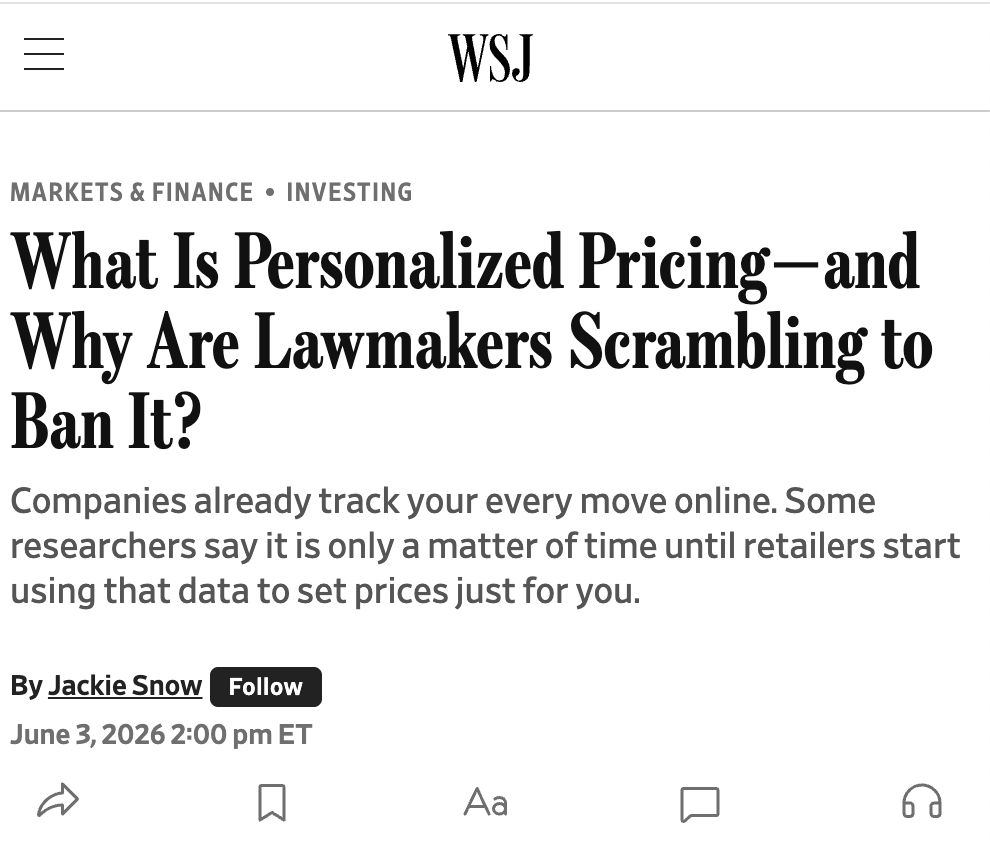
I'm very happy this piece
1) Distinguishes personalized vs. dynamic prices
2) Doesn't use the FTC's made-up term "surveillance pricing"
But it also makes the usual mistake of thinking price discrimination only raises prices.
That's simply not true! https://t.co/kvI4Wri0k5
Job openings surged for pro/business services. Hard to say immediately if its AI-driven, that will require more time. Also unsurprising that actual hires weren't up - it takes time to fill those specialized roles. overall, positive news.
The Commission's DMA review declares the law "fit for purpose" and in need of no revision.
@AuerDirk refutes the claim, finding three defects the review doesn't engage: vague drafting, sub-criminal procedural protections, and contested constitutional foundations. 🔗 ⬇️
SITUATION EXPLAINED: What would taxing AI labs actually cost us?
@kristianstout:
"We're at the very beginning of what you can think of as the intelligence revolution."
"The intelligence revolution stands to be something much closer to the electricity revolution... a platform that enabled further innovation to develop technologies that actually changed the world."
"If we stop now and say, 'Let's just take a cut of what we've got. This is good enough,' we are gonna miss out on biopharma revolutions, transportation revolutions, all kinds of revolutions that we can't foresee."
SITUATION EXPLAINED: What can the history of encryption teach us about regulating AI?
We asked @kristianstout what policymakers should learn from that decade.
"In the '90s, there was a legislative effort to put export controls on encryption, on math equations, which is essentially what AI is at its root."
"What it ended up doing was driving a lot of our innovative researchers offshore. Switzerland and Israel became frontier labs for encryption for a good 10 years."
"IBM did really well... companies with really good budgets to pay compliance lawyers survived. Startups that couldn't afford that had a lot of trouble starting up."
"We drove a lot of our innovative researchers offshore, and then we ended up having to backpedal because everybody else started eating our lunch on encryption."
ICLE's @kristianstout says the White House's latest AI order gets security right, but cautioned that voluntary systems can harden over time, especially when the standards are classified, technical, or opaque👇
Great town hall today with some of the FCC’s talented team in our Office of Engineering and Technology.
This group has paved the way for faster wi-fi, advanced our national security interests, and ensures your electronic devices make it into our market.
Very timely @TB_Times piece from @raylehmann and @kristianstout on Florida's AI boom and the infrastructure questions that arise as hurricane season begins. As @politico and others have reported... this is an increasingly important issue in the state's gubernatorial contest. 👇
My colleague @kristianstout and I in today's @TB_Times on the heightened challenges Florida will face in building out the infrastructure needed to power the technologies on which future economic growth will depend. https://t.co/RVmRwVCXvp
56% of planned U.S. data centers are in states highly exposed to natural disasters.
@raylehmann and @kristianstout wrote in the @TB_Times about why Florida's AI infrastructure bet depends as much on flood pumps and substations as on servers. 🔗 ⬇️
Exactly: "This is, I think, the regulatory equivalent of a student grading their own homework and being pleasantly surprised to discover they deserve top marks." But I think we got used to this. The echo chamber does not allow for honest feedback.
🚨🔊 New post!
Some legal cases age like wine. Others age like browser tabs left open too long.
In our latest post @TOTMblog, @DarioOliveiraN1 and I discuss CADE’s long-running Google News inquiry in Brazil—and why the agency’s recent decision to keep the case alive raises important procedural and substantive concerns.
The case began in 2019 with allegations that Google News and Google Search displayed headlines, snippets, and other journalistic content without compensation. After years of investigation, CADE’s own technical bodies found no evidence of competitive harm: no foreclosure, no essential-facility problem, and even evidence of a positive net flow of traffic from Google to publishers. *That should have ended the matter*.
Instead, the case has now been revived through a different lens: exploitative abuse and alleged economic dependence—while also trying to incorporate Google’s much more recent "AI Overviews" feature into a proceeding that was never designed to assess it.
That is problematic for at least two important reasons.
1⃣ exploitative-abuse theories are notoriously difficult to define, prove, and remedy. Even in jurisdictions where they are available, they are usually treated as a tool of last resort.
2⃣ If AI Overviews raise genuine competition concerns, they should be analyzed in a new case, with a new theory of harm, a properly defined relevant market, and evidence tailored to the actual conduct under scrutiny.
The deeper point is not that platforms should never be investigated. Of course they should when the evidence supports it. But competition enforcement should remain disciplined: market power, conduct, harm, causation, and remedies cannot be replaced by a broad notion of “dependence” or by the intuition that successful platforms must somehow compensate every business that relies on them.
If CADE wants to investigate the future of search, it should do so directly.
🔗in the replies.
"My parents are fallible goofballs like anyone else. But there is something a bit different about the conversations at my dinner table—and something magical and rare about the people leading them."