Defending the Constitution Means Defending It for Everyone
I am Catholic. My faith is an important part of who I am and what I believe. I do not subscribe to the Muslim faith, and I recognize that Islamic teachings and American constitutional principles can sometimes conflict.
But here's something I believe just as strongly: I support and defend the United States Constitution, even when its protections extend to people whose religious beliefs I do not share.
Our Constitution is clear. Article VI specifically prohibits religious tests for public office. That means a Muslim has the same constitutional right to seek and hold elected office as a Catholic, Protestant, Jew, or someone with no religious affiliation.
There are approximately 520,000 elected positions in the United States. Recent estimates identify only a few hundred Muslim elected officials, representing roughly 0.005% of those positions. That is an extremely small percentage.
Yet I continue to hear claims that Muslims cannot sincerely swear an oath to support and defend our Constitution.
That claim is simply false.
A person's religious beliefs do not automatically determine whether they will honor their constitutional oath. Their actions do.
I will always defend my Catholic faith. I will also defend the Constitution, including the religious freedoms it guarantees to people whose beliefs differ from mine.
And let me be equally clear: Anyone who takes an oath to uphold the Constitution must honor that oath. No religious belief, political ideology, or personal agenda excuses violating it.
We can disagree about religion. We can debate policies. We can challenge elected officials and hold them accountable.
But we cannot claim to defend the Constitution while denying its protections to others simply because we disagree with their faith.
The Constitution is not something we defend only when it is convenient or when it protects people who think and believe as we do.
That is what makes America different. And that is what makes our Constitution worth defending.
THE JIM JORDAN I KNEW — AND THE QUESTION REPUBLICANS MUST NOW ANSWER
Some people will not like this post. I completely understand that. But I'm speaking from personal experience, and I believe these are questions Republicans need to confront.
When I was first elected to Congress, I got to know Jim Jordan.
Jim was a firebrand. He was a man of strong convictions who rarely, if ever, compromised his principles. He opposed increasing the national debt, raising the debt ceiling, and expanding government spending. He was willing to challenge his own party's leadership and take positions that were politically unpopular.
I didn't always agree with Jim. In fact, we disagreed on a number of issues. But I respected him because I believed he was doing what he thought was right for our children and grandchildren.
I'll never forget a conversation we had.
I asked him, "Jim, suppose you were driving my race car. You were guaranteed to finish second. But if you pushed the car harder, you had a 10% chance of winning and a 90% chance of blowing the engine, finishing last, and costing me millions of dollars. What would you do?"
Jim smiled and said, "I'd blow up the engine."
That was the Jim Jordan I knew.
You might disagree with him, but you knew where he stood. He wasn't interested in second place, compromise, or political convenience. He was willing to risk everything for what he believed.
But something changed.
Jim was not originally one of Donald Trump's strongest supporters. Over time, particularly after Trump entered the White House in 2017, Jim became one of his most loyal defenders.
For nearly a decade, he has been one of Trump's most visible advocates on television, radio, and in public appearances.
And in my view, that loyalty has increasingly influenced his approach to governing.
The man who once fought relentlessly against spending, debt, and government expansion has become far more willing to defend policies coming from a Republican White House.
He has defended Trump's tariffs, supported his administration's approach to the war in Iran, and stood behind much of the president's agenda.
I believe the Jim Jordan I first met in Congress would have challenged some of those decisions, regardless of which party controlled the White House.
Today, I see a different Jim Jordan.
Now, Jim represents one of the safest Republican congressional districts in Ohio. That gives him political protection that many other Republican members simply do not have.
Members in competitive districts don't have that luxury. They must answer to Republicans, independents, and even some Democrats to survive.
AND THAT BRINGS US TO TUESDAY'S ELECTION.
Republicans suffered devastating losses across the country. Voters sent a message that should be impossible to ignore.
The war in Iran, tariffs, rising costs, and dissatisfaction with the direction of the country all contributed to an election that Republicans should be examining very carefully.
Yet, instead of asking whether our policies and messaging need to change, some seem determined to continue defending the very agenda that contributed to those losses.
And now Jim Jordan is running to become the next leader of House Republicans.
I understand why many Republicans support him. He is articulate, aggressive, hardworking, and an effective political fighter. Those are qualities that have served him well.
But the question isn't whether Jim Jordan can fight.
THE QUESTION IS WHETHER HE CAN LEAD REPUBLICANS IN A NEW DIRECTION.
Can someone who has spent years defending the Trump agenda objectively evaluate where that agenda failed?
Can someone who has become so closely identified with one president bring back the independent voters and disillusioned Republicans the party desperately needs?
And perhaps most importantly:
SHOULD THE PEOPLE WHO DEFENDED THE POLICIES VOTERS JUST REJECTED BE THE SAME PEOPLE ENTRUSTED WITH REBUILDING THE REPUBLICAN PARTY?
I still respect Jim Jordan. I respect his years of public service, his work ethic, and the convictions that originally brought him to Congress.
But respect doesn't mean we should avoid asking difficult questions.
Republicans cannot rebuild by pretending Tuesday never happened. We cannot continue defending the same policies, making the same decisions, and expecting different results.
We need leaders willing to challenge bad policies, even when those policies come from a Republican president. We need leaders who put principles ahead of personalities and the future of the Republican Party ahead of loyalty to any one individual.
SO HERE IS MY QUESTION:
CAN JIM JORDAN — OR ANYONE ELSE WHO SPENT YEARS DEFENDING THE AGENDA VOTERS REJECTED ON TUESDAY — REALLY BE THE LIGHT THAT LEADS THE REPUBLICAN PARTY OUT OF THE DARKNESS?
That's not a statement. It's a question. And it's one Republicans need to answer before choosing their next leaders.
Since the conflict started I publically said if it did not end quickly, it would be a real problem for Republicans come November. Glad to see Vice President Vance is agreeing it cost Republicans the midterms.
Now it is time to move forward. Not backwards, regroup and prepare for 2027 abd 2028 elections.
https://t.co/8VeQsBLUHu
OHIO REPUBLICANS SUFFERED A DEVASTATING ELECTION NIGHT
Republicans lost every statewide race in Ohio except State Auditor, where Frank LaRose managed to narrowly pull out a victory.
We lost three Republican members of the U.S. House of Representatives: Mike Carey, Max Miller, and Mike Turner.
We lost Ohio's U.S. Senate seat.
We also lost seats in both the Ohio House and Senate, including enough seats in the Ohio House to lose our Republican supermajority.
The results could have been worse, but not much worse.
This wasn't just a bad election night. It was a devastating rejection of Republican candidates and a serious warning to Republican leadership.
The question now is whether party leaders will acknowledge what happened, take responsibility, and make the changes necessary to regain the confidence of Ohio voters.
Or will they continue blaming the voters, making excuses, and pretending nothing needs to change?
Hopefully, Republican leadership learns from this disaster. Because repeating the same mistakes and expecting different results is not a strategy for winning elections.
Punchline of the day.......
REPUBLUCANS GOT TRUMPED YESTERDAY !!!!!
It will be interesting to see how Rubio and Vance start to distance themselves from the President over the next two years.
THE REPUBLICAN PARTY NEEDS TO WAKE UP TO THE NEXT GENERATION OF VOTERS!
According to early national election polling, approximately 70% of voters under the age of 30 supported Democratic candidates in yesterday's election.
That should be a wake-up call for Republican leadership.
The Republican Party needs to stop ignoring this significant group of voters and start making a serious effort to bring them into the fold.
That means more than asking for their votes every two years. It means giving younger Republicans a seat at the table, appointing them to leadership positions, involving them in decision-making, and creating meaningful opportunities for them to shape the party's future.
These younger voters are not just the future of the Republican Party. They are the next generation of community, business, and political leaders.
WHAT DID VOTERS REJECT IN THE 2026 MIDTERM ELECTIONS?
The early national exit polls tell a troubling story for Republicans. Here is what voters appear to have rejected:
1. High Prices and the Cost of Living
Nearly 90% said the cost of living was a major or crucial factor in their vote. Approximately two-thirds blamed President Trump for high prices.
2. Tariffs and Economic Policies
A majority believed Trump's policies, including tariffs and the Iran war, had made their economic situation worse.
3. The War with Iran
Most voters believed the United States made the wrong decision to take military action against Iran.
4. Presidential Overreach
Approximately 70% believed Congress was not doing enough to provide checks and balances on President Trump.
5. The Direction of the Country
Approximately 75% were dissatisfied or angry about the direction of the country.
6. Government Corruption and Self-Interest
Nearly 90% considered government corruption a major factor in their vote. Approximately 60% believed Trump placed his personal interests ahead of the country's interests.
7. The President's Job Performance
Approximately 62% disapproved of Trump's performance, while only 38% approved.
8. The State of the Economy
Voters were more than twice as likely to say their personal finances had gotten worse rather than better.
9. The Lack of Accountability in Washington
Voters expressed substantial concern about the state of American democracy and the need for stronger congressional oversight.
SOURCES:
Reuters, November 3–4, 2026 — National exit polls conducted by SSRS for major news organizations.
CBS News, November 3, 2026 — National Midterm Election Exit Poll.
Associated Press, November 3, 2026 — National voter exit polling.
These are preliminary national findings. They identify voter dissatisfaction and priorities, not proof that every voter rejected every policy.
My Prediction: Jon Husted Isn't Finished Running for Governor.
Here's my prediction:
As soon as the dust settles from yesterday's election, Jon Husted will begin positioning himself to challenge Amy Acton for governor in 2030.
After all, Husted kept his gubernatorial campaign account open, reportedly with more than $5 million remaining in it.
I've always believed Husted's real ambition was to become governor of Ohio, not a United States senator. But he also knew that defeating Vivek Ramaswamy in a Republican gubernatorial primary would have been an uphill battle.
So he took the Senate seat instead.
Yesterday, after nearly $275 million was reportedly spent supporting Husted or opposing Sherrod Brown, including spending by outside organizations, Ohio voters delivered their verdict.
And despite that financial advantage, Husted lost.
At some point, Republican leaders and candidates need to recognize that money, endorsements, political connections, and name recognition cannot substitute for earning the confidence of voters.
My hope is that Husted recognizes the message voters sent and considers a different career path rather than another campaign for governor.
It's time for the next generation of Republican leadership in Ohio.
We cannot rebuild the Republican Party by continually recycling the same political figures, relying on the same political insiders, and expecting different results.
Republicans need fresh faces, new ideas, principled conservatives, and leaders who understand that the party belongs to its voters, not its political establishment.
Yesterday wasn't just an election loss. It was an opportunity to change direction.
The question now is whether Republican leadership is willing to listen.
America Is Still the Greatest Country in the world — And Our System Still Works!
We are a strong country. We are a great country. And one of the greatest things about America is that the people, not the politicians, have the final say.
Our Constitution gives us the right to choose our leaders, and our elections give us the opportunity to hold them accountable.
Sometimes, when a president, a political party, or its leadership goes too far, the American people send a clear message.
That message was sent loud and clear yesterday.
I have always believed that our system of checks and balances, when respected and applied correctly, will continue to move our country in the right direction, regardless of which party or individual holds office.
Our system worked again in this election.
Whether voters were rejecting the direction of the Republican Party, the policies of President Trump, or the leadership that failed to listen, one thing is clear: The voters wanted change.
And that is exactly how our system is supposed to work.
We should never lose faith in the greatest system of government in the world simply because an election doesn't go our way.
For Republicans, this should not be a time for excuses, finger-pointing, or blaming the voters. It should be a time for reflection, accountability, and rebuilding.
The Republican Party can emerge from these losses stronger, wiser, and more committed to the conservative principles that made it successful. But only if we are willing to listen, learn from our mistakes, and put the voters ahead of political personalities.
Winning elections is important. But respecting the will of the people and protecting the principles of our republic are even more important.
Our country is bigger than any president, any political party, or any election.
God bless America, and may we, as Republicans, have the wisdom and courage to learn from yesterday, rebuild our party, and move forward together.
The Ohio Republican Party leadership needs to do some serious soul-searching this morning.
The idea that Donald Trump endorsed a candidate, so every Republican should automatically fall in line, is a direct rejection of one of our most fundamental Republican principles: the right of Republican voters to choose their candidates through a fair and open primary process.
And if I hear one more party leader tell us, "We know best," my response is simple: Clearly, you don't.
The Republican Party does not belong to its leadership. It does not belong to its donors. And it does not belong to any one elected official, including Donald Trump.
It belongs to the Republican voters.
For too long, party leadership has confused loyalty to individuals with loyalty to principles. They have tried to dictate who Republicans should support rather than allowing voters to make those decisions themselves.
Hopefully, resignations will be submitted today, and the Ohio Republican Party can begin the difficult but necessary process of rebuilding.
We are not the party of Donald Trump anymore.
We must return to being the party of Republican principles, conservative values, and, most importantly, the Republican voters.
Leadership should listen to the voters, not lecture them.
It's almost midnight in Ohio, and Democrats appear to be on track for a midterm rout across the country.
Tonight's election results are sending a message that Republicans cannot afford to ignore.
Are voters rejecting Republican principles, President Trump's policies, the way those policies have been implemented, or the candidates the Republican Party has chosen for them?
Those are questions Republicans need to ask themselves, and the answers may not be what party leadership wants to hear.
Blaming Republican and independent voters for exercising their right to choose is not the answer. Winning elections requires earning votes, not demanding loyalty.
Here in Ohio, Amy Acton has defeated Vivek Ramaswamy for governor, while Sherrod Brown has defeated Jon Husted in the U.S. Senate race.
Both Republican candidates received President Trump's endorsement and the backing of the Ohio Republican Party well before voters had the opportunity to make their choices in a primary.
Those early endorsements sent a clear message to other potential Republican candidates: The party leadership had already made its decision.
Would different Republican candidates have won tonight? Nobody knows. But that's exactly the point. When party leadership effectively determines the preferred candidates before Republican voters have a meaningful opportunity to evaluate alternatives, we undermine the very process we claim to defend.
**Should the Republican Party choose its candidates, or should Republican voters?**
I have long believed in closed Republican primaries, where Republicans choose their own nominees without interference from voters of other parties. I also believe the Republican Party should remain neutral in contested primaries and allow its members to make those decisions.
The party establishment is not always right, and an endorsement should never replace the voice of the Republican voter.
Republicans across the country, and especially here in Ohio, need to reflect on more than just tonight's losses. We need to examine our policies, our messaging, our candidates, and the process by which those candidates are selected.
The voters are not responsible for delivering victories to the Republican Party. The Republican Party is responsible for earning their votes.
**The voters have spoken. The question now is whether Republican leadership is willing to listen.**
— Jim Renacci
If Republicans Lose on Tuesday, Who Is Really to Blame?
With Election Day approaching, I have a question that I believe every Republican should be asking.
If Republicans lose control of the U.S. House and Senate, and if Vivek Ramaswamy loses the Ohio governor's race to Amy Acton, whose fault will it be?
Will Republicans blame the Republican voters who refused to support their candidates?
Will they blame independents who decided to vote for Democrats?
Will they call those voters RINOs, disloyal Republicans, socialists or even communists?
Or will they finally consider the possibility that the Republican Party and some of its candidates have lost touch with the very voters they need to win elections?
Somewhere along the way, we seem to have forgotten a fundamental principle of our representative democracy.
Candidates must earn the votes of the people. The people do not owe their votes to the candidates or the party.
Just because someone has an R after their name does not automatically entitle them to a Republican's vote.
And just because a Republican voter chooses not to support a particular Republican candidate does not suddenly make that voter a Democrat.
I have said repeatedly that I believe in Republican principles and policies. Limited government, fiscal responsibility, individual liberty, personal accountability and constitutional freedoms.
But believing in those principles does not require blind loyalty to every candidate the party chooses to support.
Perhaps the problem isn't the voters.
Perhaps it's a party that has become more interested in demanding loyalty than earning trust.
Perhaps it's a party that discourages disagreement, attacks those who question its candidates and sometimes tries to determine the outcome of primaries before Republican voters have spoken.
And perhaps it's candidates who spend more time appealing to their political base than reaching the independent and undecided voters necessary to win a general election.
Winning a primary does not guarantee winning a general election. And winning the endorsement of party leadership does not guarantee earning the confidence of the voters.
I still believe in closed Republican primaries. I still believe the party should stay out of endorsing candidates in contested primaries. And I still believe Republican voters, not party insiders, should determine who represents them.
If Republicans win on Tuesday, they should celebrate.
But if they lose, they should do some serious soul-searching instead of immediately attacking the voters.
Because in a democracy, voters are free to choose whom they believe will best represent them.
The responsibility to earn those votes belongs to the candidates and their party.
You cannot insult voters, dismiss their concerns, question their loyalty and then expect them to show up simply because you tell them they have no other choice.
And you certainly cannot blame voters for exercising the very freedom Republicans claim to defend.
If Republicans lose, maybe the first question shouldn't be, "What's wrong with our voters?"
Maybe it should be, "What did we do to lose their trust?"
Principles matter. Character matters. Candidates matter.
And ultimately, the voters decide.
Principles Matter. Consistency Matters. And Religious Freedom Matters.
Senator Bernie Moreno recently criticized Michigan Democratic Senate candidate Abdul El-Sayed, who is Muslim, questioning his religious beliefs and whether he understands that Jesus Christ came for our salvation.
But here's my question for Senator Moreno.
You endorsed Vivek Ramaswamy for Governor of Ohio.
Vivek is Hindu. He has publicly stated that while he believes Jesus is a son of God, he does not profess the traditional Christian belief that Jesus is the Son of God.
So why is one candidate's religious belief apparently disqualifying while another candidate with different religious beliefs receives your endorsement?
I am not defending Abdul El-Sayed or his political positions. Nor am I attacking Vivek Ramaswamy for his religion.
I am questioning the consistency of the standard being applied.
As a Christian, I believe Jesus Christ is the Son of God and our Savior. But I also believe in the United States Constitution, which specifically prohibits religious tests for public office.
We should judge candidates by their character, qualifications, principles, policies and ability to serve the people, not whether they practice the same religion we do.
If religious beliefs are going to be used as a political litmus test, then that standard must be applied consistently, regardless of whether someone has an R or a D after their name.
You cannot condemn a Democrat for a religious belief while endorsing a Republican who does not share the very same Christian doctrine.
That's not standing on principle. That's applying a double standard.
And once again, this is why I believe principles and character must matter more than party loyalty.
By Jim Renacci
I've been watching and reading social media posts from across the political spectrum, and something has become increasingly clear.
Apparently, if you're a Republican but aren't 100% loyal to 100% of the Republican candidates, you're suddenly labeled a Democrat, a RINO, a socialist, or even a communist.
Really?
Whatever happened to a Republican's right to think independently and decide who deserves their vote?
Is that no longer a Republican principle?
If Republican candidates lose on Tuesday, will we blame Republicans who didn't vote for them? Or will we acknowledge that the majority of voters simply chose someone else?
And here's a bigger question.
Do we blame voters for exercising their constitutional right to choose, or do we hold the Republican Party accountable for a process that sometimes discourages competition and fails to properly vet candidates?
Who should decide who represents the Republican Party?
Party leadership or Republican voters?
Should a Republican be expected to support a candidate simply because that candidate has an R after their name, regardless of qualifications, character, principles, or positions?
And when did questioning a Republican candidate become an act of disloyalty?
I have always believed in Republican principles. But believing in those principles does not mean blindly supporting every person who claims to represent them.
Loyalty to principles should always come before loyalty to a candidate or a party.
I continue to believe that closed Republican primaries are necessary. Republican voters should decide who represents their party.
I also believe the Republican Party should NEVER endorse candidates in contested Republican primaries. Let the candidates compete. Let their records, qualifications, character, and positions be examined. And most importantly, let Republican voters decide.
Party leadership is not always right. And when party leaders attempt to predetermine the outcome of a primary, they risk overriding the very voters they claim to represent.
The party should support the voters' choice, not attempt to make that choice for them.
Next Wednesday, after the votes are counted, there will be plenty of questions to answer.
But perhaps the most important question is this:
Does the Republican Party belong to its leadership, its candidates, or the Republican voters?
I know where I stand.
The party belongs to the people. And no Republican should be attacked for exercising the very freedom of choice our party claims to defend.
In politics, it's not about who YOU like, who YOU think is better, who YOU believe is unqualified, or who YOU think is the wrong candidate.
It's about who gets the most votes.
That's how elections work. And sometimes, the candidate you believe is best isn't the candidate the majority chooses.
So stop the name-calling. Be civil. Understand that people have legitimate concerns, different opinions, and different reasons for supporting or opposing a candidate.
Respect those differences and let the voters decide.
You don't have to agree with someone's political choices to respect their right to make them.
And here's something worth remembering:
When you call someone names, you rarely change their vote. You rarely change their opinion of a candidate.
But you absolutely can change their opinion of YOU.
Disagreement is part of democracy. Disrespect doesn't have to be.
At the end of the day, elections determine who wins. But how we treat people along the way says far more about our own character than it does about the candidate we support.
I like Vivek Ramaswamy. I've helped him with policy, I've supported him, and I believe he is the stronger candidate in the race for Ohio Governor.
But the argument that Amy Acton is a weak candidate simply because she won't debate him is a weak argument itself.
After all, John Husted has not agreed to debate Sherrod Brown. And let's not forget that Mike DeWine refused to debate me.
I believe in debates. I participated in debates in every election I ran in, except against DeWine, who refused. I believe voters should demand debates from every candidate, regardless of party.
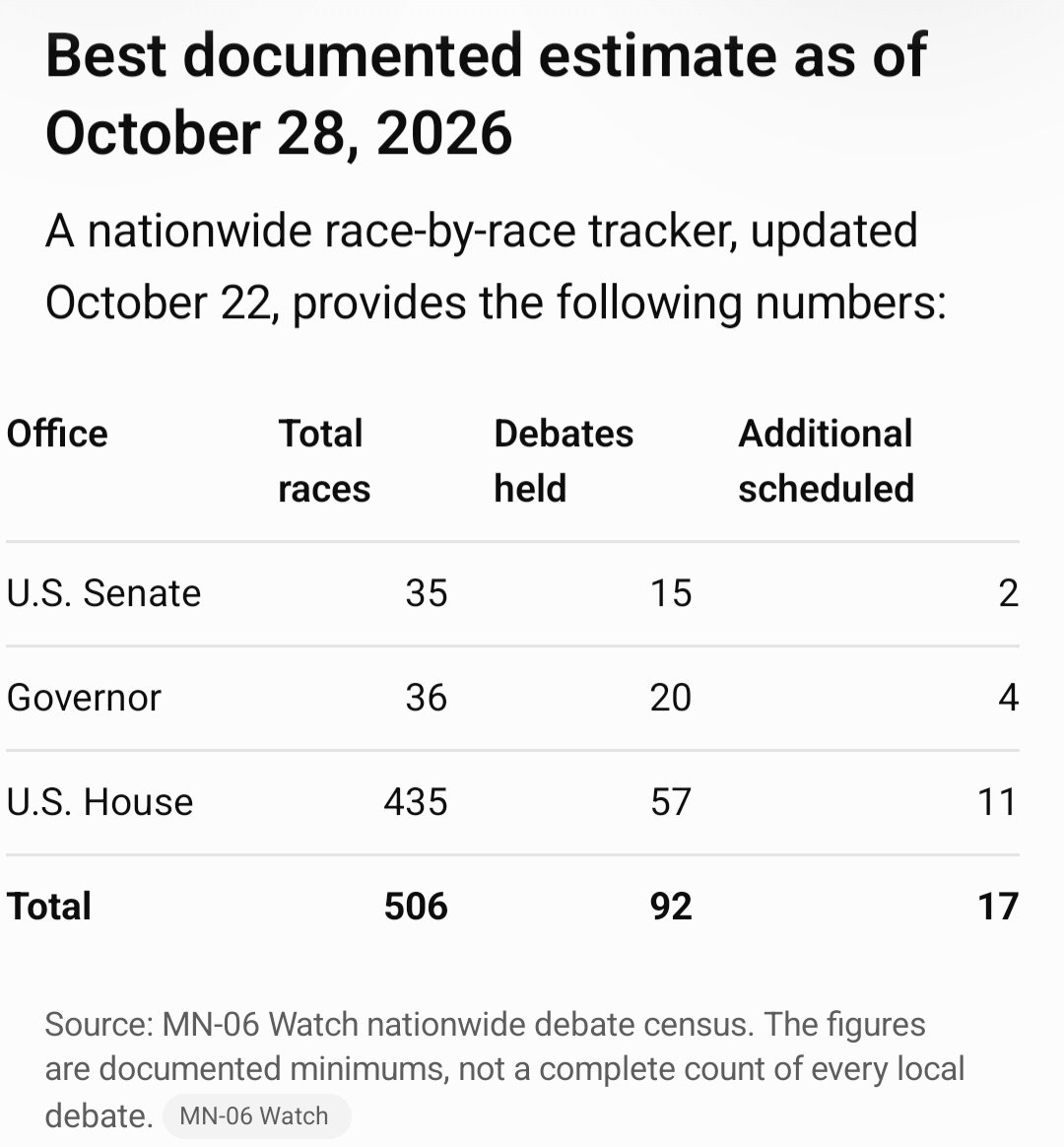
But the reality is that campaigns currently get to make that decision for themselves. And when only about 22% of major congressional and gubernatorial races nationally have held or scheduled debates this election cycle, it's difficult to argue that refusing to debate is somehow unique to your opponent.
We can't criticize Democrats for avoiding debates while giving Republicans a pass for doing the same thing. Principles have to apply equally, regardless of the letter after someone's name.
On paper, Vivek is the stronger candidate. He has the background, policy positions, and arguments to make that case directly to Ohio voters.
My advice to Vivek is simple: Stop making the debate the issue. Make the issues the issue.
Tell Ohioans why your policies are better, why your vision is stronger, and why you deserve their vote.
The best way to prove you're the stronger candidate isn't to complain that your opponent won't debate you. It's to give voters compelling reasons to elect you.
I Believe in Republican Principles and Policies More Than I Believe in Any Candidate or Political Party.
I've been a Republican for most of my life. I've served in public office, supported Republican candidates, and worked to advance the principles that I believe make our country stronger.
But somewhere along the way, I think we've confused loyalty to our principles with loyalty to individual politicians and political parties.
I am a Republican because of what I believe, not because of who happens to be running for office or who happens to be leading the party.
I believe in limited government, fiscal responsibility, individual liberty, personal accountability, free enterprise, and the Constitution. I believe government should live within its means, protect our freedoms, and be accountable to the people it serves.
Those beliefs don't change depending on whose name appears on the ballot or which party holds power.
I can support a candidate's policies without defending their behavior. I can agree with a party's platform while questioning its direction. And I can criticize a Republican or the Republican Party without suddenly becoming a Democrat.
Character matters. Integrity matters. Personal accountability matters. And principles should never become negotiable simply because someone has an R next to their name.
Too often, we ask voters to defend the candidate or the party rather than asking candidates and parties to defend the principles they claim to represent.
That's backwards.
Political parties should stand for something bigger than the personalities leading them. Candidates come and go. Party leadership changes. Elections are won and lost. But our values should remain.
I want Republicans to win elections. But more importantly, I want Republican principles to mean something when we win.
And when Republicans abandon those principles, we should be just as willing to hold them accountable as we would a Democrat.
Because if we abandon our principles to defend a candidate or protect a political party, what exactly have we won?
I don't believe any candidate deserves blind loyalty. And I don't believe any political party should be above criticism.
My loyalty is to my principles, not to a candidate or a political party.
And I believe that's how it should be.
If you disagree that's ok. I also support your 1st amendment right to disagree.
For those who follow the daily polls and political trends, the floor may have just fallen out from under the Republican campaign for Ohio Governor.
And any Republican who fails to distance themselves from this ad risks taking on water as well.
I have to give Jon Husted credit. He said he would not have run the ad. That was the right response. While he stopped short of outright condemning it, he made his position clear.
Vivek Ramaswamy needs to pivot, and quickly. Stop defending the ad and start talking about his policies, his vision for Ohio, and why he believes he is the better candidate.
If he chooses to double down, I don't see anything good coming from it.
Here's what too many people in politics seem to forget:
Voters don't always elect the most qualified candidate. They often elect the candidate they like, trust, relate to, or even sympathize with.
You can have the strongest résumé, the best policies, and the most impressive background, but none of that guarantees victory if voters don't like what they see or hear.
And when voters believe someone has been treated unfairly, sympathy can become a powerful political force.
Elections aren't won simply by convincing voters that your opponent is worse. They're won by convincing voters that you're better.
That is a lesson every candidate, Republican or Democrat, would be wise to remember.