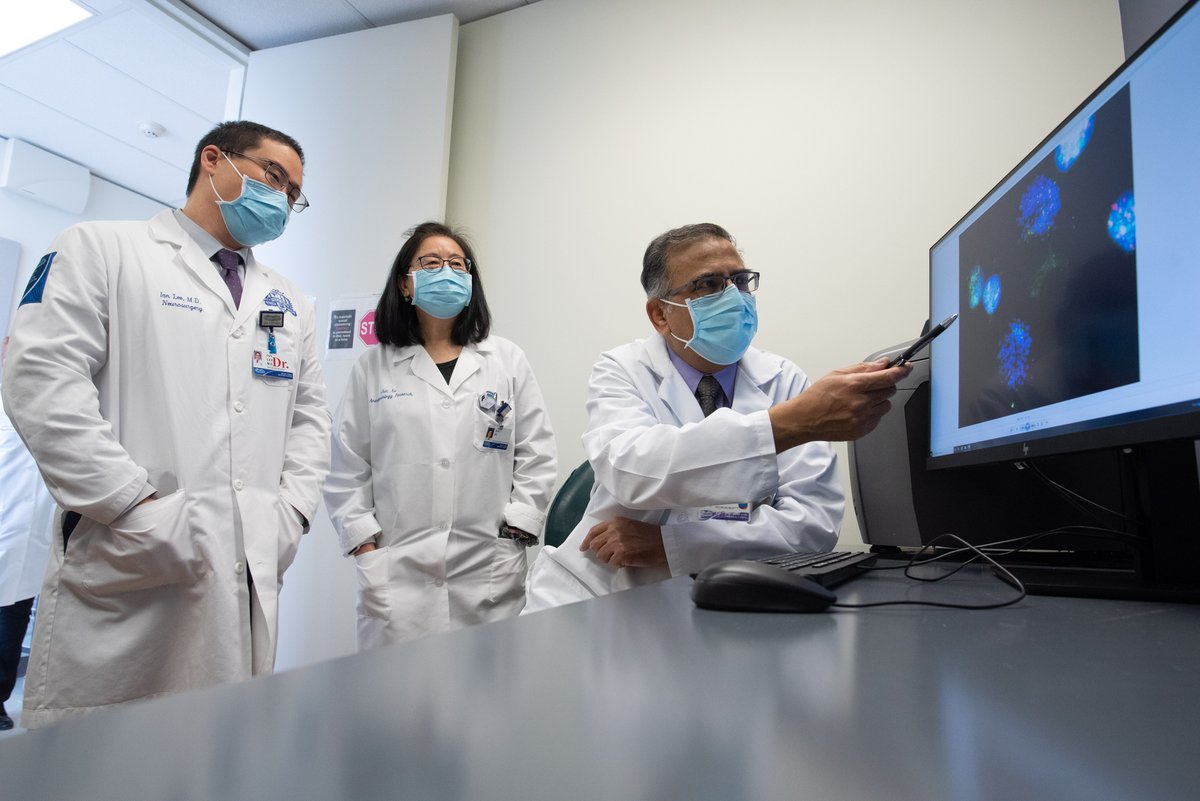
Happy Laboratory Professionals Week to the Hermelin Brain Tumor Center Team! It is because of your efforts and passion that we continue to move forward towards new and exciting treatments! #labweek2021@HenryFordNews@SteveKalkanisMD@JimSnyderDO
@Lifeiskitsch Thanks for sharing @Lifeiskitsch —this is a move in the right direction from a classification perspective. I agree with you, it may be harder to connect the dots across criteria changes. Hopefully this will make diagnoses more accurate and clinically relevant.
Proud to support #HFTCDetroit — Honored to be a part of team #HBTCstrong and @HenryFordNeuro —Thankful for the brain and spine tumor community and #HFTC who Inspire me and so many more
@fschmnn@Lifeiskitsch @walkbald @HenryFordNeuro It’s complicated. Traditionally, we named brain tumors by how they look under a microscope. More recently, we use the genetics of the tumor (1p19q) as the critical factor in naming the tumor subtype. Some unofficially describe a tumor based on how it behaves too
@AkalStation@Lifeiskitsch@HenryFordNeuro@AkalStation yes, they are typically molecularly different. Sometimes a low grade to high grade GBM is called a secondary GBM. Often, IDH is the molecular feature of interest in this consideration.
@Lifeiskitsch@HenryFordNeuro You are most certainly on the right track! (We can still talk about it if you like). @Lifeiskitsch you are doing great things in brain tumor advocacy—raising awareness and providing a voice for many.
@Lifeiskitsch@Sabine_NJ@HenryFordNeuro Hi @Lifeiskitsch and @Sabine_NJ I have not seen this used yet, but it seems like a valuable tool that may be informative for clinic care, tracking progress during recovery and research. Thanks for sharing!
Our search for a liquid biopsy solution for #braintumors and other neuro-oncology conditions has been absolutely fascinating and more rewarding than I ever thought. Thanks for tuning in to our #research.
Innovation Alert!🚨
HFHS innovators are developing a liquid biopsy that can be used to help detect brain cancer. Instead of frequent MRIs, patients can have their blood drawn to look for tumor presence and change in tumor behavior with the hope to refine the patient experience.
@monicabyrne13@Lifeiskitsch tricky question. I agree seizures, from tumor or not, can cause hallucinations or bizarre behaviors. A tumor can disrupt perceptive and cognitive pathways in unexpected ways, cause antons syndrome or expressive speech issues...Neuro Drugs can cause hallucinations.
Check out my latest publication on #RWD “Developing Real-world Evidence-Ready Datasets: Time for Clinician Engagement”
Thanks Dr @YoshieUmemura for the invitation and thank you to my exceptional collaborators! https://t.co/EK4oZIFpLy