📊 I help scale companies | Building GrowthHit (agency) & Neat (shirts that hide sweat) | Get a FREE copy of my book “The 7 Laws of Scaling” - link below👇
How do you grow a #D2C startup from idea to 8 figures?
After working with 100+ brands, I have seen some raise millions and others go on Shark Tank.
Here are the 22 things to do.
See thread:
We bought Neat Apparel because of one thing.
Patented military technology that hides sweat.
In 2023, I found a brand doing $9K/month. On life support. The founder was a veteran who had licensed sweat-wicking technology from a military contractor.
The key feature: the fabric pattern literally hides sweat marks.
You could pour water on the shirt and it wouldn’t show.
I tested it myself. Wore it to a pitch meeting in July. No sweat marks.
I bought the company.
The product was an A.
But the business was failing because:
→ Market: F. Selling to military only. 200K people.
→ Position: C+. They were close but it didn't work for ads.
→ Reach: D. No ad spend. No content. Word of mouth only.
→ Convert: D. Website built in 2018.
The product was never the problem.
We repositioned for ‘anyone who sweats.’ Rebuilt the site. Started running ads.
$9K/month to $150K/month in 18 months.
Product is Law 2 on the 7 Laws of Scaling. It matters.
But it wasn’t the constraint. Positioning was.
That’s the whole point of the diagnostic.
Get a free copy of my book here: https://t.co/RIDJuy4Xnw
Neat™ did $45,000 over 5 days last week.
Including $11,000 in a single day.
When we bought this brand, it was doing $9K a month.
I debated posting this because it's easy to look like you're just celebrating a number.
But that's not what this is.
What this actually is:
It's what 18 months of unglamorous work looks like when it compounds.
Rebuilding the email program from scratch.
Going bundle-first when every instinct said keep it simple.
Running tests that didn't work.
Staying patient when the CAC wasn't moving.
The $45K week didn't happen last week.
It started in November 2024 when we made our first product decision that felt risky.
We still have a long way to go. The summer goal is a $25 CAC — we're at $44.
But I want to document the moments that feel like proof of concept.
This was one of them.
Less than 1% of companies ever break $10M in revenue.
The founders who do aren't working any harder than the ones who don't - they're following 7 specific laws every business at that level follows on the way up.
Across my own DTC brand Neat, my agency GrowthHit, and brands like TRTL and Rora, I've used these to generate over $250M in revenue.
And I just put together a full breakdown of all 7 laws so you can see exactly which you need to apply to your business right now.
Here's a peak at what you’ll learn:
1/ How to evaluate whether you're actually in the right market to begin with, and the 4 things to test before you commit
2/ The cash conversion cycle every founder has to know, plus the 3 numbers that determine how fast you can scale
3/ The law I had to learn the hard way when I stepped away from both my companies for months
Watch the full video: link in the comments
Law 7 Is Where Most ‘Successful’ Companies Die
IT's the last law of scaling, Expand.
And it’s the cruelest one.
Because you only face it after you’ve won. You have the market. You have the product. You’re acquiring customers. Revenue looks great.
Then growth flatlines.
Here’s what a D on Expand looks like:
→ You acquire customers profitably but they never buy again
→ Your repeat purchase rate is under 20%
→ You keep spending more on acquisition because you can’t retain
→ Every year, you need to replace 60-80% of your revenue just to stay flat
Expand asks: once someone buys, do they buy again? Do they buy more? Do they tell others?
If the answer is no, you’re on a treadmill.
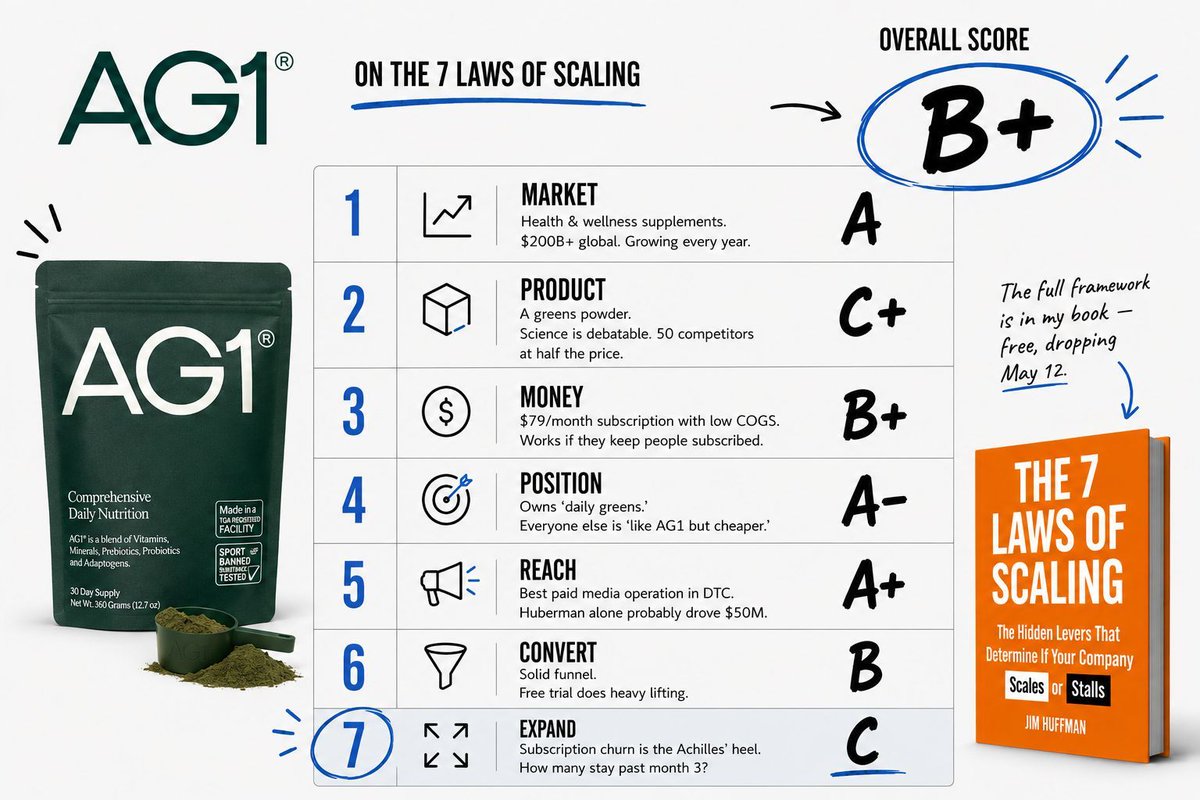
Exhibit A: AG1.
I scored them on the 7 Laws of Scaling.
Market: A — Health & wellness supplements. $200B+ global. Growing every year.
Product: C+ — A greens powder. Science is debatable. 50 competitors at half the price.
Money: B+ — $79/month subscription with low COGS. Works if they keep people subscribed.
Position: A- — Owns ‘daily greens.’ Everyone else is ‘like AG1 but cheaper.’
Reach: A+ — Best paid media operation in DTC. Huberman alone probably drove $50M.
Convert: B — Solid funnel. Free trial does heavy lifting.
Expand: C — Subscription churn is the Achilles’ heel. How many stay past month 3?
Overall: B+
AG1 proves you can build a $1B+ brand with an A+ on Reach and an A- on Position.
But churn is undefeated. Ask Blue Apron. Ask Quibi. Ask any subscription company that grew fast and bled faster.
Expand is Law 7 because it’s the last lever. But if it’s an F, all the growth you built in Laws 1–6 leaks out the bottom.
(Get a free copy of the book - https://t.co/5h5krJEYma )
If you can’t fill In this sentence, you have a positioning problem.
There’s one sentence that separates companies that scale from companies that stall.
‘We are the only _______ that _______.’
If you can’t fill that in — clearly, honestly, in a way your customer would agree with — you have a positioning problem.
Law 4 of the 7 Laws of Scaling is Position. And it’s the most common constraint I see at GrowthHit. By far.
LAW #4: Clear positioning reduces the cost of everything—unclear positioning inflates the cost of everything.
Here’s why it matters so much:
Positioning is the bridge between your product and your customer’s brain. Without it, you’re invisible. With it, everything downstream gets easier. Ads work better. Sales cycles shorten. Word of mouth starts.
3 diagnostic questions:
1. Can a stranger explain what you do and why you’re different in 10 seconds?
Not your team. Not your investors. A stranger who visited your homepage for the first time. If they can’t, your positioning is unclear. And unclear means invisible.
2. Do you compete on price?
If your default move in a competitive deal is to lower the price, you have a positioning problem. Strong positioning lets you charge more because the comparison set is different. Neat doesn’t compete with Hanes on price. We’re the anti-sweat shirt. Different category.
3. Can a competitor copy your positioning?
Allbirds owned ‘sustainable footwear.’ Then Nike launched a sustainable line. Then Adidas. Then everyone. If your position can be copied, it’s a feature, not a position.
The fix for Neat was simple. We went from ‘military sweat gear’ to ‘the shirt that hides sweat.’ Same product. Different position. 10x growth.
Grade yourself:
A = Own a category or clear white space. Competitors can’t copy it.
B = Differentiated but not yet owning a position in the customer’s mind
C = Somewhat different. Customers still compare you to 3-4 alternatives.
D = Competing mostly on price or features. Interchangeable.
F = No clear position. Homepage could be any company in your space.
Want a free copy of the book? Link here: https://t.co/5h5krJEYma
We did $1M last year at Neat. Now, we're trying to do that in 3 months. This is Week 8 of "The Million Dollar Summer."
We spent real money testing whether our ad creative or our offer is what actually drives sales.
Here's what we found.
We ran two approaches simultaneously on Meta. One led with a bold video concept — our "Sweat Monster" character — designed to stop the scroll. The other led with a straightforward buy-one-get-one offer. Same product. Same audience. Different bets.
The creative got attention. The offer got purchases.
But then something shifted. The Sweat Monster video started converting — and our cost per acquisition dropped to $39. Meanwhile, our short-form static ads came in even lower, around $18-$23 CAC.
The lesson isn't "creative beats offer" or "offer beats creative." It's that you don't know until you test — and most brands aren't patient enough to wait for the data.
We almost killed the Sweat Monster too early.
Instead we learned. We iterated. We tested our way to a scalable ad campaign.
More next week.
I went from broke freelancer to running a $4M a year agency over the last 8 years.
Along the way I picked up 21 specific lessons that determined how I built it, from how I priced my first projects to how I structured the team once we hit 7 figures.
So I just put a video together walking through every single one of them, from the first pivot that finally let me charge what I was actually worth to the operating system I built once GrowthHit got past 7 figures.
I cover:
1/ The niching down decision that finally let me charge what I was worth
2/ Why I switched from hourly billing to value-based pricing, and how it changed every client conversation after
3/ How I built a team that runs the agency without me being in every meeting
4/ The work-life setup I designed at 7 figures so growth didn't cost me my evenings
5/ The bottoms-up approach to landing dream 500 clients that became our entire growth engine
Watch the full video: link in the comments
In December I gave a talk to a room of 50 founders.
Every one of them doing over $1M. Most stuck between $3M and $10M.
The talk was called "What’s blocking your growth: Scaling to 8-figures." It was the system I'd built over 10 years of running GrowthHit and buying Neat Apparel — the framework that tells you exactly which lever to pull next.
I almost didn't give it.
My family was going through something hard. I thought about cancelling. But I looked at my notes and realized: the whole point of leverage is that the system works when you can't.
So I gave the talk.
3 hours. 7 laws. Real numbers from real businesses.
Here's what happened:
I walked through how we diagnosed Neat Apparel — a company doing $9K/month — and identified Position as the constraint. Not ads. Not product. Not traffic. Positioning.
I watched 50 founders start nodding.
Then I showed the pyramid. Market → Product → Money → Position → Reach → Convert → Expand.
And I asked them to score their own business, live, on a napkin.
The room went quiet for 2 minutes. That's when I knew.
When I finished, people came up and said some version of: "You should write a book."
5 more emailed me to request the deck for their team.
One said: "I've been blaming my sales team for 18 months. It's my positioning."
That room stress-tested the framework against 50 real businesses in real time. It held up.
So I wrote the book.
It's called The 7 Laws of Scaling. It launches next month.
It's not about working harder. It's about finding the one lever that matters most right now.
More to come.
(Get a free copy here: https://t.co/5h5krJEYma )
Neat did $1M last year. Now we're trying to do $1M in 3 months. This is Week 7 of "The Million Dollar Summer."
I hate discounts.
But, I love sales.
So . . . here we are.
We just launched our biggest sale of the year: 25% off site-wide for Memorial Day.
Here's why we're not hypocrites.
At Neat™ we have a strict rule: two site-wide discounts per year. That's it.
Memorial Day. Black Friday.
We protect the other 350 days so that when we do pull the trigger, it actually means something.
Why Memorial Day? It's the starting gun of peak season. Summer is when sweat-proof shirts go from "nice to have" to "where has this been my whole life." We want wallet share early — before customers spend that money somewhere else.
The gross revenue offsets the margin hit. But only if you're surgical about it.
Dedicated ads. Dedicated emails. Dedicated landing page.
We'll share the results.
The $1M Summer needs a big May. This is how we're starting it.
More next week.
I let AI run my $1.5M/yr ecommerce brand, Neat, for 30 days, and I just pulled the raw numbers from the experiment.
5 jobs got handed off, including the daily Meta ads review, our entire creator pipeline, and Shopify development.
The team got back 2-3 hours a day on ads alone, and the bundle builder we shipped through Cowork is already raising AOV every single day.
Not everything worked though.
Some of the email re-engagement sequences were not good on the first pass, and the competitor intelligence outputs ended up sitting unused.
So I recorded a video walking through every job AI took over, what worked, and what didn't.
Here's a preview of what's inside:
1/ The 5 specific jobs Cowork now runs at Neat, including daily ads review, Klaviyo flows, creator outreach, competitor teardowns, and Shopify development
2/ How the cart bundle builder went from a wireframe to live code without briefing a dev agency or paying agency rates
3/ What happened when AI rebuilt our re-engagement sequences for lapsed Klaviyo segments and which ones converted below average
4/ The 30-day revenue comparison on the email side and what that proves about retention vs. acquisition spend
Watch the full video : link in the comments
The unexpected scaling law that kills companies
. . . and they never see it Coming
This is a story I see at least 3 times a year.
Founder comes to GrowthHit. Revenue is up. Team is growing. They just had their best quarter ever.
They want us to ‘scale their ads.’
We run the numbers.
They’re losing money on every customer they acquire.
Their true CAC is $100.
Their first-purchase contribution margin is not potitive.
They need 3 repeat purchases to break even on acquisition.
Their repeat purchase rate? 18%.
They’re scaling a money fire.
Law 3 of the 7 Laws of Scaling is Money. Not revenue. Not valuation. The unit economics of every transaction.
3 diagnostic questions:
1. What’s your contribution margin per transaction?
Not gross margin. Contribution margin. Revenue minus COGS minus fulfillment minus payment processing minus returns. The actual cash left over after you deliver the product. If you don’t know this number to the penny, you’re guessing.
2. What’s your CAC-to-LTV ratio?
Below 1:1 = you’re paying more to get a customer than they’re ever worth. 1:3 = healthy. Above 1:5 = you’re probably under-investing in growth.
3. How long until a customer becomes profitable?
If it takes 9 months to recoup acquisition cost, you need 9 months of cash float per customer. That’s a working capital trap. Most businesses that ‘grow themselves into bankruptcy’ die here.
At Neat, we changed the Money grade from a D to a B with one move: bundles. Single shirt was $49. Nobody is profitable acquiring a $49 customer in DTC. We moved to bundles. AOV went to $120. Same CAC. Completely different business.
Grade yourself honestly:
A = Strong unit economics, short payback, capital-efficient growth
B = Solid margins with one area to optimize
C = Positive but tight; growth stresses the model
D = Losing money per customer or unsustainable payback period
F = Unit economics fundamentally broken
What’s your grade?
Scaling Law 5 Is the One Everyone Wants to Fix First
Every founder I meet wants to talk about Reach.
More traffic. More followers. More impressions. More eyeballs.
Reach is Law 5 on the 7 Laws of Scaling. And it’s the most misunderstood.
Here’s why: Reach is a multiplier, not a foundation.
→ If your positioning is an F, more reach just means more people ignoring you
→ If your money is a D, more reach just means losing money faster
→ If your product is a C, more reach just means more returns and refunds
But when the laws beneath it are solid? Reach becomes a rocket.
Exhibit A: Gymshark.
I scored them on the 7 Laws of Scaling.
Market: A — Athleisure / fitness apparel. Massive. Not going anywhere.
Product: B+ — Good quality, accessible prices. Not materially different from 20 competitors.
Money: B — DTC margins solid. Wholesale expansion adds pressure.
Position: A- — Owns ‘gym culture.’ Clear, specific, tribal.
Reach: A+ — Basically invented influencer marketing for fitness. This is the moat.
Convert: B+ — Drops model creates urgency. Site is solid.
Expand: C — Women’s, accessories, international — all make sense but dilute the core.
Overall: B+
Gymshark’s Reach is an A+ because they didn’t just spend more on ads. They built a distribution engine — thousands of fitness creators who ARE the brand.
But notice: their Position had to be at least an A- for Reach to work. The foundation came first.
That’s the order. Laws 1 through 4 are the foundation. Laws 5 through 7 are the multipliers.
What would you grade Gymshark? Agree or disagree?
Want the book? Get a free copy https://t.co/5h5krJEYma
My ecommerce brand, Neat, is doing over $150k/mo and email is one of the most profitable channels we run.
The crazy thing is, Claude Cowork runs the entire email marketing system.
It writes the flows, plans and writes 30 days of campaigns in a single session, and tells me exactly what to test next without me having to spend hours in my email dashboard.
So I filmed a full walkthrough showing exactly how the system works so you can set up something similar for your brand.
I cover:
1/ The 3 automated flows running at Neat on autopilot, and how I set them up: welcome series, abandoned cart sequence, and a BOGO flow for campaign subscribers
2/ How I plan and write every campaign for the full month in a single session at the start of each month, and why batching it keeps the messaging consistent
3/ How Claude Cowork writes segmented versions of each campaign for different parts of the list, without adding much time to the session
4/ The 1 metric I use to know whether the email system is actually making money
Watch the full video below:
We did $1M last year at Neat. Now, we're trying to do that in 3 months. This is Week 5 of "The $1M Summer."
Remember that goal of 486 new customers a week?
We just went from 78 to 273.
For one week, we proved we could 3X growth.
And the channel that drove it wasn't ads.
It was email.
Here's what happened. We've been quietly rebuilding our email flows behind the scenes. Welcome sequences. Post-purchase follow-ups. Win-back campaigns for customers who haven't bought in 30 days. Nothing revolutionary. Just the fundamentals done right.
This past week those flows generated one of the highest revenue weeks we've ever seen at Neat™.
No extra ad spend. No influencer push. No flash sale.
Just the right message to the right person at the right time.
Here's the thing about email that most DTC brands underestimate: your ad budget gets you the customer. Your email program is what pays you back. If you're pouring money into acquisition and ignoring retention, you're leaving the most profitable part of the business on the table.
We're not declaring victory. One good week doesn't make a summer.
We need 139 to become the floor, not the ceiling.
But for the first time, The Million Dollar Summer feels less like a crazy goal and more like an actual plan.
More next week.
I’m running a free 7-Day Scaling Challenge.
One law per day. You’ll score your own business.
Day 1: Score your Market
Day 2: Score your Product
Day 3: Score your Money
Day 4: Score your Positioning
Day 5: Score your Reach
Day 6: Score your Conversion
Day 7: Score your Expansion + get your overall Scaling Score
Each day you get:
→ A 5-minute email explaining the law
→ 3 diagnostic questions to answer
→ A grade (A through F) for that dimension
By the end of the week: a complete diagnostic of your business. Not theory. An actual scorecard.
I built this because most founders are solving the wrong problem.
They think they have a traffic problem. They actually have a positioning problem.
They think they have a conversion problem. They actually have a money problem.
The diagnostic tells you which one it actually is.
Starts today. Free. Always.
Comment “Challenge” and I’ll send it to you for free.
Tag a founder who needs this.
Want a free copy of this book? Link here https://t.co/pMS5MOSbyL