@ben_golub There have been somewhat similar problems, as far as I know, at JET (where I resigned as editor 3 years ago). This is a very worrying development, and it would be good if the economics profession could organize to take a stance towards Elsevier.
I have decided to leave math academia.
Not because of burnout, the academic job market, or a loss of love for mathematics. Surprisingly, it is because of how much mathematics I could do with LLMs over the last few months.
For most of my life, pursuing mathematics felt like the obvious choice. It gave me a sense of purpose, rooted in the search for hidden truths in God’s Book.
Over the past few months, that conviction has been shaken. With LLMs, I could get several breakthroughs on problems I care deeply about and had worked on for years during my PhD. This progress might have taken years of my academic life if not for LLMs.
This could have strengthened my conviction that mathematics was my calling. Instead, it undermined it. With each passing week, my role in the discovery loop seemed to grow smaller.
What made mathematics meaningful to me was never just the final answer. It was the struggle: months or years of exploration, failed approaches, and deep thought before a hidden structure finally became visible. That struggle gave me a sense that the result was truly mine. Prompting my way to answers, without the struggle that once defined the process, no longer felt like the same vocation. The answer might be just as beautiful, but it did not feel earned in the same way.
I now believe that we are rapidly approaching a world in which most answers from God’s Book will be only a prompt away. Once I truly internalized that possibility, dedicating much of my life to finding those answers slightly earlier no longer felt as meaningful as it once had.
But one problem kept bothering me: How do we know the oracle is right?
Intelligence (and hence the amount of math papers) is becoming abundant and cheaper by the day. Trust is not.
The proofs produced by these systems can be highly sophisticated, and their errors can be extremely subtle. Determining whether an apparent breakthrough was actually correct sometimes took me days. Until it is verified, a beautiful proof is not different from slop.
That gap drew me toward formal verification and eventually toward formalizing math proofs in Lean, including proofs of several longstanding conjectures and Erdős problems discovered with the help of LLMs. I began to see verification as a central intellectual bottleneck. Intelligence is useful only when its outputs can be trusted.
So I am leaving math academia. I am shifting my attention from discovering answers to building systems that can certify them.
I am very excited to be joining @PramaanaLabs to work on this challenge. Over the next few years, I hope to help build a future in which increasingly powerful systems are not merely intelligent, but provably correct and reliable across problems far beyond mathematics.
Exactly this. Surely each “paper” should become an interactive website where you can alter parameters of the model (if theory) or run alternative analyses of the data (if empirics); converse w an LLM about the paper and findings; stress test etc
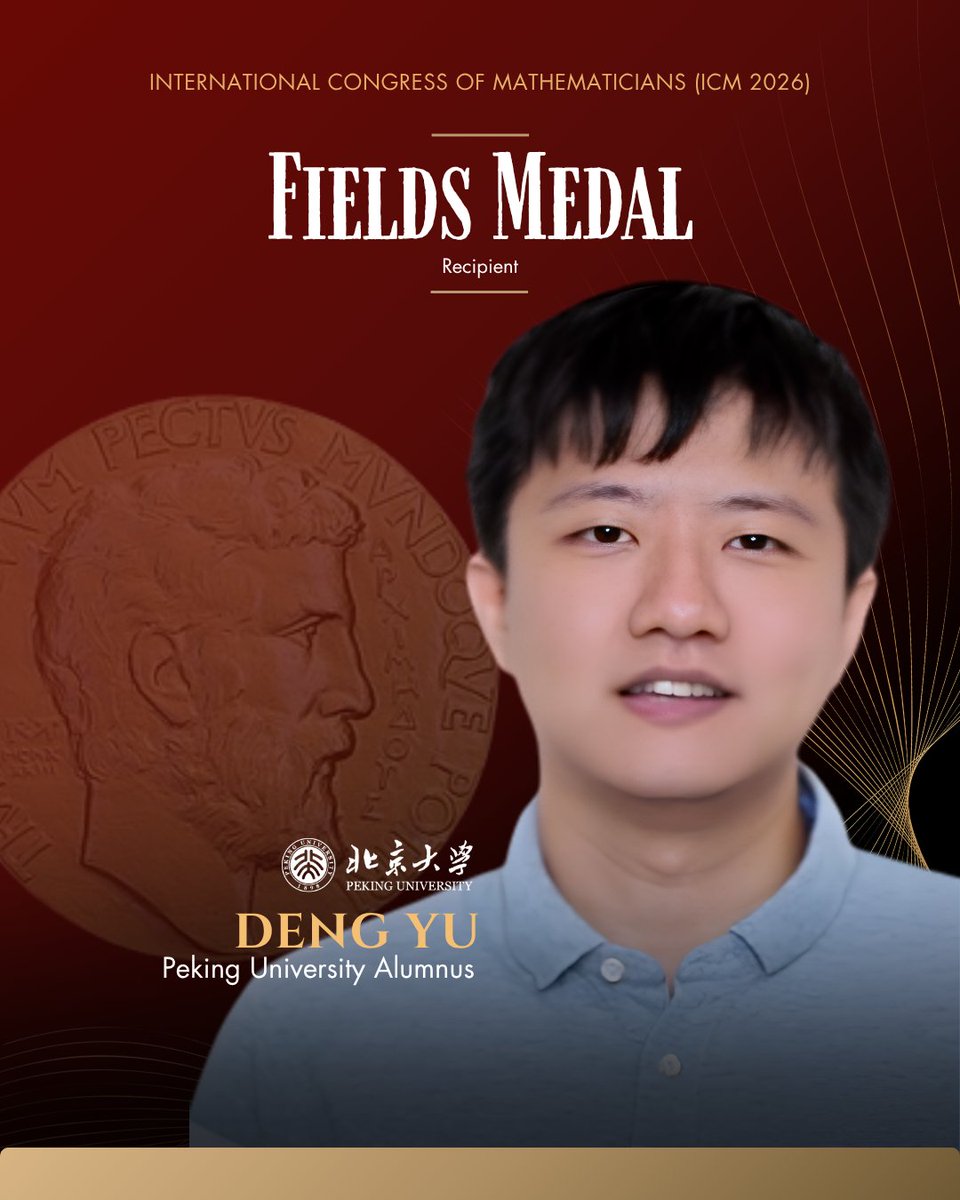
Huge congratulations to PKU alumni Wang Hong and Deng Yu, recipients of the 2026 Fields Medal — mathematics’ highest honor! 🧮
Announced at the 2026 International Congress of Mathematicians (ICM) in Philadelphia, the pair are among four mathematicians worldwide to claim this prestigious prize, awarded every four years to outstanding scholars under 40.
The awards are historic on several levels.
—First time two mathematicians who completed undergraduate studies in mainland China win the Fields Medal in the same year.
—Both joined Peking University as undergraduates in 2007.
—Wang Hong becomes only the third female Fields Medalist ever, the first Chinese woman, and the first recipient with a bachelor’s degree from a mainland Chinese university.
We are immensely proud of their extraordinary breakthroughs and lasting contributions to global mathematics.
This is crazy.
The incredible Yitan Zhang (https://t.co/3x1DGfqJ3R) worked on proving this conjecture for 7 years.
Moh, his advisor, wrote that Zhang "failed miserably" in proving the Jacobian conjecture, "never published any paper on algebraic geometry" after leaving Purdue, and "wasted seven years of his own life and my time".
What a twist.
Spent the last week at the Econometric Society Summer School, organized by the amazing In-Koo Cho and @ArielRubinstein.
some quick impressions, disorganized and unfiltered
Economic theory is in a crisis, but productively so.
1/
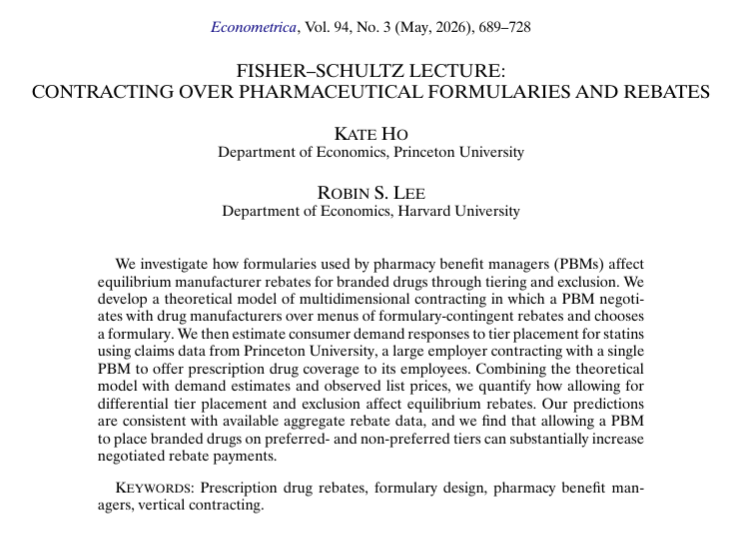
Two interesting papers in the latest Econometrica
1) Even Jean Tirole is not infallible. There is a (small) mistake in his 1985 paper that people found 40 years later.
2) Robin Lee finished the paper based on the late Kate Ho's 2021 Fisher–Schultz Lecture.
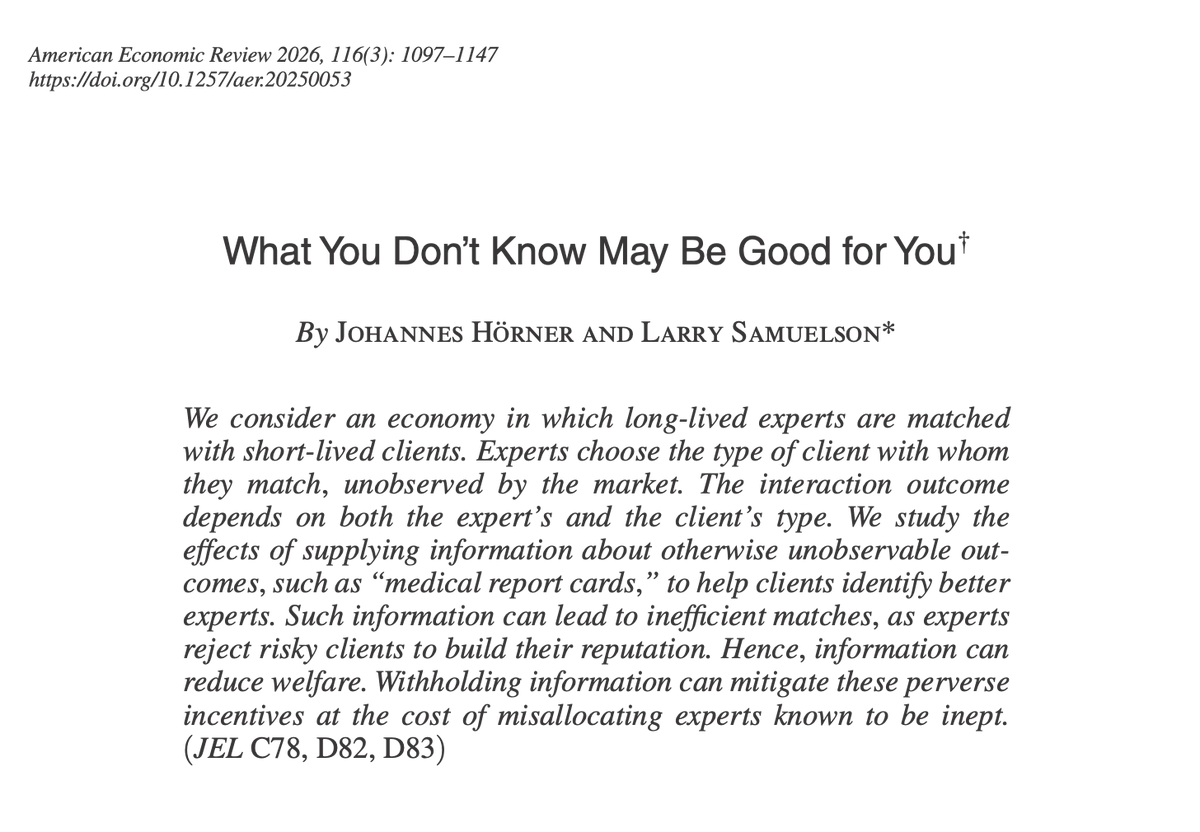
"Our goal in this paper is to examine the extent of the inefficiencies arising from the perverse incentives created by information provision."
NEW in the March 2026 American Economic Review by Johannes Hörner and Larry Samuelson: https://t.co/qjxrk9KJqQ
“I hope I've demonstrated that you can face anything, you can face the end of your days, you can face hell with dignity. Fight, girls, and hold your heads high. Billie and Georgia, you are my heart, you are my everything. Goodnight. I love you.
Eric Dane leaves his daughters — and the world — with one final message in Famous Last Words.
#EricDane was kind enough to reach out to me and thank me for the political videos I was making. He didn't have to do that. We talked and I am very sorry for his friends and family and everyone who loved him.
We lost a very good man.
RIP Eric Dane.
“This clown wants to make France an AI leader with €30M.”
€30 million → to attract and support around forty top-tier international researchers. They chose France for its values and its commitment to science.
Sometimes it’s too slow…
€54 billion → mobilized as early as 2022 to build France 2030. A France that advances health, climate, and fundamental science by investing boldly in artificial intelligence.
Over €100 billion → in private investment announced at the Paris AI Summit by French and international companies to develop AI in France.
That’s it?
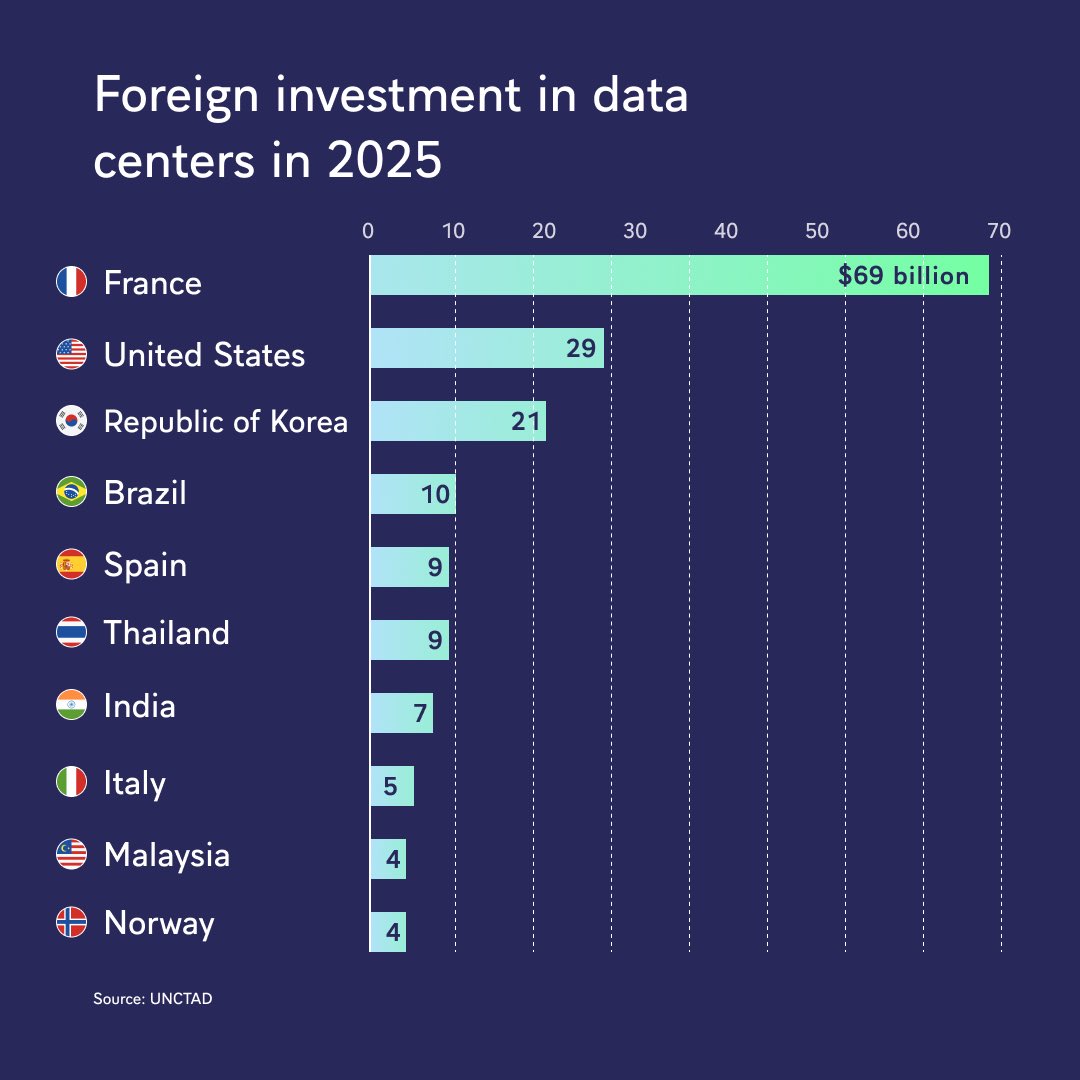
#1 → In 2025, France ranked first among countries attracting foreign investment to build data centers. More billions invested in our regions and in our talent.
Yes. Here in France, we believe in science. And AI is here to elevate, to build, to move the world forward, not to insult. 🙊
#ForSure
Starting salary for an Assistant Professor in Economics at France's top public university: 25,000 to 40,000 Euros, depending on experience and qualifications, with a 128hrs teaching load (https://t.co/6S3KKncNrV)
"Free markets failed for 700 years. When poor farmers couldn't pay, a simple quota beat auctions. Sometimes the invisible hand needs handcuffs."
New paper by @javdito & @JosespinSanchez
https://t.co/n74XJcE5R9
#REStud#EconX#EconTwitter
Just spent an hour explaining to a friend in industry why their "causal forest" wasn't estimating anything causal. It's made me conclude that the name "causal forest" is an invitation to sloppy thinking.
Calling a random forest "causal" because it targets treatment differences doesn't bypass the fundamental problem of causal inference. The algorithm is a flexible tool for finding heterogeneity. It doesn't discover causality, it assumes it.
Without randomization or a valid quasi-experiment, you aren't estimating causal effects; you're measuring conditional associations in high dimensions.
A name that would cause much less confusion for people outside of the academy: "treatment effect heterogeneity estimator."
Less sexy, fewer citations, but more accurate.
I am pleased to announce that the OPEN ACCESS link for The Microeconomics of AI is now available. Click here to download for free. https://t.co/JRixMWmbem
The paper studies reputational bargaining in which the stubborn type can choose their initial demand. Types can pool or separate in equilibrium. When the probability of the stubborn type is small, any feasible payoff can be achieved in equilibrium https://t.co/f87oRKGb6g






![January's tweet photo. Nested search
Yutong Zhang
https://t.co/YhEgWIkdeL [𝚎𝚌𝚘𝚗.𝚃𝙷] https://t.co/pQXYFxSiMz](https://pbs.twimg.com/media/HASxZTRXcAAKtc1.png)


