We’re happy to introduce StarVLA, an open-source codebase to help you develop and experiment with your own VLA models.
Nearly 4,000 GitHub stars, with 60+ community projects building on it.
Models, recipes and benchmarks:
https://t.co/sG2hVHqZRA
Introducing starRoboEval from the StarVLA Community: 14 simulation benchmarks, one service interface.
Agents receive images and robot state, then send actions. Simulator internals and scoring stay on the server.
Bring your own agent: https://t.co/MUlKf7qV2q
Recently, GPT-6-Astra / Fable 5.2 have shown impressive results in robotics.
But how much comes from the models themselves, and how much from benchmark-specific harnesses?
Many of these tests focus on RoboDojo. How does GPT perform beyond it, on mobile manipulation, whole-body control, and navigation?
We tested one generic setup across 14 simulation benchmarks. Explore the results and evaluation recordings:
https://t.co/HQgYpqC6X7
Full results and evaluation recordings: https://t.co/FlBzXMsmfV
Code and agent integration guide: https://t.co/MUlKf7qV2q
Bring your own agent and evaluate it on the same benchmark services.
Recently, GPT-6-Astra / Fable 5.2 have shown impressive results in robotics.
But how much comes from the models themselves, and how much from benchmark-specific harnesses?
Many of these tests focus on RoboDojo. How does GPT perform beyond it, on mobile manipulation, whole-body control, and navigation?
We tested one generic setup across 14 simulation benchmarks. Explore the results and evaluation recordings:
https://t.co/HQgYpqC6X7
We’ve been building and improving StarVLA for the past year, with support from the community and researchers across universities. It hasn’t been easy, but together we’re making robot learning research more accessible. Thank you for being part of it.
We’re happy to introduce StarVLA, an open-source codebase to help you develop and experiment with your own VLA models.
Nearly 4,000 GitHub stars, with 60+ community projects building on it.
Models, recipes and benchmarks:
https://t.co/sG2hVHqZRA
We often want to try different training data without rebuilding the whole pipeline.
StarVLA lets you train on one robot’s data, mix data across embodiments, or co-train with vision-language data using shared training tools.
https://t.co/V1gRwhhEYi
StarVLA is a sample and strong baseline across 13 embodied benchmark
Some reference results from StarVLA across LIBERO, SimplerEnv, RoboTwin and RoboCasa.
The training recipes, checkpoints and evaluation settings are linked from the homepage.
https://t.co/M1kuskf6AM
We’ve been building and improving StarVLA for the past year, with support from the community and researchers across universities.
It hasn’t been easy, but together we’re making robot learning research more accessible. Thank you for being part of it.
We’re happy to introduce StarVLA, an open-source codebase to help you develop and experiment with your own VLA models.
Nearly 4,000 GitHub stars, with 60+ community projects building on it.
Models, recipes and benchmarks:
https://t.co/sG2hVHqZRA
A VLA can start from a VLM or a video world model.
In StarVLA, we connect pretrained backbones to different action heads while sharing data, training, and evaluation tools. This clip shows how the pieces fit together.
Have a look at our codebase: https://t.co/V1gRwhhEYi
We’re happy to introduce StarVLA, an open-source codebase to help you develop and experiment with your own VLA models.
Nearly 4,000 GitHub stars, with 60+ community projects building on it.
Models, recipes and benchmarks:
https://t.co/sG2hVHqZRA
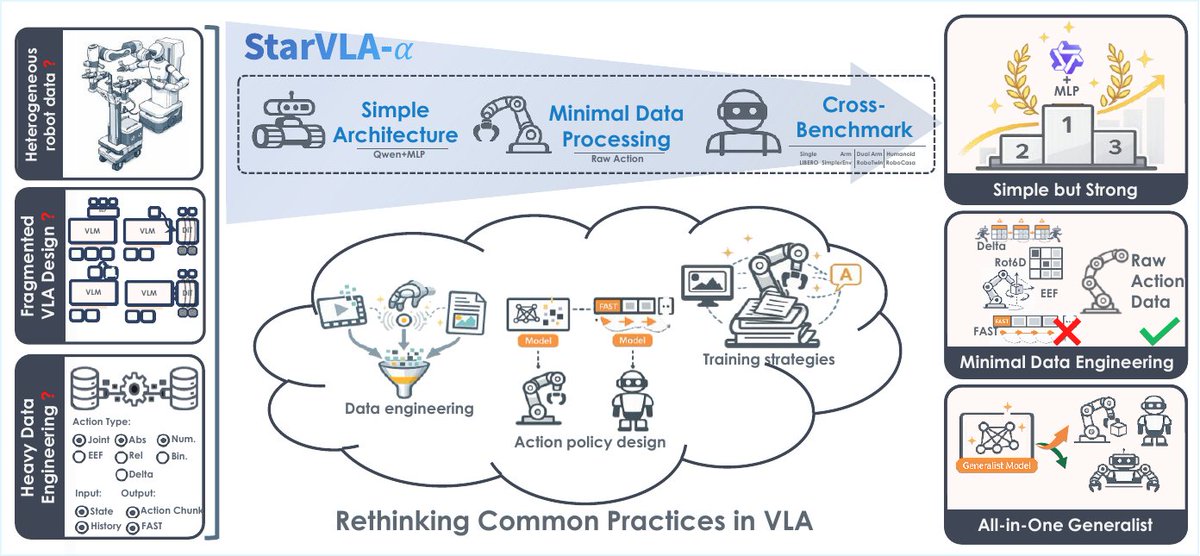
StarVLA-α ⭐️ is here – a strong VLA baseline built with Qwen3-VL-4B and a tiny action MLP.
Minimal design. Max performance across 4 benchmarks.
📄 Paper: https://t.co/fXyJOCJfw2
💻 Code (merged into StarVLA): https://t.co/cgG1n2LtnK
#VLA#Robotics#AI#StarVLA