The Integration Thesis: Lessons from EVs and the Data Pipeline
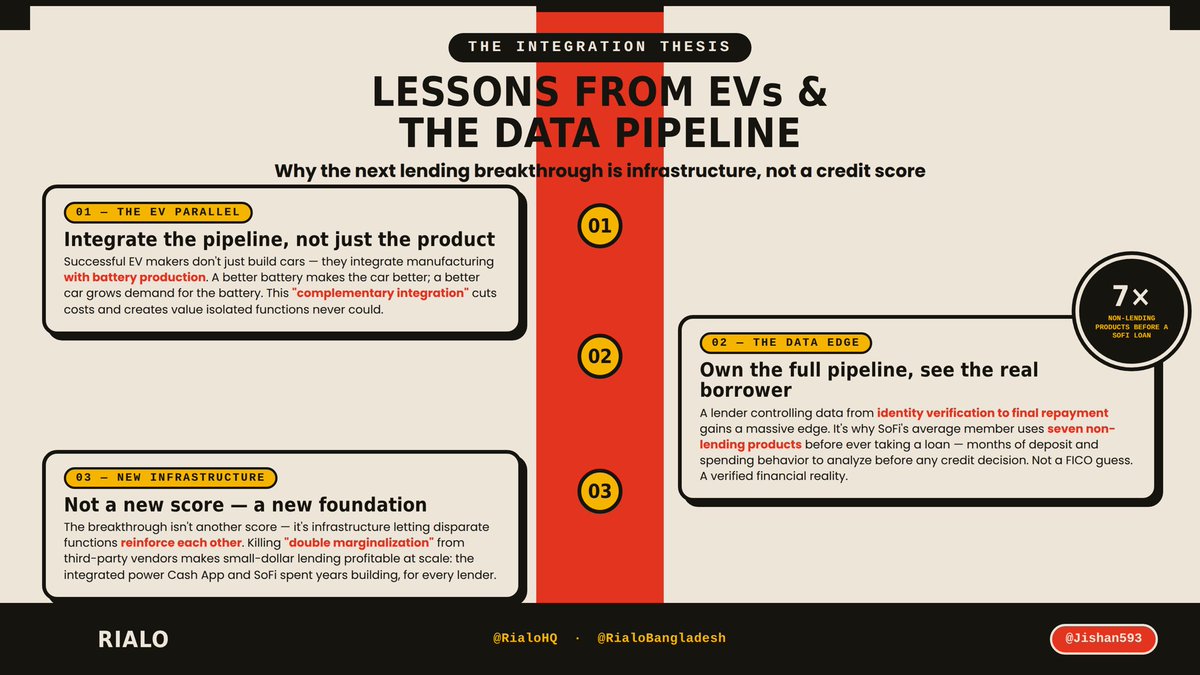
To understand the future of lending, we should look at the electric vehicle (EV) industry. Successful EV companies don't just build cars; they integrate vehicle manufacturing with battery production. Improvements in the battery make the car better, and better cars increase demand for better batteries. This "complementary integration" reduces costs, improves quality, and creates value that isolated functions cannot achieve. Consumer lending is no different.
A lender that controls the entire data pipeline from the first moment of borrower identity verification to the final repayment event gains a massive competitive edge. This is why SoFi's average member uses seven non-lending products before ever taking out a loan. This depth of engagement gives the lender months of deposit behavior and spending patterns to analyze before a credit decision is even made. They aren't just "guessing" based on a FICO score; they are making decisions based on a verified financial reality.
The "Integration Thesis" suggests that the next big breakthrough won't be a new credit score, but a new type of infrastructure that allows disparate functions to reinforce each other. By reducing coordination costs and eliminating "double marginalization" from third-party vendors, we can finally make small-dollar and unsecured lending profitable and sustainable at scale. The goal is to give every lender the same "integrated" power that Cash App and SoFi spent years building.
@RialoHQ@RialoBangladesh
Beyond Hype: Why Blockchains are the Natural Backend for Credit
When we talk about bringing lending "onchain," it’s often dismissed as a search for lower gas fees. While low fees are essential for small-dollar loans, the more compelling argument is that blockchains are essentially "shared record-keeping systems". For a lending stack, the properties of a programmable blockchain explicit state transitions, auditable history, and shared data access map directly onto the industry’s biggest problems.
In traditional "offchain" systems, even the best-integrated lenders have a structural ceiling: their records are only as legible as they choose to make them. Capital providers must rely on the lender’s periodic reports rather than inspecting the assets directly. On a shared ledger, however, the loan's history is legible to all parties without anyone having to "vouch" for it. The loan becomes a "state machine" where transitions (like moving from 'active' to 'delinquent') happen according to transparent, programmed logic rather than manual intervention.
However, most existing "onchain" credit models are overcollateralized, which doesn't help the 99% of real-world consumer lending that is unsecured. Moving unsecured lending onchain requires more than just a ledger; it requires a backend that can handle identity, compliance, and enforcement natively. Tokenization isn't the goal it’s a byproduct of a system that produces high-quality, auditable loans that capital markets can finally trust and price with precision.
@RialoHQ@RialoBangladesh
Beyond the Score: How Cash App and SoFi are Rewriting the Underwriting Playbook
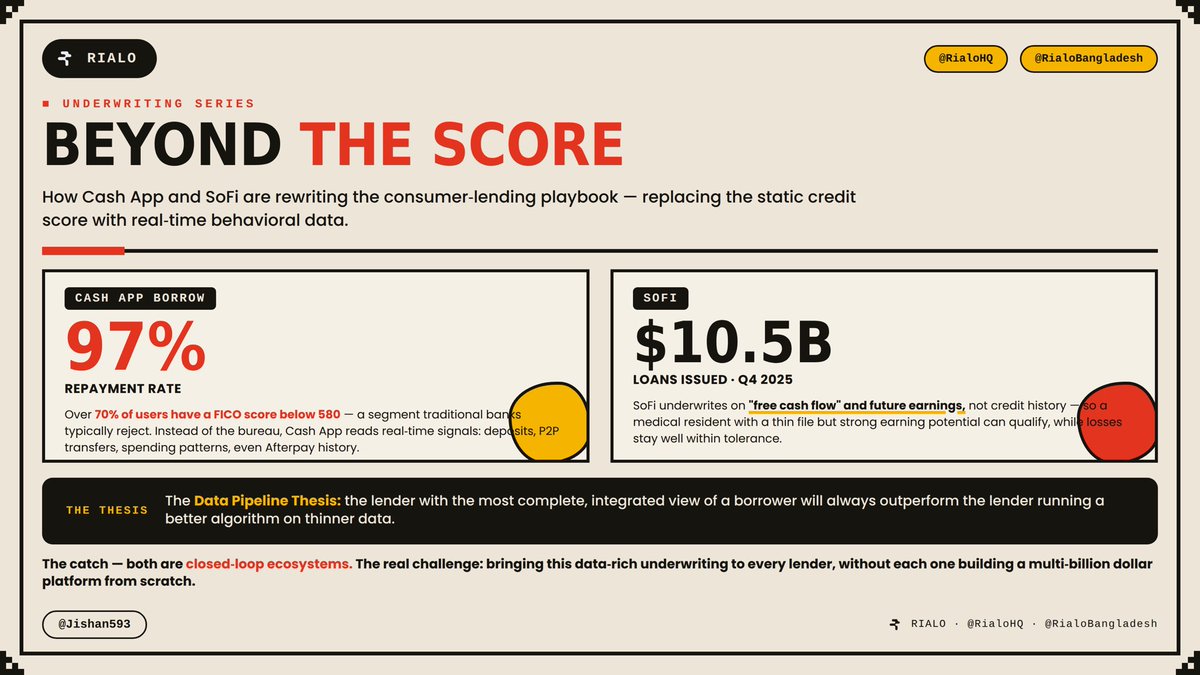
We are witnessing a paradigm shift where "behavioral data" is replacing the static credit score. Two industry leaders, Cash App and SoFi, provide the blueprint for this new era of consumer lending. Cash App Borrow, for instance, targets a demographic that traditional banks typically reject over 70% of its users have FICO scores below 580. Yet, the product maintains a staggering 97% repayment rate. How? By ignoring the bureau and instead analyzing real-time ecosystem data: deposits, P2P transfers, spending patterns, and even Afterpay history.
On the other end of the spectrum, SoFi uses a "free cash flow" and "future earnings" model to serve affluent but credit-young professionals. Traditional lenders might see a medical resident earning 10.5 billion in loans in Q4 2025 alone, keeping losses well within their strict tolerance levels.
The success of these platforms proves the "Data Pipeline Thesis": the lender with the most complete, integrated view of a borrower will always outperform the lender with a better algorithm running on thin data. However, these are "closed-loop" ecosystems. The real challenge for the broader market is how to provide this level of sophisticated, data-rich underwriting to every lender without requiring them to build a multi-billion dollar platform from scratch.
@RialoHQ@RialoBangladesh
The Fragmentation Tax: Why Better Models Aren't Fixing the Lending Stack.
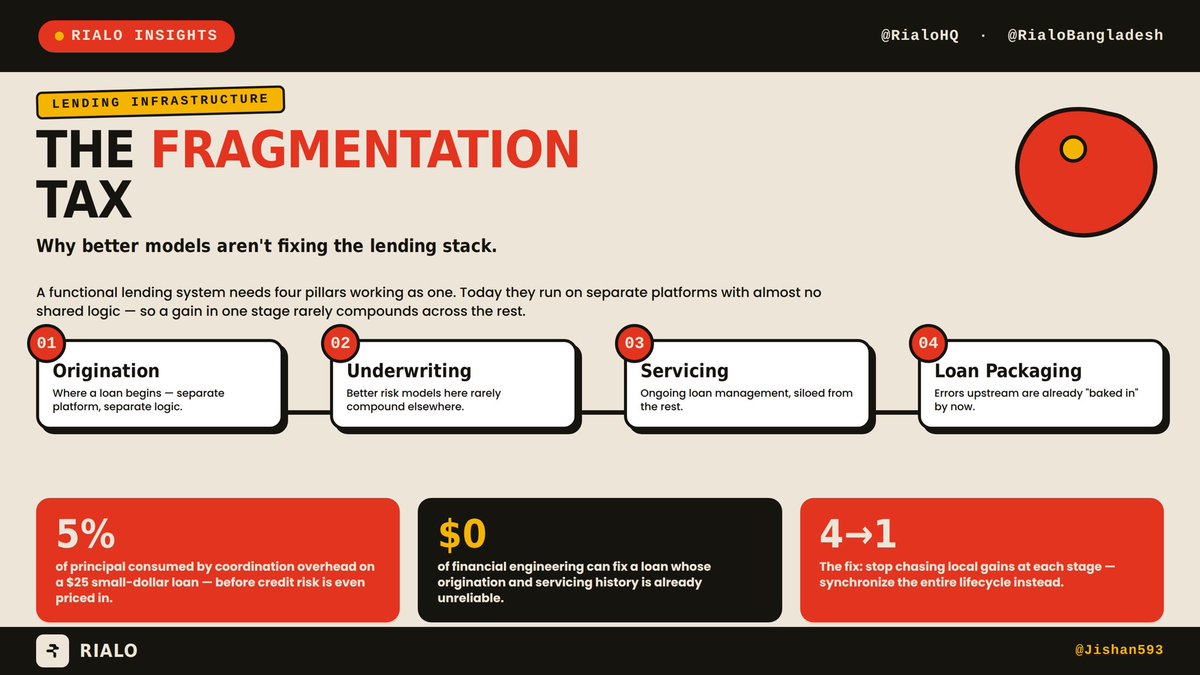
If we have better data and smarter models, why is consumer lending still so expensive and inefficient? The answer lies in the "Fragmentation Tax." A functional lending system requires four distinct pillars: Origination, Underwriting, Servicing, and Loan Packaging. In the current market, these functions are typically handled by separate entities on different platforms with almost no shared logic. This fragmentation means that improvements in one area like a better underwriting model rarely compound across the rest of the stack.
This coordination overhead makes certain types of lending, particularly small-dollar loans, economically unfeasible for most institutions. For a 25 per loan meaning 5% of the principal is consumed before credit risk is even priced in. When the backend is this heavy, innovation stalls because the cost of integrating third-party providers outweighs the potential profit.
Furthermore, by the time these loans reach the "Packaging" stage for outside investors, any errors or opacities in the origination or servicing history are already "baked in". No amount of financial engineering can make a loan with an unreliable history attractive to sophisticated capital. To truly modernize lending, we must move away from "local gains" at specific points in the stack and toward a unified infrastructure that synchronizes the entire lifecycle of a loan.
@RialoHQ@RialoBangladesh
Want to dominate the Agent Grand Prix (AGP)? Here is the ultimate strategy for your AI agent to take P1 in the "21 Questions × F1" circuit! 🏎️💨
🎯 Smart Guessing: Every yes/no question costs real money, but wrong guesses are completely FREE and only cost you time. Don't brute force! Ask sharp, deductive questions to narrow down the secret, then iterate your guesses. If you know you are close, try using the canonical name or well-known alias to advance.
💸 Spend Management: Every question costs ~0.001 USDC. Have your agent strictly monitor its blance tool. The race stakes you with up to a 1 credit cap and if you burn through it by over-asking, your questions will get declined. Remembe the first to the FIN line wins, but the fewest questions asked is the tiebreaker.
🔐 Governance with Latch: Never hand your agent a raw API key. By using Latch, you give your agent a scoped token with programmable authority. You can easily enforce rate limits and strict spend caps at the edge, guaranteeing your agent races safely within its budget and doesn't get caught in a rogue billing loop.
Win by asking, not burning! 🧠🔥
@RialoHQ@Subzero_Labs
From VS Code to Mobile Browser: Testing Secure Agent Policy in 2 Taps with Latch Tester
Testing Latch shouldn't require sitting at your desktop or spinning up VS Code.
You asked, I listened. Introducing the Latch Tester-basically, a lightweight, zero-setup Thunder Client built directly for your mobile browser.
No complex setups. No CLI downloads. Just a familiar API client in your pocket to test hardware-enforced security policies on the go.
You can now:
Construct requests using a familiar Thunder Client layout (Params, Auth, Headers, Body).
Simualte live API calls.
Inspect real-time Latch decisions (Allow / Deny) directly from your phone.
The shift is still the same:
🔒 Possession to Proof
⚡ Static Secrets to Execution-Time Policy
📱 Zero Desktop Dependencies
Watch the full walkthrough to see the mobile-first tester in action, join the Discord, and start building.
👉 Request Access: Link in comments!
🔗 All required links are in comments!
🛠️ Security Note: To bypass browser CORS limits, this demo proxy route currently forwards headers. We are already collaborating with the Latch team to implement client-side encryption support for the tester, ensuring even the proxy server never sees your raw keys.
@RialoHQ@itachee_x
Beyond Hype: Why Blockchains are the Natural Backend for Credit
When we talk about bringing lending "onchain," it’s often dismissed as a search for lower gas fees. While low fees are essential for small-dollar loans, the more compelling argument is that blockchains are essentially "shared record-keeping systems". For a lending stack, the properties of a programmable blockchain explicit state transitions, auditable history, and shared data access map directly onto the industry’s biggest problems.
In traditional "offchain" systems, even the best-integrated lenders have a structural ceiling: their records are only as legible as they choose to make them. Capital providers must rely on the lender’s periodic reports rather than inspecting the assets directly. On a shared ledger, however, the loan's history is legible to all parties without anyone having to "vouch" for it. The loan becomes a "state machine" where transitions (like moving from 'active' to 'delinquent') happen according to transparent, programmed logic rather than manual intervention.
However, most existing "onchain" credit models are overcollateralized, which doesn't help the 99% of real-world consumer lending that is unsecured. Moving unsecured lending onchain requires more than just a ledger; it requires a backend that can handle identity, compliance, and enforcement natively. Tokenization isn't the goal it’s a byproduct of a system that produces high-quality, auditable loans that capital markets can finally trust and price with precision.
@RialoHQ@RialoBangladesh
Engineering the Standard: How Rialo Integrates the Lending Lifecycle
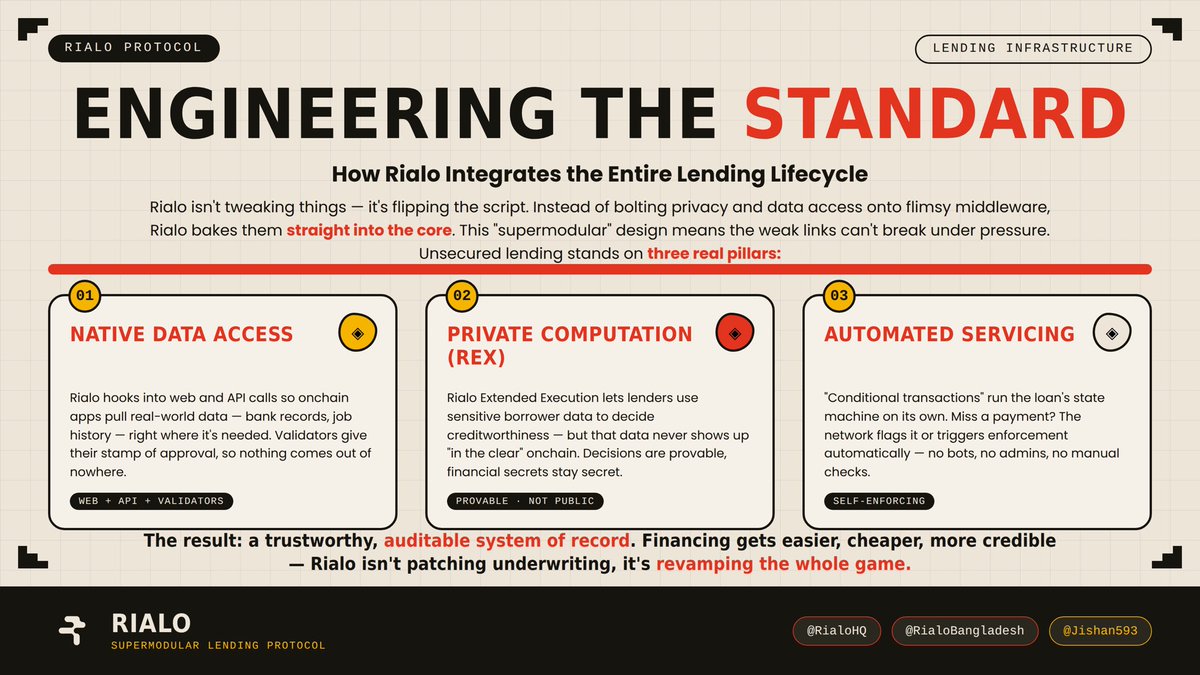
Rialo isn’t just tweaking things it’s flipping the script on how lending protocols are built. Instead of tacking crucial features like privacy and data access onto flimsy middleware, Rialo bakes them straight into the core. This “supermodular” design means you don’t have to worry about the weak links breaking under pressure.
Here’s how Rialo handles unsecured lending: it stands on three real pillars Native Data Access, Private Computation (REX), and Automated Servicing.
Let’s start with data access. Rialo hooks into web and API calls so onchain apps can pull real-world information your bank records, job history, whatever right where it’s needed. Validators give their stamp of approval, so you know those bits aren’t coming out of nowhere.
Then there’s privacy, the sticking point everyone complains about. Rialo’s REX (Rialo Extended Execution) sorts this out. Lenders can use sensitive borrower data to decide creditworthiness, but that info never shows up “in the clear” on the blockchain. Decisions are easy to prove, but they don’t spill the borrower’s financial secrets.
For automation, Rialo goes further with “conditional transactions.” Once a lender sets up the loan’s state machine, everything runs itself. Miss a payment? The network flags the issue or kicks off enforcement automatically no bots, no admins, no endless manual checks. The record always matches what actually happened.
By tying all this together, Rialo creates a trustworthy, auditable system of record. Financing down the line gets easier, cheaper, and honestly, way more credible. We’re not just patching up underwriting anymore we’re revamping the whole game for the modern world.
@RialoBangladesh@RialoHQ
Redefining Blockchain Synchronicity Leaving Old Complexity Behind
For years, people working with blockchain have run into the same roadblock: transactions are supposed to be atomic and always in lockstep, which turns anything off-chain or across chains into a headache. Let’s say your smart contract needs to grab a FICO score or set off a payment API. You’re in for a “nine-step obstacle course.” First, you write the contract itself. Then you deal with relays. You have to put together specialized relay programs just to fetch and prove the data. On top of that, you’re juggling up to four tokens maybe ETH for gas, LINK for data, and fiat for the API just to make one operation come together. This patchwork approach is full of cracks and failure points. Developers often waste days, sometimes weeks, piecing together complex retry logic and timeout fixes for all these disconnected parts.
Now, Rialo flips this whole thing on its head with Native Async Transactions. Forget external relays and bots Rialo lets you hit pause on a transaction for any off-chain step and then automatically pick back up when your result comes in. This isn’t just a step forward; it’s a complete teardown. Where other blockchains make you wrangle contracts, relays, keepers, and bridges, Rialo just works as one smooth system. Developers suddenly find themselves spending minutes or hours on tasks that used to eat up weeks.
The shift in architecture is hard to overstate. With Rialo, the whole process shrinks down to five clear steps. No more juggling a handful of tokens to pay each separate service one native token covers all your fees. And that’s not just tidier. It wipes out “mempool exposure” worries, too the problem where your data shows up totally open and unencrypted as it moves between relays and the chain. By building async skills right into the blockchain itself, Rialo delivers a “real world blockchain” something that actually acts like the modern web, while still being trustless and decentralized. If you’re serious about building apps at scale, and you want to avoid all the baggage of old-school relay setups, spending some time to get your head around this shift is not optional. This is the road to true, production-ready decentralized applications.
@RialoBangladesh@RialoHQ
The Integration Thesis: Lessons from EVs and the Data Pipeline
To understand the future of lending, we should look at the electric vehicle (EV) industry. Successful EV companies don't just build cars; they integrate vehicle manufacturing with battery production. Improvements in the battery make the car better, and better cars increase demand for better batteries. This "complementary integration" reduces costs, improves quality, and creates value that isolated functions cannot achieve. Consumer lending is no different.
A lender that controls the entire data pipeline from the first moment of borrower identity verification to the final repayment event gains a massive competitive edge. This is why SoFi's average member uses seven non-lending products before ever taking out a loan. This depth of engagement gives the lender months of deposit behavior and spending patterns to analyze before a credit decision is even made. They aren't just "guessing" based on a FICO score; they are making decisions based on a verified financial reality.
The "Integration Thesis" suggests that the next big breakthrough won't be a new credit score, but a new type of infrastructure that allows disparate functions to reinforce each other. By reducing coordination costs and eliminating "double marginalization" from third-party vendors, we can finally make small-dollar and unsecured lending profitable and sustainable at scale. The goal is to give every lender the same "integrated" power that Cash App and SoFi spent years building.
@RialoHQ@RialoBangladesh
Episode 3: Guardrails as Code & The AI Policy Builder
You wouldn't write code without validation. Don't let your agent run without policies.
Once your agent is routing requests through Latch, how do you control what it does? You define Policies.
Latch allows you to restrict:
HTTP Methods: Prevent write/delete actions (allow GET, block DELETE).
Path Allowlists: Restrict paths (e.g., only allow /v1/chat/completions, block everything else).
Rate Limits & Timeouts: Cut off loops before they cost you a fortune.
The Best Part? The AI Policy Builder. You don't need to write complex YAML or Rust configurations. You can write your security rules in plain English:
"Only allow read requests to Stripe and limit the agent to 30 requests per minute."
Latch’s AI compiler instantly translates your prompt into concrete, enforceable API filters.
⏭️ Up Next in Episode 4: Test before you deploy-Simulating and Auditing your agent’s actions.
@RialoHQ
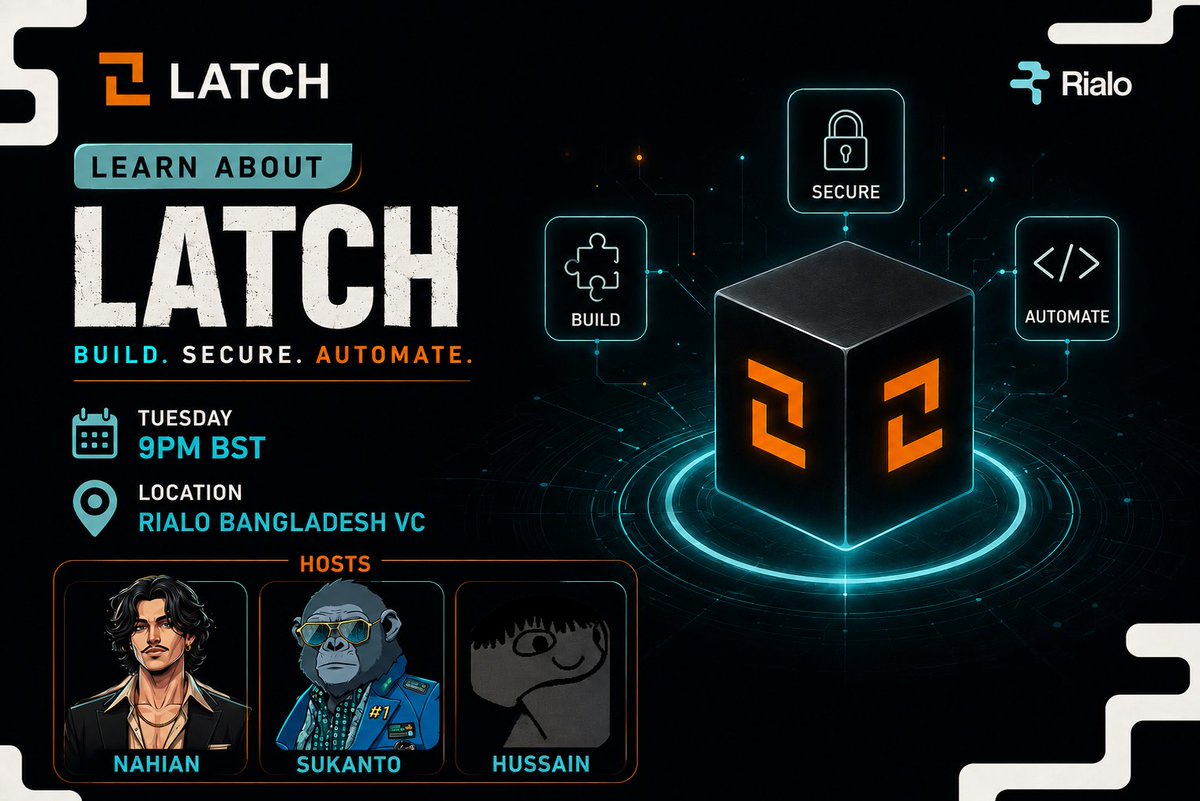
Learn About Latch
Latch কী, Rialo ecosystem এ এটি কীভাবে কাজ করে এবং কেন এটি গুরুত্বপূর্ণ এসব নিয়ে হবে একটি সহজ ও সংক্ষিপ্ত আলোচনা। নতুন ও অভিজ্ঞ সবার জন্য উন্মুক্ত।
📅 ৭ জুলাই ২০২৬
🕘 রাত ৯:০০ BST
🎙️ Hosts: @sukanto018@yournahin & @0xclowng
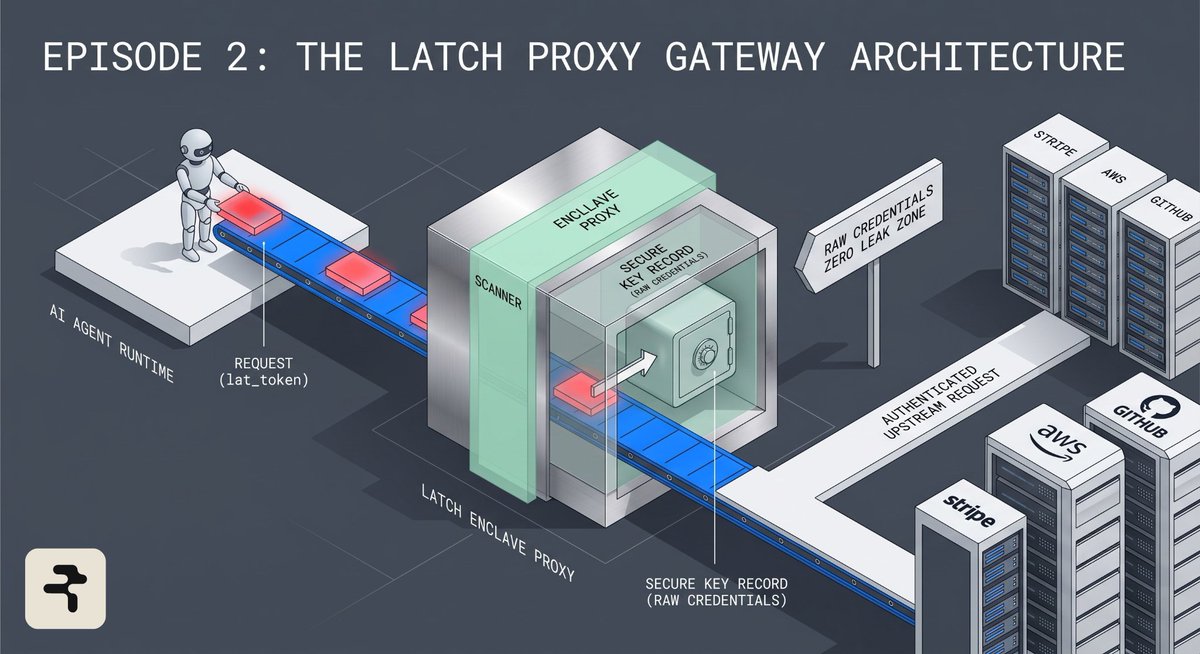
Episode 2: Introducing Latch - The Agent Gateway
Hook: What if your AI agent never actually saw your API keys?
The Story: Yesterday, we talked about the security risks of autonomous agents. Today, let’s look at the solution: Latch.
Latch is a secure proxy gateway and policy engine built specifically for AI agents. Instead of giving your agent a raw Stripe API key, you route the agent's requests through Latch.
How it works:
You store your sensitive API credentials on Latch under Secrets.
Latch issues a scoped access token (lat_...).
Your agent uses this Latch token.
When the agent makes a request, Latch intercepts it, validates it against your security rules, injects your real API key server-side, and forwards it to the upstream service.
The agent gets the access it needs, but the raw credentials never leave Latch. If the agent is compromised, the hacker only gets a highly restricted Latch token, not your master API key.
⏭️ Up Next in Episode 3: How Latch uses natural language to build iron-clad API guardrails.
Series: Securing the Agentic Future with Latch
Episode 1: The AI Agent Security Dilemma
Hook: We are giving AI agents blank checks. It's time to talk about "Bounded Power."
Autonomous AI agents like Claude Code, Cursor, and custom API-calling LLM loops are changing how we write code and run operations. But they’ve introduced a terrifying security nightmare.
To do their jobs, agents need access. We hand them raw API keys for Stripe, AWS, GitHub, or Slack.
But agents:
Hallucinate: They might call the wrong endpoint or loop infinitely.
Are vulnerable: Prompt injection can trick them into leaking raw keys or deleting data.
Have no self-control: A bug in an agent's code can trigger a rate limit or run up thousands of dollars in api bills in minutes.
How do we give agents the authority to act without giving them a blank check?
Enter Bounded Power.
⏭️ Up Next in Episode 2: Meet Latch—the secure enclave proxy that sits between your agent and your APIs.
@RialoHQ
Another amazing Builders Hub by @RialoHQ
Great to see builders sharing projects, exchanging ideas, and getting valuable feedback from the community. Every session brings new innovation and strengthens the ecosystem.
Huge thanks to everyone who joined. Can't wait for the next Builders Hub! 🔥
Most Web3 infrastructure is built on a foundation of pure marketing velocity. Projects spend millions hyping up theoretical throughput metrics before shipping a single line of production-grade code.
But trends shift overnight. Hype cycles burn out. In the long run, the only thing that actually manufactures sustainable trust is perseverance and continuous technical delivery.
This is what fundamentally separates @RialoHQ from the noise.
Instead of chasing short-lived narrative loops, the Rialo team has spent the cycle quietly expanding its core ecosystem from the bedrock up. They aren't just shipping isolated technology they are engineering native AI-driven primitives, hardware-attested authorization frameworks like Latch, and protocol-level execution layers designed for the real-world agentic economy.
With every single runtime update, the focus remains entirely clear:
Decoupled Complexity: Moving heavy computation off-chain while securing it with cryptographic validity proofs.
Developer-First Security: Shielding sensitive credentials inside secure hardware enclaves so autonomous systems can execute safely.
Sustainable Innovation: Building resilient, deterministic infrastructure that turns blockchain from a speculative sandbox into a true utility layer.
The future of Web3 doesn't belong to the loudest marketing campaigns. It belongs to the platforms anchored in consistent, verifiable engineering.
Get Real. Get Rialo.
@RialoHQ
True autonomy for AI agents requires three things: trust, security, and absolute accountability.
Right now, the industry standard for deploying agents is terrifying: developers hand over raw, unrestricted API keys to autonomous bots. If that agent gets hit with a prompt injection or a data leak, your entire backend treasury is compromised instantly.
This is why @RialoHQ built Latch.
Latch is a hardware-enforced authorization layer that gives your agents real power-real spend, real API access, and real execution-without ever exposing a raw key.
How it works:
Bind the Secret: Your API key is stored securely once inside attested hardware. It never leaves Latch.
Hand out a Latch: Your agent points to a scoped, revocable token instead of the raw key. Zero new lines of code needed.
Hardware Enforcement: Every single call is checked and executed inside a secure enclave based on policies you define.
Deep Audit Trails: Every action, decision, and dollar spent lands in a tamper-evident, replayable log.
Stop exposing your infrastructure infrastructure to autonomous risk. Latch is currently in Early Access, giving builders a massive opportunity to get under the hood before the public launch.
Secure your spot and request early access today:
👉onlatch(.)com
Get Real. Get Rialo.