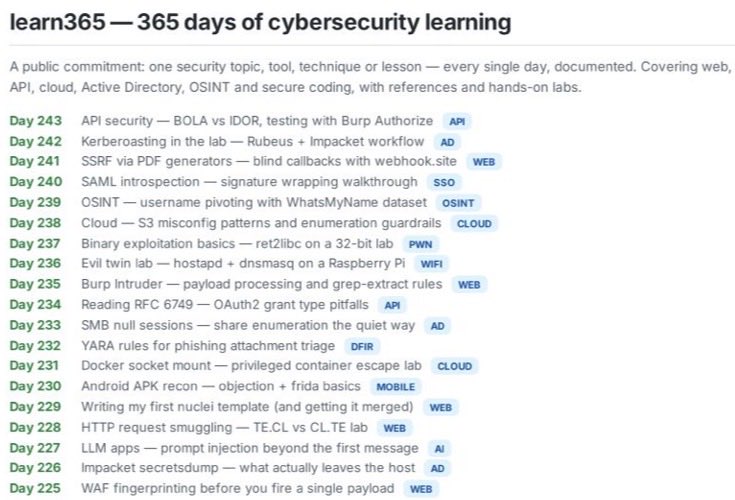
Cybersecurity Learning (Learn365)
This repository contains all the information shared during @harshbothra_’s Learn 365 Challenge.
Source: https://t.co/w19Ko5tmQ5
👋🏻ADIÓS A LOS DE CIBERSEGURIDAD!
YA PUEDEN IR APLICANDO A MCDONALD'S.
Acaba de salir un repositorio con cientos de herramientas de seguridad para IA en un repositorio open source.
Muestran técnicas y herramientas para poner a prueba sistemas de IA:
↳ Frameworks de jailbreak para LLMs
↳ Testers de prompt injection
↳ Agentes de red team para IA
↳ Herramientas de extracción de modelos
↳ Vectores de ataque a la supply chain
↳ Pentesting automatizado para aplicaciones con IA
Las MISMAS herramientas que usan los equipos de seguridad para defender sistemas.
Ahora están disponibles para cualquiera.
Dejo el enlace al repositorio en los comentarios↓↓
There are two main branches for a career path in reverse engineering.
1) Vulnerability research.
2) Malware analysis.
Everything else that's niche branches off these two disciplines. Starting my career in Malware analysis and transitioning to Vulnerability research was not an easy pivot, the skills are very similar, but the knowledge base is completely different. I would not advise anyone to go throughout their entire career focusing on one, many doors will be shut if that's the case. When I started doing VR, I've seen so much potential and honestly this is where most of the industry's biggest challenges are. Been a great experience so far.
If you're starting out, get good at one, then immediately shift your learning towards the next one.
The winner of an Anthropic hackathon open sourced his entire Claude Code setup - and this is absolute f*cking gold
68 subagents, 286 skills, 94 commands, MIT license
ECC turns Claude Code from one assistant into a full engineering team
It plans before it builds, writes the failing test first, then reviews its own work from a fresh context.
• the agents, by job
> planning - one line in, a blueprint you approve before any code exists
> review - reads your diff in a clean context. separate reviewers per language
> build repair - one resolver per toolchain, down to PyTorch and CUDA
> security - an OWASP pass, plus a scanner for injection risks in your agent config
> architecture - design calls before they become migrations
> domain work - database queries, ML pipelines, e2e tests, docs
that security pair is what people skip
an outside OWASP review runs four figures and takes a week
this one runs on your branch before lunch
• the skills, by category
> testing - tdd-workflow gates red to green. eval-harness sits on top
> language packs - Python, Go, Rust, C++, Django, Laravel, Spring Boot, Next.js
> context - search-first reads the docs first. iterative-retrieval keeps your repo out of the window
> shipping - Docker, CI/CD, health checks, rollbacks, migrations
> not code - writing in your voice, market research, pitch decks
strip it down and ship your own version tomorrow
start with one plan and one rules pack
installing all 286 skills at once is the fastest way to make it worse
the devs who wire this up over a weekend spend next quarter reviewing output instead of typing it
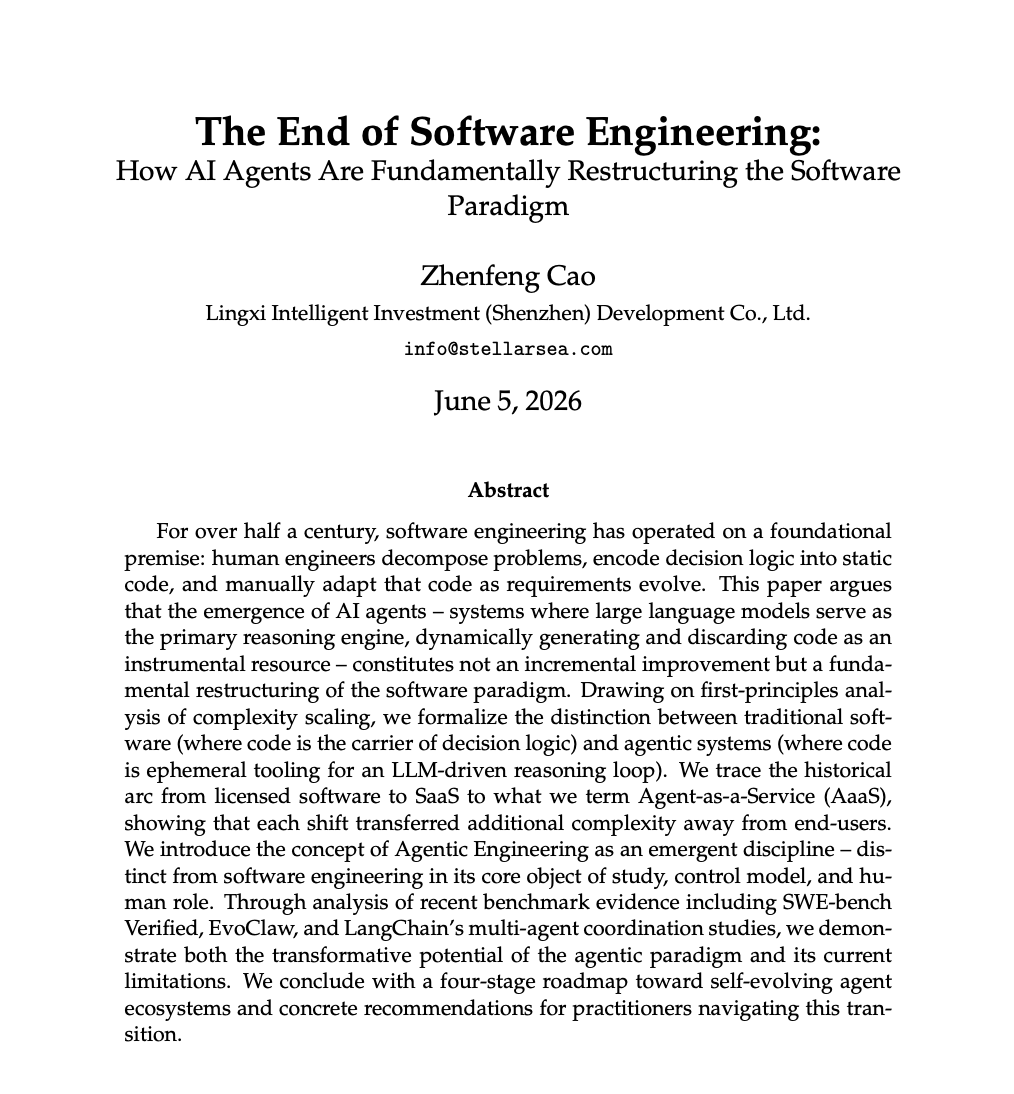
Chinese researchers published a paper with a devastating title: "The End of Software Engineering”
it argues software engineering is finished.
In traditional software, code is the carrier of pre-written human logic.
In agentic software, the AI agent is the software.
Code is no longer a permanent monument built by human hands. It is completely ephemeral, dynamically generated, executed, and discarded on the fly by an LLM-driven reasoning loop.
Think about how software delivery has evolved:
• Era 1: On-premise licensed software (you installed it locally)
• Era 2: SaaS (hosted in the cloud, managed by vendors)
• Era 3: Agent-as-a-Service (AaaS)
Each historical shift transferred complexity away from the user. But this latest shift transfers something entirely different.
It transfers decision-making complexity itself.
The paper argues that traditional engineering is hitting a hard complexity wall. Human brains can only hold so much state, manage so many dependencies, and debug so many lines at once.
LLM-based agents scale non-linearly.
They don't just write functions faster. They navigate architectural complexity by outsourcing reasoning to models that improve every single month.
Which means the role of the developer is permanently changing.
You are no longer a code author typing syntax line by line.
You are an intent architect.
Your job is no longer writing the implementation. It is specifying goals, designing multi-agent coordination loops, and auditing outcomes.
I believe networking is one of the first things every cybersecurity newbie learns, so everyone should be good at it. Everyone should be able to design and build a complex network.
Practice cybersecurity skills using 70 hands-on projects with full source code, organized from beginner fundamentals to advanced security operations.
https://t.co/xu93Q5bOoU
3rd Place: ThinkVoice lets you speak without moving your mouth by combining Grok Voice with brain-sensing technology.
It understands the conversation, suggests what you might want to say next, and lets you select a response using subtle motor movements.
@Daniel_farinax@yangchasiu@elithpalomino
2nd Place: Signal embeds followers’ bios, posts, and engagement into a living graph and A/B tests different launches using simulated populations of your following, so every post hits maximum engagement.
@adibilawar@jasonlai150_@SChen1249@JeffreyZh0u
1st Place: Nova taught Grok to reverse-engineer binaries into clean C. Started with 262KB GameBoy ROMs, ended up rebuilding a 1995 car’s ECU runtime.
@theoc____@supratikp07@henryzhang