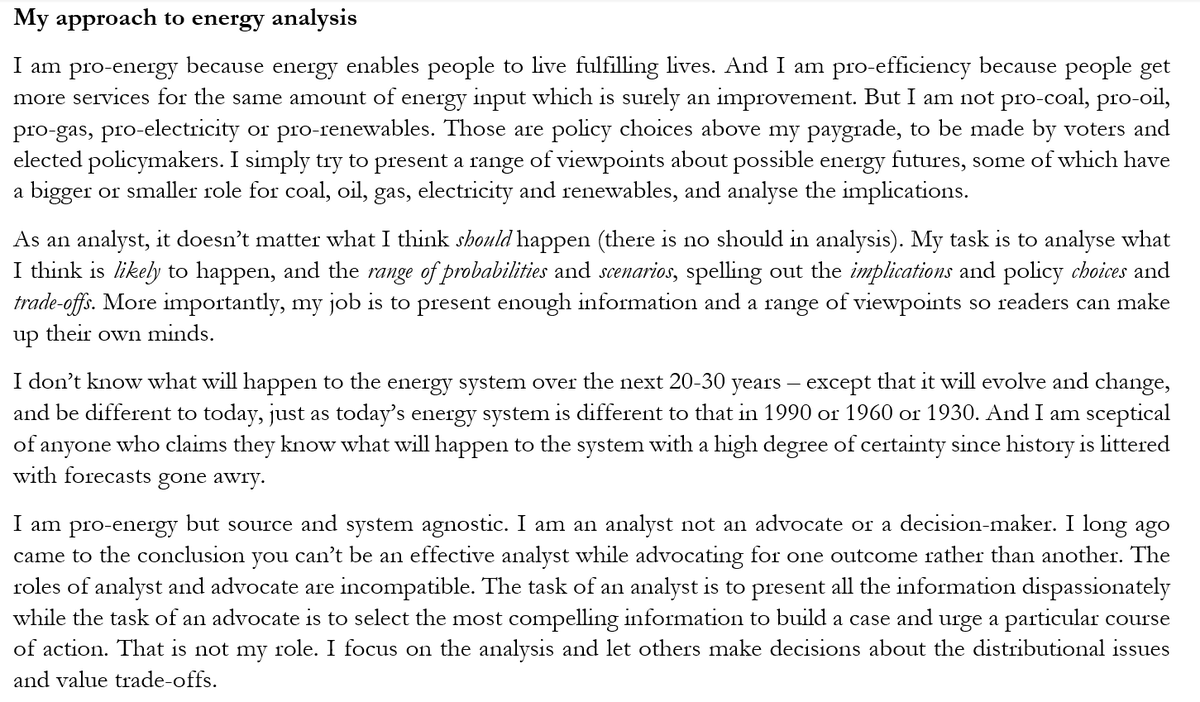
ENERGY ANALYSIS - some thoughts. I regularly get critical emails from people who think I am too pro-oil or pro-renewables. So I thought I would put on record my own approach to energy systems and how to analyse them:
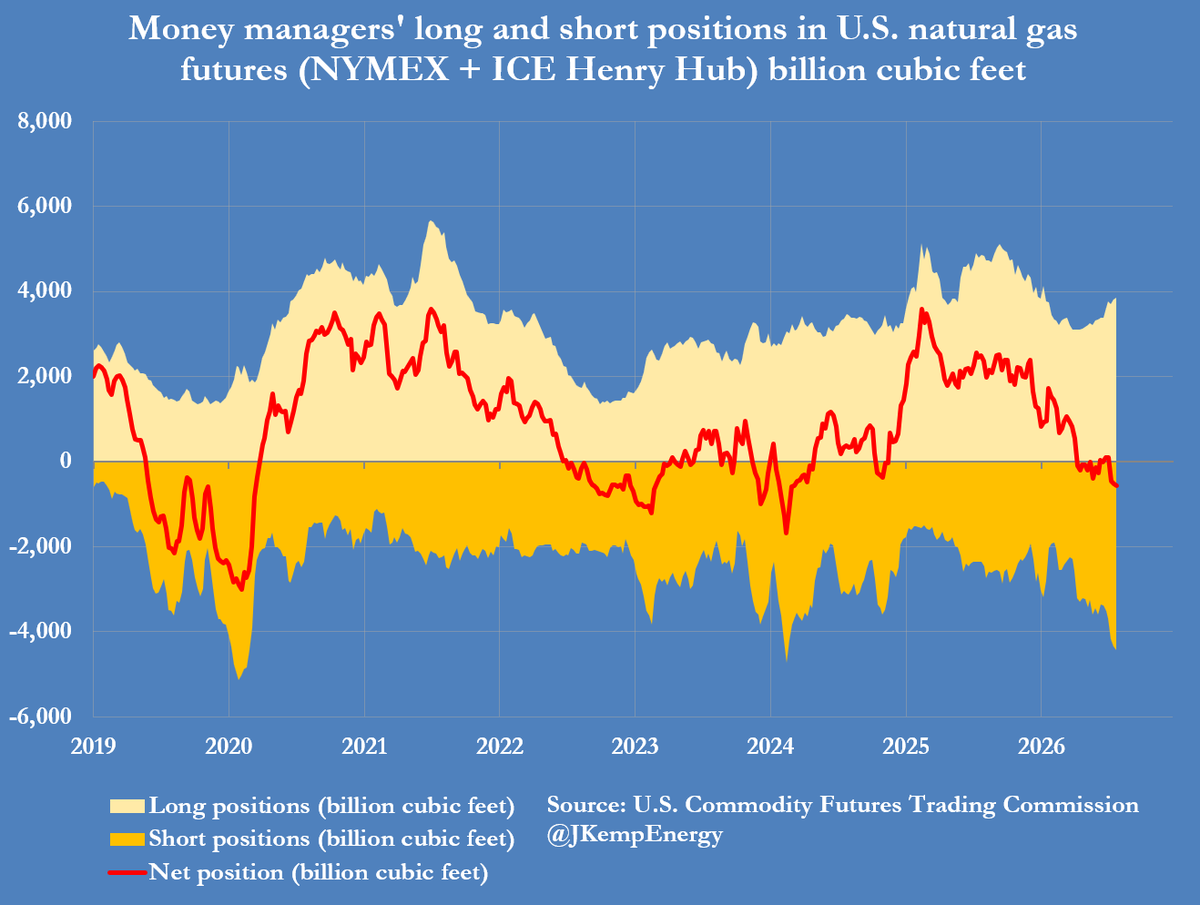
HEDGE FUNDS and other money managers have cut their position in U.S. gas futures and options to the lowest for more than two years as inventories remain above normal for the time of year despite the start-up of additional LNG export terminals. Fund managers currently hold a net short position of 570 billion cubic feet in the two major contracts based on prices at Henry Hub. The position is in just the 14th percentile for all weeks since 2010 – consistent with a very bearish outlook for gas prices as domestic supply continues to run ahead of consumption and exports:
U.S. oil refiners struggle to satisfy fuel demand amid foreign wars
U.S. oil refiners reported record profits in the second quarter as fuel production in the rest of the world was severely disrupted by the wars between the United States and Iran and between Ukraine and Russia.
Partial closure of the Strait of Hormuz coupled with Ukraine’s intensifying attacks on Russia’s refineries cut fuel output worldwide, raising margins for other refiners still able to operate.
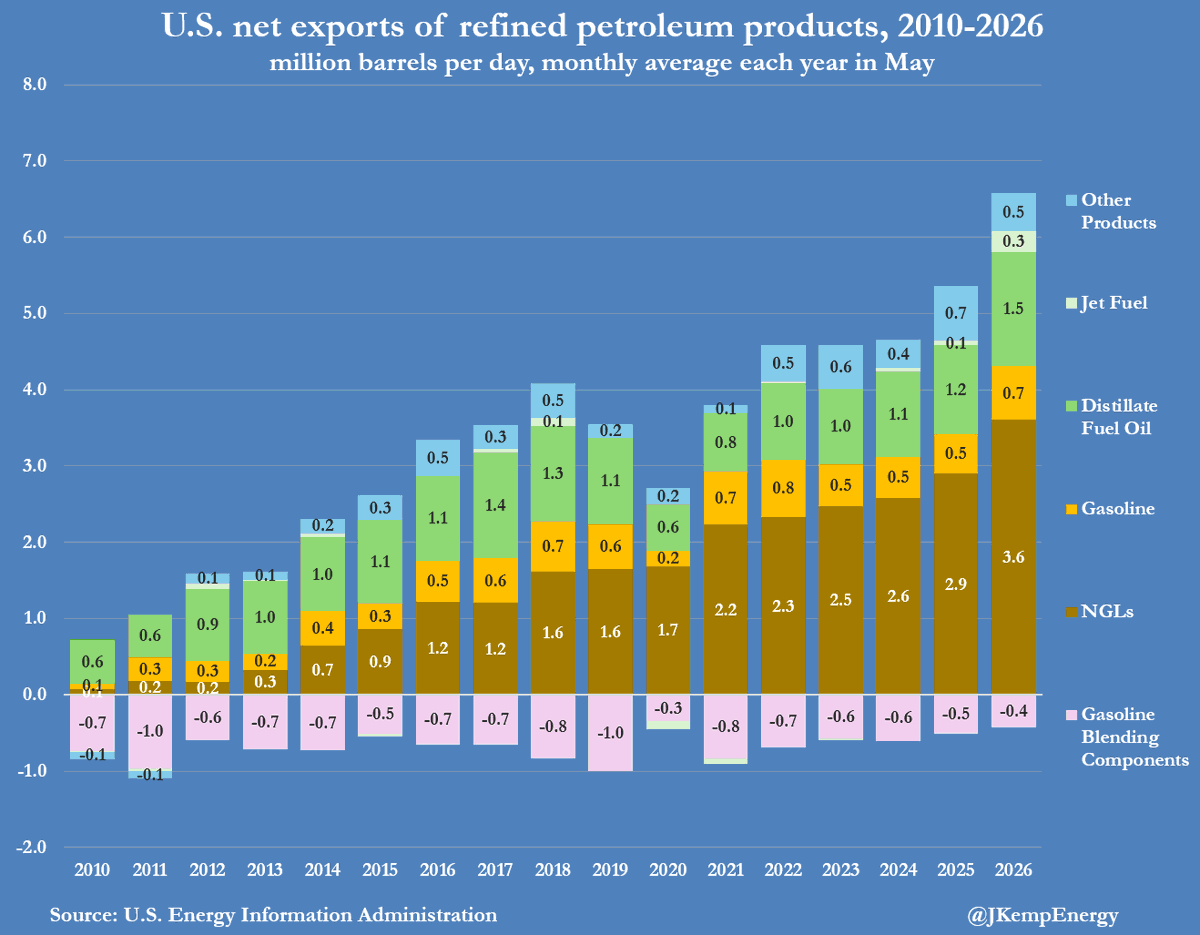
In response, U.S. refiners boosted their exports to a record rate, but were unable to increase output by the same amount, leading to a severe depletion of domestic fuel stocks, especially for gasoline and to a lesser extent diesel ...
This is a short extract from my newsletter emailed to clients earlier today. If you would like to read my newsletters in full, three times a week, you can subscribe via my website https://t.co/aW1Xb1tAI9
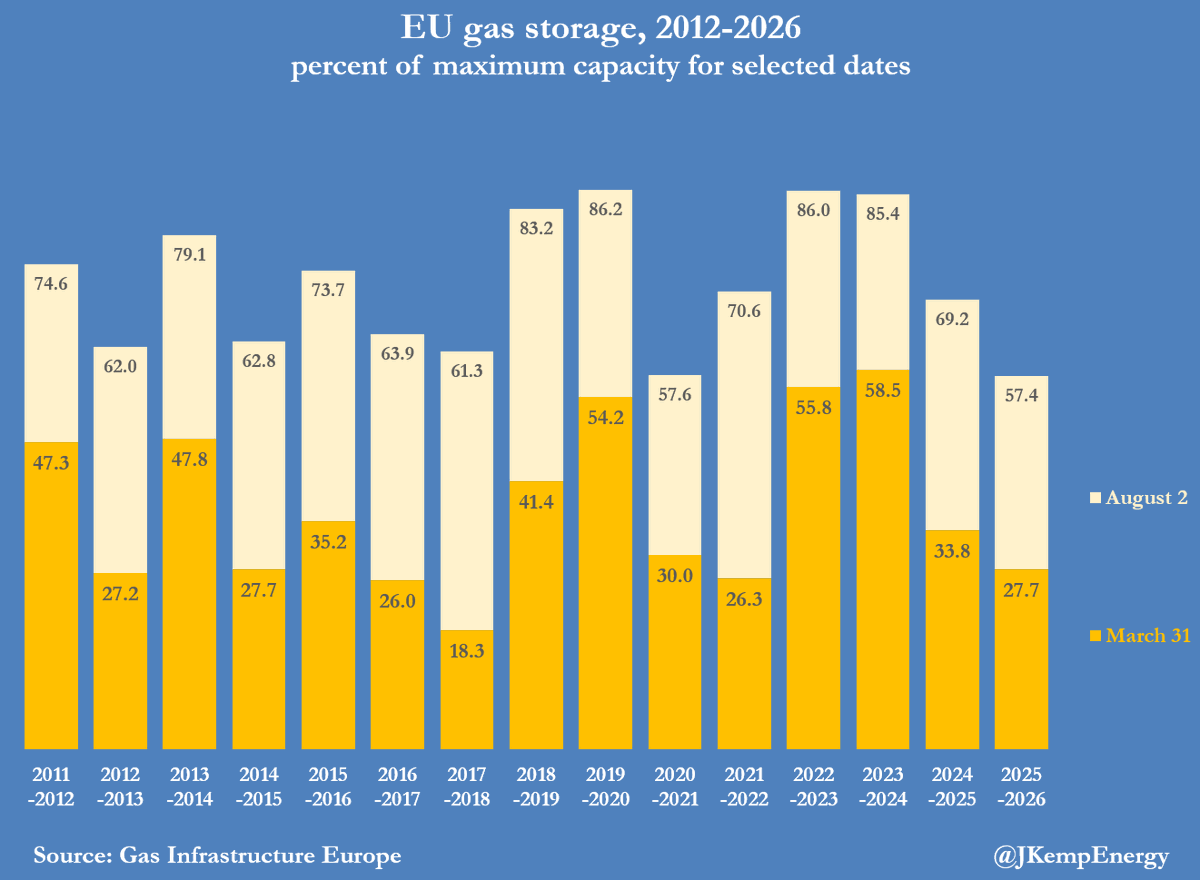
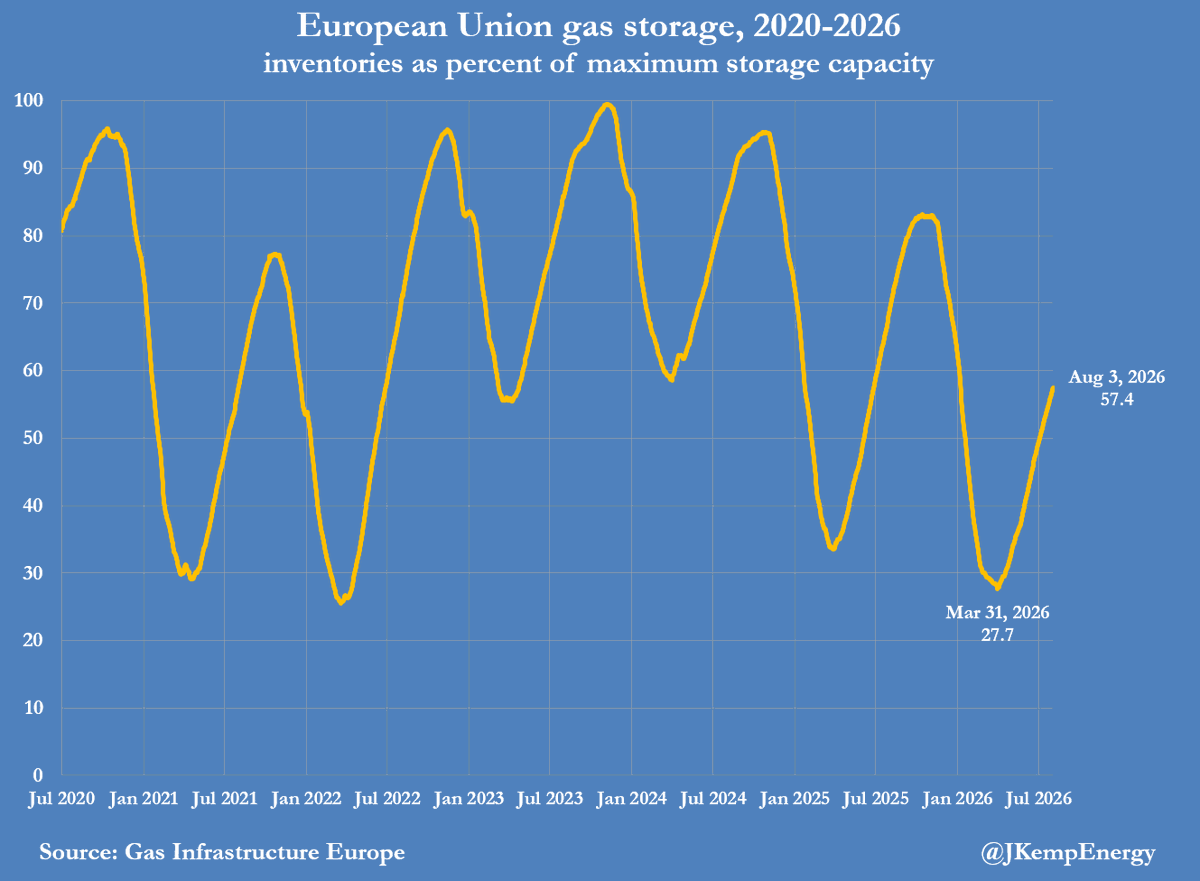
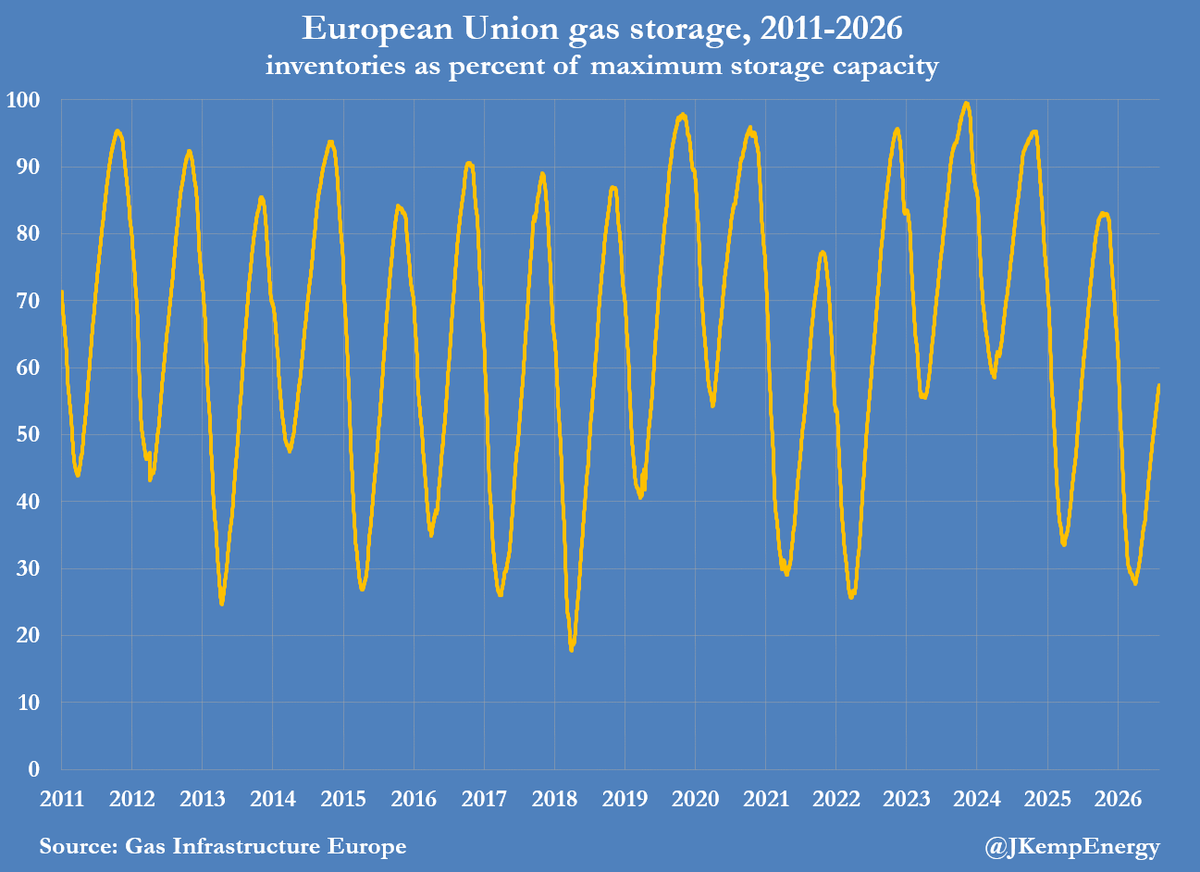
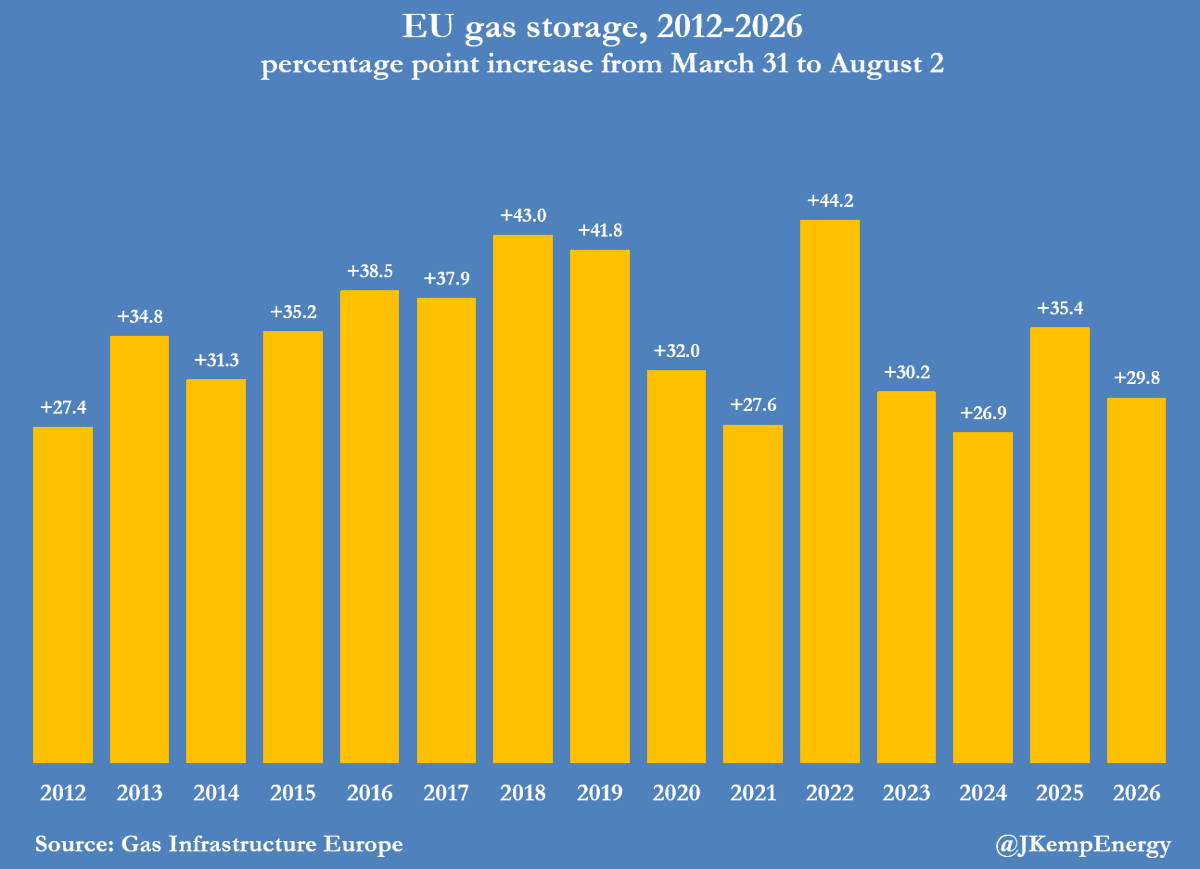
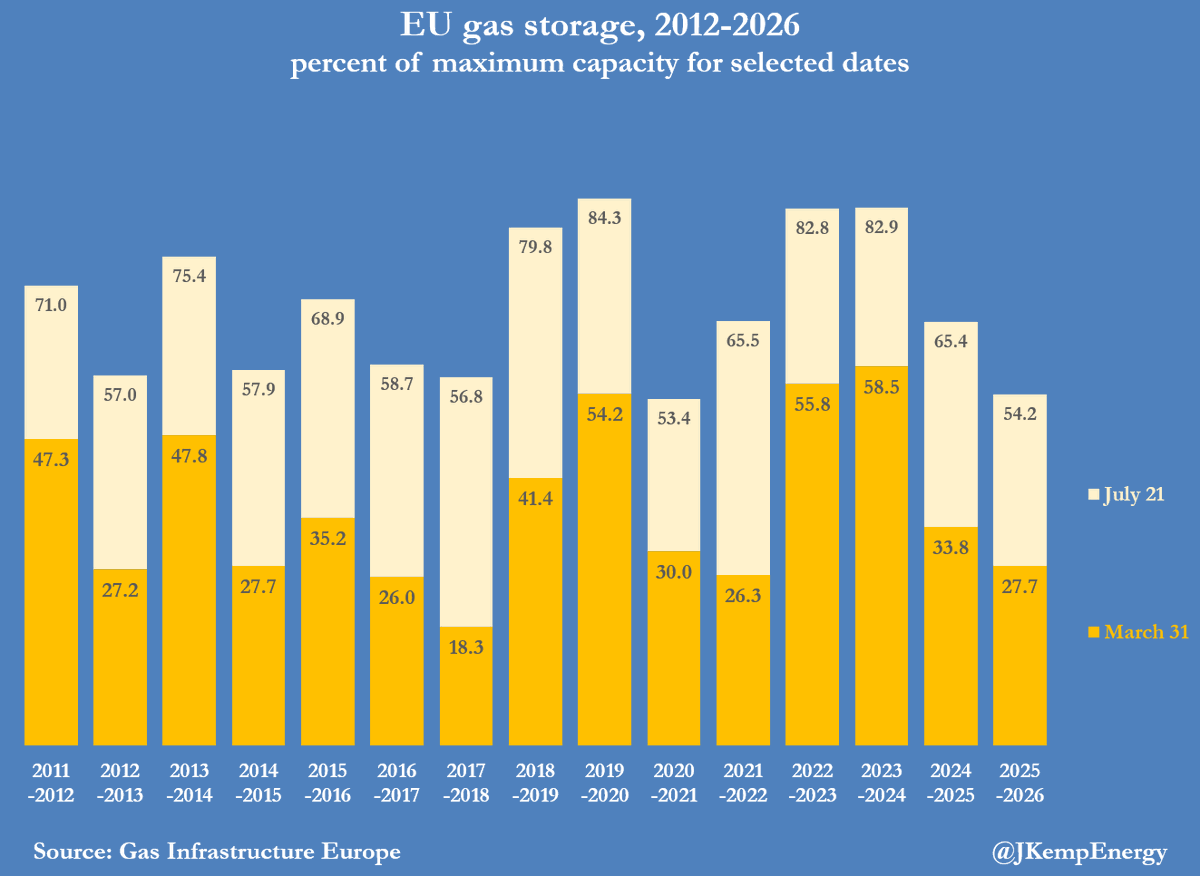
EUROPE is falling further and further behind replenishing its underground gas storage ahead of next winter. Storage sites across the European Union were just 57% full on average on August 2, the lowest for the time of year in records dating back to 2011. Storage is supposed to reach 90% on or before December 1 under regulations approved last year. The regulations contain exceptions that would lower the target to 80% or 75% in the case of persistent and exceptional difficulties securing enough gas. It looks increasingly as if these flexibilities will need to be invoked in full with storage currently on track to be around 75% or less before the winter depletion begins:
I'm sorry to sound like Cato the Elder, repeating the same warning over and over again, but the reality remains unchanged: no matter what President Trump says or threatens, Tehran shows no indication that it intends to back down.
As long as the maritime blockade remains in place and Washington continues to enforce it, Iran is likely to continue targeting commercial shipping transiting the southern channel of the Strait of Hormuz, as well as U.S. military facilities in the Gulf and Jordan. This is not a prediction with certainty; it is the baseline assumption that should guide policy based on the Islamic Republic's behavior and strategic logic.
The problem is that threats lose their value when they are not backed by a willingness to act. Every warning that is not enforced weakens American deterrence and raises doubts among U.S. partners about Washington's credibility. If the United States has no intention of following through, it should be far more cautious about issuing ultimatums. If it does intend to act, it must be prepared to accept the costs that come with that decision.
The larger problem is the refusal to acknowledge the strategic reality. The administration faces only difficult options. It does not control the Strait of Hormuz, it is not prepared for a large-scale war with Iran, and it is unwilling to accept an Iranian-dominated security order in the Strait. That strategic deadlock has encouraged the search for a "third way," but there is no magic solution to the Iran challenge.
Washington ultimately faces two broad choices: adapt its policy to the reality on the ground, or embark on a much broader military confrontation with Iran, one that would likely be costly, prolonged, and offer no guarantee of achieving America's political objectives. Trying to preserve the current status quo is not a sustainable strategy. There is little reason to believe Iran will stop attacking shipping or that the Strait of Hormuz will reopen under the current conditions.
The longer Washington avoids making this strategic choice, the greater the damage to American credibility, regional influence, and deterrence. Strategy begins with accepting reality as it is, not as policymakers wish it to be.
#iran
Oil rally fades as belligerents back away from escalation
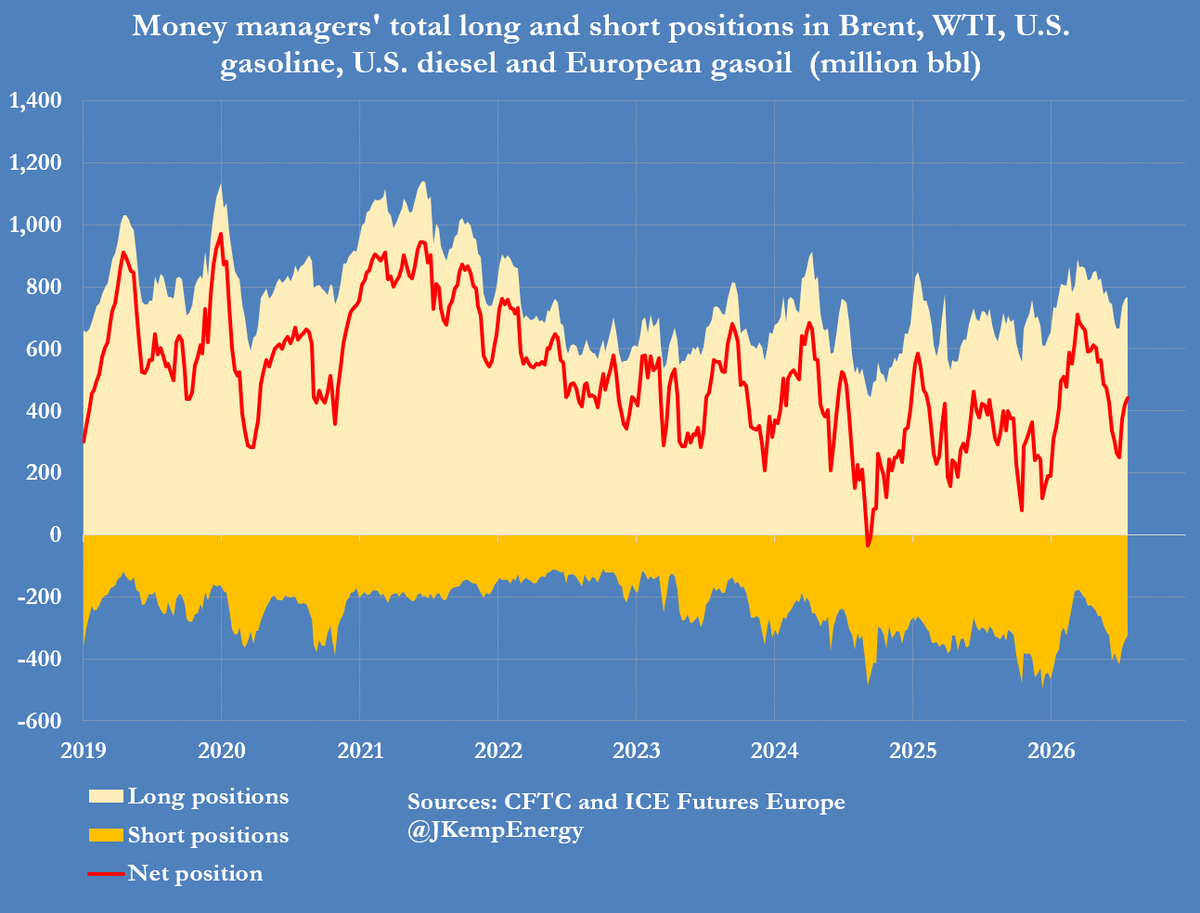
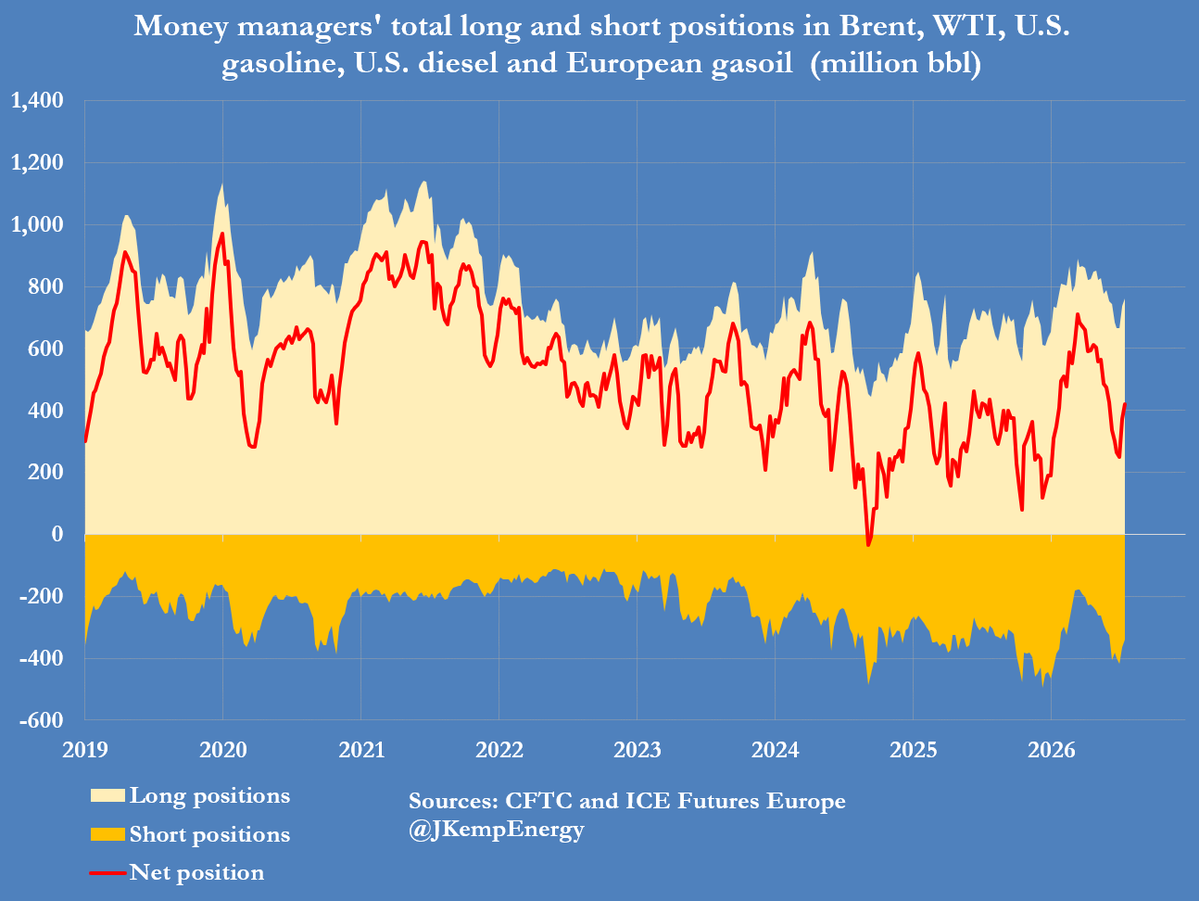
Investors made relatively few changes to their positions in crude oil and refined products last week as the conflict between the United States and Iran remained poised between further escalation and renewed negotiations.
The aggressive short-covering rally in Brent crude futures that characterised the two previous weeks ended as investors remained uncertain about whether sufficient crude could still be sent through the Strait of Hormuz.
There was even more uncertainty whether oil could be re-routed through the Red Sea following threats from Yemen’s Houthi militia against tankers transiting the Bab el-Mandeb at the southern end of the waterway ...
This is a short extract from my newsletter emailed to clients earlier today. If you would like to read my newsletters in full, three times a week, you can subscribe via my website https://t.co/aW1Xb1tAI9
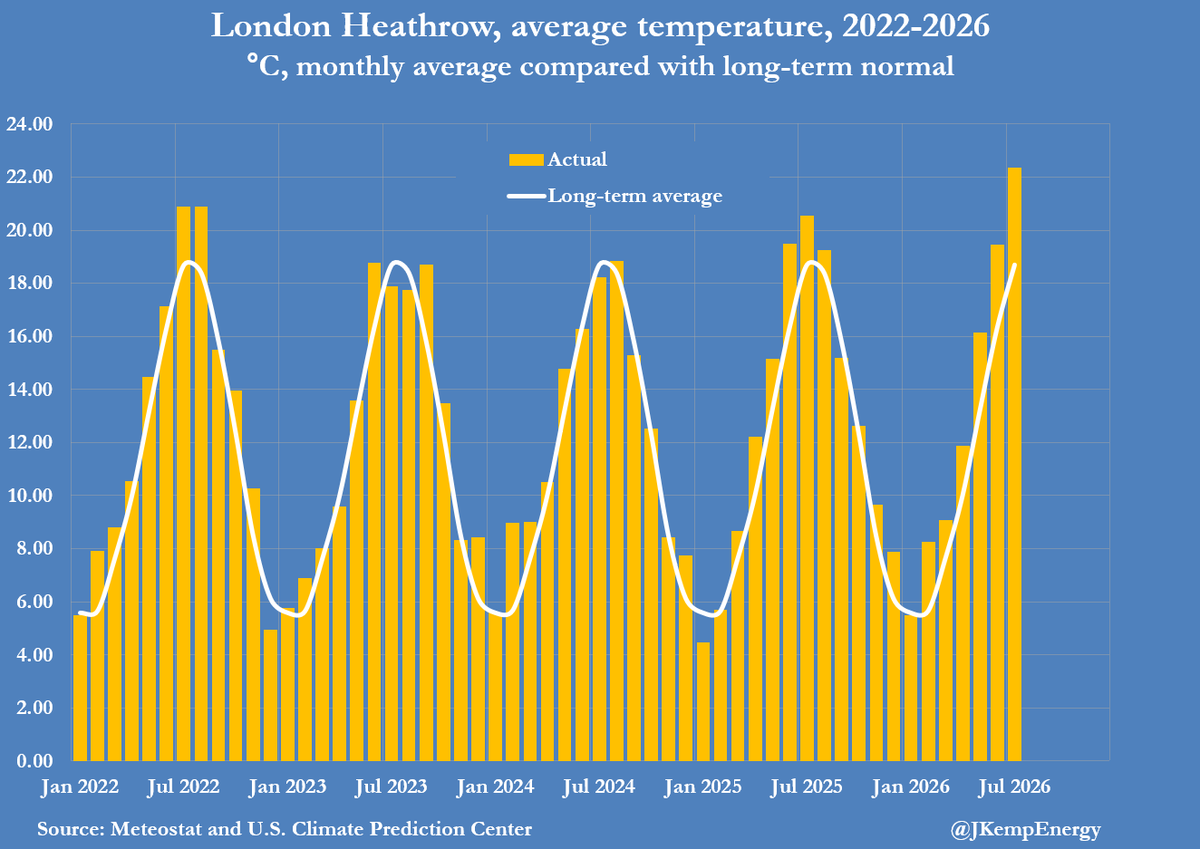
U.K. TEMPERATURES across London and Southeast England were far above the long-term seasonal average in July. Temperatures (including overnight) at Heathrow Airport averaged more than 22°C compared with less than 21°C in the same month a year ago and a 30-year average below 19°C. Temperatures were at or below average on only one day out of 31 days during the month. Higher temperatures have driven a surge in airconditioning demand and electricity consumption:
China’s renewable surge relegates coal to reserve role
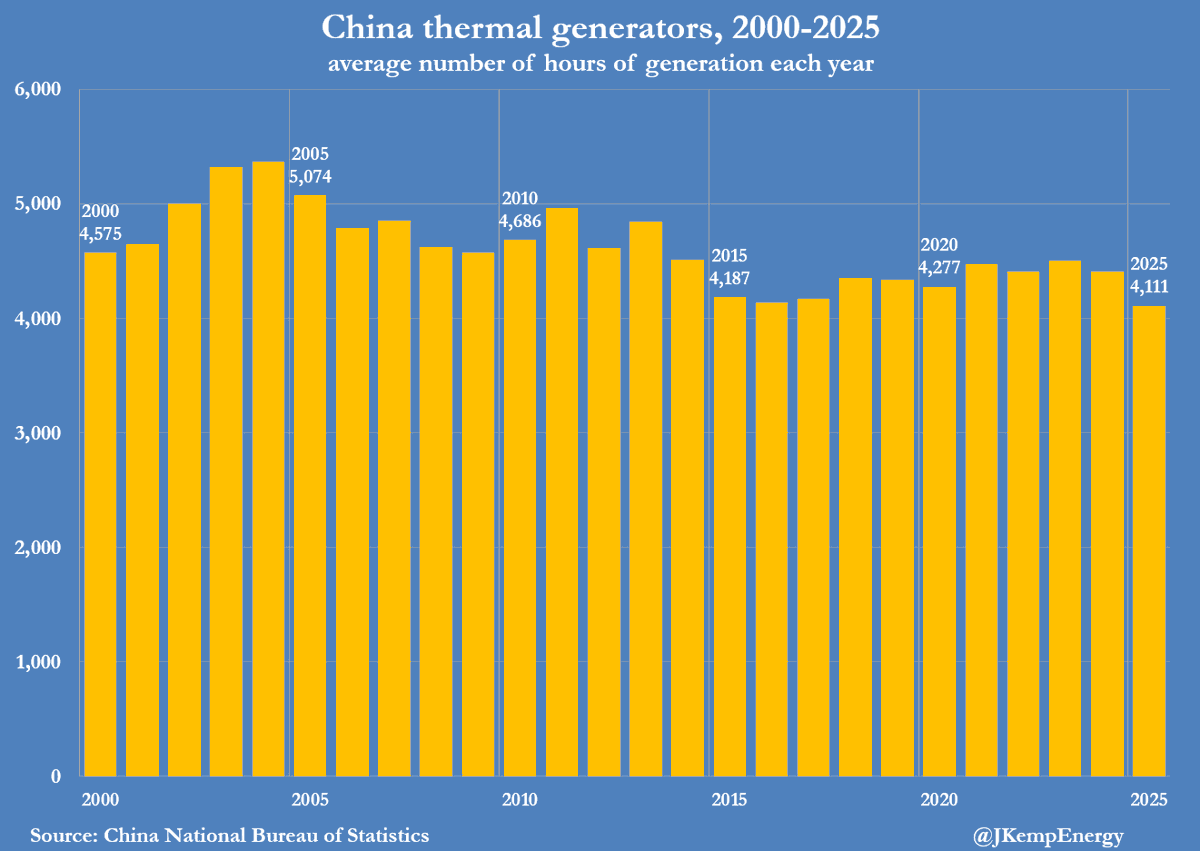
China’s electricity system is progressively transitioning to one dominated by renewables, with coal-fired generation held in reserve to deal with periods of exceptionally high demand or when output from wind, solar or hydro is below normal.
Policymakers increasingly describe as coal as “ballast stone” and a “safety net” — backing up intermittent renewables in electricity generation and lessening the security risks of depending on imported oil and gas ...
This is a short extract from my newsletter emailed to clients earlier today. If you would like to read my newsletters in full, three times a week, you can subscribe via my website https://t.co/aW1Xb1tAI9
Oil prices and cracks climb on continued fund buying
Investors continued to cover bearish short positions in Brent as the conflict between Iran and the United States escalated and the Strait of Hormuz remained largely closed to tanker traffic.
Hedge funds and other money managers purchased the equivalent of another 22 million barrels in Brent futures and options over the seven days ending on July 21 ...
This is a short extract from my newsletter emailed to clients earlier today. If you would like to read my newsletters in full, three times a week, you can become a subscriber via my website https://t.co/aW1Xb1u8xH
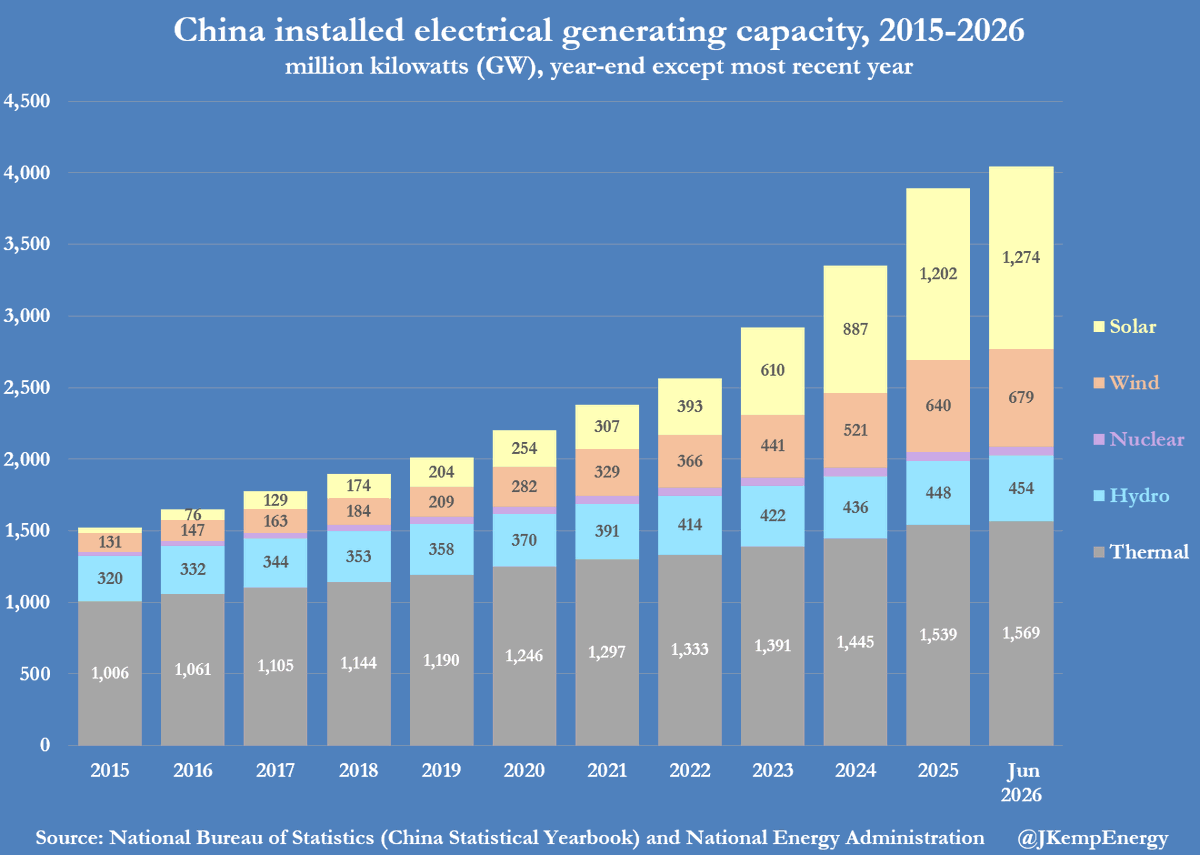
CHINA installed another 151 million kilowatts (GW) of electricity generation capacity in the first six months of 2026. Nearly half of the extra capacity was grid-scale solar (72 million kW) with other significant contributions from wind (39 million kW) and thermal power plants (30 million kW). Non-fossil generators now account for 60% of installed capacity up from 40% in 2018:
U.S. OIL REFINERS are running flat out to meet the global demand for fuel as war disrupts supplies from the Persian Gulf and Russia. U.S. refiners have processed an average of 17.3 million barrels of crude and other feedstocks so far this month, utilising 96% of their total operable capacity of 18.0 million b/d. Processing has been the fastest for the time of year since 17.6 million b/d in 2019, when refiners were utilising 94% of their much higher operable capacity of 18.8 million b/d. But maximising utilisation to satisfy demand leaves no contingency to deal with accidents or any other form of disruption and limited capacity to rebuild depleted inventories – which is why crack spreads and refining margins have been trading at or round record highs:
@BurritoEveryDay@JavierBlas Glad you liked it. The Champagne Fairs show how rapidly Europe's economy was modernising before the Black Death and other problems resulted in a huge setback in the mid-1300s ...
Retail traders will lose money in 24/7 oil markets
Most professional traders are unenthusiastic about plans to move to continuous oil trading, including weekends, with new micro futures products aimed at retail customers, but the change is probably inevitable.
“When it comes to the question of whether the oil industry needs 24/7 trading, my answer is simple: “Hell no.” according to Bloomberg’s chief commodities columnist Javier Blas.
“From what I hear in the oil-trading community, most share my views. Yet, round-the-clock trading is coming. In fact, it’s essentially already here, via unregulated financial markets,” he wrote.
Start-up markets have already begun to offer continuous or near-continuous trading in crude oil prices tailored to the needs and financial means of retail customers.
In response, the Chicago Mercantile Exchange (CME) has requested permission from U.S. regulators to launch its own micro futures contract for 10 barrels rather than the usual 1,000 barrels of crude.
“Trade oil in your size, on your time, 24/7” the exchange’s website says, enabling customers to sign up for updates about trading ten barrel WTI oil futures.
Traders as well as analysts and journalists are unlikely to be thrilled at the prospect of continuous markets — meaning more working hours including weekends.
But technology changes and the commercial logic makes longer trading hours inevitable, as the Bloomberg article makes clear.
In the long term, most retail traders will lose money because they under-estimate the information and technology advantages held by professional traders and over-estimate their own trading “edge”.
Longer trading hours, smaller contract sizes and more retail trading are likely to accelerate the wealth transfer from retail “outsiders” to professional “insiders” ...
The full article is free to read on my website: https://t.co/5e4VlSwEki
Europe’s gas storage target is slipping out of reach
Europe is now more than half-way through the summer replenishment season and the region is falling further and further behind rebuilding gas inventories ready for next winter.
Underground storage sites across the European Union are on average just 54% full, the second lowest on record, and far below the average fill rate of 70% at this point in the previous ten years.
The European Union’s target of refilling storage sites to an average of 90% before the end of November is rapidly slipping out of reach.
EU regulations provide some flexibility to reduce the storage target to 80% or even 75% and it looks increasingly likely that will be needed ...
This is a short extract from my newsletter emailed to clients earlier today. If you would like to read my newsletters in full, you can become a subscriber via my website https://t.co/aW1Xb1tAI9