@Skel10137@archeohistories On land no man can touch. Sacred law. Sacred place, in our culture we do not take, only use what we need. And there is spear heads found, axe heads, patterns carved into stone from Aboriginals sharpening their tools about half an hour drive from where I live, 10,000yr old paintin
A study of ancient Aboriginal hair samples has revealed distinct Aboriginal populations were present in Australia with little geographical movement for up to 50,000 years.
The discovery of such a long, continuous presence in the those regions emphasised why land was so sacred to Aboriginal people, researchers said.
The results emerged after researchers led by the University of Adelaideโs Australian centre for ancient DNA analysed the mitochondrial DNA from 111 hair samples collected during anthropological expeditions in the early to mid-1900s. The samples are stored at the South Australian Museum.
Mitochondrial DNA is the powerhouse that drives the conversion of food into energy, and is useful to researchers because it carries genetic material passed exclusively between a mother and her children, allowing maternal ancestry to be traced.
Despite the age of the hair samples and the fact that they were collected under harsh environmental conditions, the researchers were surprised to find high concentrations of good quality mitochondrial DNA.
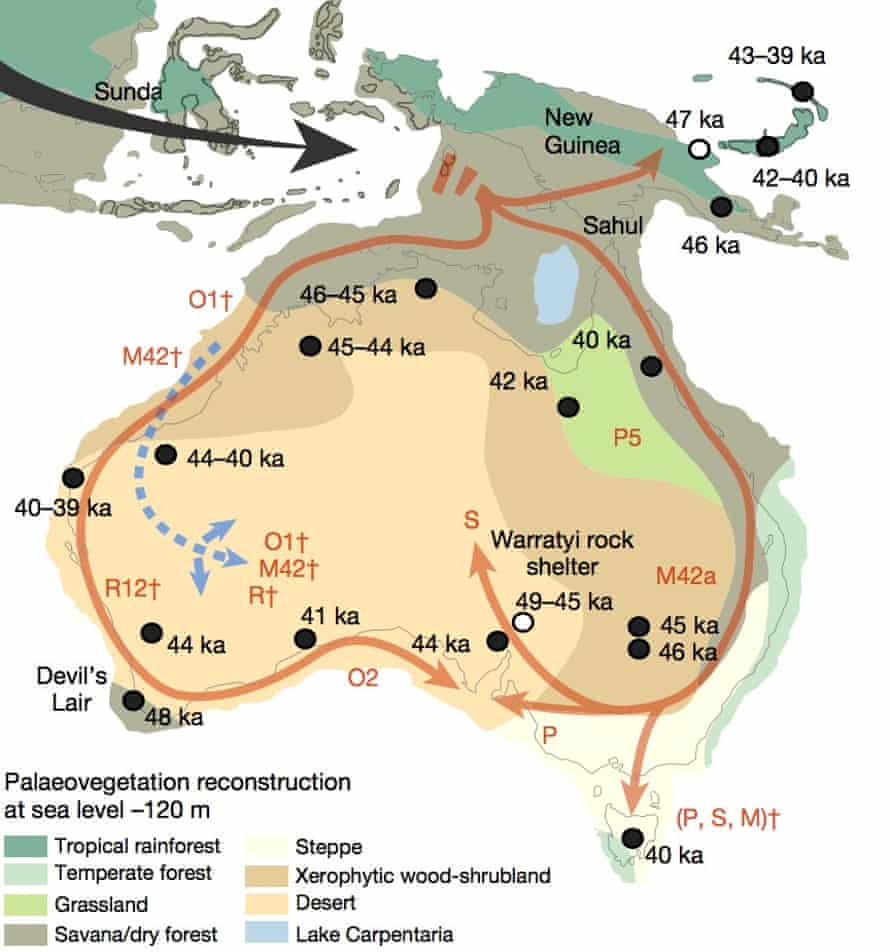
Their analysis found Aboriginal Australians are the descendants of a single founding population that arrived in Australia 50,000 years ago, while Australia was still connected to New Guinea. Populations then spread rapidly โ within 1,500 to 2,000 years โ around the east and west coasts of Australia, meeting somewhere in South Australia.
One of the researchers, the geneticist Dr Ray Tobler, said the samples meant Aboriginal ancestry could now be genetically traced back in time to a point that pre-dated European colonisation, when Aboriginal people were still living in their traditional areas, supporting what the archeological evidence already shows.
Having the genetic information was crucial because after colonisation Aboriginal people were forced off country or forcibly removed from their families and scattered all over Australia, Tobler said. โIf you want to do historical research on the connection between people and land you canโt do it using modern Aboriginal people because of that disconnection,โ he said.
โI have Aboriginal ancestry through my granddad but he never spoke about it because he was removed from his family. A lot of people in my situation interested in recording their history can do so through this project.โ
The hair samples identified four main distinct types of maternal DNA, which they labeled โPโ, โOโ, โSโ and โMโ. Those in the O group were overwhelmingly found on the west and south coast of Australia, the researchers found. Those with the other three types mainly stuck to the east coast.
The researchers know this because the sample collectors kept detailed information about birthplaces, family history and family trees, and this โ combined with film, audio and written records โ allowed the researchers to create a map of movement and reconstruct history.
The project leader, Prof Alan Cooper, said it was โamazingโ that the team had found Aboriginal communities have remained in discrete geographical regions. โThis is unlike people anywhere else in the world and provides compelling support for the remarkable Aboriginal cultural connection to country,โ he said.
โDuring that period of time, with massive climate changes and massive environmental shifts, you might therefore have expected people to respond by moving all over the place.
โClearly the environment did change significantly but nevertheless they were able to survive in one area with a fixed set of resources for up to 50,000 years. Nowhere else in world have humans been able to demonstrate an ability to do that. We donโt have a great record of living in balance with anything.โ
It illustrated the enormous amount of respect, knowledge and affinity Aboriginal people must have had with the land, and to specific areas of land, to survive, Cooper said.
ยฉ The Guardian
#archaeohistories