Passionate about deepening democracy in fragile states & those facing difficult transitions; rights-based approach to good governance. RT is not an endorsement
Fellow Ugandans, especially the Bazzukulu. Tomorrow, at 2:00 p.m., I will address the nation on the state of our country and the progress we continue to make.
Please join me live on TV, radio, and social media platforms.
It's hard for me to explain to those outside #Uganda just how irritated the Ugandans are to be lumped in with DRC for the #Ebola epidemic. As of this writing, there have been hundreds of deaths and over 1000 cases in Congo, whereas Uganda has had only 9 cases -- three Congolese, four medical workers who treated them, one driver who drove them, and one other known contact. Only one person has died in Uganda, a Congolese.
So when WHO and Al Jazeera talks about the Ebola epidemic in "Congo and Uganda," it's like saying because there are wildfires in California, you should cancel a trip to the Grand Canyon because some Californians lit a campfire there. Yes, it is possible it *could* spread and you have to be vigilant, but these two situations are nowhere near the same magnitude.
As of this writing, the only Ugandan death has been the tourism industry.
On #AfricaDay, I reaffirm unity, peace & stability. Support African-led solutions. Honour Africa’s youth. Key drivers: digital transformation, sustainable industrialization & modern agriculture for inclusive development.
...Amb. Maj. (rtd) Gen. George Owinow stated that the R-ARCSS had “considerably faltered” during the reporting period, noting that in some cases, “peace dividends achieved over the first seven years of the Agreement have been eroded.”
FULL STATEMENT: https://t.co/H1IjCGxpqg
2/2
In accordance with Article 7.9 of the Revitalised Agreement on the Resolution of the Conflict in South Sudan @RJMECsouthsudan has today presented its quarterly report to the Reconstituted Transitional National Legislative Assembly. In his address, RJMEC Chairperson...1/2
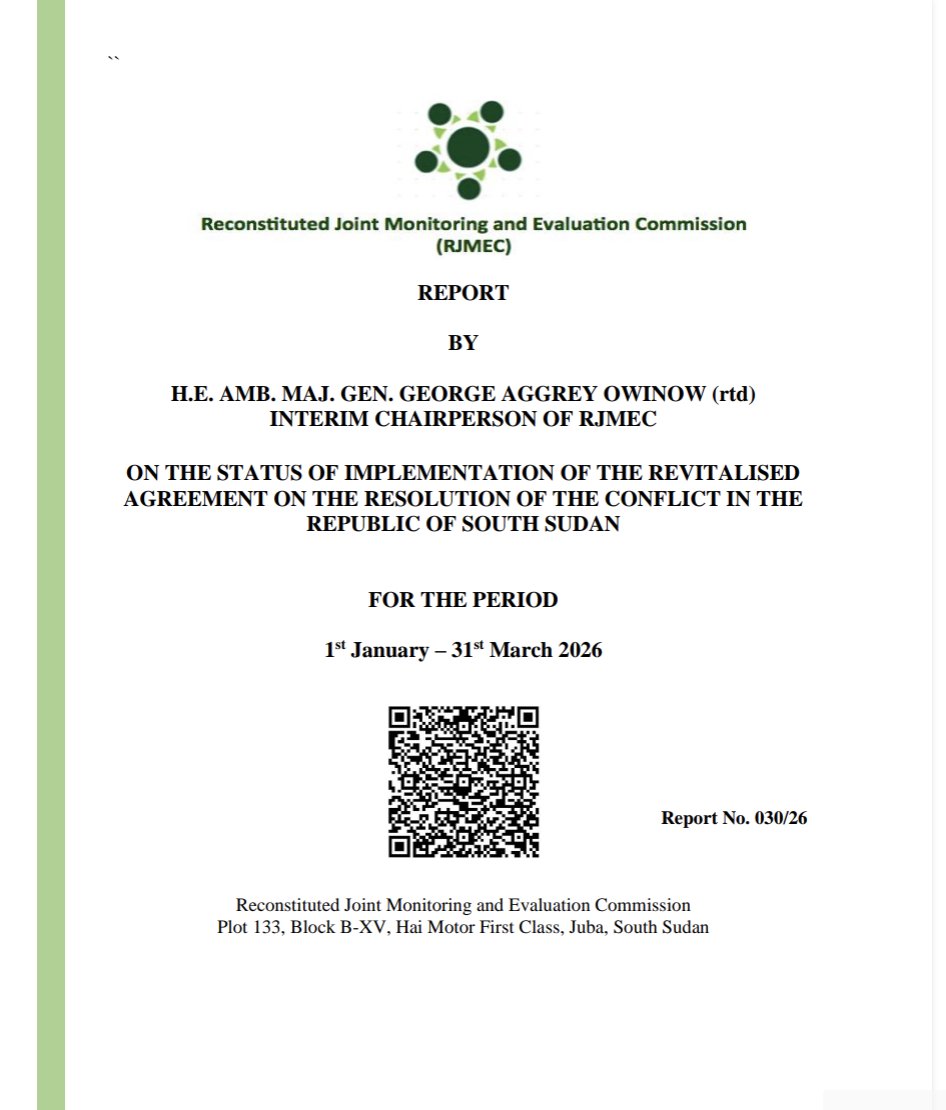
NEW: @RJMECsouthsudan today released its quarterly report on the status of implementation of the Revitalised Peace Agreement in South Sudan, covering the period between January 1–March 31, 2026.
Link: https://t.co/4GmKsy57kx
Scan: 👇
continued commitment to supporting the full implementation of the Revitalized Agreement, underscored the importance of sustained collaboration between the two institutions in advancing the legislative priorities necessary for the realization of the transitional roadmap.
Ahead of his briefing to the RTNLA, RJMEC Chairperson Amb. Maj. Gen. George Owinow paid a courtesy call on the Rt. Hon. Speaker, Joseph Ngere. During the meeting, Amb. Owinow briefed the Speaker on the key highlights of the quarterly report & reiterated RJMEC’s...1/2
@RJMECsouthsudan presents Quarterly Report to RTNLA, clarifies Amendment Procedures for the R-Agreement on the Resolution of the Conflict in South Sudan (ARCSS) and Transitional Constitution of the Republic of South Sudan (TCRSS), 2011 (as Amended)
In 1879, Ugandan healers were performing cesarean sections with a survival rate that stunned European doctors—while much of the "civilized" world still saw the procedure as a death sentence.
British explorer Robert Felkin documented the operation in detail. The surgeon used banana wine as an antiseptic, herbal anesthetics to manage pain, and cauterization with a hot iron to control bleeding. The mother survived. The baby survived. The technique worked.
This wasn't primitive luck. It was sophisticated medical knowledge passed down through generations—refined, systematic, life-saving.
Yet the dominant narrative tells us modern medicine arrived in Africa with colonizers and that before European intervention, the continent had no science, no innovation, no expertise.
But here's the contradiction: if African medical practices were so "backward," why were European observers documenting them with awe? Why were these techniques—rooted in empirical observation and botanical knowledge—producing outcomes that Europe itself struggled to achieve until the late 19th century?
The Buganda Kingdom had what the British Empire didn't: working cesarean sections that saved lives.
So what else were we doing that got erased, ignored, or rebranded as "discovered" by someone else?
Sources:
- Felkin, R. W. (1884). "Notes on Labour in Central Africa." Edinburgh Medical Journal
- Ajayi, J. F. (1965). Christian Missions in Nigeria 1841-1891. Northwestern University Press
Credit: African Echo
.... of the R-ARCSS as the only viable framework for achieving lasting peace, unity, & stability in the country. It called for an immediate ceasefire and cessation of hostilities, strict adherence to the Permanent Ceasefire, inclusive dialogue among all signatory....3/4
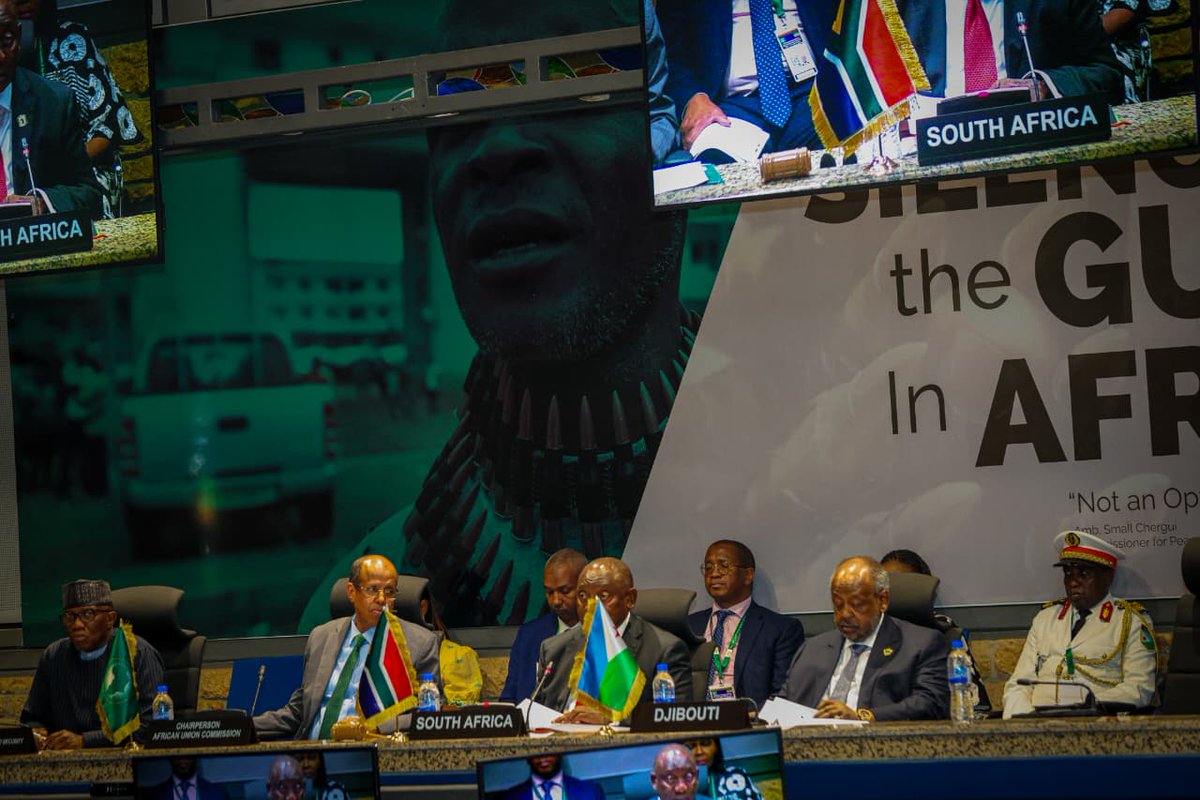
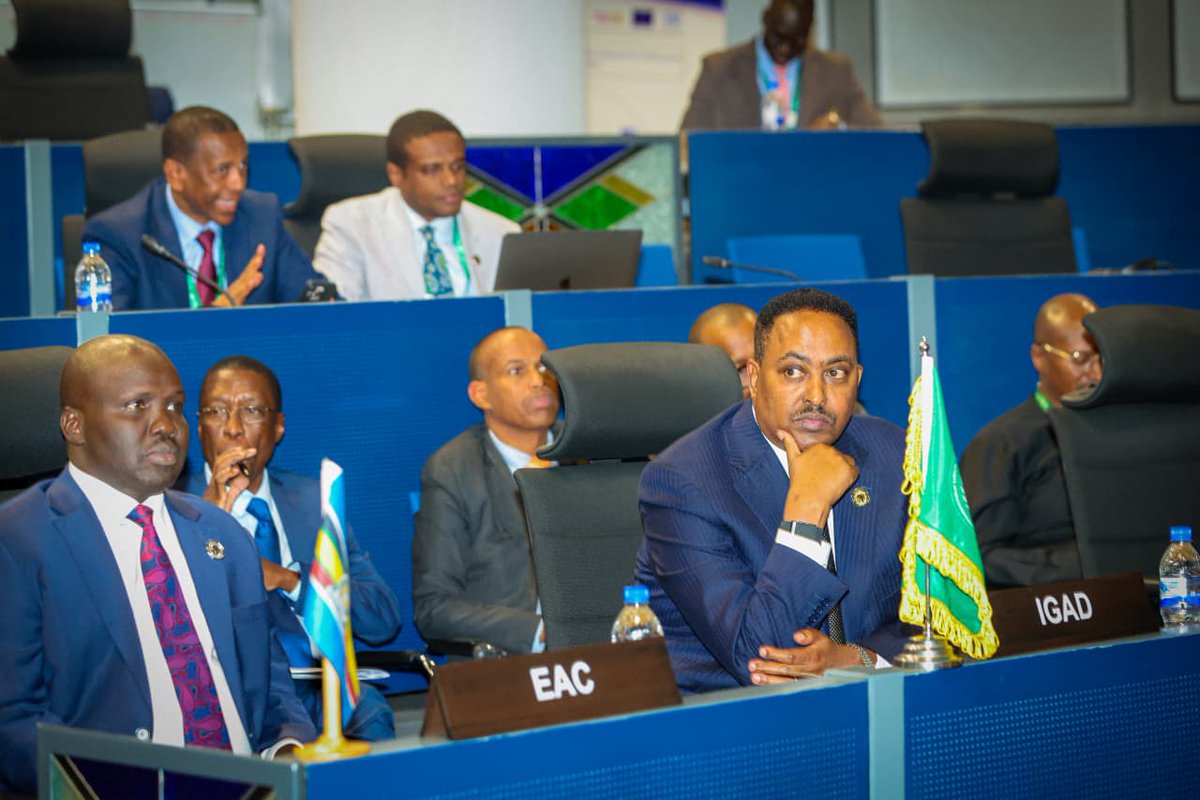
....deliberated on the prevailing situation in the Republic of South Sudan and the status of implementation of the Revitalised Agreement on the Resolution of the Conflict in the Republic of South Sudan (R-ARCSS). Among other outcomes, the Summit underscored the centrality....2/4
Yesterday, H.E. Amb. George Owinow, Interim Chairperson of RJMEC, attended the Summit of the AU High-Level Ad-Hoc Committee for South Sudan (C5) Plus IGAD Heads of State and Government convened on the sidelines of the 39th AU Summit in Addis Ababa. The meeting....1/4
During his address to the 1326th meeting of the Peace and Security Council of the @_AfricanUnion today, @RJMECsouthsudan Chairperson Amb. George Owinow said the political and security situation in the Republic of South Sudan has greatly continued to deteriorate, and the..1/2
2/2...implementation of the Agreement on the Resolution of the Conflict in South Sudan (ARCSS) severely undermined, adding that serious violations of the Peace Agreement continue unabated.
Full remarks: https://t.co/idnARiaobw
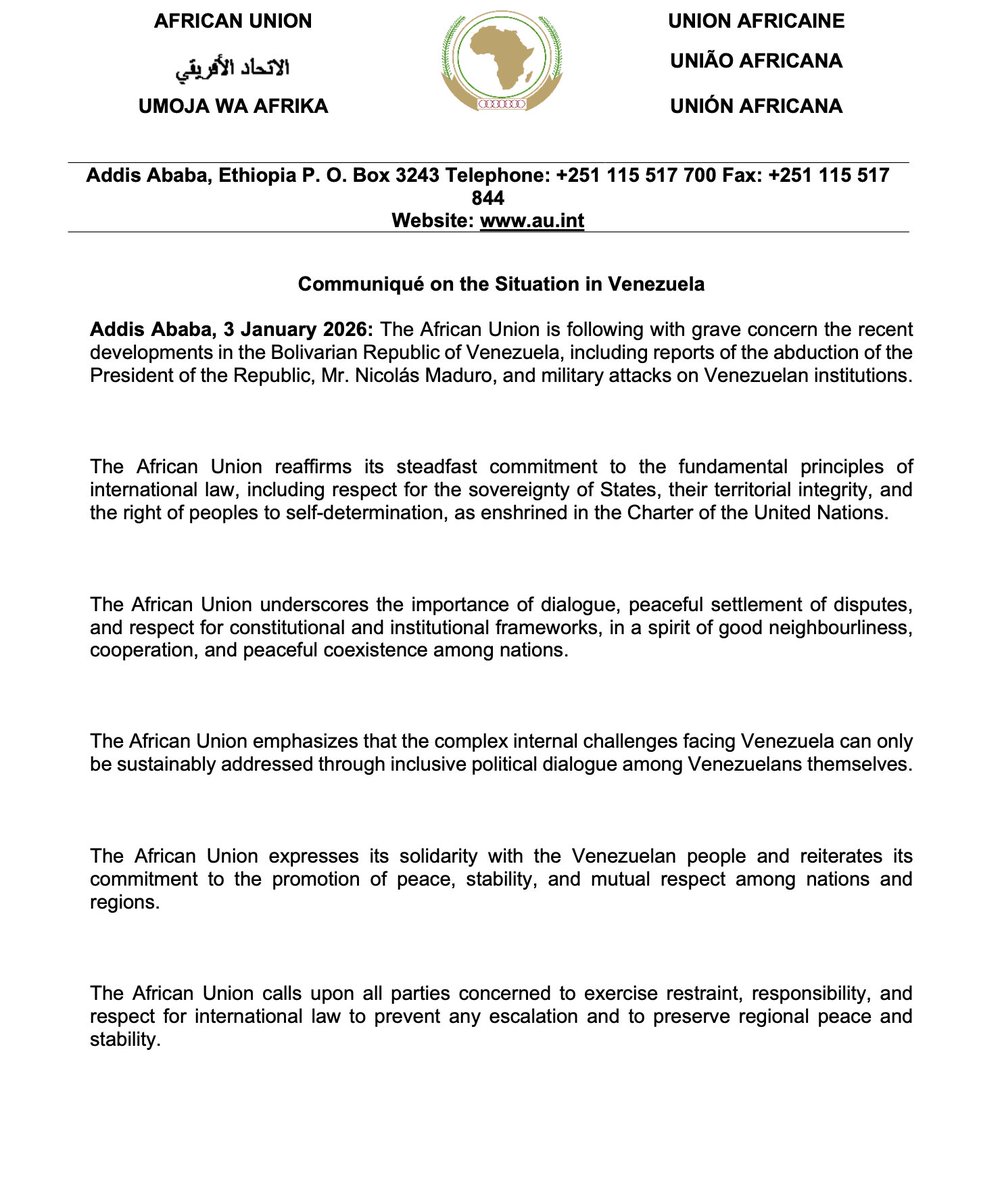
Communiqué on the Situation in #Venezuela.
The African Union is following with grave concern the recent developments in the Bolivarian Republic of Venezuela, including reports of the abduction of the President of the Republic, Mr. Nicolás Maduro, and military attacks on Venezuelan institutions.
The African Union reaffirms its steadfast commitment to the fundamental principles of international law, including respect for the sovereignty of States, their territorial integrity, and the right of peoples to self-determination, as enshrined in the Charter of the United Nations.
The African Union underscores the importance of dialogue, peaceful settlement of disputes, and respect for constitutional and institutional frameworks, in a spirit of good neighbourliness, cooperation, and peaceful coexistence among nations.
The African Union emphasizes that the complex internal challenges facing Venezuela can only be sustainably addressed through inclusive political dialogue among Venezuelans themselves.
The African Union expresses its solidarity with the Venezuelan people and reiterates its commitment to the promotion of peace, stability, and mutual respect among nations and regions.
The African Union calls upon all parties concerned to exercise restraint, responsibility, and respect for international law to prevent any escalation and to preserve regional peace and stability.
Read @ https://t.co/DW9aHzKyjx
....the Revitalised Peace Agreement and ensure that the political disagreements are resolved through dialogue and disputes addressed through agreed mechanisms of the R-ARCSS. 3/3
...taken to expedite progress, then holding elections as scheduled in December 2026 may be extremely difficult."
In his presentation, Amb. Berhanu further urged the Parties’ leaderships to desist from taking actions that further erode the political trust & confidence in....
2/3