A Nobel Prize-winning economist was seated in front of a television set from 1977 and was asked to argue for the idea that anyone should be allowed to own anything. Almost no one watches it.
Friedrich Hayek is appearing on Firing Line three years after winning the Nobel Prize to defend the idea of private property against a live panel.
There's no editing and no commercial break just four men in suits, one camera, and one hour of argument recorded on tape.
Look at the stage at which he goes from property to knowledge. The argument is not that owners are entitled to it, but that no one can have sufficient information without it.
People debate property online, and he did so on live television.
I am watching the dumbest internal fight on the right I have ever seen about JD Vance’s comments on the dollar being the world’s reserve currency…
For what it’s worth I think he is partially correct and partially wrong…
There is zero question that being BOTH the world’s reserve currency and a fiat currency has both advantages and disadvantages. The Triffin dilemma, inflationary monetary policy, etc are very real things.
I disagree with some of Vance’s reasoning focusing specifically on the manufacturing side, because I think it fails to see how American manufacturing also benefits from greater trade.
I am quite sure of these points…
You can’t print your way to prosperity and you can’t tariff your way to prosperity.
You also can’t centrally freaking plan your way to prosperity.
I would think we’d be able to have a decent conversation on these points.
But apparently even making them turns
me into a “neocon cuck” to one side and a “post liberal woke rightest” on the other…
Or…maybe Im not even close to being either of those things.
Maybe there is some nuance to the discussion and the right should be able to talk about it without immediately resorting to trashing each other on social media.
Obamacare was the government intervention on top of the government intervention making healthcare prices explode.
In 1942, a wartime wage freeze pushed companies to offer insurance instead of pay.
One of those “temporary” programs.
In 1943, the IRS made it tax free so coverage jumped from 9% to 63%.
Insurance companies (middlemen) were everywhere, price signals between patients and providers were dead.
In 1945, federal law effectively stopped health insurance from being sold across state lines.
No national competitive market.
35 states require a Certificate of Need to open a new hospital, so they end up with half as many per capita.
Supply cannot meet demand.
The mess the government created was an excuse for Obamacare.
Now the mess Obamacare created has become the excuse for government taking over the entire healthcare industry.
And it all starts with just a single government intervention in the free market.
The intellectual case against Marxism was won more than a century ago. The most rigorous and devastating blows came from the Austrian School of economics – but the strange part is that hardly anyone is taught the winning arguments.
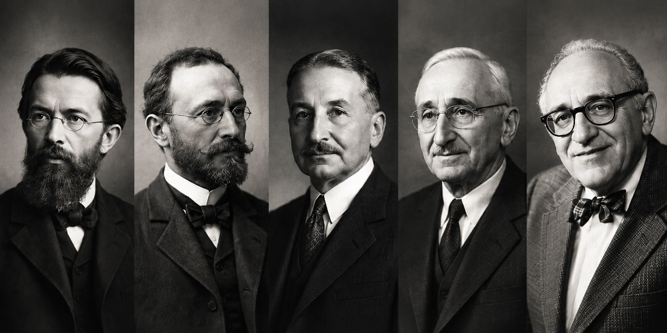
Carl Menger’s subjective theory of value, developed in the 1870s, undermined the labour theory of value on which Marx built his entire system. Eugen von Böhm-Bawerk then delivered a systematic demolition of Marx’s economics, exposing the contradictions in the theory of surplus value and the so-called transformation problem. Ludwig von Mises went further still, demonstrating that rational economic calculation is impossible under socialism because without private property and market prices there is no way to allocate resources efficiently. Friedrich Hayek later extended this into the knowledge problem: the information required to run a complex economy is dispersed and cannot be centralised. And Murray Rothbard showed how Marx misunderstood the nature of capitalism by replacing voluntary exchange and entrepreneurial creation with a false theory of exploitation based on labour value and class conflict.
These were not minor objections. They struck at the theoretical foundations of Marxism and, in the case of Mises and Hayek, correctly predicted the chronic waste, shortages, and eventual collapse of socialist economies. History confirmed their arguments on a civilisational scale.
Yet in universities, media and political debate, these critiques remain marginal. Marx is still widely taught as a serious economist and social theorist. His errors are softened, historicised, or treated as interesting starting points. The Austrian responses are rarely given equal weight. Students can pass through entire programmes in the social sciences without encountering Böhm-Bawerk’s critique or Mises’s calculation argument in any depth.
This neglect is not accidental. It reflects a deeper intellectual preference for theories that pathologise markets and legitimise expanded state power. The result is a public discourse that continues to recycle Marxist categories long after their economic foundations were shown to be unsound. The cost of that selective memory is still being paid.
INSTEAD OF WATCHING AN HOUR OF NETFLIX TONIGHT.
This 60-minute Cambridge lecture by Demis Hassabis will teach you more about the future of AI than most people will learn in the next 5 years.
Bookmark it and give it an hour, no matter what.
Those of us bitterly opposed to communism fall into two different groups.
A) Those who argue that it must be abandoned because it has show us that it doesn’t work.
B) Those of us that are so bitterly opposed to collectivism applied to dissenting individuals that we are relieved that it *cannot* work. A happy accident. Those who don’t care if it *could* be made to work: we’d continue to fight it. Working or not working is irrelevant. It’s just bad. Period. The end.
If Communism could actually be shown to deliver stable high levels of growth and innovation, broadly distributed, with low inequality,
I believe I would still fight it to my dying breath.
My opposition to communism has little to nothing to do with the fact that it doesn’t work as an economic system. So, it’s merely a relief that it doesn’t work. A convenience for its opposition.
Communism and collectivism are intrinsically soul killing for people who are hyper-individualistic . So let’s stop hiding behind the fact that they don’t work as economic or governance systems.
Some of us who aren’t the biggest fans of naked capitalism red of tooth and claw, hate communism not because we think capitalism is intrinsically fair. It isn’t. We oppose it because communism hunts the individual.
For us, It’s not communism vs capitalism. That is a businessman’s argument. Instead, it’s communism vs individualism for me. Show me a system that fights harder to let a dissenting individual thrive more than brutal market capitalism (which also barely works), and I am all ears.
Not everything is a market after all.
@ericweinstein Agreed. I believe in liberty, as "secured" in the Constitution... Communism (or any collectivism for that matter) requires me to give up my liberty... the two cannot co-exist....
Communism and the Herostratus Instinct – They Couldn’t Build It. So They Burned It.
In 356 BC, a man named Herostratus burned the Temple of Artemis at Ephesus — one of the Seven Wonders of the ancient world — because he could never build something that magnificent and needed the world to know his name. The Athenians made it a capital offense to speak it. We still know it. The first man to destroy a Wonder of the World. It is the same story as Cain and Abel.
1. Every civilization produces two types in permanent tension. Those who build – who create, who reach, who transmit excellence forward. And those consumed by the fact that others build better than they do. They cannot bear the height. Cannot match it. And eventually decide that if they cannot reach it, nobody should have it. The name for this is envy – the specific, corrosive pain caused not by your own suffering but by another’s excellence. Nietzsche called it ressentiment. Genesis called it Cain. Same wound, every century, different clothes.
2. The lie is the first weapon – not to win the argument but to poison it. Not merely strategic propaganda deployed to seize power, but deployed to corrupt, to stain, to contaminate. To make the great seem like thieves, the builder an exploiter, the cathedral oppression, the excellence privilege. The goal is not to defeat the excellent in open debate. It is to make admiring them shameful and transmitting them suspect – so the child who might have reached toward them never learns they existed. Zakłamanie aimed specifically at height (explained below). Not managing reality – poisoning the wells from which excellence drinks.
3. The targets are never accidental. Always the best – the cathedral, not the barn. The scholar, not the clerk. Colonel Ciepliński, not the collaborator who signed the confession. Excellence is the specific offense. Height is the specific wound. The destruction is always aimed upward – which is how you know it is envy and not justice.
4. Communism is the Herostratus instinct given a five-year plan, a secret police, and a philosophy that makes destruction sound like justice. The most organized mobilization of ressentiment in human history. It gave envy a manifesto, an army, and the moral high ground – the most dangerous combination ever assembled. Previous destroyers burned one temple. Communism burned the concept of the temple.
5. The pattern is unbroken across centuries. The French Revolution scattered the bones of French kings – not military necessity, ideological purification. Mao’s Red Guards burned libraries and killed scholars because five thousand years of Chinese excellence was an implicit rebuke to the revolution’s mediocrity. Today’s version cancels Shakespeare, pulls down Newton, erases Jefferson – not despite their greatness but because of it. Same wound. Same response. Updated vocabulary.
6. The lie does not stop at winning. It keeps working after victory – corrupting memory, rewriting history, staining reputations across generations. A civilization that cannot point to its greatest achievements and say — this is what we are capable of — is a civilization that has been successfully poisoned. The envy wins not when it tears down the statue. It wins when the children no longer know what the statue was.
7. You cannot build from envy. Which is why every revolution driven by it produces the same result: the heights are not replaced by new heights but by the flat, the administered, the carefully mediocre – the Idiocracy, the Last Man blinking. Not a failure of implementation. The intended output of the Herostratus instinct at civilizational scale. The Temple of Artemis was rebuilt twice before the destroyers finally won. Western civilization has been rebuilt before. The question is whether enough people understand what is being burned — and why — before the last stones are gone.
They sold the French Revolution as the triumph of liberty, reason, and the rights of man.
Then the Republic sent its infernal columns into the Vendée with orders to burn every village and slaughter every inhabitant.
Men, women, children, peasants who rose up in 1793 against conscription, against the murder of their king, and against the war on their Church.
In Nantes they tied families together and drowned them in the Loire by the thousands, calling it “vertical deportation.”
Up to 250,000 dead. 1/5 of an entire region exterminated.
Some still call this a noble struggle for progress, while others call it France’s first modern genocide.
Every bloody revolution follows the same script. It promises liberation, then builds its new order on mass graves. The moment dissent appears, the idealists reach for the firing squad and the drowning boat.
More than kill a king, The French Republic proved that when men seize power in the name of humanity, they become monsters who will butcher anyone who refuses their utopia. Only the flags change.
In the 1920s an imprisoned Italian journalist, disillusioned by the realisation that Karl Marx’s prediction of spontaneous worldwide socialist revolution was failing to come true, began working on a new revolutionary strategy that would profoundly shape the modern left.
In his Prison Diaries, Antonio Gramsci argued that capitalist societies were held together not primarily by economic power or state coercion, but by cultural hegemony - the dominance of bourgeois values, culture and institutions (education, media, family, religion and civil society). As long as the working class accepted these values as “common sense”, revolution was impossible.
His solution was revolutionary: the left must wage a “war of position” - a long, patient struggle to capture the institutions that shape culture and ideas. Only after achieving cultural dominance could they seize political and economic power.
This was a major departure from classical Marxism. Instead of focusing on factories and economic base, Gramsci shifted the battlefield to culture and consciousness. He understood that whoever controls the “superstructure” (culture) can eventually control the base (economy and politics).
Gramsci’s ideas became foundational to what later became known as Cultural Marxism. The Frankfurt School and the New Left built upon them, moving the struggle from class warfare to cultural warfare - attacking Western traditions, morality, family structures, and national identity.
Today’s identity politics, “the long march through the institutions”, critical studies in universities and the weaponisation of culture all trace their intellectual lineage back to Gramsci’s insight. He understood that real power lies in defining what society considers normal, moral and true. It has been a guiding principle for the left ever since.
@MiltonFriedmanW Uncle Miltey I have been saying this forever as it explains marijuana as a gateway drug. When it is legal the temptations of breaking the law to have other drugs is much less because they are illegal. If you break the law once it makes it easy to justify again.
We think of this evil as Marxism. In reality, Marxism is nothing more or less than the current instantiation of a much more ancient evil: possession by the envious and hateful spirit that drove Cain to murder his brother Abel.
The great book of Genesis thus portrays mankind as riven by an eternal fratricidal conflict.
Those who reject genuine sacrifice become embittered by their subsequent failure ("rejection by God").
Instead of repenting and changing, they turn to revenge.
And who do they target? Those who strive to do well and offer what is best.
I can't believe how much wisdom the author of Genesis 4 compressed into that story's few sentences. You might even come to believe that God Himself had a hand in it.
Truly: it's uncanny. The first two human beings born into history are, respectively, a good, honest productive man and his brother, who allows himself to be consumed by resentment and the desire to destroy.
Communism, in a nutshell.
I still can't get over how good this is. Conservatives have always stuck with the "It doesn't work" argument against Leftism while pointing to their charts and graphs, hoping people will follow along.
But THIS is the argument to make. 👇Leftism is ugly. It's repulsive. It's disgusting. It's lame. It's immoral. It's boring. It's depressing.
This isn't a fight between two competing economic models, one of which happens to work better. This is a fight between beauty and ugliness. Building and destruction. Thankfulness and resentment. Love and hate. Greatness and cowardice. Good and evil.
One of the most pertinent sentences ever written about economics and politics is this, from Friedrich Hayek:
“The curious task of economics is to demonstrate to men how little they really know about what they imagine they can design.”
Hayek was not arguing against reason or planning in general. He was exposing the dangerous pretence of knowledge: the arrogant belief that experts and governments possess enough information to deliberately design and control complex social and economic systems.
Modern economies are the result of millions of individuals making decisions based on their own unique, local and constantly changing knowledge. Prices, traditions and social norms emerge as a spontaneous order that no central authority can replicate. When governments try to impose top-down designs - whether through industrial policy, price controls, wealth redistribution or social engineering - they inevitably fail because they lack the dispersed knowledge that only free individuals possess.
This insight explains why central planning has repeatedly produced poverty and authoritarianism, while free societies have generated unprecedented prosperity. The planner’s fatal error is believing that society is like a machine that can be engineered, when in reality it is a complex, evolving order far beyond any single mind’s comprehension.
Hayek’s message remains urgent today: humility is not just a virtue – it is an economic necessity. The more policymakers claim they can design the future, the more dangerous they become. It is the role of economics, properly understood, to expose them.
Aristotle’s insight about the middle class is not sentimental. It is structural. The middle class is the only group whose prosperity is directly tied to the prosperity of the whole, which makes it the only group with genuinely aligned incentives.
The poor are dependent. Not by moral failing but by position – their survival depends on transfers, on the state, on someone above them making decisions on their behalf. They vote for whoever promises more, which is rational given their situation. They cannot be the foundation of a republic because their interest is not in the republic’s success but in their own extraction from it.
The oligarchy is captured. Their wealth is large enough to seek advantages unavailable to others – regulatory protection, subsidies, privileged access, barriers to competition. They do not need the market to work fairly. They need it to work in their favor, which is a different thing entirely. The oligarch’s rational strategy is not to improve the system but to carve himself an exception within it.
The middle class has nowhere to hide. Too prosperous to depend on transfers, too broad and exposed to need special favors, their entire position rests on a society where contracts are enforced, courts function, markets are fair, schools work, streets are safe, and the currency holds its value. They cannot buy their way out of dysfunction the way the oligarchy can, and they have too much to lose to wait for redistribution the way the poor must. They need the whole thing to work – which makes them, structurally, the only class that wants it to.
This is why destroying the middle class is not just an economic event. It is a political event. When it shrinks, the ballast disappears and the ship tips – toward oligarchy above demanding favors, or toward dependency below demanding transfers, or toward both simultaneously, which is precisely where most Western democracies currently find themselves.
Wealth tax explained:
1. Laura loves to cook, she risks all her life savings and opens a small restaurant: Laura‘s Kitchen
2. Laura works really hard, evenings, weekends, no vacations
3. The local community loves Laura‘s Kitchen, it’s a success, the restaurant gets larger, Laura hires 30 people from the neighborhood
4. Laura makes 1,5 Million € in profit, she pays 40% in income tax: 600,000€
5. The left „tax the rich“ party wins the elections, and introduces a wealth tax
6. Laura‘s Kitchen gets valued by the tax authorities at 25 Million €. Laura must pay 5% wealth tax: 1,25 Million €
7. The income tax of 600,000€ plus 1,25 Million € in wealth tax is more than the 1,5 Million € Laura makes
8. Laura cannot afford to pay more taxes than she makes, she closes Laura’s Kitchen
9. Laura loses her life savings despite years of hard work, 30 people lose their jobs, the state receives zero taxes
10. The local community goes to McDonalds again
11. The local left “tax the rich“ party members blame „capitalism“ for that on social media
12. Everyone gets poorer due to higher unemployment and lower tax revenues
Why is this so difficult for the left to understand?
Rothbard wrote "What Has Government Done to Our Money?" in 1963, and in roughly 100 pages he explained the entire monetary con better than a thousand PhD dissertations ever will. You've been taught that money is a mystery best left to Jerome Powell and his committee of twelve. Money is a commodity, chosen by traders on the market. Everything the state does to it is theft dressed up in equations.
Let's start where he starts. Barter fails because you want eggs and the guy with eggs wants shoes, not your fish. So the market gropes toward a commodity everyone accepts, and over centuries it lands on gold and silver. Nobody decreed it. No Federal Reserve Act of 1913 blessed it. Miners in Nevada and merchants in Genoa converged on the same metals because they held value across time and space. That's the money the government inherited. Then it went to work.
Here's the sequence Rothbard lays bare, and once you see it you can't unsee it. The state monopolizes the mint. It renames the units so an ounce becomes a "dollar," severing the word from the weight. It stacks paper claims on top of the metal, then prints more claims than metal exists. Fractional reserve banking, blessed by a central bank that stands ready to bail out the fraud. Finally it cuts the cord entirely, as Nixon did in August 1971, and now the paper floats free. Redeemable in nothing. Backed by tax collectors and prisons.
Inflation, Rothbard insists, is counterfeiting. When the Fed creates new money, the first recipients (banks, government contractors, bondholders) spend it at old prices. You get it last, after prices have already climbed. That gap is the transfer. A quiet tax nobody voted for, flowing from wage earners to the politically connected.
The genius isn't complexity. No cleaner dissection exists. Rothbard took a machine built to look impenetrable and showed you every gear.
Keynesian stimulus has never worked, and never will, and the record proves it. Every. Single. Time.
Start with the New Deal. Roosevelt tripled federal spending between 1933 and 1940, and unemployment still sat at 14.6 percent in 1940. Seven years of pump-priming bought a decade the economists call the Great Depression.
Japan tried the same trick. Through the 1990s Tokyo ran ten separate stimulus packages, poured trillions of yen into bridges and roads to nowhere, and drove public debt above 130 percent of GDP by 2000. The reward was the Lost Decade, then a second one.
Then came 2009. Obama and his advisers promised the $831 billion stimulus would hold unemployment under 8 percent. It hit 10 percent in October 2009. They spent the money anyway on shovel-ready projects that the president himself later admitted were not shovel-ready.
You see the pattern? Politicians take resources out of the productive economy through taxes and borrowing, hand them to whoever has the best lobbyists, and call the shuffle "growth."
They count the spending. They never count what the money would have built if the private sector had kept it.
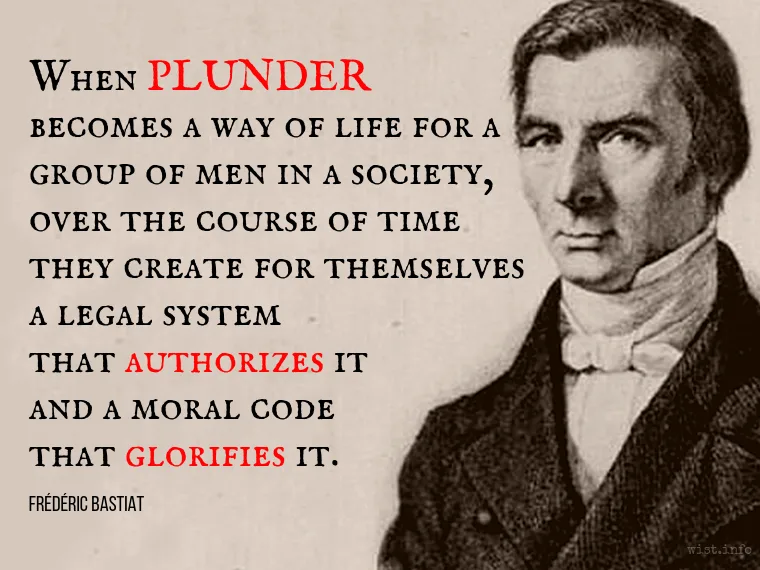
Frédéric Bastiat explained this in 1850 with the broken window. The stimulus crowd still hasn't read him.
The government cannot spend you into prosperity. It can only move wealth around and skim off the top.