The result can look like:
A meeting
A committee
A conference table
when in reality they’re simply attracted to the same resource.
⸻
🍞 3. Feeding Response
If anyone regularly feeds them:
Bread
Fish food
Pellets
they may cluster together anticipating food.
The circular arrangement can happen when they all orient toward the center where they expect something to appear.
⸻
❤️ 4. Mating Activity (Possible but Less Likely Here)
Male turtles will:
Follow females
Circle them
Nudge shells
Swim around them
@naturelife_ok Turtles sometimes congregate where conditions are most favorable—warmer water, better oxygen levels, sunlight, or food availability. The result can create surprisingly organized-looking patterns like this.
Nature is full of hidden explanations. 🐢
☀️ 1. Basking / Warm-Water Gathering (Most Likely)
Turtles often gather where:
The water is warmest
Sunlight is strongest
Food is present
Water circulation creates a comfortable spot
If there is a spring, aerator, underwater discharge, or warmer shallow area, turtles will naturally congregate there.
⸻
🐢 2. Social Curiosity
Many pond turtles are surprisingly tolerant of each other.
When one turtle finds:
Food
Warm water
A good resting spot
Others often join.
The Google May 2026 core update hits big time yesterday, Saturday, May 30th - this is turning out to be a big Google algorithm update https://t.co/PpyIUxOoGK
The click is only the beginning.
Google Ads
The real question is:
📞 Did they call?
💬 Did they text?
📝 Did they fill out a form?
📅 Did they book?
Better conversion tracking = better Google Ads optimization.
CallRail + Google Ads + Attribution = smarter growth.
#GoogleAds #CallRail #PPC #LeadGeneration
Talked to a custom pool builder last week doing $6.8M in revenue.
He's spending $48k a month on Google Ads.
Here's the thing: he has no idea what his cost per signed contract is.
He knows his cost per click. He knows roughly what his ad agency reports as "leads." He doesn't know:
> What percent of those leads actually answer the phone when his sales team calls back
> What percent of those that answer book an in-home design consultation
> What percent of those consultations turn into signed contracts
> What his actual revenue per ad dollar is
I asked him how much he thought it cost to land one signed pool project from Google Ads. He guessed $1,200.
We ran the numbers in 20 minutes. It was $4,800.
He's not losing money. His average project value is $95k so he's still wildly profitable. But he was scaling spend assuming his CAC was 4x lower than reality. If he 2x'd his ad budget tomorrow on the same conversion rates, his margin would get crushed.
The fix is boring. Set up call tracking with unique numbers per channel. Tag every lead source in the CRM. Have the sales team confirm where each consultation came from at the start of the call. Review the numbers monthly.
Three weeks of cleanup work and now he knows exactly which channels are paying him back, which ones to kill, and which ones to 3x.
This is one of the first things we sort out in month 1 with any new client. You can't optimize what you can't see, and most home service operators above $3M are running marketing with half the dashboard turned off.
Sitting outside on Long Island today in late May wearing sweatpants, drinking coffee, watching birds… and it feels emotionally closer to October than May.
Not because of the date — because of the air.
Cool sun, damp breeze, quiet atmosphere, 57°.
Makes me think humans experience seasons relationally, not by calendar date. The body remembers “seasonal echoes” more than numbers
🚨 For MANY local service businesses, “Automated Locations” in Google Ads should often be OFF in 2026.
Why?
Because Google can automatically pull in:
• random Google Business Profiles
• YouTube channels
• maps assets
• affiliate/location signals
• unwanted extensions
• broad geographic relevance
…that may NOT align with your actual targeting strategy.
For local service businesses focused on:
📞 phone calls
📩 form leads
📍 precise service areas
💰 lead quality over traffic
…this can create messy attribution and weaker lead intent.
In May 2026, Google’s AI systems are aggressively blending:
• Maps
• GBP
• sponsored placements
• AI local recommendations
• and automated assets
That means LOCAL CONTROL matters more than ever.
Many experienced Google Ads managers now prefer:
✅ manual Location Assets
✅ tightly controlled radius targeting
✅ clean GBP connections
✅ controlled asset associations
✅ cleaner CallRail attribution
✅ tighter campaign relevance
Instead of letting Google auto-connect everything in the ecosystem.
Automation is helpful…
…but too much automation can dilute local intent and muddy reporting.
Especially for:
• contractors
• mobile IV companies
• cleanup companies
• pest control
• attorneys
• med spas
• plumbers
• local service brands
Always review what Google is automatically enabling in your account in 2026.
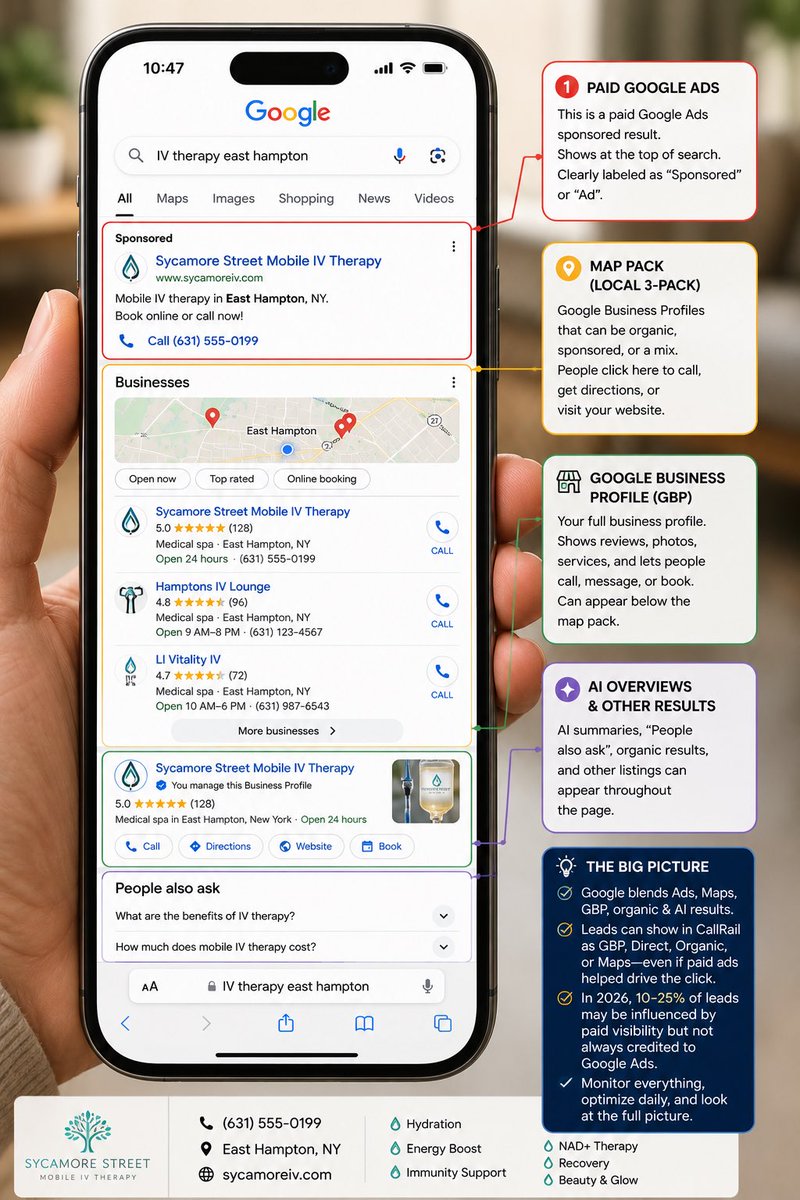
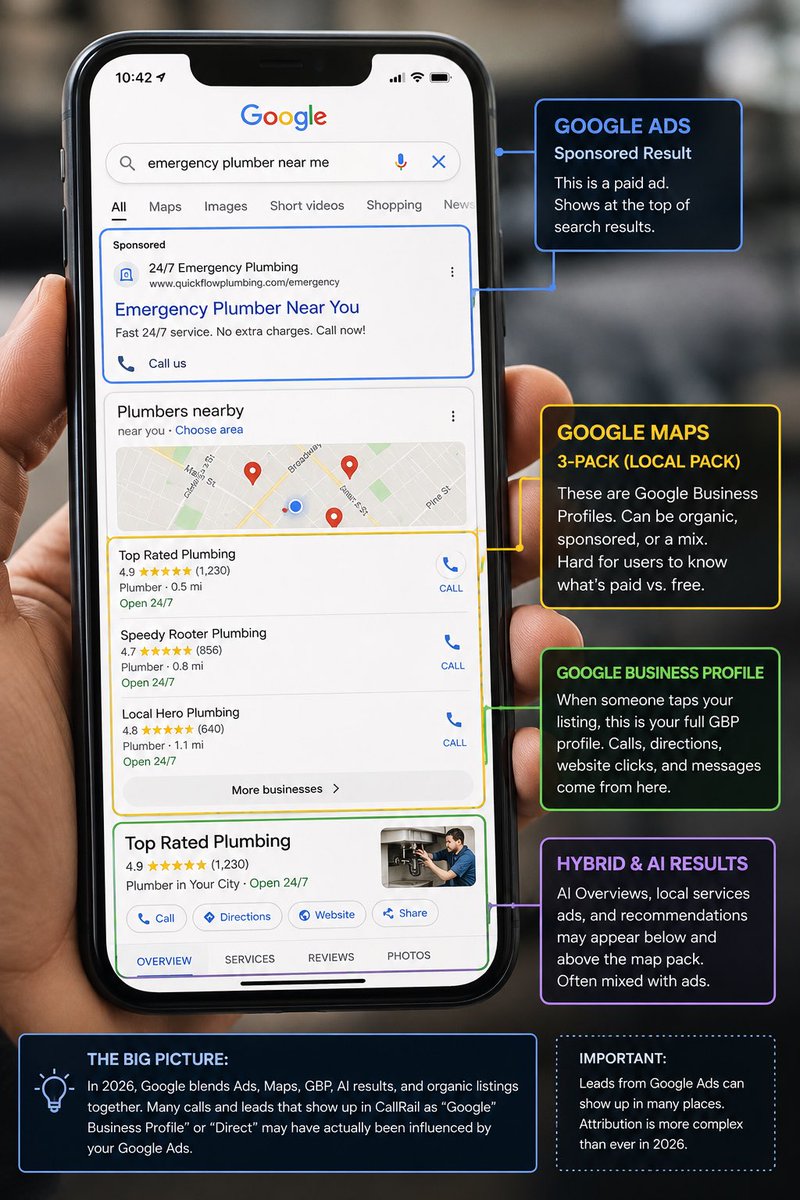
Google search in 2026 is becoming one giant blended ecosystem of:
📍 Google Maps
📱 Google Business Profile
🤖 AI Search
💰 Sponsored Google Ads
📞 Click-to-Call
🚗 Voice Search
🗺️ Hybrid Local Placements
And most customers can’t tell what’s paid vs organic anymore.
That’s creating BIG changes in:
• lead attribution
• CallRail reporting
• Maps visibility
• branded search
• and how businesses should evaluate Google Ads ROI.
I broke down everything I’m seeing halfway through 2026 — including visual examples showing how these hybrid search layouts actually appear on phones, desktop, Maps & AI search.
If you run local Google Ads, this is worth reading.
👇
https://t.co/Et6HZetctV
Google search in 2026 is no longer just:
➡️ Sponsored Ad
➡️ Organic Result
➡️ Maps Listing
It’s now a blended ecosystem of:
• Google Ads
• Google Business Profile (GBP)
• Google Maps
• AI Overviews
• Voice Search
• Local Sponsored Placements
• Click-to-Call Actions
• Branded Search
Most customers can’t tell what’s paid, organic, Maps, or AI-generated anymore.
And honestly… that’s the point.
What many businesses DON’T realize:
A lead that shows up in CallRail as:
• Google Business Profile
• Direct
• Maps
• Organic
…may still have been heavily influenced by your Google Ads budget and visibility.
In 2026, Google Ads affects MUCH more than just the “Ad” at the top of search.
If your campaigns stop, many times:
📉 Maps activity drops
📉 branded searches decline
📉 GBP engagement slows
📉 hybrid visibility decreases
The search landscape is changing monthly with AI integrations, mobile-first layouts, voice search, and blended local placements.
The businesses that win will be the ones paying attention to:
✅ visibility
✅ mobile experience
✅ maps presence
✅ GBP optimization
✅ ad copy
✅ tracking
✅ landing pages
✅ and how they actually LOOK in search today — not 2 years ago.
The attached visuals explain this much better than words alone. If you market locally, they’re worth looking at.
#GoogleAds #SEO #LocalSEO #GoogleBusinessProfile #GoogleMaps #PPC #CallRail #DigitalMarketing #LeadGeneration #AISEO #GoogleMyBusiness
Jeff Bezos reveals why he refuses to make a single important decision before 10am:
"I like to putter in the morning. I like to read the newspaper. I like to have coffee. I like to have breakfast with my kids before they go to school. My puttering time is very important to me. That's why I set my first meeting at 10 o'clock"
"I like to do my high IQ meetings before lunch. Anything that's going to be really mentally challenging, that's a 10 o'clock meeting. Because by 5pm, I'm like, I can't think about that today. Let's try this again tomorrow at 10am"
"As a senior executive, what do you really get paid to do? You get paid to make a small number of high quality decisions. If I make three good decisions a day, that's enough. Warren Buffett says he's good if he makes three good decisions a year"
There’s a generation a lot of people forget exists. We were born at the tail end of the Boomers, but we are not culturally the same as people born in the 40s and early 50s. We are Generation Jones.
And honestly, it explains a lot.
We grew up in a world that still felt fundamentally analog, but we were young enough to be dragged headfirst into the digital revolution. We are the bridge generation between rotary phones and smartphones, between slide rules and AI, between Walter Cronkite and algorithm driven media.
We remember when there were only a few television channels and the entire country watched the same thing at the same time. We also adapted to the internet, email, forums, social media, streaming and now artificial intelligence. We lived before and after the technological singularity hit everyday life.
That is not a small thing.
People born in the 40s came of age in a post World War II America that was still industrial, deeply hierarchical and institutionally stable. Their formative years were shaped by the Cold War, Vietnam, the civil rights era and a society where information moved slowly.
Generation Jones came later. We inherited the aftermath of all of that.
We were the kids who watched Watergate destroy blind trust in government. We watched manufacturing begin to collapse. We saw divorce rates explode. We were the first truly latchkey generation in massive numbers. We learned independence early because many of us had to.
We grew up with one foot in old America and one foot in whatever this new thing was becoming.
We played outside until the streetlights came on but we also learned DOS commands. We learned cursive and keyboarding. We had card catalogs and Google searches. We went from vinyl records to cassette tapes to CDs to MP3s to streaming in one lifetime.
We remember maps. We remember memorizing phone numbers. We remember life before GPS and before every human interaction became filtered through a screen.
And because of that, I think Generation Jones developed a very unique perspective. We are adaptable because we had no choice but to adapt. We learned technology as adults instead of being born into it. We remember a slower world but were forced to survive in a rapidly accelerating one.
That creates a very different mindset than either older Boomers or younger Gen X and Millennials.
A lot of us also reject the caricature people now associate with “Boomers.” We were not buying houses for the cost of a sandwich in 1965. The interest rate on my first house was over 14% and that was after buying down a point. Many of us got hit by recessions, outsourcing, pension collapses and economic instability just like younger generations did. We watched promises evaporate in real time.
We understand older generations because we were raised by them. We understand younger generations because we had to evolve alongside them.
That’s why the Jones generation often feels culturally homeless. We are rarely discussed, rarely defined and usually lumped into categories that don’t actually fit us.
But we exist.
We are the human transition point between the industrial age and the digital age.
And frankly, there will probably never be another generation quite like us again.
At Joe May Marketing, I’m seeing strong results by combining:
•high-intent Google Ads Search campaigns
•Maximize Conversions bidding
•clean CallRail + GTM + GA4 integrations
•first-time lead tracking
•strong negative keyword filtering
•AI-aware campaign structure
The goal isn’t just traffic anymore.
It’s: 📞 phone calls 📝 form submissions 💬 text leads 📍 real booked jobs
And in 2026, AI systems increasingly reward businesses that consistently demonstrate expertise and trust — both organically and through paid search behavior.
🛟📍 Pool companies running Google Ads in 2026 should NOT ignore Google Business Profile integrations.
When your Google Ads + Google Business Profile are properly connected, your ads, maps visibility, local trust signals, phone calls, and directions all start working together instead of separately. 🌊📈📞
It’s one of the easiest upgrades a local service business can make for stronger local lead flow and better reporting. ✅