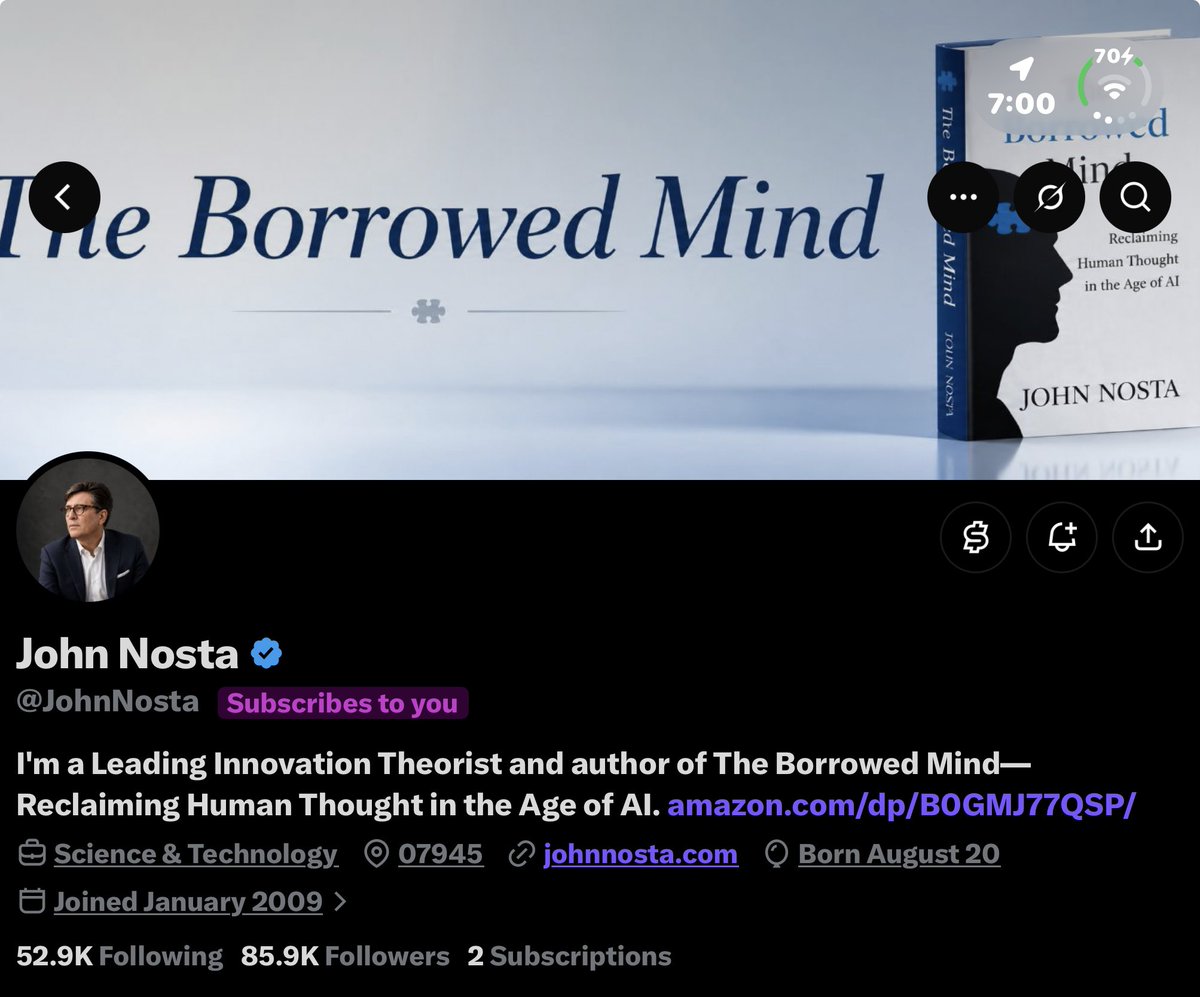
Pondering disruption, tech & otherwise, with optimism & skepticism. Contributor: Forbes, Harvard Bus Rvw, ZDNet, InfoToday. NY AI Summit.
Temple U.; Army brat.
I know a lot of you out there aren’t always the biggest fans of public speaking. In fact, it’s probably the number one fear for many people. The fear of public speaking is the most common phobia ahead of death, spiders, or heights, and the National Institute of Mental Health reports that public speaking anxiety, or glossophobia, affects a huge chunk of the population.
Whether it’s a keynote or a short presentation, it takes a lot of nerve to get up in front of an audience. I think the problem is that a lot of you are overthinking it.
Here’s some of what I’ve learned about public speaking, after giving thousands of talks, public interviews, and keynote addresses while getting paid millions of dollars annually to speak in front of people:
This is a good way to look at it. Powerful AI models will make all kinds of new businesses sustainable and productive. People will have many new avenues to create ventures.
quick observations from the claude fable and mythos 5.2 launch:
1/ it went from doing 21% of real freelance work to 41% in one release, so agencies are about to start charging per deliverable instead of per hour!
2/ it can work 10-12 hours on its own, which basically gives every small business a night shift (might as well use it if you know what you want to build)
3/ over 90% of anthropic's own code is now written by claude, and so i think the solo $1b founder is coming soon
4/ one engineer ran 1000+ subagents for 8 days and got an operating system that boots, so the ancient software running hospitals and airlines is finally rebuildable (lots of opportunity here on rebuilding)
5/ it designed 3 working electronic devices from a single prompt, which makes 1 person hardware companies a real thing
6/ it now says "i don't know" instead of guessing, and that's what law, medicine and finance have been waiting for (this has been the biggest thorn for these industries, hard to trust guessing)
7/ 1000 agents formalized fermat's last theorem in 30 hours, so software that's mathematically proven not to break is coming for payments and medical devices
8/ mythos is only for verified orgs, which means someone is going to build a business selling what only they have access to
9/ the models are getting better at noticing when they're being tested, so testing ai out in the real world is about to become its own industry
i love new model day
There will be a resurgence in live events. A revaluation of authentic human experiences in an increasingly AI-mediated world.
In-person experiences haven't suddenly become valuable. What's changing is our awareness of their value.
With good humans!
I don't believe in the R word. Retiring.
I'm 69 and building an AI startup, because making things is what keeps me curious.
The old plan was work, stop, rest. What would you build if stopping wasn't the goal?
‘Relationslipping’: Interesting term coined in recent @HarvardBiz article.
AI is threatening the fabric of teamwork, studies show. Here are 6 ways to reverse that trend.
(My latest in @Forbes)
https://t.co/OeQMTqhU7n
My dear friend John Nosta has passed away.
This is a hard one on me. He was such a dear friend.
His was such a brilliant mind and such a polymath. John Nosta entered university work at sixteen. He enrolled in an advanced summer program at Harvard University. His father, an electrical engineer in Perth Amboy, New Jersey, had wanted a doctor for a son.
The summer tested that path.
I have known John long enough to recognize the pattern that began there. He measured first. Around those years he served as president of the Perth Amboy First Aid Squad and trained as a paramedic.
The work put him in acute care, among Spanish-speaking neighbors, reading the immediate mechanics of heart and survival.
At Boston University he designed his own concentration in biophysics. He left for a year as a research associate at Harvard Medical School. There he joined groups studying cell volume regulation in ventricular myocardium, acute myocardial infarction, ventricular arrhythmias, and sudden cardiac death. Mentors included Thomas Smith, then chief of cardiology at the Peter Bent Brigham Hospital.
The papers appeared while he was still an undergraduate: one in the American Journal of Physiology in 1981 on hydrostatic forces limiting swelling of rat ventricular tissue, others in Circulation and the American Journal of Cardiology the same year and the next.
Smith advised an MD/PhD. John considered it and declined. He has said he went to college to study physiology but found his interests expanding into creativity, art, and philosophy, and that the conversations at Harvard ranged beyond the medical details into geopolitics, love, and art. He finished the degree at Boston University in 1981 and left the laboratory. His parents were not pleased.
He moved toward writing and the translation of science into other forms.
That sequence set the measure I later saw in our conversations. John held the clinical questions of volume, ischemia, and failure as a fixed reference while he examined later technologies.
He wrote more than a thousand pieces on technology, medicine, and the mind. When he published The Borrowed Mind, I recognized the same generous, fearless intellect that had appeared in our talks over the years: the insistence that human thought remains the author’s own even when the tools become fluent.
He called listening to certain technical accounts exponential learning. I called him a national treasure genius. Both judgments rest on the same early evidence: the summer at sixteen, the year of peer-reviewed work before the degree, and the decision to keep the questions open rather than close them inside a single profession. The public record continues from that point.
God rest your soul John.
John Nosta died following an aortic aneurysm.
Prayers to his amazing Amy, and children Katie, Annabel, Jack, and his greater family.
The Intellectual Dust Bowl
📌 AI may boost intellectual output while eroding independent thought.
📌 Individual cognitive surrender may become a collective vulnerability.
📌 An intellectual wasteland could be filled with brilliant answers.
https://t.co/rdSCIHgt8g #AI
Do not use your energy to worry. Use your energy to believe, to create, to learn, to think and to grow.
Study hard what interests you the most in the most undisciplined, irreverent and original manner possible.
—Professor Richard Feynman
Google shoved AI summaries down everyone’s throats, only to realize people were clicking fewer website links because AI was giving them the answers. Now it’s costing them billions in lost ad revenue. Incredible that anyone with half a brain couldn’t have seen this coming.
Meta’s Hiring Shift Isn’t a Comeback. It’s a Warning Sign for Every Tech Workforce.
The question is not whether Meta is hiring engineers again. It is. The better question is what kind of engineers Meta wants now.
What we are seeing is not a broad return to the old software engineering workforce model. It looks much more like a workforce refactoring exercise, where traditional engineering capacity is being reduced, reorganized, and redirected toward AI-native roles, infrastructure, applied AI, model tooling, and automation-heavy product development.
That distinction matters.
For years, enterprises treated engineering headcount as the primary path to scale. More platforms, more products, more cloud migration, more developers. But AI is changing the economics of that assumption. Companies are no longer asking, “How many engineers do we need?” They are asking, “Which engineers can multiply output through AI, automation, and better architecture?”
Meta is simply an early, highly visible example of a larger pattern. Layoffs and hiring can happen at the same time when the company is cutting one operating model and investing in another.
Reuters covered some of this shift here: https://t.co/QRqRa0fPWT
For enterprise leaders, the lesson is uncomfortable but clear. AI strategy is not just a tooling decision. It is an operating model decision. If your architecture, data platforms, governance, and engineering culture are not ready for AI-assisted delivery, then simply hiring more people will not fix the problem.
The future engineering workforce will not be smaller everywhere, but it will be different. The winners will be those who understand systems, automation, data, cloud economics, and AI as one integrated discipline.
Meta is not “hiring back” engineering in the old sense.
It is hiring for the next version of engineering.
The Case For Optimism As AI Transforms Our Economy
The current AI panic 'weirdly resembles the anxiety' that accompanied early capitalism. 'We’ve never once looked back and wished we could return. Why would this time be different?'
(My latest in @forbes )
https://t.co/vVAAWnr1Au
On AI & writing:
"Writing is partly a purely mechanical skill. What really counts is the idea, the original view and what the author has to tell us. A good, unconventional idea and original thinking will break through the layer of form."
-Jakub Ćwirlej
https://t.co/vlxYrYVDSw