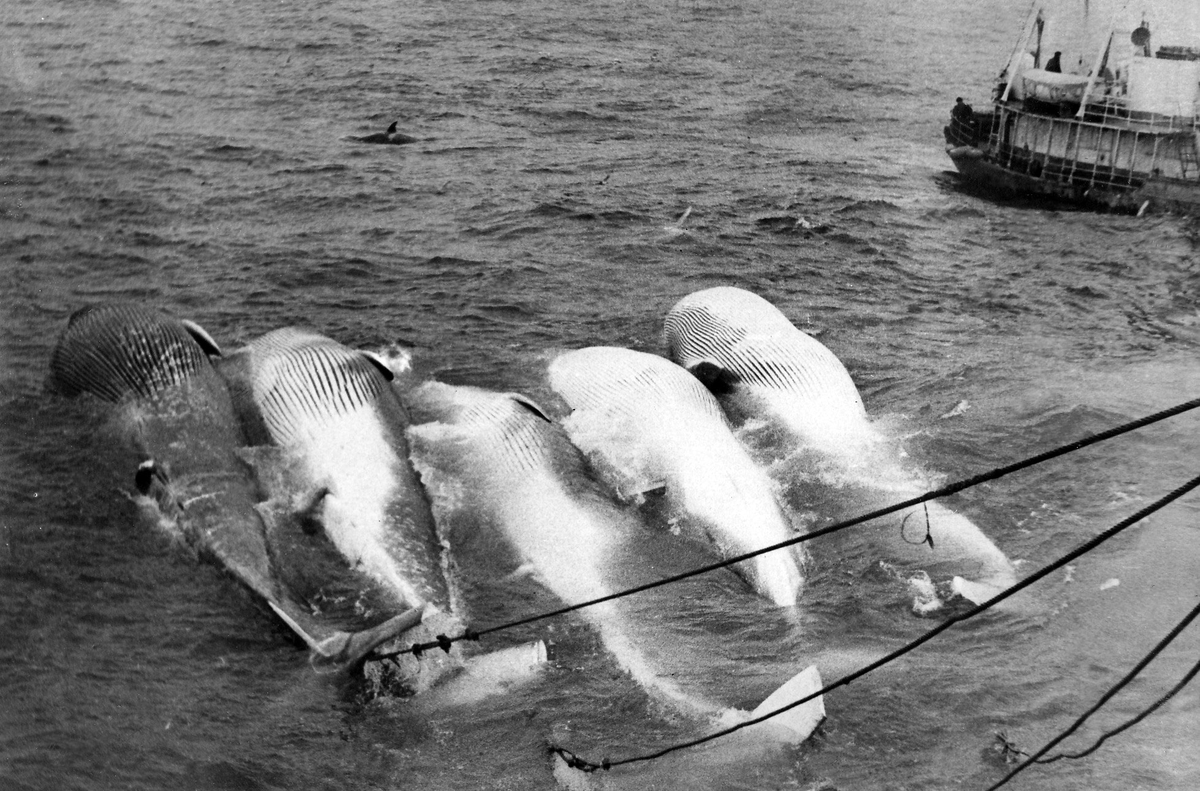
The Soviet whaling fleet killed 180,000 whales between 1948 and 1973, delivering rotten carcasses that nobody wanted to eat. Soviet citizens had zero demand for whale meat. The ships hunted anyway, fulfilling quotas handed down from central planners who counted tons of dead whale as economic output.
This was bureaucratic box-checking that nearly drove multiple whale species to extinction. Soviet whalers targeted endangered right whales and humpbacks specifically because they were larger, helping them hit tonnage targets faster. The meat rotted on deck during long voyages back to port, where officials dutifully recorded the numbers and sent reports to Moscow declaring another successful harvest.
Central planners measured success in tons harvested, not consumer satisfaction or long-term sustainability. Factory managers got promoted for exceeding whale quotas, regardless of whether anyone actually wanted whale meat (they didn't). The feedback mechanism that normally connects production to human needs had been severed entirely. When bureaucrats replace market prices with administrative targets, you get mass slaughter with zero purpose.
You still see this today every time politicians promise to "create jobs" in industries that lose money year after year. When government agencies measure their success by dollars spent rather than problems solved. When university administrators chase enrollment numbers instead of student outcomes.
Remove the profit motive and price signals, and you get 180,000 dead whales rotting in the sun while commissars celebrate meeting their targets. You don't get rational planning.
Socialism is fundamentally destructive to the environment and inevitably leads to ecological disasters.
“[Solar] is a mature, self-sustaining circular economy that cleans up after itself because the free market demands it. The other [coal] is a heavily subsidised tech wave with no economic plan in sight, except a graveyard in a landfill.”
If we are going to look at the total life cycle of wind and solar energy, we should also look at the dark side of fossil fuels.
But digging into the data reveals a huge hidden irony that the 'green energy' narrative completely misses. Coal combustion residuals (coal ash) represent one of the largest industrial waste streams on earth, packed with heavy metals like arsenic, lead and mercury.
The United States alone actively recycles over 70% of its coal ash. Out of roughly 64 million tons generated recently, over 45 million tons were kept out of landfills, according to the American Coal Ash Association. This is because over many decades it has become a massive industrial circular economy. Coal waste is highly sought-after in construction. It's chemically built into the fabric of all modern infrastructure.
Fly ash, the fine powder captured from smokestacks, is used to replace traditional Portland cement. It makes concrete stronger, denser and more durable. Even better, it avoids the CO₂ emissions required to bake virgin limestone for standard concrete.
Synthetic gypsum is also scrubbed from coal plant chimneys to prevent acid rain, and it's structurally identical to mined gypsum. Nearly a quarter of all recycled coal waste goes directly into making the drywall in houses. Drywall factories were built right next to coal plants so they could pump the waste straight into the assembly line.
Because coal plants are shutting down across the West, the construction industry now faces a severe shortage of coal ash. Companies are actively mining old landfills to harvest decades-old coal waste for infrastructure. It pays royally to clean it up.
So let’s flip the lens back to solar. Critics are right that coal produces a continuous, high-volume daily stream of waste. Solar, by contrast, sits quietly for 25 to 30 years. But that delay is exactly what makes it a ticking economic time bomb. Solar waste isn’t a predictable, steady daily flow - it's a looming tsunami.
The International Renewable Energy Agency expects up to 78 million metric tons of cumulative solar e-waste by 2050. It's an economic crisis hidden in plain sight, and we recycle less than 10% of old solar panels. Solar panel recycling is an absolute financial loser, while coal ash is highly profitable to recycle.
It costs roughly $20 to $30 to dismantle and recycle a single solar panel. But recovering the silver, copper, and silicon inside yields only a few dollars of raw material value. Dumping that exact same panel in a landfill costs just $1 to $2.
The difference between these two waste streams isn't about inherent toxicity - it's economics. One is a mature, self-sustaining circular economy that cleans up after itself because the free market demands it. The other is a heavily subsidised tech wave with no economic plan in sight, except a graveyard in a landfill.
Every single mass-scale energy system requires tearing materials out of the earth, leaving a massive physical footprint. It's true that fossil fuels have a legacy of waste. But the road train to a green utopia is leaving an unprecedented mountain of tomorrow's electronic waste.
And 'no one' wants to pay to clean it up.
Left tards never define what “fair share” means in terms of taxes. They never assign it a percentage or numerical value. As a scientist, this isn’t very convincing.
In reality, they mean everything in your wallet. All of it. They just dress theft up as “fairness.”
Ruben and his family love hitting New Mexico’s trails 🛻 Learn how Chevron is lowering carbon intensity hereRuben and his family love hitting New Mexico’s trails 🛻 Learn how Chevron is lowering carbon intensity hereRuben and his family love hitting New Mexico’s trails 🛻 Learn how Chevron is lowering carbon intensity hereRuben and his family love hitting New Mexico’s trails 🛻 Learn how Chevron is lowering carbon intensity here.
A story of two Wal stores:
Went to @Walgreens #4651 for one item: Benadryl.
Drat, it was locked in a cabinet with no button or QR code to summon help. I saw no employees except in the pharmacy, so I waited in line five minutes to ask for help. Pharmacy tech announced on loud speaker that a customer needs help on aisle 14. Waited another five minutes but no one came to help, so I left.
Went to @Walmart #1397 and had my Benadryl in hand in less than two minutes of walking through the door. Checkout was fast & easy.
Walgreens price: $14.99 for 100 tablets
Walmart price: $7.27 for 365 tablets
Walgreens 👎
Walmart 👍
Solar and wind are sold as cheaper than coal, gas or nuclear using a number called LCOE (Levelized Cost of Energy).
But LCOE is a junk metric.
It pretends that one-megawatt-hour of intermittent power is the same as one-megawatt-hour of reliable power.
It isn't.
When the sun doesn't shine or the wind doesn't blow, you still need electricity. So backup plants (coal, gas or nuclear) must run in the background, ready to fire instantly. LCOE fails to count that cost.
It also ignores the miles of transmission lines for remote wind farms, the giant storage systems to cover lulls, the stabilizers to keep frequency steady, and the massive overbuild needed just to survive bad weather weeks.These hidden costs explode as wind and solar take over more of the grid.
On paper, LCOE makes these renewables look cheap. In reality, they drive up costs system-wide. That's why nations with the most wind and solar have the highest electricity prices.
LCOE isn't just misleading, it's a lie.
Antarctica is colder and more icebound today than at any point in the past 5,000 years.
Research by Hall (2023) found that West Antarctica cooled by more than 1.8 C between 1999 and 2018.
Satellite data confirm continent-wide cooling, as do multiple glacier studies.
Pacini (2024) found the Collins Glacier was 1 km farther back 6,000 years ago and began re-advancing about 1,000 years ago, which is clear evidence of cooling since the medieval warm period.
Even the biology of the continent documents this shift.
A millennium ago, the Ross Sea hosted around 200,000 elephant seals as far south as 78 degrees. Today, those colonies are gone. They disappeared as the region froze over, too cold and ice-choked for breeding or foraging.
As the Hall paper concludes: the last few centuries, including the present, represent the coldest, iciest conditions in the post-glacial period.
Modern Antarctica is not warming, it's freezing.
They know from the beginning these public works projects will cost far more than advertised - but they lowball the estimate to get the project started. Then the real costs appear once it’s too far along to stop, and the public gets the sticker shock.
The Naples school district has 2 electric buses, that can only run 50% of the time
Cost per mile - $3.18, but the diesel buses cost $0.38 per mile.
And the electricity powering these “eco-friendly” buses comes mostly from fossil fuel!
Brilliant greenwashing scam 🤡
There’s nothing paranoid about it.
When it was decided many decades ago that virtually all scientific research would be taxpayer funded, that put Congress and thus politicians and their policy goals in charge of where that money is apportioned.
Funding agencies such as the National Science Foundation (NSF) then use that money to offer research grants that have very specific guidelines that applicants must adhere to.
For example, a grant may ask scientists to examine how greenhouse gas (GHG) emissions increase fire risk in California. If you instead plan to use that money to investigate how bad forest management policies increase fire risk, your proposal won’t be accepted and you’ll be denied the grant.
Even if you manage to write a paper that questions the conventional narrative, it can be rejected from an academic journal simply because the peer reviewer doesn’t like your argument or findings.
To pretend as if government- (taxpayer-) funded research and the peer-review system aren’t biased is an exercise for mental midgets and charlatans.