82% of UK investors are worried about climate risks, with 40% reducing holdings due to exposure to climate-related risks.
Action is needed to unlock investment—76% say they’d invest more in the UK if risks were managed.
📊 Read @JoeWithIt's findings👇
https://t.co/Ik8NYg7kem
Institutions ‘will invest more in 🇬🇧 if #ClimateRelatedRisk is cut’
Our investor research is in The Times yesterday. After the hottest year on record (with some $320Bn in #ClimateDamages), our investor survey links climate related risk and #Investor decision making.
Links👇
🌱The #TransitionPlan agenda is evolving🌱
Firms are facing growing pressure to not just #Disclose plans but to #Align them with a 1.5°C economic transition.
Loved working with @cesaro_pietro and Kate Ryan on this new @e3g blog👇
https://t.co/zsVSabSxcZ
What did the #MansionHouse package mean for the #TransitionPlan agenda?
If #StormBert should teach us anything, it's that action on resilience and the sustainability of our economy is critical to building stability (and therefore competitiveness).
Read my new blog for more👇
To compete for green investment, 🇬🇧 must accelerate its #TransitionPlan agenda.
Despite providing a signal of HMT’s commitment to sustainable finance, #MansionHouse did not drive forwards commitments on transition plans.
More in our blog by @JoeWithIt👇
https://t.co/XXyU9xGzYV
In 2020 I was one of 7 dems that won a district that Trump won, so I held a series of listening sessions with people who voted for Trump and voted for me to understand their actions. I reread the transcripts yesterday and much of it felt like it could have been said today. THREAD
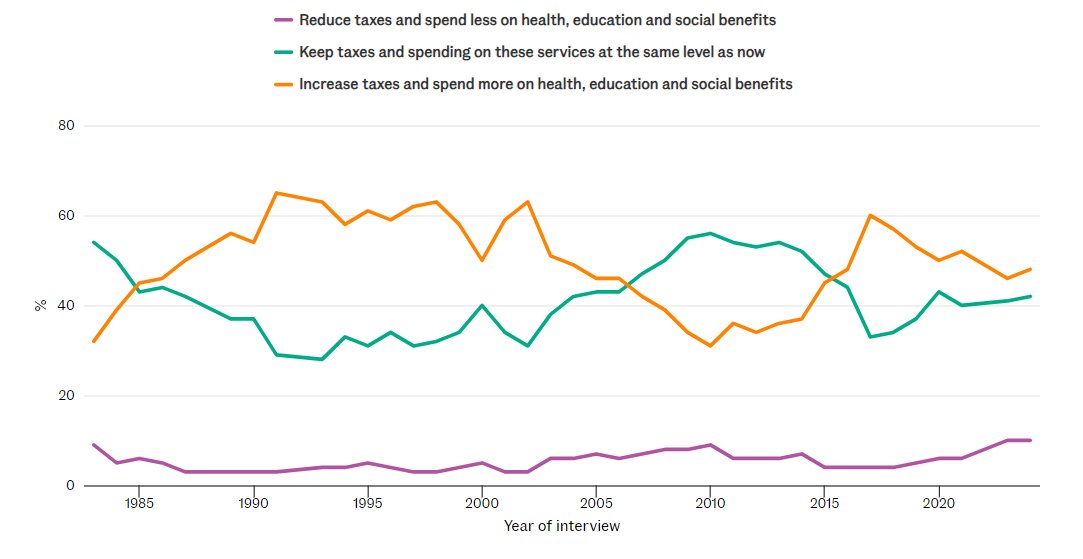
2⃣ Taxes... TAXES
I'm so tired of this fallacy. Sure, no one wants to pay more tax, but there is a huge nuance here that gets ignored.
There are (mostly wealthy) individuals who are anti tax. Most care much more about the value-for-money of their tax dollars.
See this graph:
DISCLAIMER: This thread is my personal view.
Credit to:
🔵@pewresearch for the abortion opinion chart
🟡@NatCen for the tax polling (and graph)
🟢@JKSteinberger for the plot of the shift in voters by income bracket
🔴BBC for the election graphics
1⃣ This is all about inflation and cost of living.
This is just one (very visible) corner of voters feelings. It's not as simple as 'voters want us to keep inflation low' or even 'make people richer'.
A better metric would be 'do people feel like their QoL is improving?'
So having ranted a little on what I think we're going to get wrong in analysis technique... what wrong learnings do I think we might come up with?
Well, mostly I think we're at risk of oversimplification. Our learnings must reflect quite how complex voters are.
A few examples👇
🤠Unhelpful stereotyping of complex #Demographics
We've all seen the videos. Some Trump supporters declaring their undying love for the guy. Reality check... most Trump voters are not those people (see rally sizes)
This is 72 MILLION people. Don't assume even remote homogeneity
The 'red herring' result I'm most scared of is this one:
"About 1/2 of Trump's backers labeled #Economy and #Jobs as the top issue facing the country, while 1/3 said [it] was #Immigration."
This limited data alone does not give us much insight into EACH voter's decision making.
What does 🇬🇧's left need to learn from Trump's win?
Around the world, those of us in 'left wing' political bubbles are trying to post mortem the #USelection results.
I suspect many of us will jump to the wrong conclusions. A not-so-short🧵
🗳️Survey absolutism
Give me 7 survey questions and I can create a stat that suggests the public believe almost anything. Surveys are a useful tool, but you MUST look past the headline stat
Start with how you'd interpret the question asked and then critically analyse the results
Nor will it help to dismiss this as #SingleIssue voting
I woke up this morning and spent the first half hour thinking about several key issues where Trump's stance is abhorrent to me
A contrast to most voters who build a much more complex picture before going to the #BallotBox