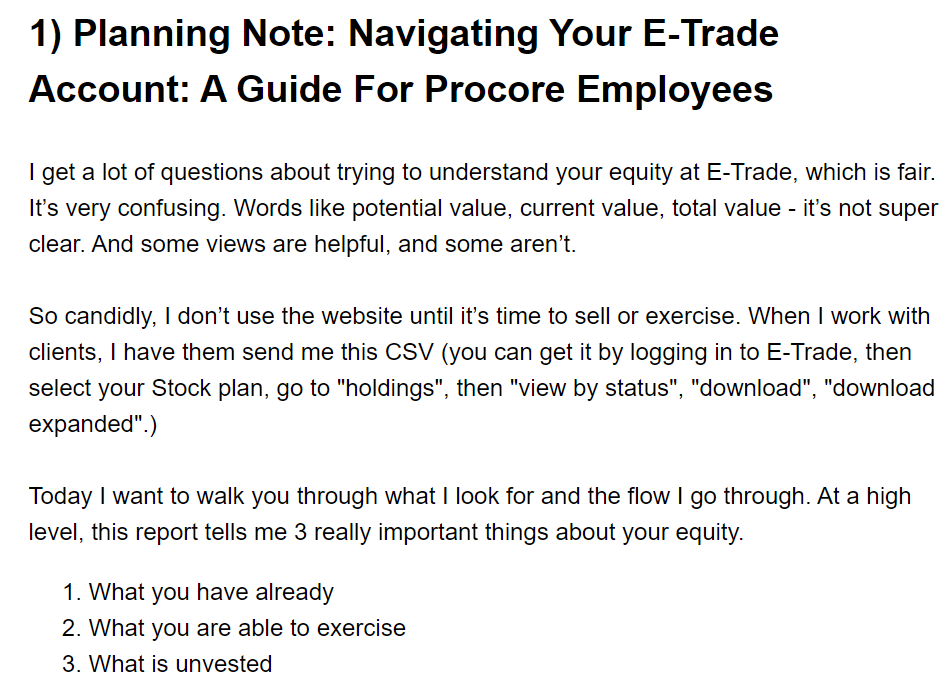
Your Procore equity can be confusing.
I want to walk you through the flow I go through and what I look for when working with new clients.
From a high level, it tells me 3 really important things about your equity.
1. What you have already
2. What you are able to exercise
3. What is unvested
There's a lot that goes into each of these specific areas, but this gives me a really good overview of what you have, and what you have the potential to have in the future.
But this spreadsheet on its own is not a magic wand that solves all your financial planning problems.
It is a piece of the overall picture.
There's a lot that this doesn't include - other assets and liabilities, tax situation, goals/values/ etc.
All of this has to work together
---
I will go into more depth in this this week's Tech Financial Planning Newsletter (comes out Saturday morning).
Get it dropped in your inbox here: https://t.co/YX6biA8YJa
A big part of our work is helping clients plan for their company stock.
While I talk about different strategies, I’ve never really “shown my work.”
So tomorrow I want to take you behind the curtain and provide a high level overview of what I’m looking at, some key pieces of information, and the overall flow I go through.
While this is specifically for Procore employees and/or people who’s equity is held at E-Trade, a lot of this can apply to you if you have equity, no matter where it’s held.
---
Plus I share what I've been reading lately and some fun personal updates.
Subscribe here to get it dropped in your inbox tomorrow morning: https://t.co/YX6biA8YJa
PS: as a reminder - I've made some changes to the CSV, like adding the planning tab, and takin out a lot of rows and columns and consolidated certain data to make it easier to digest and display for the video
Your Procore equity can be confusing.
I want to walk you through the flow I go through and what I look for when working with new clients.
From a high level, it tells me 3 really important things about your equity.
1. What you have already
2. What you are able to exercise
3. What is unvested
There's a lot that goes into each of these specific areas, but this gives me a really good overview of what you have, and what you have the potential to have in the future.
But this spreadsheet on its own is not a magic wand that solves all your financial planning problems.
It is a piece of the overall picture.
There's a lot that this doesn't include - other assets and liabilities, tax situation, goals/values/ etc.
All of this has to work together
---
I will go into more depth in this this week's Tech Financial Planning Newsletter (comes out Saturday morning).
Get it dropped in your inbox here: https://t.co/YX6biA8YJa
want to download the CSV from e-trade for yourself? within Etrade, select your Stock plan, go to "holdings", then "view by status", "download", "download expanded". That's the CSV!
My 2024 movie update - halfway edition
I’ve seen 94 movies so far (28 new releases).
I’m significantly ahead of my pace from last year - with baby Cosy, there’s been a lot more time at home, and a lot more movies!
For some people, having a movie goal is probably weird, but I love it - I love a good story.
Some of my favorites from this year:
Dune Part 2
Furiosa
Snack Shack
Perfect Days
Challengers
La Roy, Texas
Hit Man
The Fall Guy
Civil War
The Beekeeper
Right now I’m rewatching the Before trilogy - just a masterpiece
---
What good movies have you seen lately?
@JamLClark gotcha, that makes sense
I like the yearly planner because (in theory) I'd be time blocking out my day, but that's not happening as much as I'd like
My favorite tools I'm using right now
in business and in life
1. Loom - I've had Loom for a while, but I've really started to use it more the past month.
I love recording short videos for clients, especially since I have a tendency to turn emails into essays.
2. Snipd - this one is legit.
When I'm listening to podcasts (particularly business / advisor podcasts), there's often a great soundbite or piece of info that I want to remember.
And I used to try to write them down in my notes app.
But Snipd allows me to essentially bookmark that key insight with one tap.
3. Letterboxd - I absolutely love Letterboxd.
It's a social platform for movies - you can share what you're watching, see what others are watching, and more.
I am finding so many good movies that I wasn't aware of.
And that stats are really fun.
4. Merlin - I don't know what it is, but lately I've been hearing birds more...I know they've always been there, but I'm noticing them now.
So Merlin helps identify which birds you are hearing and seeing!
5. Regain - this app helps me spend less time on my phone
I've cut my phone time down dramatically the past two months
6. Holistiplan - helps me do tax planning for clients. Game changer
7. Right Capital - helps me do financial planning for clients
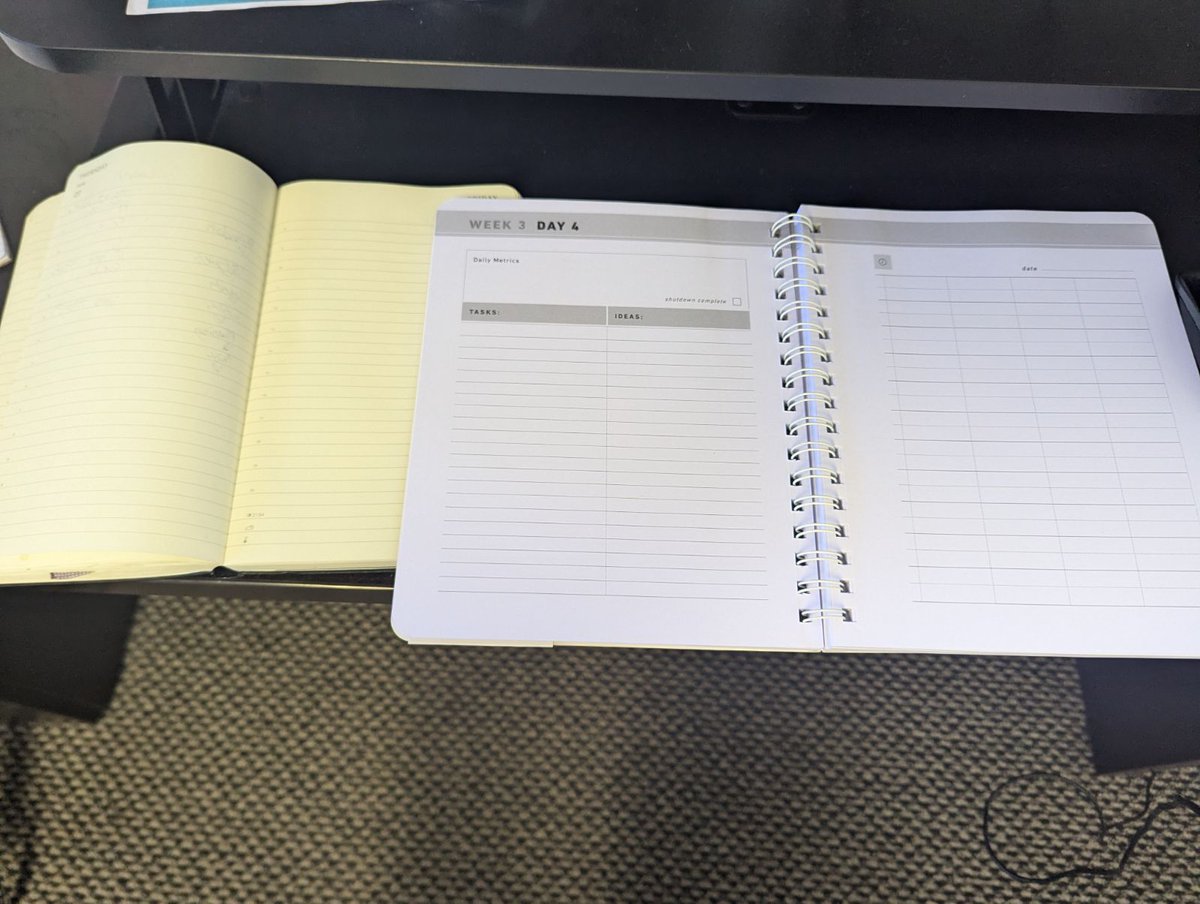
8. My daily planner - these are very much analog!
I have a yearly planner from Moleskine that I get each year - I think this is my 4th year using one.
Then I just got the time block planner from Cal Newport - there's probably some overlap there, but I'm excited to try it out too.
9. Lectio 365 - my daily devotional - I usually do it during a walk at lunch. I really like the structure it takes you through each day
---
Do you use any of these?
Anything I should be looking at?
I talk a lot about why it pays to be proactive with stock options
but this is doubly true with the potential changes to tax law in 2026.
While we don't know how this will play out (and might not for some time), that doesn't mean you should sit back and wait.
Some things to consider:
1) What tax bracket are you in today, and where could you be in 2026?
If you are in the top tax bracket and you likely will stay there, it might make sense recognize more income now versus later.
For example, if you have NQSOs, it might be advantageous to exercise now, versus in 2026 and beyond.
2) If you have a big AMT credit, will you be able to recoup it as quickly?
If some of the rules around AMT revert back, some people in tech might have a lot harder of a time getting that AMT credit back.
3) If you have ISOs to exercise, will you trigger AMT, and will that potentially change in the future?
---
None of this is a recommendation, but if you have stock options to exercise, it pays to start thinking about this now.
The hard part is that there is so much unknown, and we don't want to overcorrect one way or the other.
But some action now is almost certainly better than waiting until later.
Procore's benefits can add up to an extra $11,250 each year.
Here's the breakdown:
1) ESPP - if you are maxing it out, at a minimum the benefit is $3,750.
This assumes you are putting in $21,250 (how much you put in depends on your salary - it's either 15% or $25,000 of total benefit - contributions + discount).
However it can be even more depending on how big of a discount you get...this last period was much more than 15%!
2) 401k match - up to $5,000 / year
3) Procore Perks - $375 / quarter, so $1,500 / year
4) FSA/HSA - a lot depends on your health plan and if contributing to an account like this makes sense, and if so, how much.
But contributing to one of these accounts saves you in taxes this year (both FSA and HSA) and potentially in the future (HSA).
It's tough to put an exact amount on this, but we'll say $1,000
Other benefits - the actual Procore health plan, life insurance, disability insurance, time off, family building benefits, pet insurance, food & snacks, Legal Ease, and more...
There's a lot, and some of these might apply, some not.
There's a benefit there, but I'm not sure how to quantify them, at least generally.
---
Again, this is an estimate, but Procore's benefits could be an extra $11,250 a year.
"It's always felt like Monopoly money"
I've heard this from several clients - except the money isn't pretend anymore
I work with a number of families who were early hires at a company like Procore and got a lot of stock.
And it seemed like it was all pretend money.
Except it's not.
It's become a significant piece of their finances, or in some cases, basically the whole financial plan.
If you
🟢have stock options that you haven't exercised
🟢continue to accumulate shares via RSUs or ESPP
🟢are sitting on a big chunk of stock
🟢or a combination of all 3
There's a cost to waiting.
Waiting might mean:
🔴paying more in taxes than you needed to
🔴selling at the wrong time
🔴anxiety and stress watching wild swings
Put a strategy in place before your Monopoly money turns into real life financial problems
What are you reading?
I just finished "Slow Productivity" by Cal Newport - it's one of the best books I've read in a while.
There's so many great takeaways and actionable ideas, but one of my favorite quotes from it is "grand achievement is built on the steady accumulation of modest results over time. This path is long. Pace yourself."
---
Some other favorites (in no particular order)
"Just Keep Buying" by @dollarsanddata
"Psychology of Money" and "Same as Ever" by @morganhousel Housel
"Delivering Massive Value" by Matthew Jarvis, CFP
"The Ruthless Elimination of Hurry" by John Mark Comer (currently reading "Practicing the Way"
"Never Split the Difference" by Christopher Voss
---
I am slowly building up my collection of business & personal development related books.
I have much more that I've read on Kindle, and most of my fiction books are at home (like my complete Harry Potter and Calvin & Hobbes collection)
I also have way too many coffee table books.
---
I just bought 3 books by Cal Newport and "Just Retire Already" by Derek Mazzarella.
What else should I check out?