Professor of Economics at Stockholm University (SOFI) and Nottingham University. Research fellow at @cepr_org. I study gender economics and political economics.
@RetractionWatch This was a long process on our end because the author only agreed to share a small portion of the do-file. The journal shared replication material one year after publishing Ciacci (2024), which allowed us to reanalyze not just one, but all five identification strategies.
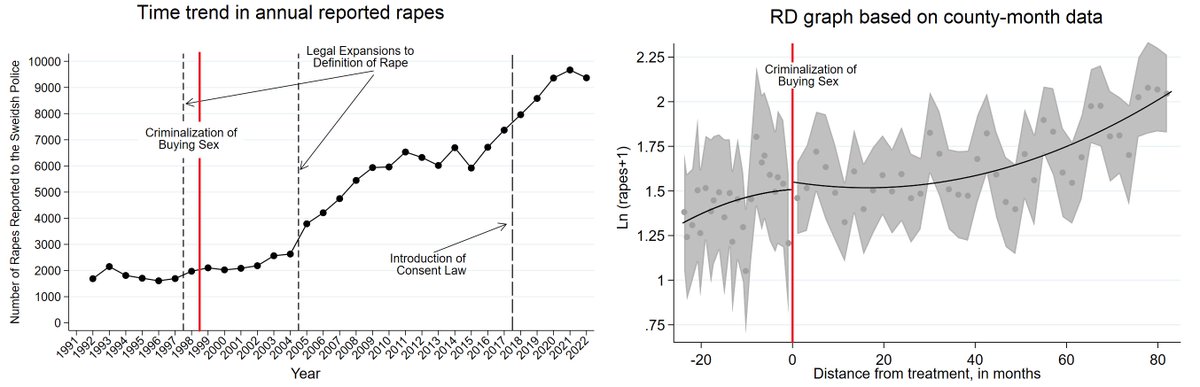
@RetractionWatch At the end of the day, there was no jump—let alone a 50% jump—in reported rapes when Sweden enacted the ban on purchasing sex. This is straightforward to see in the raw annual data and RD graph below.
Very pleased to release this paper on meritocracy, in which I continue to develop ways to understand the concept of meritocracy and its relationship to efficiency and to equality.
As famously argued by Amartya Sen, meritocracy and merit are underdetermined as abstract concepts. I answer this challenge in two ways. First, I focus on education and labor markets as specific contexts. Second, I distinguish between retrospective and prospective meritocracy.
Retrospective meritocracy refers to a conception of meritocratic assignments of students to colleges, workers to jobs, that is based on the idea that assignments to schools, jobs, etc. should be rewards for past achievement or be done on the basis of some notion of intrinsic excellence embodied in an individual. As such, the concept is backwards-looking. Prospective meritocracy refers to a conception of assignments in which merit is functionally defined by the objectives of the social planner setting the assignment rules. This means first, merit cannot be defined prior to these objectives, and second, one must account for the social and dynamic consequences of the assignments, which may place the focus on societal consequences as well as the consequences for the organizations for which the assignments apply.
My main arguments involve the implications of prospective meritocracy for evaluating different rules for assignments. Focusing on education, the interactions between students within a school, the consequences for school assignments for the distribution of skills among workers, and the intergenerational consequences of contemporary assignments, mean that efficient assignment rules can be very complex. The idea that meritocracy mechanically implies that students with the highest test scores and grades should be assortatively matched to the most elite universities can break down, even if the social planner does not make egalitarian considerations intrinsic to their objectives. It is possible for affirmative action to be efficiency enhancing and therefore prospectively meritocratic. Further, I argue that dynamic considerations mean that prospective meritocracy requires forms of equality of opportunity because of efficiency considerations. This does not mean that some forms of equality of opportunity cannot be efficient (under some standard criteria), but rather than equality of opportunity and meritocracy should not be understood as in conflict per se.
One conclusion from this type of reasoning is that an environment can be conditionally meritocratic but unconditionally not meritocratic. Static efficiency assignment rules that justify assortative matching at a single point in time, can be dynamically inefficient. By implication, I argue that there is excessive sorting in various environments because of the failure to address dynamic considerations.
Prospective meritocracy places qualitatively greater information requirements on a policymaker than does retrospective meritocracy. This is an important caveat to my arguments, and implies the the need, IMO, to develops ways to understand the design of robust meritocratic policies. On the other hand, to the extent that retrospective meritocracy is claimed to be efficient, for example following the logic of Becker's marriage model, evidence is also weak. See the forthcoming paper by Zachary Bleemer @zbleemer and Jeffrey Rothstein "The Meritocratic Consensus and Stratification in Higher Education,"
A cancer diagnosis increases the likelihood of criminal behavior, representing a previously overlooked negative externality on society, say researchers at @nationalbanken, @UCPH_Research, and @TilburgU#Chart https://t.co/IWwZ0kKpTs
📣 Help! We are trying to reach people outside Europe with our short survey on research graphs! Could you share the link with someone? Take the survey yourself? Thanks in advance!! 🙏🌷🙏 (Europeans still welcome, of course!)
Here is the link: https://t.co/X8q0KZKzoG
❗ Help needed ❗ Please take our 5-minute survey about interpreting research graphs 📈 And please help us share this post with lots of people 🤗
Take the survey here: https://t.co/4BzqPEI6Mh
Thank you!!
My recent paper update got a fair amount of attention and so I decided to make a twitter thread!
The paper studies recruitment at major US and European multinationals to quantify the salience of hiring discrimination in access to top jobs and identify its source…🧵 (1/24)
Examining the One Laptop Per Child program in Peruvian rural primary schools finds no significant effects on academic performance but some evidence of negative ones on grade progression ,from Santiago Cueto, Diether W. Beuermann, Julian Cristia, Ofer Malamud, and @franciscopardop https://t.co/PLkZMG5eKw
Low-income households denied SNAP due to administrative barriers suffer downstream consequences. Process-related denials increase debt, delinquencies, and decrease credit scores, from @tatianahomonoff, Min S. Lee, and @katherinemeckel https://t.co/yj0qWeRx2f
🚨 out at @apsrjournal 🚨
➡️ We ran a large media literacy experiment to fight misinformation
➡️ 13,500 students, 583 villages in Bihar, India
➡️ Created custom misinfo curriculum of 4 months
➡️ Partnered w the government to roll it out as an official course in classrooms
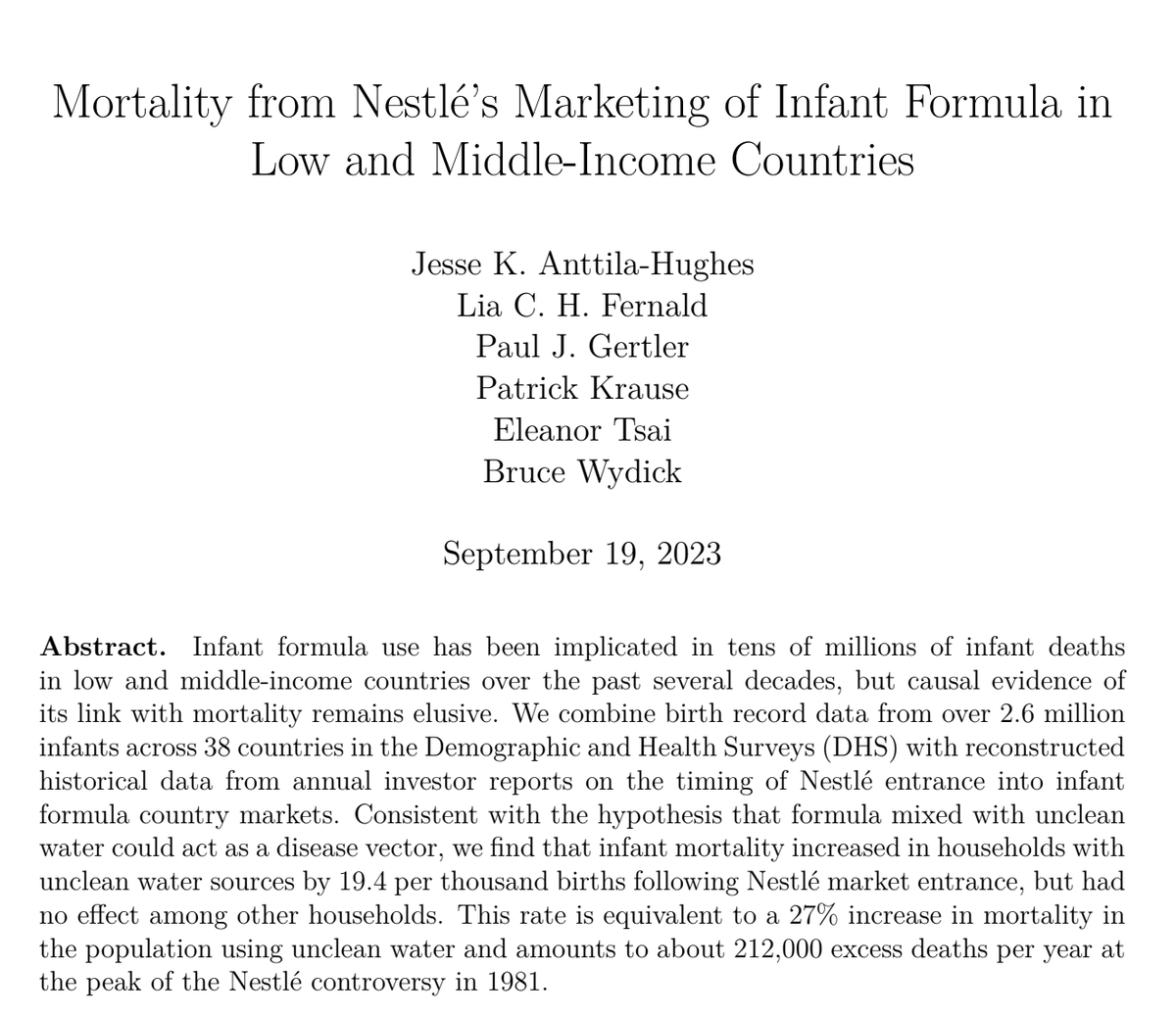
In the 1980s, Nestlé was moving into infant formula markets in low-income countries.
With each new market entry, moms switched from breastfeeding to unclean water, and infant mortality increased substantially; 200,000 excess deaths per year. 1/n
📚 📣 Are you in the Stockholm area on September 22nd? Come discuss new research about gender gaps in academia at Stockholm University! Email me to sign up. Program below!
New RCT finds that helping others improves well-being more than "self-kindness", with befits for depressed mood, anxiety, and loneliness. https://t.co/1GJYjzYnj0