@onetupthree This is great to know! Thank you so much! I do wanna to ask, how u create the erosion texture with nice blending to every frame(if that make sense?)
@rebbford Honestly if u have a quick time to Chongqing, u wont regret it! And just back from Beijing/Hangzhou/Shanghai last week, had a blast. Black myth Wukong having art show in Hangzhou til May 21
People claim that the lack of craters at the Al-Ahli Hospital in Gaza, rules out an airstrike by Israel.
But JDAM (includes the MK.83 GBU-32) does have an airburst mode, which does not produce a crater.
It kills using shrapnel, shockwave and fireball from the explosion
1/2
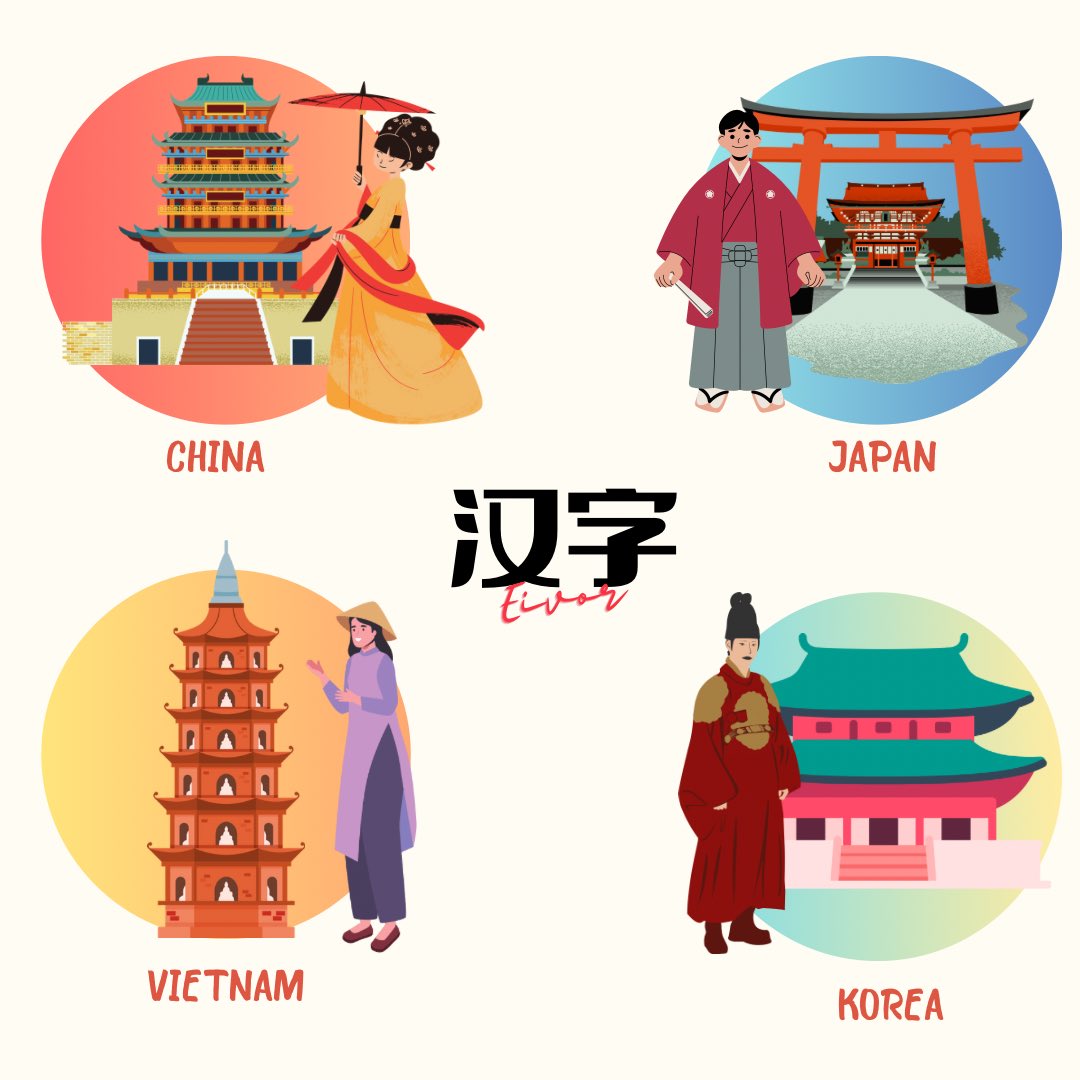
For thousands of years, the people of Greater China, Japan, Korea, and Vietnam were profoundly impacted by Chinese culture, customs, and values. Until the turn of the twentieth century, written Classical Chinese was the regional lingua franca for literary and scientific interchange, and Chinese characters (汉字/漢字) were regionally adopted in Japan as Kanji (漢字), Korea as Hanja (한자/漢字), and Vietnam as Chữ Hán (𡨸漢).
In late classical history, the literary importance of classical Chinese diminished as Japan, Korea, and Vietnam each adopted their literary device. Japan developed the Katakana (片仮名) and Hiragana (平仮名) scripts, Korea created Hangul (한글), and Vietnam adopted the Vietnamese alphabet, which is based on the Latin alphabet.
The brief history of the Chinese characters used in China, Japan, Korea, and Vietnam is outlined here.
🇨🇳 Chinese characters are logograms developed for the writing of Chinese. Chinese characters are the world's oldest continuously used system of writing and are among the most widely adopted writing systems by the number of users.
According to traditional legend, Chinese characters were invented by Cangjie, a scholar said to have been a scribe to the legendary Yellow Emperor during the 27th century BC. Inspired by his study of the world's animals, the earth's landscape, and the stars in the sky, Cangjie is said to have invented symbols called zì (字) – the first Chinese characters. The legend relates that on the day the characters were created, grain rained down from the sky, and that night, people heard ghosts wailing and demons crying because human beings gained wisdom.
Since the 1950s, the People's Republic of China has officially adopted simplified Chinese characters for use in mainland China, while Hong Kong, Macau, and Taiwan were not affected by the reform. The use of traditional Chinese versus simplified Chinese characters varies greatly and can depend on local customs and the medium.
🇯🇵 Chinese script was adopted for recording the Japanese language from the 5th century AD.
Chinese characters adapted to write Japanese words are known as kanji. Chinese words borrowed into Japanese could be written with Chinese characters, while native Japanese words could also be written using the character(s) for a Chinese word of similar meaning. Most kanji have both the native (and often multi-syllabic) Japanese pronunciation, known as kun'yomi, and the (mono-syllabic) Chinese-based pronunciation, known as on'yomi.
Modern Japanese writing uses a composite system, using kanji for word stems, hiragana (which were derived from the cursive forms of whole characters) for inflectional endings and grammatical words, and katakana (which were were obtained by selecting a part of each character) to transcribe non-Chinese loanwords as well as serve as a method to emphasize native words.
In Japan, 2,136 Chinese characters are taught through secondary school, and hundreds more are used daily.
🇰🇷🇰🇵 Throughout most of Korean history, as early as the Gojoseon period up until the Joseon Dynasty, Literary Chinese was the dominant form of written communication. Although the Korean alphabet hangul was created in 1443, it did not become widespread official use until the late 19th and early 20th century.
Hanja has become a politically contentious issue in both South and North Korea, with some Koreans urging a "purification" of the national language and culture by totally abandoning their use.
Hanja retains its prominence, especially in Korean academia, as most Korean documents, history, literature and records (such as the Veritable Records of the Joseon Dynasty, among others) were written in Literary Chinese using Hanja as its primary script. Therefore, an excellent working knowledge of Chinese characters is still essential for anyone wishing to interpret and study older texts from Korea or read scholarly texts in the humanities.