U.S. Stocks | | Cryptocurrency 🚀 Daily pre-market analysis, market trend forecasts, stock picks, and position-building strategies are shared via WhatsApp group
🚨 JUST NOW: President Trump and First Lady Melania PERSONALLY welcomed Chinese President Xi Jinping and the first lady of China on the tarmac at Joint Base Andrews
And 47 personally greeted troops as they walked from the plane.
The first time in SIXTY YEARS a President has welcomed a world leader on the tarmac.
47 has a MASSIVE event scheduled with Xi tomorrow at the White House
Complete with flyovers 😏
🚨 Jensen Huang’s Latest Stock Calls
Last time he called out:
$NBIS (Nebius) — at $18
$INTC (Intel) — at $40
$MU (Micron) — at $56
Now he’s calling:
$OKLO (Oklo) — at $39
$BE (Bloom Energy) — at $277
$UUUU (Energy Fuels) — at $11.68
“Nuclear is a wonderful source of energy”
💡 Don’t miss out again. Save this list and turn on notifications so you catch the next alert.
Wall Street is back in a “good news = bad news” market. PMI just hit multi-year highs while hiring accelerated and price pressures intensified. That's great for economic growth. But for stocks? Hot data → Fed stays hawkish → yields rise → valuations compress. My market view: If Treasury yields keep climbing, high-multiple tech remains vulnerable. If yields stabilize, I expect buyers to rotate back into quality AI names. Watching:
🚨 JUST NOW: Marco Rubio says President Trump could UNLEASH EVEN WORSE on Iran if they keep FAFOing
"If there's gonna be a deal with Iran, it's not gonna happen at a press conference...he's open to a deal...if they continue to insist on nuclear weapon, support for proxies? [...] We're gonna have BIG PROBLEMS WITH THEM."
Rubio has been meeting with global officials ALL WEEK at the UN, and he's working hard on securing peace 🇺🇸
Iran has no option but to cave. If they don't, the country collapses.
NVIDIA
The stock price is currently hovering around $229, with a closing price of $228.87. I believe investors need to distinguish between two completely different situations. Delays in GPU shipments are a regulatory issue and do not indicate that the demand for AI computing is weakening. NVIDIA's latest quarterly results are as follows: • Revenue: #NVDA #NVIDIA #AI #Semiconductors #Nasdaq #StockMarket #WallStreet
The next phase of AI may hinge on a massive assumption.
Operating cash flow for Big Tech companies is projected to grow from approximately $600 billion to $2 trillion.
That’s more than a threefold increase.
Why does this matter?
AI infrastructure spending is exploding, and hyperscale data centers require significantly higher cash flow to support this infrastructure build-out.
The upside for AI isn't just about bigger models.
The key lies in whether AI-driven revenue and efficiency gains can ultimately generate enough cash flow to justify the massive capital expenditures.
Chart of the Day:
$600 billion → $2 trillion
I’m keeping a close eye on this figure. 👀
NVIDIA, Microsoft, Google, Amazon, Meta, Oracle
#AI #BigTech #Stocks
$MRVL is emerging as one of the stocks with the most growth potential in the AI infrastructure trade.
The stock rose approximately 2.7% today, following a 5.38% gain yesterday. Trading volume has reached around 13 million shares, with the intraday price climbing from $250.07 to $264.92.
What impresses me most is the combination of price momentum and catalysts related to AI connectivity.
Marvell’s recent unveiling of 2nm optical demonstrations aims to enable higher-bandwidth, lower-power AI data center networking, while its expanded partnership with GlobalFoundries seeks to provide increased capacity for high-speed optical connectivity.
From a technical standpoint, the next test is straightforward: Can MRVL turn the $265 level into support?
If the answer is yes, momentum traders will be watching closely. If not, a pullback to the $257–$250 range for consolidation wouldn't be surprising.
#MRVL #MarvellTechnology #AI #AIStocks #SemiconductorStocks #DataCenter #Tech #Nasdaq #StockTrading #WallStreet
AI-driven trading continues to dominate Wall Street.
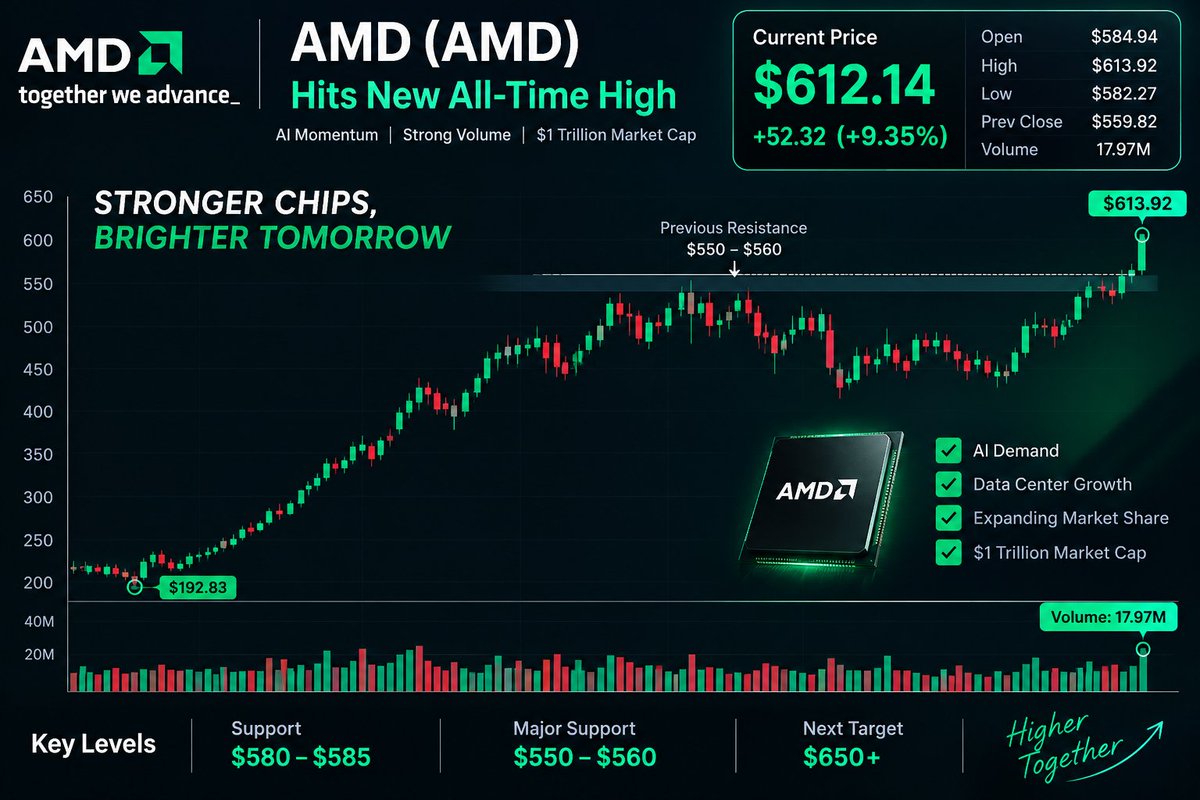
On Monday, AMD shares surged nearly 10%, pushing its market capitalization past the $1 trillion mark for the first time. Meta rose more than 11%, while shares of Nvidia, Microsoft, Amazon, Alphabet, Broadcom, and Micron also saw gains. The semiconductor index climbed 4.29%.
The AI narrative is no longer just about software—it is increasingly focused on chips, data centers, and infrastructure spending.
From a technical standpoint, the semiconductor sector shows strong upward momentum, though continued gains could lead to overcrowded positioning. I am focusing more on trading volume, follow-through, and the sustainability of the breakout rather than just the overall rise in share prices.
#AI #AMD #Nvidia #Semiconductors #TechStocks #ArtificialIntelligence #Stocks
🚨 What if Tesla doesn't need millions of robotaxis?
Here’s the math:
Assume a fully autonomous robotaxi generates about $80,000 in annual revenue.
12,500 vehicles × $80,000
= $1 billion
That’s exactly what caught my attention.
The potential leverage comes from software and utilization rates.
Private cars often sit idle for most of the day.
Robotaxis could operate for much longer periods.
If Tesla can safely deploy true autonomous vehicles at scale, every additional vehicle could become a revenue-generating asset.
My take:
The biggest uncertainty isn't the math.
It comes down to execution.
Can Tesla deliver:
🤖 Reliable autonomous driving systems
📱 Scalable fleet management
💵 Highly attractive unit economics
🏙️ Regulatory approval
📈 High utilization rates
If the answer is yes, the potential market could be far larger than the traditional auto sales market.
The robotaxi story is ultimately an economic one, not just an AI story.
#TSLA #Tesla #Robotaxi #AutonomousDriving #AI #FSD #TeslaAI #FutureOfMobility #TechStocks #Stocks #Investing #WallStreet
🚨 Oil Alert: Hopes for the reopening of the Strait of Hormuz have dealt a heavy blow to crude oil prices.
Reports suggest that Iran could reopen the Strait of Hormuz within seven days if the U.S. eases military pressure and lifts the blockade on Iranian ports.
Brent crude futures fell approximately 2% to $98.33 per barrel, while WTI crude futures for October delivery dropped about 2.6% to $93.28 per barrel.
Oil prices slid to two-week lows due to an improved supply outlook in the Gulf region. Brent crude futures for November delivery fell $2.01 (2%) to $98.33 per barrel, while WTI crude futures contracts for October and November dropped 2.61% and 2.65%, respectively. The decline is attributed to reports that Iran could reopen the strategically vital Strait of Hormuz within a week, provided the U.S. eases military pressure and port blockades. A senior Iranian official stated that Iran's delegation to the UN General Assembly has the authority to engage in diplomatic contact with the U.S. This development has boosted hopes for the resumption of oil shipments through the waterway, which previously handled one-fifth of global oil and gas supplies. Additionally, Saudi Arabia has resumed operations on its East-West Pipeline and may restart exports from the Red Sea port of Yanbu. Meanwhile, Saudi Aramco has increased shipments through the Strait of Hormuz following a temporary pipeline disruption caused by an attack. Experts warn that oil prices are unlikely to fall further unless there is a significant increase in the shipment of refined products, particularly diesel. Diesel remains in short supply as ongoing conflicts involving Iran and Ukraine disrupt exports from major producing nations.
AMD is no longer just NVIDIA's shadow
🔥
$AMD
+9% — The AI trade is expanding; AMD’s stock price has surged past $610 to hit an all-time high, even as the fundamentals underpinning its long-term growth become increasingly difficult to predict. AMD’s second-quarter data center revenue reached $6.7 billion—a 107% year-over-year increase—driven largely by the strong performance of its EPYC CPUs. #AMD #NVDA #AIStocks #ArtificialIntelligence #Semiconductors #DataCenter #WallStreet
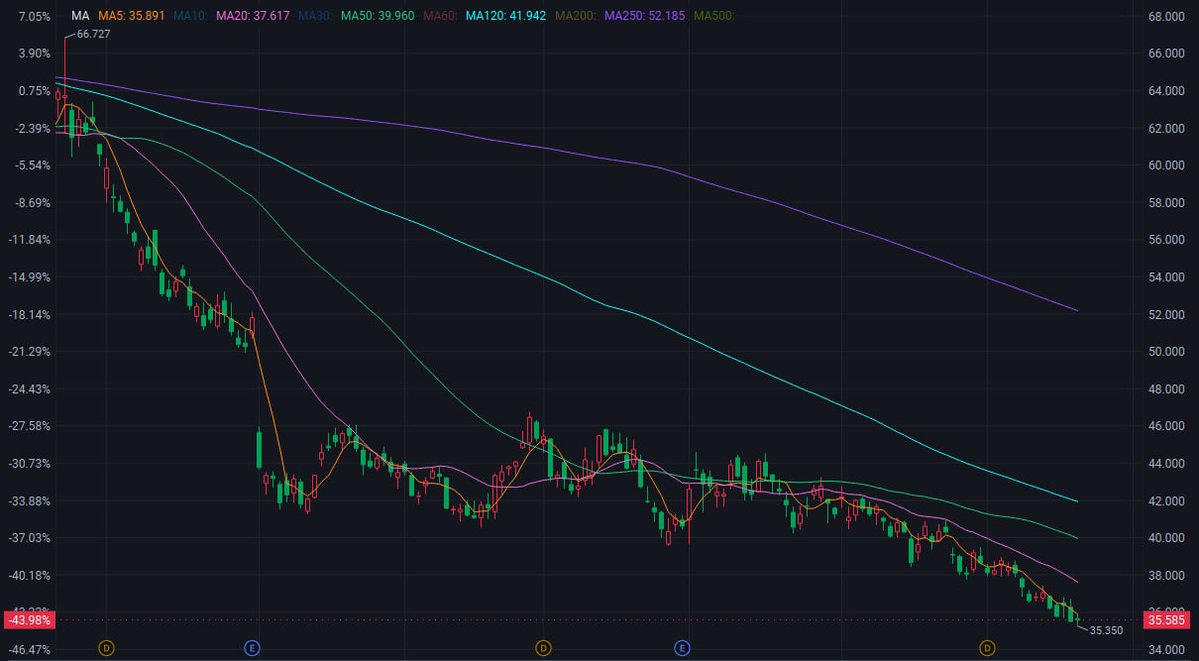
Can $NKE stop hitting new lows?
If the share price begins to reclaim support levels while analyst sentiment remains highly cautious, the risk/reward profile could shift rapidly.
But a fundamental issue remains:
A turnaround in performance needs to be reflected in actual sales, profit margins, and consumer demand.
My personal take:
I have no desire to buy Nike stock simply because Wall Street is bearish.
I want to see the charts stabilize first.
Bearish sentiment + improving price action = interesting.
Sentiment is bearish and the price is hitting new lows—stay patient.
Let the market prove it.
$NKE #Nike #Stocks #Retail #ConsumerStocks #WallStreet #StockMarket #Investing #Trading #NYSE #Sneakers #ConsumerGoods #MarketDynamics
The most interesting thing right now isn't just Bitcoin.
It’s the synchronization across risk assets.
Bitcoin → ~$85,000;
Nasdaq futures → Up 1.04%;
S&P 500 futures → Up 0.67%;
Crude oil → Dropping sharply;
AI/Semiconductors → Rebounding.
Several charts I’m watching are at critical technical levels.
$NVDA
The weekly structure remains constructive near the $221 resistance/rebound zone.
$INTC
$107 is the key breakout level I’ve been tracking. If this holds, the bullish pattern remains intact, with the next technical zone to watch around $117.
Tesla (TSLA)
$502 remains a key breakout level. A move above this suggests upside potential toward the $575 zone, while $705 serves as a more significant weekly reference point.
Then there’s Bitcoin.
The CLARITY Act failed to pass.
Bitcoin didn't care.
The Fed raised interest rates.
Bitcoin recovered.
Oil prices fell.
Nasdaq futures surged.
So, I think today’s price action is worth watching closely.
My take: The market is increasingly inclined to trade based on actual price action rather than just reacting to yesterday's headlines.
But I don't expect the stock market to simply skyrocket.
I want to see key levels confirmed.
Breakout + Holding + Follow-through.
That’s the scenario I’m watching for.
#Bitcoin #BTC #Nvidia #Intel #Tesla #Nasdaq #AI #Semiconductors #Crypto #TechStocks #StockMarket #Trading #Markets #BreakingNews #WallStreet
As of pre-market trading today, Reuters reported that Nasdaq 100 futures rose by approximately 1.09% and S&P 500 futures by about 0.63%; meanwhile, Bitcoin (BTC) climbed roughly 3.5%, briefly surpassing the $85,000 mark.
A drop in oil prices served as a key catalyst. Brent and WTI crude prices fell by about 2% at one point today, driven by expectations of a diplomatic easing of tensions in the Middle East and improved oil shipping volumes through the Strait of Hormuz.
Falling oil prices helped alleviate inflation concerns. The yield on the 10-year U.S. Treasury note dipped back below the 5% level, easing interest-rate pressure on high-valuation technology stocks.
The AI and semiconductor sectors are attracting renewed capital interest. Reuters noted that Intel shares rose as much as 5.4% in pre-market trading, while Marvell, Meta, and Dell also showed significant strength.
Bitcoin's rally was also driven by technical and positioning factors. After BTC broke through the $84,000 level, a wave of short-position liquidations fueled further upward momentum; reports indicate that over $260 million in short positions were liquidated within a single hour.
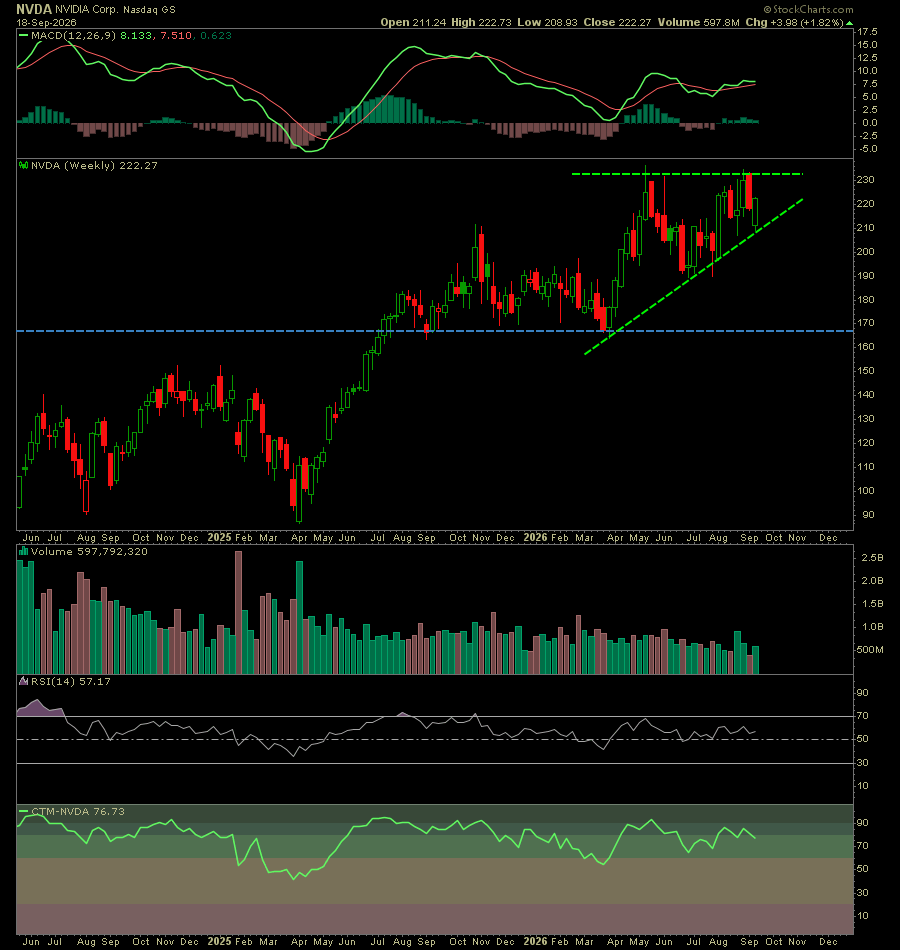
Nvidia staged a strong rebound on the daily chart this week; even more noteworthy is the ascending triangle pattern currently forming on the weekly chart.
Closing above the key long-term resistance level of $221 on Friday marked a further improvement in the technical outlook compared to a week ago. If the breakout is confirmed and the price holds above this level, the market will likely focus on key price zones further up.
Potential price targets to watch include $227, $232, $244, and $252.
Should Nvidia strengthen in tandem with Microsoft, both could serve as major heavyweights driving further gains for the Nasdaq index.
It is important to note that technical patterns do not guarantee future performance; the ability of the $221 level to flip from resistance to support, along with trading volume and subsequent price confirmation, remains crucial in determining the validity of the breakout.
The world's largest companies have now become part of a massive AI capital system.
Nvidia (NVDA) market cap: ~$5.37 trillion
Apple (AAPL) market cap: ~$4.91 trillion
Google (GOOGL) market cap: ~$4.30 trillion
Microsoft (MSFT) market cap: ~$3.67 trillion
Amazon (AMZN) market cap: ~$2.74 trillion
TSMC (TSM) market cap: >$2.2 trillion
Meta (META) market cap: ~$1.7 trillion
Tesla (TSLA) market cap: ~$1.45 trillion
Micron (MU) market cap: >$1 trillion
This message is more important than any single stock:
Compute → Fabs → Networking → Memory → Cloud → Applications.
AI is no longer just a single industry.
It is an entire capital structure.
I remain focused on infrastructure because every new AI workload ultimately requires more computing power, bandwidth, memory, electricity, and data center capacity.
And this video confirms that thesis.
Nvidia (NVDA) closed at $222.27 on Friday, up 1.34%, with a trading volume of approximately 190 million shares.
$MU closed at $1,015.80, up 3.92%, following a 5.50% gain in the previous session.
Capital isn't just pouring into a single "AI" bucket.
It is flowing through the entire stack.
#AI #Nvidia #MU #Micron #TSMC #AIInfrastructure #Semiconductors #BigTech #WallStreet #TechStocks
Veteran strategist Ed Yardeni lowered his year-end target for the S&P 500 (^GSPC) from 8,400 to 7,900 last week, anticipating multiple interest rate hikes this year.
"The longer oil prices remain high, the more likely inflation is to become entrenched, especially given the economy's resilience," he said.
Bank of America equity strategist Savita Subramanian sees a better entry point for the S&P 500, noting, "We are entering a period of seasonal weakness, and we believe a pullback is inevitable."