$ONDO isn't waiting for Wall Street. It's bringing Wall Street onchain.
Ondo Stocks has already surpassed 150,000 unique holders and 292,000 tokenized stock and ETF positions in under a year.
The bigger signal: demand for onchain exposure to traditional markets is compounding fast.
$ONDO keeps proving that RWAs are becoming a product people actually use.
ethereum:0xfaba6f8e4a5e8ab82f62fe7c39859fa577269be3 is trading at $0.3755 right now, sitting mid-range after a volatile year.
Here's the structure that matters.
Early trading was rough, a sharp spike shortly after listing, followed by a long grinding decline through the back half of last year.
By February, price had based out in the $0.25 to $0.30 range for months.
On May 8, ONDO spiked hard to roughly $0.50 in a single move, with RSI hitting 91.93 that day, deeply overbought.
That kind of spike rarely holds. It didn't. Price faded from there into a $0.30 to $0.45 range that's held since.
Within that range, ONDO dipped toward the $0.30 area in August before climbing back to current levels near $0.3755.
Momentum is mildly constructive, not extreme.
RSI(14) sits at 59.24, above the neutral 50 line, with its moving average at 42.30. Elevated but nowhere near May's overbought reading.
MACD's line is sitting above its signal line, a mild positive tilt.
In plain terms: ONDO is recovering inside an established range, not breaking out of one.
The range's ceiling near $0.45 to $0.50 and its floor near $0.30 are the levels worth watching for an actual break either direction.
Not a signal to act on, just what the chart is showing. I'm not a financial advisor, and this isn't trading advice.
Six months of lower highs, and the chart just did the one thing it has refused to do since November.
It stopped making new lows.
$190 held.
$167 never got tested.
$144 never came into play.
Everyone is staring at the majors while this quietly builds a floor under itself.
The staircase down has one step left to break, and that step sits at $230.
Above $240, the entire pattern the shorts have been leaning on is gone.
Below $190, the range failed, and the patient bears were right to wait.
A base nobody is watching is the only kind that ever pays.
Who else sees this?
A subnet lead on Bittensor scammed his own investors.
Within 24 hours, three competing subnets launched, doing the same thing. Better.
That's not spin.
That's what happens when a network is actually decentralised instead of just calling itself that.
Here's what's useful in this story, not just interesting.
The person behind what's now called the Covenant incident only owned 18% of that subnet.
The rest, investors, miners, contributors, didn't disappear when he did.
Because the code was open source by design, other builders forked it, improved it, and replaced it in a day.
Const's framing is the actual lesson.
"If you think it's about one individual instead of the network, go die on that hill."
The ideas came from Bittensor. Nobody can take them back out.
Second useful thing.
Bittensor just shipped something called conviction. Worth understanding if you're evaluating any subnet.
Bitcoin measures trust through proof of work.
Ethereum through proof of stake.
Bittensor just added a third dimension: time.
Subnet owners can now provably lock commitment to their project on chain. A public signal of how long they're actually staying.
It's opt in, not mandatory.
Which means you can now check whether a team backing your investment has put their money where their mouth is, literally, on chain.
Third. This is the part most people will scroll past without registering.
AI agents can already mine Bittensor subnets.
Const said it plainly. Point an agent like Claude at a subnet, and it figures out how to mine it, optimise it, even exploit it, in under a day.
What used to take a team of engineers weeks to work out now happens in an afternoon.
That's not a future prediction.
That's already working today.
If you're evaluating a subnet, check three things before anything else.
Is the code actually open source?
Has the team signalled conviction through locked commitment?
Can it survive a bad actor leaving without the whole thing collapsing?
The Covenant incident is now the live case study for what "yes" looks like on all three.
Hyperliquid keeps ~70 cents of every fee dollar as revenue. Uniswap, the sector's fee leader, keeps only about 7. Here's the top 10 DEXs ranked by fee-to-revenue conversion (live DefiLlama, Aug 2026):
$DYDX: 100% ($327K → $327K)
$AERO: 75% ($4.59M → $3.45M)
$HYPE: 70% ($43.13M → $30.07M)
$GMX: 37% ($3.12M → $1.15M)
$CAKE: 34% ($24.79M → $8.41M)
$CRV: 33% ($2.66M → $875K)
$JUP: 24% ($58.11M → $13.93M)
$RAY: 16% ($5.69M → $887K)
$MET: 14% ($11.11M → $1.51M)
$UNI: 7% ($81.20M → $5.75M)
Uniswap still leads on raw fee volume by a wide margin, but its fee-to-revenue conversion is the weakest on the list — most of what users pay flows to liquidity providers, not the protocol. $DYDX technically converts 100%, though at a fraction of the scale of the others. Among DEXs operating at real volume, $AERO and $HYPE are the true efficiency leaders, far outperforming $UNI, $JUP, and $RAY on that metric.
$RENDER just did the thing that traps every late seller.
Price bled from 2.45 in May straight into the mid August lows near 1.25.
The people who finally capitulated did it right at the floor.
Then the reversal showed up.
RSI snapped vertically off oversold to 58.16.
MACD flipped its cross with the histogram turning green beneath the zero line.
Price closed back at 1.399, up 2.19% on the day.
That is not a dead cat bounce.
That is momentum changing hands after two months of sellers running the tape.
The level that decides everything from here sits at 1.60.
That was support all spring and it is now the first real ceiling bulls have to reclaim to confirm the flip.
Lose 1.25 and the whole recovery read is dead.
Oversold reversals look obvious in hindsight and feel impossible in real time.
The chart was flashing fear at the exact spot it usually pays to fade it.
The signal was already on the screen.
Did you read it, or did you sell it?
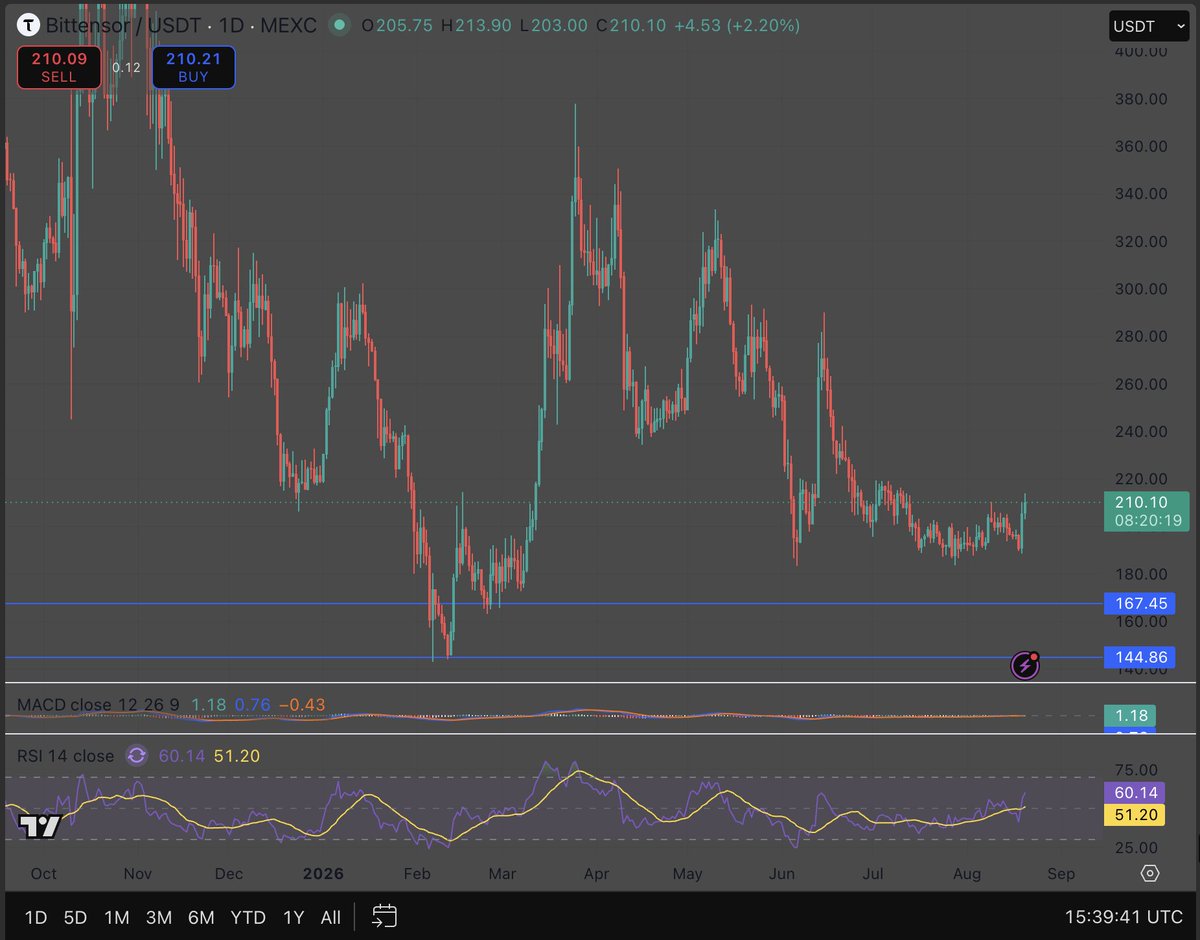
$TAO has been quietly building a base while everyone's been watching the majors.
Current price: $206.17, basically flat on the day, +0.29%.
Here's the structure that actually matters.
TAO's all time high was $757.60, set back in March 2024.
What this chart shows is the more recent history: a local top near $520 in November, then a hard decline from there.
By February, price had fallen to $144.86, a roughly 72% drawdown from that November high alone, and TAO is still sitting around 73% below its true all time high.
Since that November peak, it's been a series of lower highs. A rally to $375 in April. Another to $320 in May. Each bounce topping out below the last.
That's the part worth sitting with. Not a straight line down, a staircase down.
But look at where price actually is right now.
Since July, TAO has been consolidating tightly in the $190 to $210 range.
No new lows. No breakdown toward that $167 or $144 support even being tested.
After six months of lower highs, a range that holds instead of breaking further is worth noting.
Momentum backs up the "cooling off, not collapsing" read.
RSI(14) sits at 57.20, above the neutral 50 line, with its moving average at 50.99.
Not overbought, not oversold, just neutral to mildly constructive.
MACD's line is sitting above its signal line, a mild positive tilt after months of the indicator hugging the zero line with no strong trend either direction.
The setup in plain terms: TAO stopped making new lows for the first time since the November top, and it's building a range instead of continuing the staircase down.
That's not the same as a reversal being confirmed.
A break above the $230 to $240 zone would be the first real signal the staircase pattern is broken.
A break below $190 would say the range failed.
Not a signal to act on, just what the chart is showing.
I'm not a financial advisor, and this isn't trading advice.
$RENDER IS QUIETLY BECOMING AI VIDEO INFRASTRUCTURE.
OTOY Studio’s new Seedance 2.5 Video Edit enables targeted edits like:
→ Relighting scenes
→ Swapping backgrounds
→ Removing elements
→ Iterating without regenerating the entire shot
The bigger alpha: OTOY Studio connects these AI workflows directly to Render’s decentralized GPU network, while supporting RENDER token payments.
AI video is moving from generation to continuous editing. Render is positioning its GPU network underneath that workflow.
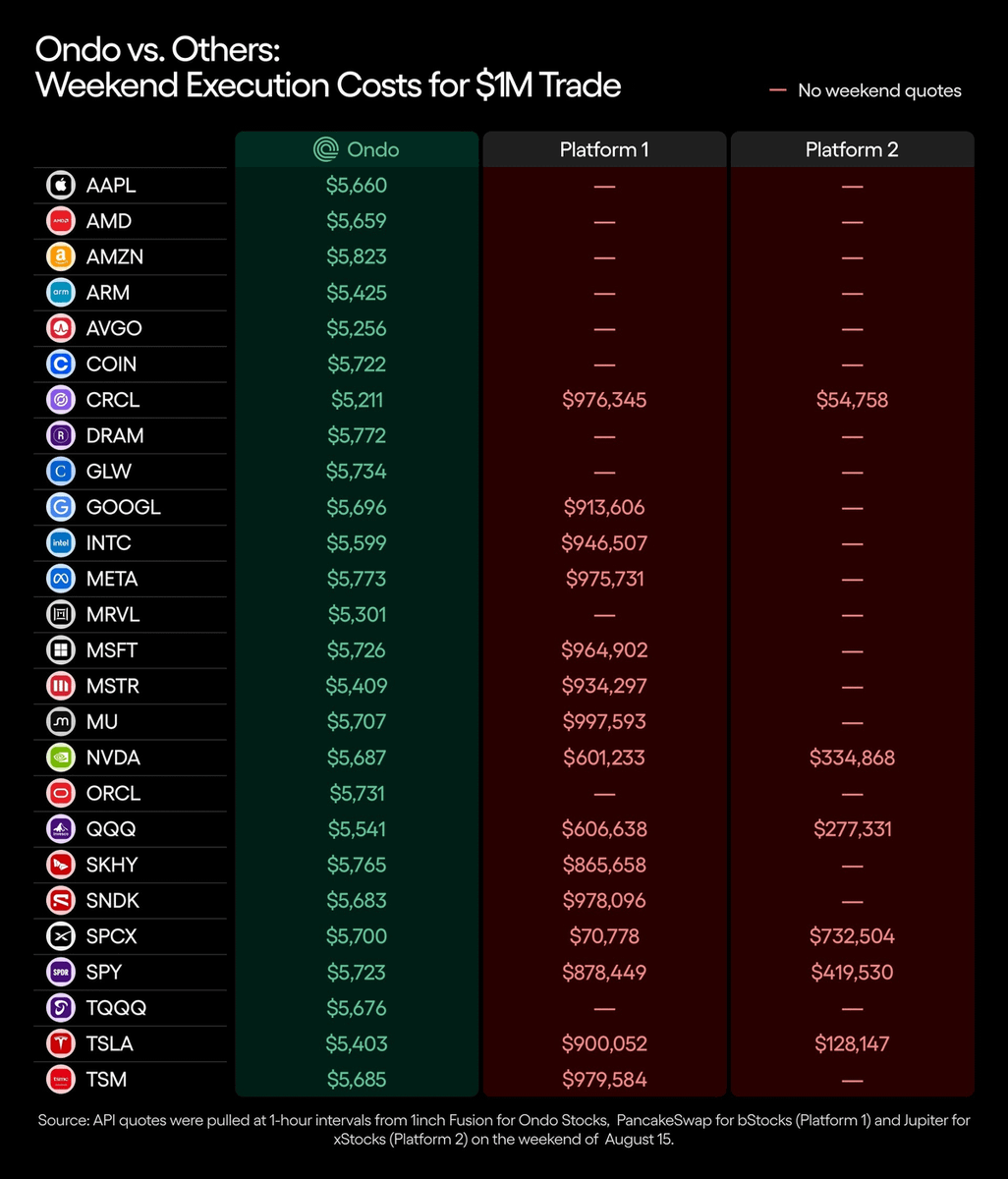
While Wall Street was closed this weekend, someone still paid $997,593 in costs to trade $1 million of Micron stock.
On Ondo, the exact same trade cost $5,707.
That's not a typo.
That's what happens when a market has to fake liquidity it doesn't actually have.
Traditional exchanges shut down on weekends.
So anyone trading tokenised versions of those stocks elsewhere is trading against thin, stale order books.
The spreads blow out because there's no real depth behind the price.
Ondo tested this directly on the same $1M trade:
META: $5,773 on Ondo vs $975,731 elsewhere.
GOOGL: $5,696 vs $913,606.
Same asset. Same moment. Roughly 170x cheaper.
This is the actual test of "24/7 markets."
Not whether a platform is technically open on Saturday.
Whether it can execute size without falling apart when the rest of the world's liquidity goes home.
Real liquidity doesn't clock out.
Most of the market just hasn't been built to prove it yet.
Robinhood Chain Launched Specifically to Bring Tokenized Equities to 28 Million User, Yet $ONDO, the RWA Token Most Directly Tied to That Narrative, Barely Moved at All.
Here's how RWA has performed since the July 1 launch:
$LINK: +32.3%
$PAXG: +7.7%
$XAUt: +7.5%
$SKY: +6.4%
$ONDO: +0.1%
$HBAR: -5.7%
$XLM: -7.9%
$ALGO: -6.8%
$QNT: -12.7%
$AVAX: -38.6%
$LINK is the standout by a wide margin, up over 32% since the launch, likely riding the same institutional infrastructure narrative that's driven its CCIP adoption story all year.
Even the gold-backed tokens, $PAXG and $XAUt, comfortably outperformed $ONDO despite having nothing to do with Robinhood Chain at all.
Meanwhile $AVAX, another chain frequently positioned around RWA and tokenized asset infrastructure, posted the worst performance on the list, down nearly 39%.
If Robinhood Chain's launch was supposed to be a genuine catalyst for the RWA sector, the token most directly associated with that exact use case, $ONDO, essentially didn't react at all.
|| Source: CoinMarketCap