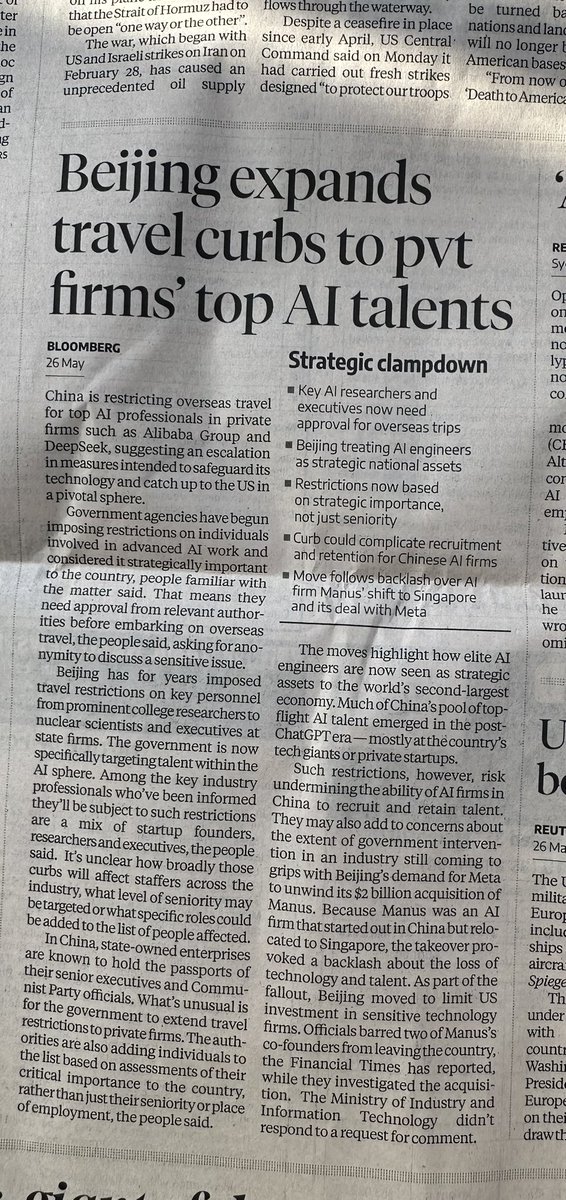
Beijing is now tightening travel rules for top AI talents in private companies like Alibaba and DeepSeek. Key AI researchers and executives must get government approval before going abroad.
China is treating its best AI minds as strategic national assets.
https://t.co/Zjy4My5RdO
@realchasegeiser@DavidSacks The only solution I've liked is Jaron Lanier's: stop giving away our data. Control it. Own it.
Blockchain can help make that real.
@PMCroninHudson@WSJ It's alarming to see how AI can be weaponized for state propaganda. We must be vigilant about who shapes the information landscape.
A Anthropic acabou de matar o Markdown.
Um engenheiro do Claude Code publicou um artigo ontem que pode decretar o início de uma nova era.
A tese é brutal: Markdown nunca foi o formato certo para comunicação entre humanos e IA. Era só o que tínhamos.
O próprio autor admite que nunca leu um arquivo Markdown gerado por IA com mais de 100 linhas até o fim.
Você também não lê. Eu também não.
A sacada:
Markdown assume que você vai ler do início ao fim.
HTML assume que você quer ver o que importa e mexer com as mãos.
Na prática:
→ 30 tickets de projeto viram kanban arrastável com colunas Now / Next / Later / Cut e botão de exportar
→ Lógica de rate limiting vira flowchart SVG com código inline, no lugar de 200 linhas de texto
→ Code review vira diff colorizado com grafos de dependência entre módulos
→ Parâmetros de animação, cores, regex, cron jobs ganham sliders com preview ao vivo
→ Specs de projeto viram 6 opções lado a lado com mockups interativos
Todos exemplos reais do artigo. Todos substituem um muro de texto por algo que você de fato abre e usa.
O trade-off existe: HTML é 2-4x mais lento para gerar. Mas com contexto de 1 milhão de tokens, esse custo sumiu.
E a parte que ninguém está discutindo: o HTML gerado não é só para humanos. O agente de verificação também lê. O spec deixou de ser documento e virou memória compartilhada entre agentes.
Markdown é relatório.
HTML é interface.
Relatórios são para ler.
Interfaces são para continuar o trabalho.
Se você usa IA em 2026 e ainda pede Markdown para tudo, você pode estar usando um smartphone como lanterna.
@adelbucetta@0xKingsKuan Spot on. AI should push us to rethink our workflows and improve productivity. Companies that get this will thrive... once we can figure out what it looks like.
I’d put an orchestration layer between Slack and the agents.
Slack probably shouldn’t be where every agent talks. It should be the exception layer.
Have a manager agent filter, rank, summarize, and decide what deserves a message versus what belongs in a dashboard, report, alert, or workflow.
The problem may not be agents.
It may be agent output without management.
@_0xpainn Replacing teams with AI agents is tempting, but it’s crucial to ask: what value are we losing in the process? Better systems don’t just cut costs; they improve service.
Don't Let AI Turn You Into Kanye West.
Success gets dangerous when nobody around you says, "That's a bad idea."
AI can do the same thing.
It can agree with you, flatter you, and make weak thinking sound brilliant.
Use it as a critic, not a cheerleader.
Article in the comments.