I went to In-N-Out and ordered a cheeseburger. The cashier, a calm young woman named Destiny, asked me a question I did not expect.
"You want that Animal Style?"
I paused.
I did not know what this meant. But a samurai does not admit he does not know. So I answered with weight.
"...Animal Style."
"Cool. So that's mustard-grilled, extra spread, grilled onions, pickles. Yeah?"
I understood now. This was a sacred permission. For one meal, I was being told to put down my manners at the door. To eat the way a beast eats, without shame. I had waited my whole life for someone to give me this order.
"Yes," I said. "I will become the animal."
Destiny did not blink. "...Okay. You want your fries Animal Style too?"
I stopped. Even the potatoes?
"The potatoes also become animals?"
"I mean, they get cheese and sauce and grilled onions, so..."
"Then yes. Let the potatoes abandon their restraint as well."
"...Got it." She was the calmest woman I have ever met. "3x3, 4x4, or just the one?"
I did not know these numbers, but I knew a challenge when I heard one. "How many must I face?"
"It's, like, how many patties you want."
"How many is the most honorable?"
"...Four is a lot."
"Then four. A warrior does not ask for fewer."
She wrote it down without argument. A 4x4, Animal Style, with animal fries. She warned me once, kindly. "That's gonna be huge." I told her I was counting on it.
It arrived. It was a tower. Cheese and sauce ran down my hands the moment I lifted it. There was no clean way to eat it. There was no dignified way. That was the entire point.
I ate it like a beast. Both hands, no honor, grilled onion on my chin, and I have to be honest with you, it was the best thing I have ever put in my mouth.
For thirty years I have kept my manners at every table in the world.
They handed me a burger and told me to be an animal, and I have never felt so free.
So tell me, America.
The whole country knows the secret menu. What else are you hiding in plain sight?
And "Animal Style." Was I eating the animal, or finally becoming one?
@BinghamtonDaily Are the property taxes waived indefinitely? How many jobs have been created? How much sales tax has been generated? Incomplete story here John. (and I have zero political interest asking the above questions).
Elon Musk is not stealing from you.
Gavin Newsom is stealing from you.
Karen Bass is stealing from you.
Tim Walz is stealing from you.
Elizabeth Warren is stealing from you.
AOC is stealing from you.
Becoming wealthy does not make you evil.
The people who take from you, promising to fix problems and then enriching themselves while trying to get you to hate those they're taking the money from... are evil.
November 2023. The most powerful companies on Earth lined up to make him kneel.
Disney. Apple. IBM. Comcast. They pulled their money and waited for the apology.
The whole press corps wanted one word out of him. Sorry.
Sorkin leaned in and offered him the exit. Just walk it back.
Musk: “If somebody’s going to try and blackmail me with advertising, blackmail me with money, go fuck yourself.”
No retraction. No cleanup post at 2am. No quiet calls begging the brands back.
They wrote that it was over. That he’d finally buried his own company.
He was worth around $230 billion that night.
This week SpaceX went public.
He became the first trillionaire who has ever lived.
Forbes puts him at $1.1 trillion. Almost four times the next richest person alive.
This was never about him.
The people threatening you only hold the power you agree to hand them.
Every time you apologized to keep the peace, you taught them the price was you.
He refused to pay it once, in front of the entire world.
The world blinked first.
The crowd never remembers who knelt. It remembers who refused to flinch.
The only person who can ever make you beg is you.
Aldon Smith passed away this weekend. Most people are talking about his incredible ability, potential, and performance as a football player.
Even though that is all true. He was so much more than that. He was a great friend and his kindness changed my life forever.
I met Aldon our freshman year at Mizzou. He was redshirted and relatively unknown as an athlete. His giveaway was the biggest hands you'll ever see and his ability to dunk at 250lbs, but his size in many ways didn't match his personality. He was relatively quiet and in most scenarios would try to shrink into the room vs stand out in it.
Over the course of the next year, we became close. We were very different people, from different places, but we both connected on the feeling of being a bit lost in the beginnings of adulthood. That year, I never really thought about him as a football player. He was just this gentle giant who loved to play video games and talk about life.
His sophmore year he broke the single season sack record at Mizzou, became an All American, and his life changed forever.
He became a celebrity on campus. He became a household name in Missouri. He became a top NFL draft prospect.
I remember how crazy his life became, and how quickly. ESPN doing interviews. Fancy cars being "loaned" to him. And people everywhere inserting themselves into his life.
Despite the craziness, my friend was always a text away.
My junior of college, I decided to take my first stab at entrepreneurship. I wanted to launch a chapter of Camp Kesem.
Kesem is a summer camp for children whose parents have been affected by cancer. The camp would be totally free and be a chance for a kid to experience the magic of being a kid again. As a son of a breast cancer survivor the idea of being able to create this camp in Missouri meant the world to me.
The Livestrong Foundation was hosting a nation wide contest to win $10,000 as seed capital to get started. To win, you had to have the most votes.
I tried really freaking hard to win that competition. I was going up against some really influential people at huge schools. As a somewhat awkward kid in Columbia, MO I had no chance.
So I asked my friend Aldon for a favor. I asked him if he would help me out and promote the link to vote.
He did more than just posting about Kesem on Facebook, skyrocketing us into the top place in the country. He kept supporting me the next 3 years while I was working on building Kesem.
He showed up to have fun with the kids. He helped me fundraise. He helped me get Kesem to become an official organization sponsored by the NFLPA so he could publicly endorse us as as a player.
Since then Torry Holt, Larry Fitzegerald, and many others have supported Kesem. But Aldon was the first.
Kesem led me to move to Austin to work for the Livestrong Foundation. Kesem is how I met my wife. Kesem gave me the confidence to start Workweek and continue the path of building something from scratch.
But in reality, Aldon enabled all those things.
Throughout the years we had many amazing memories together. Having my wife and I vacation to his house in San Jose. Going to New Orleans for the Super Bowl and seeing his entire family make the trip. Meeting his son and watching him be a dad. The hilarious night we met Derek Jeter. Having the most intellectual conversations about life while playing Call of Duty.
I also saw him struggle. There's no doubt he was a complicated person. Truthfully, I don't know if he ever really figured out who he wanted to be. I know just because your'e 6'4, 250lbs, and get 5.5 sacks in a single NFL game doesn't necessarily mean you want to be a football player. No matter the reasons, he made many bad decisions in his life. Some of those mistakes made it hard for me to stay as close as we'd once been.
One day, not too long ago, I just decided to text him. It had been years since we really chatted. I just wanted to say thank you for all that he had done for me and that I was sorry I wasn't there for him more through his struggles. We FaceTimed after that, and it was like the old days all over again.
Aldon was more than the headlines, the mistakes. He was a generous, gentle soul, a kid at heart, someone who was endlessly curious about life... all in the body of a world class NFL player, bearing the weight of professional pressure and personal circumstances that most of us can't even imagine.
People are complex. People who make bad decisions can also do great things. A person can be hated by almost everyone and, yet, there are people in that person's life who still love them deeply.
I learned many of these lesson due to Aldon, and I'll carry them with me forever.
Rest in peace, Aldon. You won't be forgotten.
Every dollar Elon Musk has made is traceable. Every product sold, every service rendered, every government contract awarded, every share of stock bought or sold. It’s all on the record.
You, on the other hand, haven’t built a company, invented a product, or created anything people willingly pay for. You’ve spent the last 14 years collecting a $174,000 Senate salary.
Yet somehow you managed to buy a luxury D.C. condo, a $4 million Victorian mansion in Cambridge, and saw your net worth balloon by 150% to $12 million. Everyone knows where Musk’s money came from. The same can’t be said for yours.
History's first trillionaire is a guy who catches rockets out of the sky with chopsticks and beams internet to every dead zone on the planet.
Same guy ships cars that drive themselves, humanoid robots for the factory floor, brain chips that let paralyzed people move a cursor with pure thought, and an AI running on a supercomputer his team stood up in months instead of years.
And the people crashing out about his net worth are doing it on the app he owns. The same app governments spent years trying to censor.
You cannot legislate a rocket into orbit.
Elon just created 4,400 millionaires in a single day.
400 of them are now worth over $100 million.
These aren't VCs. They're SpaceX employees, and the list includes welders, technicians, and cafeteria staff, because for two decades the company paid every level of the workforce in stock instead of higher salaries.
Juan Hernandez immigrated from Mexico and took a $28 an hour contractor welding job in 2015. He says he didn't even know what SpaceX was. The company gave him a $10,000 equity grant and let him buy more shares through payroll deductions. That stake is now worth $880,000.
Trevor Hise's parents wanted him to take a stable job at General Electric. He picked SpaceX instead, stayed 12 years, and accumulated over 100,000 shares. At the $135 listing price that's $13.5 million. He's 37 and semiretired. His words: "The magnitude of this has been ridiculous."
The most telling detail came before the listing. Over 100 employees quietly banded together and negotiated a group wealth management deal covering up to $5 billion, because none of them had ever needed a wealth manager before.
Software IPOs have minted millionaires for 30 years. This is the first one where the money went to the factory floor.
Dear @WhiteHouse, my name is Rodney Smith Jr., founder of Raising Men & Women Lawn Care Service in Huntsville, Alabama. Through our 50 Yard Challenge, over 6,000 kids across the country have signed up to mow free lawns for the elderly, disabled, veterans, active-duty military, first responders, and single parents. With America celebrating its 250th birthday this year and me also being born on July 4th, I wanted to humbly ask if a few kids from our program and myself could travel to Washington, D.C. to help mow the White House lawn for this historic celebration.
More than anything, I want these kids to see how a simple act of service something as ordinary as mowing a lawn for someone in need can lead to extraordinary places. What better lesson in community service than showing them that helping others can take them all the way to our nation’s capital? I’d also love to bring my American flag-themed mower in hopes that the President might sign it, so I can later auction it off and donate 100% of the proceeds to a nonprofit supporting veterans. It would be a once-in-a-lifetime opportunity to highlight the importance of service, patriotism, and the impact young people can have when they choose to make a difference. 🇺🇸
The @ProFootballHOF named the low-angle shot of George Kittle diving for a TD as the 2025 NFL Photo of the Year, beating nearly 1,300 entries 🥶
📸: @TeradaPhoto
I am the Chairman and CEO of Vornado Realty Trust. Eighty-four years old. Seven buildings in Midtown Manhattan. I said what I said.
I said "tax the rich" is the equivalent of a racial slur. I said it at REBNY. Into the microphone. Eight hundred people. Median net worth in that room was north of $240 million, I know because our CFO ran the guest list through a Bloomberg terminal as a joke, and then it wasn't a joke. And when I said it, twelve people applauded. The rest nodded. One woman in the third row mouthed, "Finally." I saw her.
Sharon, my communications advisor, Columbia, $430,000 a year, very bright, Sharon wants me to walk it back. She drafted something. "Mr. Roth's comments were intended to highlight the emotional impact of political rhetoric on business communities." I read it. I put it in the trash can on my desk. Not the recycling. The trash. Here's my clarification: I understated it.
"Tax the rich" is worse than a slur. A slur is just a word. It doesn't come with a CBO score. Nobody is introducing a bill called the Racial Slur Implementation Act of 2026. But there are seventeen active proposals in Congress, I had Sharon count them, seventeen proposals designed to take more of my money. My money. Mine. Money I acquired by being better at acquiring Manhattan commercial real estate than anyone alive for four consecutive decades. That is not a crime. That is a record.
I pay property taxes on $18.2 billion in assessed assets. $412 million a year. Say it again: four hundred and twelve million. I carry that number. It's the first thing I think about when I see a protest sign. I think: I pay more in property tax than the entire annual budget of the city of Fort Lauderdale. I looked this up. Fort Lauderdale: $408 million. Steve Roth: $412 million. I am a small city. And the city doesn't get screamed at.
My effective tax rate last year was 11.4 percent. I say this because I believe in transparency and because I'm not ashamed of it. The rate reflects the legal structure of real estate investment trusts, depreciation schedules Congress established in 1986, and carried interest provisions that both parties have voted to preserve for forty years. I did not write these laws. I organized my entire financial existence around them with the help of nine full-time tax professionals who have offices on the 38th floor of 888 Seventh Avenue, which I also own. Their office is in my building. Their work protects my buildings. This is not a loophole. Sharon calls it a loophole. I've told her: a structure maintained by nine attorneys across four decades is not a loophole. A loophole is something you slip through once. This is architecture. This is the foundation. This is the building.
Last Tuesday, same as every Tuesday, I walked past 1290 Sixth Avenue. My building. And there was a man. Same man as last week. Same sign: "Billionaires Pay Your Fair Share." He was standing on my sidewalk. My literal sidewalk — my company owns the ground lease. He was maybe thirty. He was wearing a jacket I would estimate cost $60. My lunch that day was $114. For one. I am telling you this not to boast but because these are facts. He has decided I'm his enemy. Based on a number he saw on a Forbes list. He doesn't know what I pay. He doesn't know what my buildings cost this city in construction jobs and lease revenue and foot traffic. He knows one number. He has made one judgment.
I see him every Tuesday. I've started to notice things. He brings coffee from the cart, not the Starbucks. He has a backpack that looks heavy. He doesn't look unhealthy. He looks like he probably works somewhere, but not on Tuesdays. I've wondered: does he have a job? Does he have a building? Does he have anything that depends on him the way 4,200 employees depend on me? I suspect not. And yet he has opinions about my tax rate.
I gave $22 million to charity last year. The Met. NYU Langone. Mount Sinai. I gave a building to NYU. Not money for a building — a building. The Steven Roth Residence Hall. It houses 400 students. That man with the sign has never housed 400 students. He hasn't housed one. He gives cardboard. I give structures. This is not a comparison I'm making to flatter myself. It's just arithmetic.
When I said what I said at REBNY, I was saying what every person in that room believes and none of them will say publicly because they have communications advisors and the communications advisors all went to Columbia and they all say "unhelpful." I'm eighty-four. I'm too old for helpful. I'm too old to perform restraint for people who hate me for something I can't change.
I didn't choose to be rich. I chose to be good at one thing for a very long time, and this is what happened. You don't punish someone for that. You don't legislate against someone for that.
My net worth fluctuates between $3.8 and $4.1 billion depending on the quarter. I fluctuate more in a fiscal week than that man on my sidewalk will earn in his life. Both of these are facts. Only one of them is considered polite to say.
They want me to apologize.
I'll be dead in ten years. Twenty if I'm lucky. And they'll still be renting my buildings.
Since Gov. Kathy Hochul took office in 2021:
Rent: +20% ⬆️
Major crime: +18% ⬆️
Living expenses: +18%⬆️
Electric bills: +35⬆️
Property taxes: +13%⬆️
New Yorkers in 2026: “We’ll take 4 more years of this, please!!”
What the hell are you doing, New York?
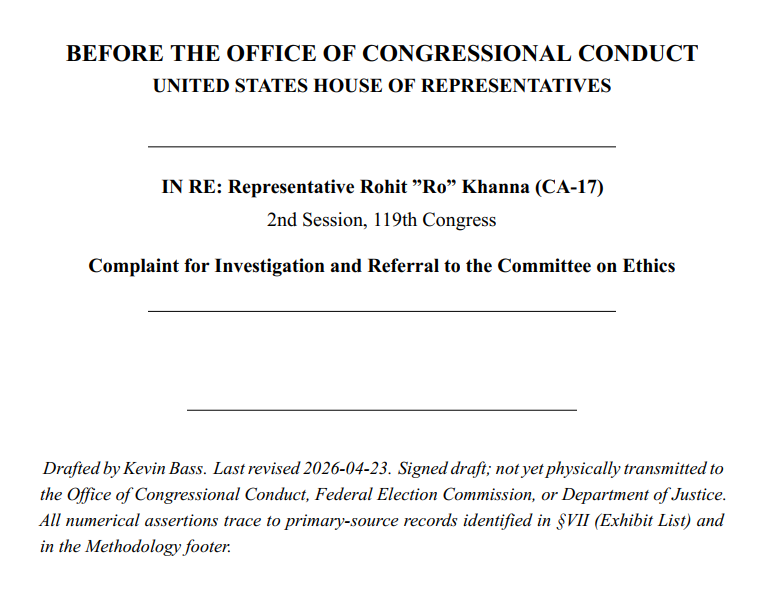
I have conducted the most comprehensive public records audit of any Congressman in the history of the United States.
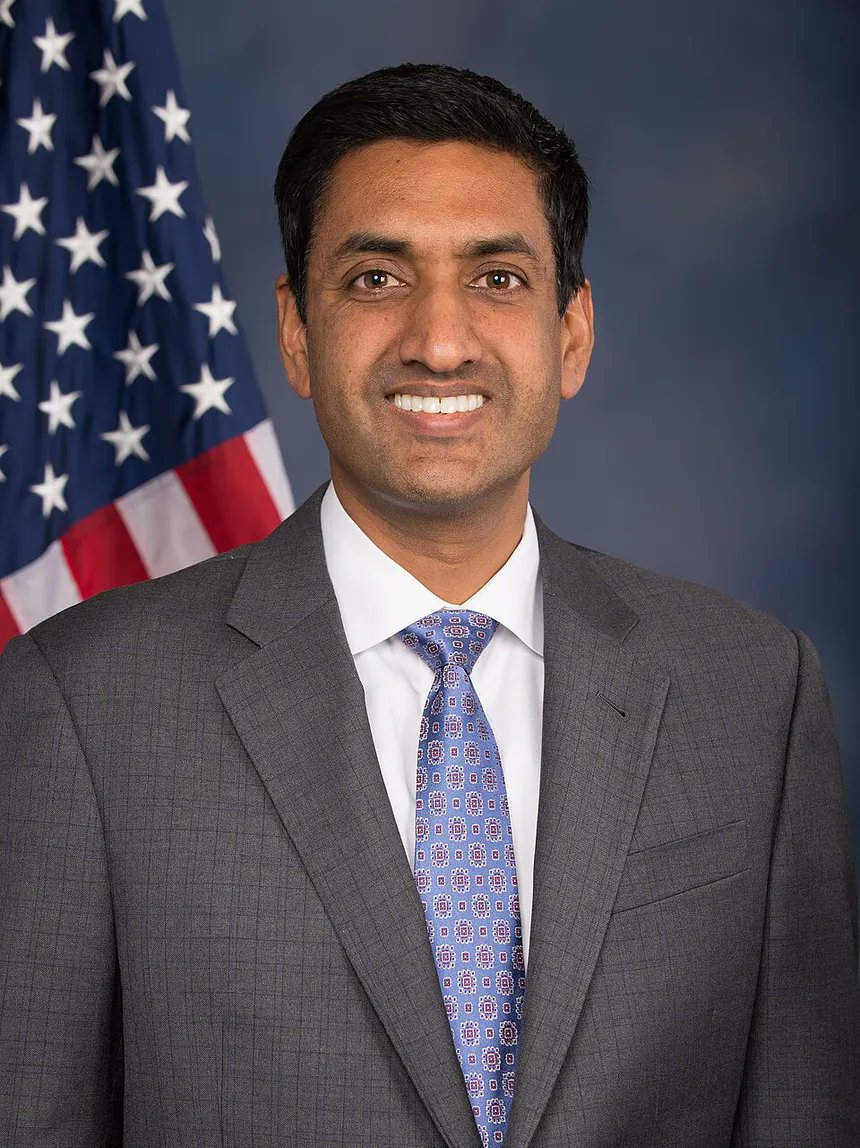
That audit was conducted on Congressman @RoKhanna.
This audit has exposed shocking ethical lapses and potentially criminal behavior by Congressman Khanna.
I am filing a 239-page ethics complaint, including 30 evidentiary exhibits, with the Office of Congressional Conduct (OCC), to be followed by complaints to the House Ethics Committee and the Department of Justice (DOJ) in the coming days.
Besides being based on an extremely comprehensive public records audit, the complaint is the first of its kind in another way: the factual basis of every single specific claim in the complaint is fully verifiable and reproducible by anyone with a computer.
Attached to this post is a link to the GitHub Release containing the complete reproducibility kit. Anyone with Python 3 and the GitHub CLI installed can download it and run a single command — `python https://t.co/IFYR1uU2LR` — which walks them through the analysis at whatever verification depth they pick:
1. A 30-second offline check that every body figure derives from the bundled snapshots;
2. A primary-source spot-check that re-fetches the underlying records from the House Clerk and IRS and confirms the bytes match;
3. An OpenTimestamps proof that the package existed at publication time and wasn't backfilled; and
4. An opt-in path that lets the reviewer re-run the OCR pipeline themselves against the primary-source PDFs.
This means that any person in the world can confirm for themselves that all statements made in this complaint are fully reproducible and true.
---
The complaint asserts the following:
Representative Ro Khanna is a Democratic congressman from California's 17th District (basically Silicon Valley). He has been in Congress since January 2017. He is currently in his fifth term.
Khanna has done six different things wrong.
Each one is bad enough to investigate on its own.
Together, they are very bad.
His family's stock trades line up suspiciously with the committees he sits on, the donors who fund him, and the votes he takes.
That's bad.
Khanna's household made between $15 million and $108 million from these trades, with a middle estimate of about $61 million.
The estimate cannot be made any better than this. The disclosure forms provide only disclosure "bands". Precise amounts can only be determined with subpoena power.
But we do have one hard number:
Compared to just buying a basic stock-market index fund, his family beat the market by about $28 million.
$28 million.
The complaint says that Congressman Khanna should pay this money back.
Now, how the trading actually works in this household is important because it helps us to understanding everything else, so I will explain that now.
Khanna himself has filed 114 reports with the House Clerk listing every trade his household has made. Those reports cover 37,238 individual trades. That's a huge amount. Most members of Congress don't trade nearly that much.
But here's the kicker.
Almost none of those trades are in Khanna's own name.
99.997% of them are listed as belonging to either his wife (Ritu Ahuja Khanna) or his dependent child.
That's basically all Khanna trades. A massive volume.
Yet virtually none in his own name.
Curious.
Khanna has publicly said this is fine because the trading is done through what's called a "separately managed account" or "blind trust", meaning a broker or trustee makes the decisions without telling him.
If that were true, he'd be off the hook because he wouldn't know what was being bought or sold.
The complaint says that's not true. When you read his official financial disclosure form (the one he signs every year), it shows:
> No separately managed account
> No blind trust
> No third-party broker handling the actively-traded stocks
Instead, the trades come from about a dozen family trusts (the Ritu Ahuja 1994 Trust, the Ritu Ahuja 1995 Trust, the Ahuja Children's Trust, etc.).
These are family-controlled entities.
Whoever's making the trade decisions is a family member. His wife or his child. (Put another way: his "wife" or his "child".) Not an outside professional.
Uh oh.
The "I didn't know what my spouse was trading" defense doesn't work. Nothing on the official paperwork supports it.
Think about it.
Do you think Khanna and his wife sit around and his wife is just buying Palantir stocks, while, by coincidence, Khanna sits on the defense tech committee?
And they don't talk?
That's the framework. But it gets a whole lot worse.
Because the complaint isn't undergirded merely by this speculation. But by hard evidence.
The complaint makes six specific allegations, or "counts".
---
COUNT 1: Filing trade reports late
This sounds like a technical detail, but it is not. It is the pattern of misbehavior that enabled everything else.
When a member of Congress, their spouse, or their kid makes a stock trade worth more than $1,000, they have to report it within 45 days. That's the STOCK Act, passed in 2012. Each late report costs at least $200 in fines.
Out of about 36,000 auditable trades made by Khanna, 624 were filed late.
The worst one was 358 days late -- almost a full year. A trade in HUMANA stock made in October 2023 wasn't reported until November 2024.
The complaint provides a calculation of how Khanna fares compared to other Congressmen in terms of how often he is late in filing.
Khanna's rate of late filing (1.74%) is better than most members of Congress. The average House member is late on 10% of trades.
So if you measured just the percentage, he'd look fine.
But here's where things get crazy.
The complaint uses a special "composite score" that combines (1) how much money is involved, (2) how late, and (3) how many trades.
By that score, Khanna ranks in the top 7% of the entire House.
This means that Khanna's late filings expose more dollars to delayed disclosure than 93% of members.
A late report means the public can't see what a member of Congress is buying or selling at the time it happens.
By the time it's disclosed, the value of the inside information is gone.
The late filings are not hitting Khanna on a technicality.
They imply that the entire system designed to prevent insider trading in Congress is broken inside Khanna's office.
The 45-day disclosure rule is not a paperwork deadline. It is the security camera. It is the only mechanism that lets the public see what a Congressman is buying while the trade still matters -- while the bill is still being debated, while the FDA decision is still pending, while the news is still fresh.
When Khanna files 358 days late, the camera is off. By the time anyone sees the trade, the moment has passed. The witnesses have moved on. The dots cannot be connected.
A few late filings is a paperwork mistake. 624 of them, on a household making 37,000 trades, in the exact industries Khanna's committees regulate, is a system.
It is Khanna's system. It is how he does his dirty work.
And it is the system that lets every other count in this complaint happen in the dark.
Until now.
The complaint asks for:
1. Civil penalties for the late filings.
2. A requirement that Khanna set up an actual qualified blind trust going forward.
3. An Ethics Committee finding under House Rule XXIII that the absolute-count and composite-score chamber rankings reflect conduct that does not reflect creditably on the House.
---
COUNT 2: Buying defense stocks right before defense bills pass
Members of Congress can't trade based on inside information they got from doing their congressional job (the STOCK Act, sections 3 and 4).
Khanna sits on the House Armed Services Committee, which writes the giant yearly defense bill (the NDAA).
And across four different years, his household bought stock in big defense contractors (Boeing, Lockheed Martin, Northrop Grumman, Raytheon, etc.) right before the NDAA passed:
> 7 defense stock buys 12 days before the 2018 NDAA
> 4 defense stock buys 4 days before the 2021 NDAA override
> 1 Palantir buy 13 days before the 2022 NDAA
> 2 Raytheon buys 2 days before the 2024 NDAA
Khanna publicly voted NO on 12 of 13 of these NDAA passage votes.
So he's saying "I oppose this bill" with his vote.
But his family is buying stock in the companies that would benefit from it passing.
That, of course, is insane.
The complaint argues this is the worst version of the conflict:
Khanna gets the political credit for opposing the bill.
Meanwhile, he makes money from insider knowledge from sitting on the Committee, knowing it would pass anyway.
In addition.
Khanna sits on a committee that oversees defense contracts. The data analytics company Palantir got $4.88 billion in federal contracts during his time in Congress.
On at least nine separate days, Palantir got a federal contract AND Khanna's household bought Palantir stock the same day.
One of these was a $19 million Air Force contract on May 10, 2022: the same day his dependent child's account made six separate Palantir trades.
Khanna's defense trades made about $5.4 million in profits beyond what the broader market did, suggesting that Khanna was using his insider knowledge -- through the intermediary of his dependent child -- to beat the market.
What the complaint asks for:
1. Send to House Ethics.
2. Send to DOJ for possible criminal charges.
3. Force Khanna to give back the $5.4 million.
---
COUNT 3: Buying drug company stocks right before government drug actions
COUNT 3 is the same as COUNT 2, except healthcare stocks instead of defense stocks.
Yes, Khanna is doing the same thing across stock classes. Of course.
Khanna sits on a committee that oversees the agencies regulating drug companies (HHS, CMS, FDA). The complaint identifies 14 different government drug-pricing actions between 2017 and 2024 where Khanna's household made pharmaceutical-company trades within 14 days of the action.
1,244 pharmaceutical-sector trades clustered within ±14 days of these events. That's chamber rank 1 of 66 House members, 14 times the chamber 95th-percentile.
The biggest example: On August 2, 2024, Khanna's family made 286 trades in a single-day rebalance.
Hidden inside was simultaneous trading in four of the nine drug companies (AbbVie, Amgen, Johnson & Johnson, Merck) whose drugs were going to be on the government's negotiated-price list.
That list was published 13 days later, on August 15, 2024.
It was confidential and not yet public on the day of the trades.
But Khanna had insider access to the list. And made the flurry of trades that aligned with it at precisely the right time.
Two other "conflict triangles" the complaint highlights:
1. Palantir (already mentioned in Count 2): Khanna chairs the China select committee and is a top member on the cyber subcommittee. Palantir is a defense tech company affected by both. His family has done 29 Palantir trades and gotten $22,700 in donations from Palantir's chief operating officer.
2. Nvidia: In 2024, Khanna's family donated 10,076 shares of Nvidia stock (worth about $1.67 million when given, much more later as the stock soared) to a family foundation. In the same year, he voted NO on a chips bill, voted YES on four China-policy bills, and continued chairing the China committee. This is the committee that has the most influence over Nvidia's massive AI chip business.
3. The Goldman Sachs margin loan setup: Across 2017-2019, Khanna's spouse had two simultaneous Goldman Sachs margin loans (basically borrowing money against stocks to buy more stocks).
Each loan was labeled as belonging to a family trust ("Ritu Ahuja 1994 Trust" and "Ritu Ahuja 1995 Trust"). This same Goldman Sachs is also the broker for a sophisticated short-volatility options trading program in the spouse's account, and Goldman employees have donated about $48,000 to Khanna over the years.
You can't run an options trading program on a margin account passively; somebody (the spouse) has to authorize each trade.
What COUNT 3 asks for: Same as COUNT 2:
1. Send to Ethics.
2. Send to DOJ.
3. Force Khanna to step away from CMS, FDA, and defense matters pending investigation.
---
COUNT 4: Khanna's family trades line up with insider events at the issuer level — same-day SEC filings and same-day insider trades
The single sharpest count in the complaint.
The legal hook is the STOCK Act §§ 3-4, codified at 15 U.S.C. § 78u-1(g) — the federal statute that extends Rule 10b-5 insider-trading prohibitions directly to Members of Congress who trade on material non-public information acquired through their legislative or oversight duties.
Khanna's household trades are not just suspicious because of how many they are. They are suspicious because they happen at very specific moments.
Two examples:
> 186 of his household's trades happened on the same calendar day that the company in question filed important news with the SEC (Form 8-K — the disclosure form companies file for material acquisitions, executive changes, regulatory actions, and the other news events the SEC requires public companies to disclose immediately).
> 86 of his household's trades happened on the same calendar day that a named officer at the same company (CEO, CFO, board member) was buying or selling their own stock in the same direction.
On each of these patterns, Khanna ranks at the top of the entire House:
> Same-day-8-K count: rank 1 of 96 House Members. 4.3 times more than the second-place Member.
> Same-day-aligned-insider count: rank 3 of 156 House Members.
The complaint does NOT allege that Khanna's RATE of same-day-8-K trading is exceptionally high. As a percentage of his trades, his same-day-8-K rate is 5.4% — which is above the chamber median (4.5%) but inside the normal band. The complaint discloses this candidly, up front, to pre-empt the inevitable "his rate is in-band" defense.
The argument is about ABSOLUTE count combined with ticker-specificity: the same-day intersections concentrate on companies in sectors his committees regulate.
These two findings join two more from Count 3:
> 4,595 pharmaceutical trades within 14 days of FDA Advisory Committee meetings. Rank 1 of 66 House Members. 6.1 times the second-place Member.
> 1,244 pharmaceutical trades within 14 days of CMS rulemaking events. Rank 1 of 66 House Members. 14 times chamber P95.
Across four independent issuer-event and regulator-event substrates — SEC 8-K filings, named-officer Form 3/4/5 filings, FDA Advisory Committee calendar, CMS rulemaking calendar — Khanna's household ranks first or third by absolute count. The four substrates are independent: different agencies, different filer classes, different denominators. The convergence is structurally inconsistent with portfolio management that doesn't draw on contemporaneous information advantage.
The complaint asks for:
1. Ethics Committee referral for full investigation.
2. DOJ referral for criminal review under 15 U.S.C. § 78ff (Exchange Act criminal penalty) if any single windowed trade reflects willful use of material non-public information.
3. Disgorgement under STOCK Act § 9 of any profit attributable to same-day-issuer-event or same-day-officer-aligned trading.
4. A House Rule XXIII finding that the four-substrate convergence reflects conduct that does not reflect creditably on the House.
---
COUNT 5: Ex-government officials who became lobbyists are donating to him
The law says that federal officials who leave government can't immediately go lobby their old agencies. Various waiting periods apply, and the lifetime ban (18 U.S.C. § 207(a)(1)) prevents them from ever working on the same specific matters they personally worked on in government.
Yet, five former federal officials, who all later became registered lobbyists, donated to Khanna's campaign. Each one's old job lines up with what they're now lobbying about:
1. Chris Israel. Former Deputy Assistant Commerce Secretary. Now lobbies for tech and pharma companies (Qualcomm, AbbVie, PhRMA). Donated $1,000 (one $500 check was refunded within 24 hours).
2. Arshi Siddiqui. Former senior staffer to Speaker Pelosi. Now a partner at Akin Gump, lobbying on Armed Services issues for RTX (Raytheon) and Honeywell. Donated $2,000.
3. Francisco Sanchez. Former Obama Commerce Department Under Secretary for International Trade. Now lobbies on international trade issues. Donated $1,250.
4. Kevin Batteh. Former CFTC counsel. Now lobbies on CFTC and DoD issues for Citadel and D.E. Shaw. Donated $1,000.
5. Robert Taylor. The most damning case. Former Deputy Assistant Secretary of Defense for Senate Affairs. Now lobbies for Boeing, BAE Systems, Aerojet Rocketdyne, Textron — the exact defense contractors his old job covered. Donated $1,000 (NOT refunded). Khanna sits on Armed Services.
Their employees too: The companies these lobbyists work for collectively gave $365,140 across 264 individual contributions to Khanna.
Khanna says he doesn't take corporate PAC money. But the corporations' executives give to him personally.
Lobbyists are required to disclose their political contributions. Two of the five lobbyists hid the Khanna donations from their required reports. Robert Taylor's case is the worst: he affirmatively certified "I made no contributions" while a Khanna donation was sitting in the period.
The complaint asks for:
1. DOJ referral for the lifetime-ban review (especially Robert Taylor).
2. DOJ referral for Taylor's allegedly false lobbying disclosure.
3. FEC audit.
COUNT 6: The Ahuja family foundation and a missing rental property
Three problems.
PROBLEM 1: Khanna's family foundation isn't disclosed as a spouse asset
Remember how 99.997% of the trades made by Khanna are made either through his spouse or his child?
His wife's Ahuja Charitable Foundation is a $45 million private family foundation. His wife Ritu Ahuja Khanna, is:
> A named trustee every year from 2018 through 2024 (according to the foundation's own IRS filings)
> A substantial contributor for tax years 2022, 2023, and 2024 (also per IRS filings)
The foundation owns massive amounts of stock in defense companies (Honeywell, L3Harris, TransDigm, Boeing, GE Vernova) and healthcare companies, again exactly the sectors Khanna's committees oversee.
Khanna's annual financial disclosures don't mention the foundation as a spouse-held asset at all. And they don't mention his wife's trustee role. Federal ethics law (5 U.S.C. § 13104(d)(1)(A)) requires members to disclose their spouse's income from nonprofit positions where the spouse has decision-making power. The complaint says the Ethics Committee should decide whether this should have been disclosed.
Now, in 2024, Khanna's wife "donated" 2,821 shares of Nvidia to the Foundation, and the related Ahuja family trust donated 7,255 more shares
This was a combined 10,076 shares of Nvidia worth $1.67 million at donation time (much more later).
This happened the same year Khanna voted on multiple chip and China bills and continued chairing the China committee.
PROBLEM 2: A rental property in Dover, Delaware is missing
In tax year 2021, Khanna disclosed a $100,000-$250,000 mortgage from "First Bank of Wilmington, Delaware" tied to a Dover, Delaware rental property.
But across ten years of disclosures (2014-2023), the Dover, Delaware property itself never appears as an asset. Federal law says any rental property worth more than $1,000 has to be disclosed.
And here's the killer: Every other rental property the household owns (Cincinnati OH, Denham LA, Walton Hills OH, Harahan LA, an NY condo, Walton OH) is correctly disclosed both as an asset AND with the rental income.
Only Dover, Delaware is missing on both sides. So the household clearly knows how to fill out the form. They just didn't for this one property.
Why?
What's special about that property?
The public deserves to know if Khanna is hiding something.
PROBLEM 3: Margin loans and options trading prove there's no blind trust
Across 2017-2020, Khanna's spouse had Goldman Sachs margin loans (borrowing against stocks). At the same time, the household was running a sophisticated options trading program. They were writing PUT options on the spouse-owned account.
Under brokerage rules, writing options on a margin account requires personal customer authorization. You can't run an options program with a passive blind trust.
The "I have no idea what my spouse is trading" defense is impossible.
Khanna knew. And he was breaking the rules.
The complaint asks for:
1. Ethics Committee review of the foundation question.
2. Per-year corrective filings on the Dover property.
3. Civil penalties.
4. A possible "honest services" fraud referral if the Ethics Committee finds intentional concealment.
---
How much money Khanna made
> $61 million in profits the family made from these trades (middle estimate)
> $28 million of that is "alpha" — money beyond what just buying an index fund would have earned
> 41% of those profits ($25.2 million) came from trades made within two weeks of an event Khanna could have known about because of his job
> The complaint asks for that money to be paid back (called "disgorgement") under STOCK Act penalty rules
What the complaint asks
1. The Office of Congressional Conduct should investigate and refer the case to the House Ethics Committee for a real investigation
2. Parts of it should go to the FEC for the LD-203 lobbyist-contribution-disclosure compliance audit
3. Parts of it should go to the DOJ for possible criminal review (insider trading under 15 U.S.C. § 78u-1(g) and § 78ff; lifetime lobbying ban violations under 18 U.S.C. § 207; false statements on lobbyist disclosure filings under 18 U.S.C. § 1001 and 2 U.S.C. § 1606)
4. Khanna should set up an actual blind trust to prevent this in the future
5. He should recuse himself from CMS, FDA, and defense matters while it's being investigated
6. The roughly $28 million in market-beating profits should be returned