#Gold versus #USD
... Gold bullion accounted for 27 percent of all global central bank reserves at the end of 2025, a marked jump from the level of 20 percent at the end of 2024.
Some of this was a result of the rapid increase in the price of gold in 2025 when it rose by 60 percent, which boosted the value of central bank holdings, despite a small slowdown in purchases from more than 1,000 tonnes over the previous three years to 850 tonnes.
However, the trend is unmistakable. Correspondingly, the share of the US Treasury bonds fell from 25 percent to 22 percent over the last year. Dollar-denominated assets remained the highest proportion of reserves, coming in at 42 percent.
---
ECB reports shift away from US Treasury bonds towards gold
@BeamsNick
- World Socialist Web Site
https://t.co/HAs8L194Pp
Curtis Mayfield (1942)–“One of the most talented rhythm & blues singer/songwriters and producers to emerge in the early 1960s...[His] tenor voice, distinctive guitar phrasing & intelligent songwriting [produced] some of the most subtle & evocative popular music of his generation”
#Cuba#Castro
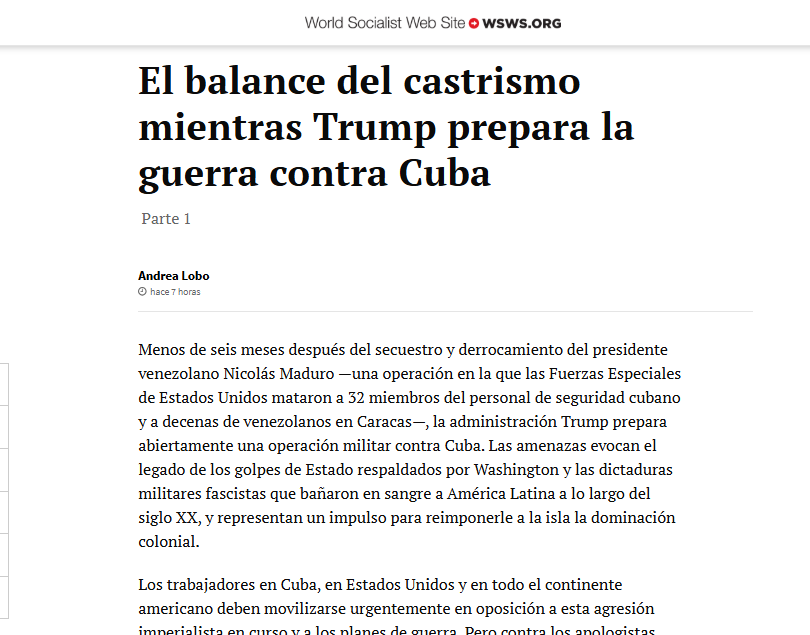
El balance del castrismo mientras Trump prepara la guerra contra Cuba
Parte 1
- World Socialist Web Site
https://t.co/OXYNP1h7JS
... Cuando llegó la revolución de 1959, no fue principalmente el foco guerrillero en Sierra Maestra el que derribó a Batista. Fue el movimiento huelguístico masivo en las ciudades el que paralizó su régimen y lo tornó insostenible. El movimiento castrista llenó un vacío político creado por el colapso de la autoridad de Batista y la ausencia de una dirección revolucionaria de la clase obrera capaz de disputar el poder.
Este es un punto crucial: el triunfo del Movimiento 26 de Julio de Castro no fue una confirmación de la guerra de guerrillas como camino al poder, sino una demostración de que, privada de dirección revolucionaria, la clase obrera sólo puede ser testigo de cómo los movimientos nacionalistas burgueses heredan el Estado como supervisores de una explotación capitalista continua.
El gobierno de Eisenhower y luego el de Kennedy se rehusaron a negociar con quienes habían depuesto a su marioneta en La Habana, o a aceptar siquiera reformas agrarias mínimas y otras medidas exigidas por las masas. En cambio, suspendieron la importación de azúcar cubano, imponiendo un embargo comercial estadounidense casi total. El gobierno castrista que emergió de este proceso respondió, por necesidad económica, con nacionalizaciones masivas de las plantaciones, los servicios públicos, los ferrocarriles, los hoteles y las industrias de propiedad estadounidense.
Tras recurrir a la burocracia estalinista de la Unión Soviética en busca de ayuda, Castro implementó programas que lograron conquistas sociales genuinas en alfabetización, salud pública y educación. Estos logros fueron reales, pero se alcanzaron dentro de un aparato estatal que siguió siendo fundamentalmente capitalista en su carácter de clase, y bajo condiciones de total subordinación política de Cuba a la política exterior contrarrevolucionaria de Moscú.
La dependencia estructural de la economía cubana del patrocinio externo confirmó que los trabajadores no podían ni pueden salvaguardar las conquistas sociales restantes de ese período a través del gobierno castrista. El liderazgo nacionalista burgués cubano siempre ha necesitado un patrocinador para mantener a flote su economía. Durante la Guerra Fría, ese patrocinador fue la Unión Soviética. Tras la disolución de la URSS, fue Venezuela y, en un sentido más limitado y a corto plazo, México.
Toda una capa del liderazgo militar y partidario cubano se enriqueció a través del acceso privilegiado a los ingresos del turismo y las empresas conjuntas con capital europeo y canadiense. En la última década, el gasto en turismo y hoteles ha eclipsado todas las demás prioridades de inversión. En 2024, el Estado cubano concentró el 37,4 por ciento de todas las inversiones en la construcción de complejos turísticos, una cifra once veces mayor que el gasto en educación y salud combinados.
... más
The march brought together leading Democrats, billionaires, police officials and a fascist delegation from the Israeli state, including Smotrich, Eliyahu and Sofer - Democrats and Mamdani administration provide platform for Israel Day pro-genocide march
https://t.co/I3FhbVAg01
A reply to Edward Luce of the Financial Times on youth radicalization
@DavidNorthWSWS
https://t.co/M7xbibZl6B
"The radicalism of the youth of the 1960s was not “drug inspired.” It was a response to Vietnam, the struggle for civil rights, and, even more fundamentally, the fresh and not-forgotten horrors of the two World Wars. The 1917 October Revolution had not disappeared from memory, capitalism and anti-communism were in bad odor, Stalinism was increasingly discredited, and there was a revival of interest in Trotsky, whose extraordinary books were recognized as political and literary masterworks. This resurgence was suppressed by the reactionary political climate of the Reagan-Thatcher years to which Mr. Luce was exposed, to his own misfortune, during his intellectually formative years.
But Mr. Luce correctly detects a process of radicalization among the world’s youth. The question is, at what point will this radicalization break beyond the bounds of the media-vetted pseudo-leftism of people like Sanders and Mamdani and reestablish contact with the genuine Marxian-socialist political perspective and culture that was exemplified in the October Revolution and figures like Lenin, Trotsky and Luxemburg. This break must and will occur, and the rediscovery of Trotsky’s extraordinary political legacy and writings will be a critical element of the reemergence of Marxism as a mass socialist movement based on the working class.
The World Socialist Web Site has posted a preface I have written to a new edition of Trotsky’s autobiography, My Life."
https://t.co/5zk10WsRs0
- World Socialist Web Site
The AEU in Victoria has five people on the executive each earning quarter million-dollar salaries. So, it’s interesting to see how the union officials can use language about solidarity when they earn so much more than the people they are supposedly representing.
Workers in Cuba, the United States and across the Americas must urgently mobilize in opposition to this ongoing imperialist aggression and the plans for war.
The balance sheet of Castroism as Trump prepares war on Cuba - World Socialist Web Site https://t.co/35bWDqjt8T
Successful meeting at Berlin’s Humboldt University calls for the freedom of Bogdan Syrotiuk
The meeting took place at a time when Bogdan’s trial is at a critical turning point. #FreeBogdan https://t.co/sZvpOiZIgo
#Marx#PoliticalEconomy#ClassStruggle
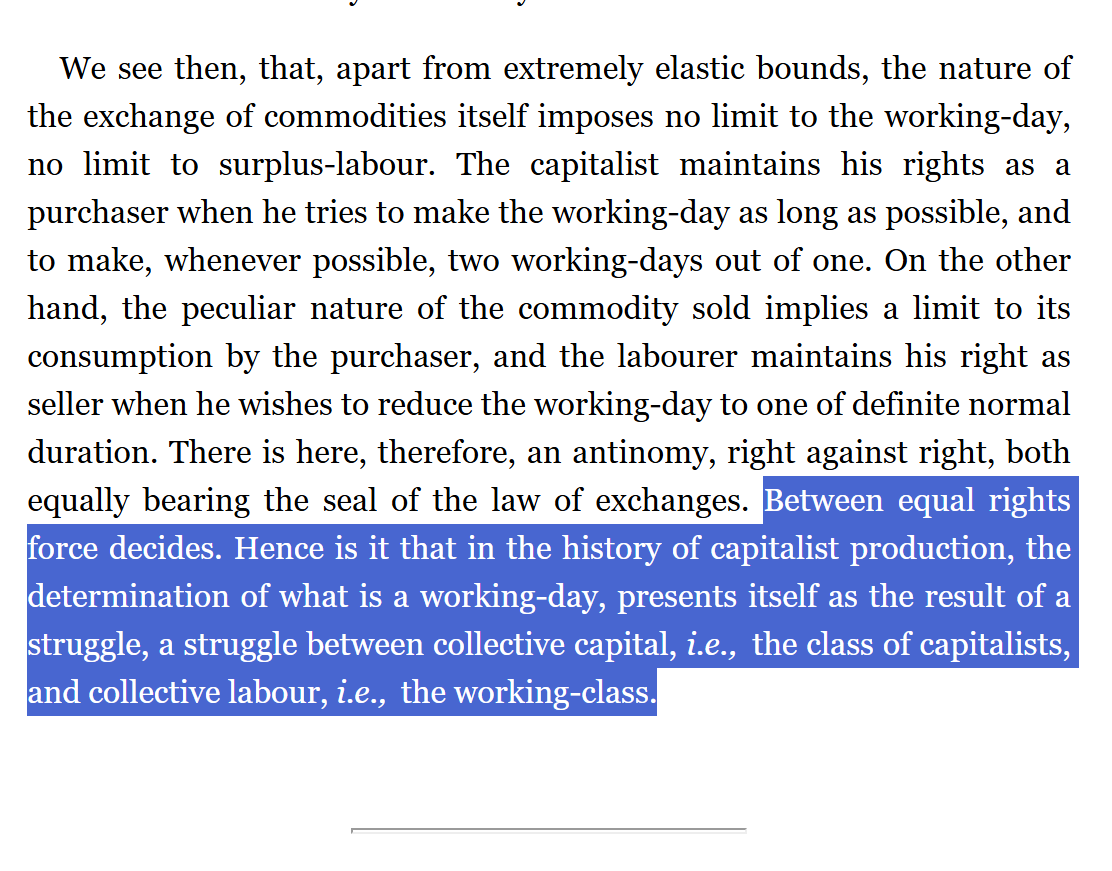
Capital Vol. 1 (Marx, 1867)
"Between equal rights force decides."
IN CONTEXT
... The capitalist maintains his rights as a purchaser when he tries to make the working-day as long as possible, and to make, whenever possible, two working-days out of one. On the other hand, the peculiar nature of the commodity sold implies a limit to its consumption by the purchaser, and the labourer maintains his right as seller when he wishes to reduce the working-day to one of definite normal duration. There is here, therefore, an antinomy, right against right, both equally bearing the seal of the law of exchanges. Between equal rights force decides. Hence is it that in the history of capitalist production, the determination of what is a working-day, presents itself as the result of a struggle, a struggle between collective capital, i.e., the class of capitalists, and collective labour, i.e., the working-class.
SOURCE:
Capital Vol. 1, Chapter Ten: The Working-Day SECTION 1 THE LIMITS OF THE WORKING-DAY (Marx, 1867) https://t.co/T7ipfdpWBU
VIDEO (WSWS/SEP):
Trotsky, Stalin and the 1926 British General Strike: lessons for today
https://t.co/UhkR6m4NbR
4 Jun 2026
(55 mins)
There are few more bitterly contested and less clearly understood historical experiences than the general strike of 1926, despite it being a decisive moment in the history of the British and international working class.
"No, it's because Israel is a proxy for US imperialism in the Middle East."
INDEED!
---
The reality of US-Israel relations—Part 1 of 3
https://t.co/7nQqBlnvXw
The reality of US-Israel relations—Part 2 of 3
https://t.co/kGclb5uk17
The reality of US-Israel relations—Part 3 of 3
https://t.co/gySUU75GRL
- World Socialist Web Site
Israel became known as “America’s aircraft carrier.” In 1985, the US concluded its first-ever free trade agreement with Israel, and then designated it a non‑NATO ally, embedding Israel within its security ecosystem - The reality of US-Israel relations—2
https://t.co/79ZzeheWED
#Chile
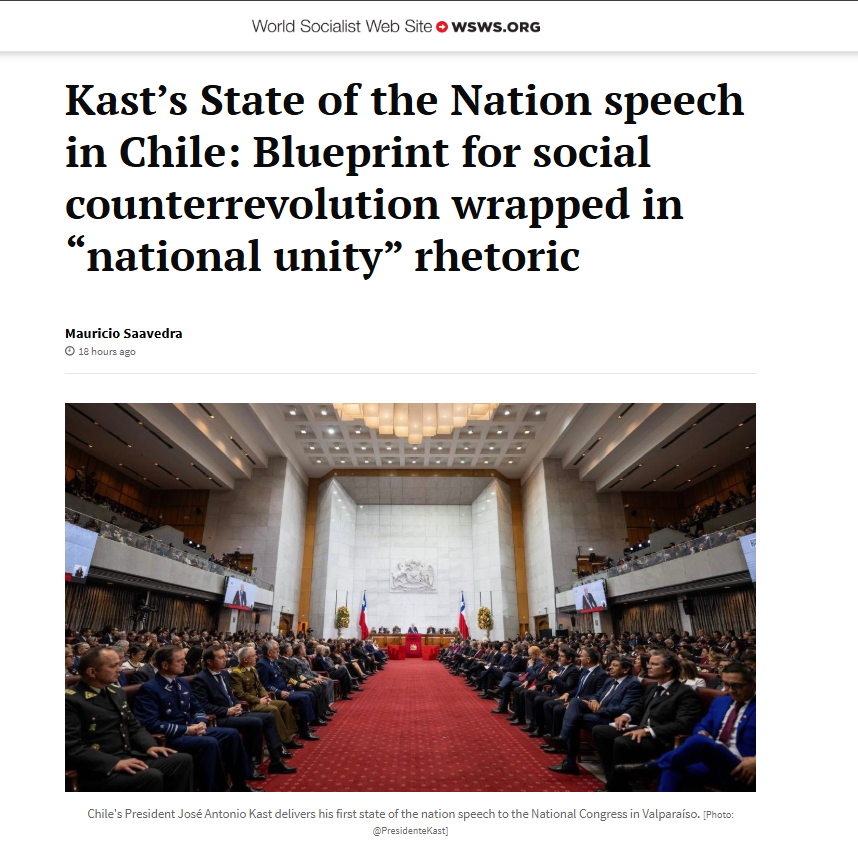
Kast’s State of the Nation speech in Chile: Blueprint for social counterrevolution wrapped in “national unity” rhetoric
- World Socialist Web Site
https://t.co/PzhXozIxNI
... “Every peso the government allocates to pay interest on a mismanaged debt is one less peso we have for security, for health, for education, for pensions, for housing,” Kast said, before pivoting to the real agenda: corporate tax cuts, deregulation and the unlocking of stalled investment projects. He boasted that $13.9 billion in investment was approved in May alone—the highest amount in 11 years—and that 389 projects representing nearly $89 billion are undergoing environmental assessment.
This is the language of the oligarchy. The “investment” Kast celebrates is the mechanism by which finance capital and the transnational corporations will extract wealth from Chilean labor and Chilean natural resources. The streamlining of environmental permits, the reduction of corporate tax rates from 27 to 23 percent, the tax stability guarantees for large investors—these are not technocratic adjustments. They are the policy instruments of class expropriation, directly modeled on Pinochet’s Decree Law 600.
Kast was explicit about the class logic: “The dilemma between popularity and responsibility—we’ve already resolved it. We resolved that dilemma in favor of responsibility.” To put it more bluntly, the needs of the working class will be sacrificed to the demands of capital, and this will be done with no apologies.
Marxists, including the Bolsheviks, consistently opposed Zionism as a reactionary nationalist ideology that divided the Jewish and Arab working class, directed the Jewish workers away from the socialist struggle and toward an alliance with imperialism.





![DavidWSWSarts's tweet photo. Curtis Mayfield (1942)–“One of the most talented rhythm & blues singer/songwriters and producers to emerge in the early 1960s...[His] tenor voice, distinctive guitar phrasing & intelligent songwriting [produced] some of the most subtle & evocative popular music of his generation” https://t.co/08F5QHCltd](https://pbs.twimg.com/media/HJ5mUs_XAAAsrYW.jpg)