This hilarious French guy just cracked me up!!
From his first Texas brisket to mind blowing Costco runs, friendly strangers saying hi, and waiters treating him like family, he is completely smitten.
He even said he would start a revolution to bring Costco to France. Proof that sometimes it takes a visitor to remind us how good we have it. Merci mon ami.
We are still keeping the ranch on pizza debate going though. 😂😅🛒
Guys. I’m tired. So tired. This country. This president. This world. This Congress. Two 86 year old parents about to leave. Thankless job. Husband let go right before retirement. The cost of life is INSANE.
I just want some peace.
The National Desk went and investigated inside the drug factories making medicine for America in India
They found they are cheating tests and making our drugs in “secret locations not approved by the FDA”
“They told our crew to destroy the footage”
“Adverse events, including death happen on a daily basis here in the U.S. Falsified data, filth and contaminated facilities. Some with secret locations unapproved by the FDA, but making medications bound for America. This affects every single one of us”
If you sometimes feel like your medicine doesn’t work, this is why
Private equity firms bought 500 hospitals. Death rates in their emergency rooms went up 13%. They fired 12% of the staff. Then they paid themselves billions in dividends.
A Harvard study just confirmed what doctors already knew: people are dying so investors can hit quarterly targets.
Exactly what happens. A PE firm buys a hospital using debt. The debt gets placed on the hospital's balance sheet, not the firm's. Now the hospital owes hundreds of millions it never borrowed. To service that debt, the hospital cuts costs. Costs mean nurses.
The numbers from the Harvard/University of Chicago study are horrifying. After PE acquisition, emergency department salary spending dropped 18.2%. ICU salary spending dropped 15.9%. Hospital-wide employees were cut 11.6%. Emergency department deaths rose 13%, seven additional deaths per 10,000 visits.
A separate study found patients undergoing surgery at PE-acquired hospitals had 17% higher odds of dying within 90 days.
Steward Health Care, owned by Cerberus Capital, filed bankruptcy with $9 billion in debt after closing hospitals across Massachusetts. The CEO lived on a $40 million yacht while emergency rooms went dark. Eight hospitals serving 2 million people nearly disappeared because a PE fund extracted more cash than the system could survive.
The private equity industry has poured over $1 trillion into healthcare. They operate a quarter of ERs nationwide. This isn't going away.
The investing angle nobody talks about.
Non-PE hospital operators like HCA Healthcare (HCA) and Tenet (THC) are the direct beneficiaries. Every time a PE hospital closes or deteriorates, patients flow to the nearest competitor. HCA has returned 1,200% since 2011. Patient volume from PE closures is a structural tailwind nobody's pricing in.
Medical staffing firms (AMN Healthcare, Cross Country) charge premium rates specifically because PE hospitals cut staff. The staffing shortage IS the business model for these companies.
The disruption play: outpatient surgical centers (SCA Health, now part of UnitedHealth) are pulling profitable procedures out of hospitals entirely. PE-owned hospitals lose their highest-margin surgeries to outpatient, and the death spiral accelerates.
Pull up tradevision and monitor healthcare M&A alerts, hospital closure filings, and patient volume migration data. When a PE-owned hospital announces "restructuring," the patient volume shift to competitors like HCA starts within 30 days. That 30-day window is when the competitor's earnings revisions haven't updated yet. Free to try.
(a private equity firm bought your local hospital. borrowed $500 million in the hospital's name. fired 12% of the nurses. emergency room deaths rose 13%. then they paid themselves dividends. nobody went to prison. they're currently buying another hospital.)
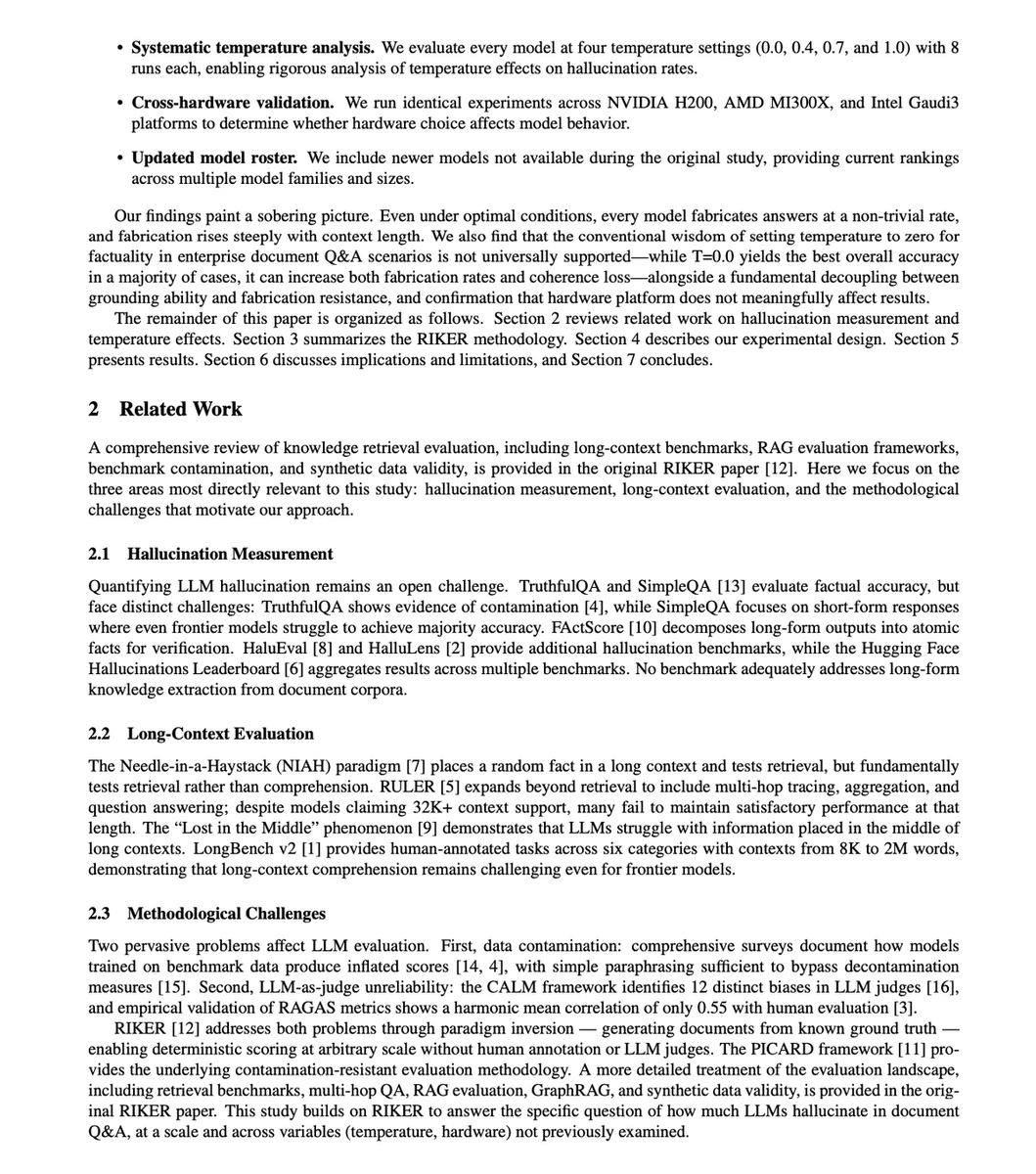
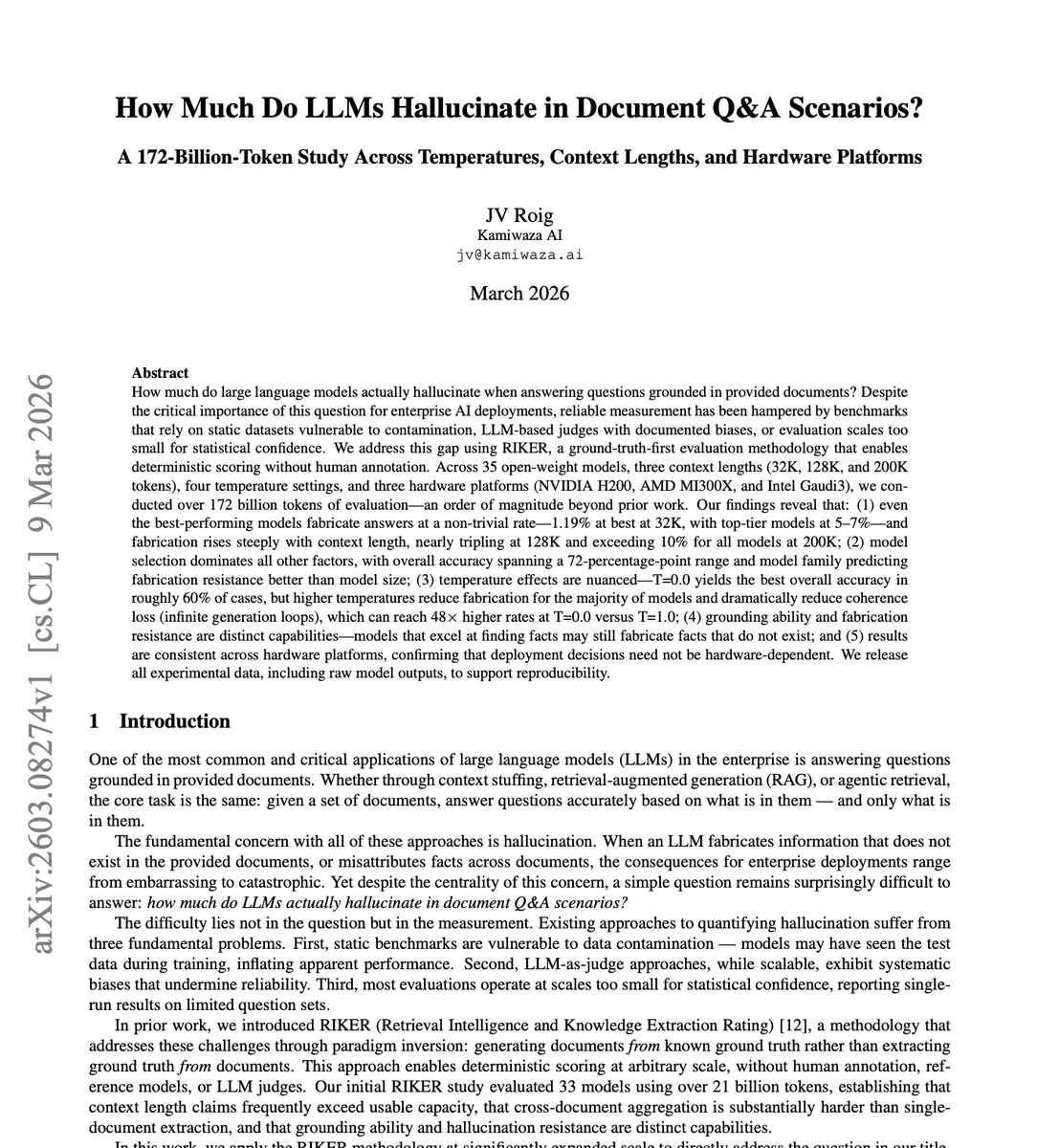
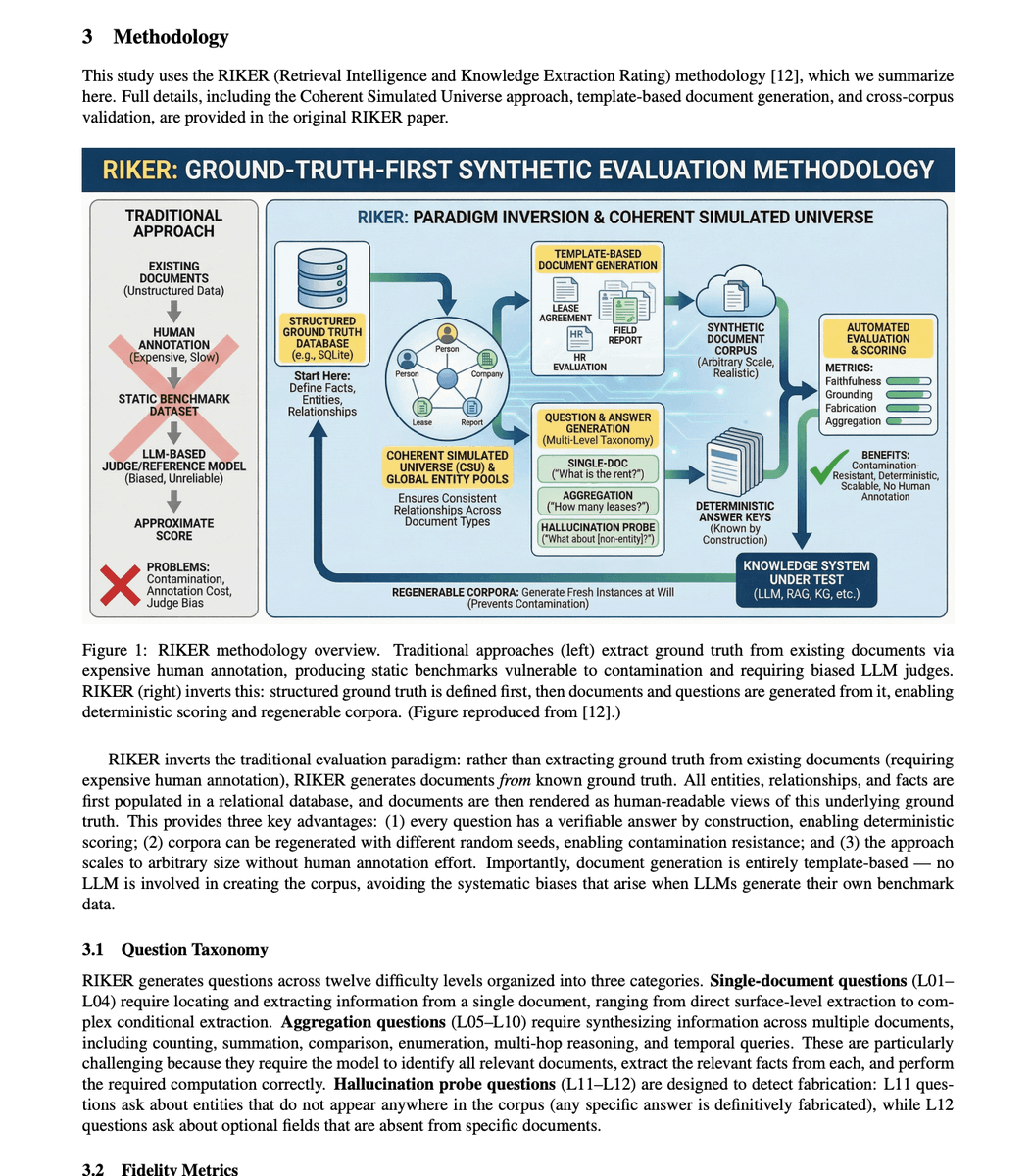
BREAKING: 🚨 Someone just tested 35 AI models across 172 billion tokens of real document questions.
The hallucination numbers should end the "just give it the documents" argument forever.
Here is what the data actually showed.
The best model in the entire study, under perfect conditions, fabricated answers 1.19% of the time. That sounds small until you realize that is the ceiling. The absolute best case. Under optimal settings that almost no real deployment uses.
Typical top models sit at 5 to 7% fabrication on document Q&A. Not on questions from memory. Not on abstract reasoning. On questions where the answer is sitting right there in the document in front of it.
The median across all 35 models tested was around 25%.
One in four answers fabricated, even with the source material provided.
Then they tested what happens when you extend the context window. Every company selling 128K and 200K context as the hallucination solution needs to read this part carefully.
At 200K context length, every single model in the study exceeded 10% hallucination. The rate nearly tripled compared to optimal shorter contexts.
The longer the window people want, the worse the fabrication gets. The exact feature being sold as the fix is making the problem significantly worse.
There is one more finding that does not get talked about enough.
Grounding skill and anti-fabrication skill are completely separate capabilities in these models.
A model that is excellent at finding relevant information in a document is not necessarily good at avoiding making things up. They are measuring two different things that do not reliably correlate. You cannot assume a model that retrieves well also fabricates less.
172 billion tokens. 35 models. The conclusion is the same across all of them.
Handing an LLM the actual document does not solve hallucination. It just changes the shape of it.
I voted for Donald Trump because he felt like the lesser of two evils.
I didn’t want Joe Biden or Kamala Harris continuing what I believed was corruption and chaos.
Trump promised no new wars.
He promised to end wars.
He promised America First.
That’s why I supported him.
But now?
We’re watching conflicts escalate.
Billions sent overseas.
Military aid flowing to Israel and Ukraine.
Meanwhile Americans are struggling to buy groceries.
Veterans are homeless.
Families are drowning in debt.
Where is America First?
I didn’t vote for more foreign entanglements.
I voted for peace.
I voted for prosperity at home.
That’s why I’m disappointed.
That’s why I’m upset.
And that’s why I can’t support him anymore.
She came in like a plot twist, handed out more combos than a fast-food menu, and left those two dudes questioning their life choices, with a side of humility.😏
Disney is releasing the original 1977 version of Star Wars is returning to theaters for the 50th on February 19th 2027. No New Hope, no digital add-ons, no greedo shooting, nothing but the original remastered and beautiful.
All we can say is it's about dang time!
Even if the Iran situation doesn't dissolve in to chaos, Republicans in Congress and the Trump Admin are banking on voters entering the booth with this mindset in November…
“I can’t afford a home, pay my student loans, buy groceries, pay for daycare, there’s still 20 million illegals taking jobs and living off my tax dollars, and our elections are still third world, but at least Nicholas Maduro and the Ayatollah are out of power.”
The hubris and flat-out stupidity are astounding.
February Market Thoughts
By Raymond Zucaro
2/28/2026
February market thoughts
Well as avid readers know, I kind of march to my own drum. This month I would like to start off with an old joke.
A Soviet and an American are seated next to each other on a plane traveling from Moscow to Washington DC. The American says, I have to hand it to you, your propaganda is very impressive. The Soviet smiles and thanks him but replies that it's nothing compared to American propaganda. Confused, the American tells him, "but we don't have propaganda." The Soviet smiles and says "exactly"
In unrelated news, the Ellison family won their proxy battle for Paramount—Netflix gracefully backed out but pocketed a $2.8 billion breakup fee[1]. This acquisition adds some interesting pieces to Oracle founder's growing media empire, which already includes household names like CNN, CBS, 60 Minutes, and TikTok, to name a few.
We were lucky to have been asked to return on the Best Geopolitical podcaster, The Duran, the video can be found here (link)[2]
Well as another month finishes up, the “no new wars president begins another conflict”. As we closed last month’s thoughts the war drums began ringing hard. We will expand our thoughts more on this topic below.
State of the Union and state of play.
The State of the Union was really a nothingburger; frankly filled with so much false information that we were reminded of our opening joke.
The Republicans, with control of the executive, House, and Senate, have not been able to advance the SAVE Act to clamp down on voting anomalies. And the Supreme Court's dragging its feet on Voting Rights Act changes, pushing them long enough that any changes won't have enough time to be implemented ahead of the mid-term elections. We're now fully convinced that any advances this administration makes going forward will be minimal, if any.
Iran; everyone has a plan until they get punched in the mouth[3]
We do not think Iran will be anywhere near as quick and surgical as Venezuela was. We worry that with the seeming success of that operation, the administration has become swollen with hubris. Unlike the clear winners and losers of the Venezuela piece, it is too early to tell here—but the wildcard is energy. If this stays limited to episodic strikes and proxy flare-ups, we get short-term oil spikes (risk premium stuff, $5-10/bbl pops) and volatility without lasting damage. But if Iran escalates to structural disruption—say, sustained threats to the Strait of Hormuz, major hits to export hubs like Kharg Island, or prolonged outages knocking out 2-3+ million bpd consistently—then we're talking something bigger: persistent higher oil prices, global supply chain hits, and real economic drag that could fracture coalitions fast. That's the line where episodic turns structural, and hubris meets reality.
Tariff Loss; fiscal gut punch
As we've been warning, the possibility that Trump’s weaponized use of tariffs could be struck down by the Supreme Court was very real. In a split 6-3 decision on February 20th [4], the Supreme Court ruled that Trump had indeed exceeded his authority. This significant rout puts a large part of Trump's economic policy in question.
First off, this ruling puts what Fitch Ratings[5] has estimated at $240 billion already collected[6] certainly in question going forward. Fitch notes that's equivalent to 0.8% of GDP being struck down. Many companies have already started filing lawsuits to recover what was illegally collected.
So, in sum, going forward Trump cannot use that mechanism to collect tariffs, and furthermore, what has already been collected will most likely have to be paid back, creating a massive fiscal hole. A sudden reversal of revenue that was plugging gaps in the budget post-tax cuts, forcing either spending cuts, more borrowing, or scrambling for new levies. Even the Court called it a “mess,” and that's putting it mildly—this isn't just policy whiplash; it's a straight-up fiscal gut punch that could keep real yields from spiking too much and nudge the dollar softer over time.
Trump quickly pivoted, assigning blanket tariffs first at 10%[7], then over the following weekend bumping them to 15%[8]. Ironically, for large key markets, the current tariffs are well below what Trump had wanted against key economies like China and Brazil, where the net tariff will actually be lower.
Frankly, it's not even clear to us that the new tariffs Trump implemented are legal, but we'll leave that discussion for the experts and the courts. We would suggest a review of this article (link)[9].
Well we will say we had expected a short-term spike in interest rates on the back of this, but the quick implementation of new tariffs and the drumbeat of war caused a flight to quality (buying US Treasuries).
Marketing (and Asset class) observations
During the month of February, we did a lot of marketing, speaking with people in the United States and also outside the United States.
One strong observation: we noted that international clients and prospects are much more open to true global investment. Hearing comments along the lines of “I would not vacation in some of those markets, let alone invest there” left us at times speechless. Frankly, after speaking with some of the largest US-based pension funds and hearing zero—if any—emerging-market fixed-income exposure, it leaves us questioning their myopic stance.
We also recently attended a very interesting industry-focused seminar on Emerging Markets. Speakers and panelists included some very large EM-focused asset managers, as well as a mix of strategists and even one very senior director and co-head of the Americas for one of the top three rating agencies.
It was interesting for us to hear as many of them echoed our observations: that EM fundamentals and growth prospects—on their own but especially in relation to the “developed” world—have not been this robust in a long time. The rating agency noted that issuers in the Emerging Markets have had a much better upgrade-to-downgrade ratio than they are seeing in many developed markets. They pointed out that much of what is driving the current “developed” market boom—the AI industry—is interestingly pulling along many emerging markets, as much of the capex and build-out related to AI draws on resources found in abundance in Emerging Markets. And let's not kid ourselves—this isn't just about raw commodities anymore. We are talking real yields in the US that are still elevated enough to keep the dollar from completely collapsing, but any path toward softer real yields (FED easing, fiscal mess from the tariff unwind) would turbocharge EM inflows. A weaker dollar has historically been rocket fuel for EM—cheaper debt servicing, better export competitiveness, commodity tailwinds, and capital chasing higher returns outside the US. We've seen it play out in 2025 already with EM equities crushing it partly on currency effects alone. If real yields trend down and the dollar follows suit, this super cycle doesn't just start; it accelerates hard. The largest asset manager on the final panel expects this to be the first year in a five-year super cycle for EM.
Unfortunately for many of my fellow North Americans, we think the rest of the globe sees this trend before many of them do.
[1] https://t.co/B6nGpfTACX
[2] https://t.co/tu7DlilNFP
[3] https://t.co/47lWPnKDGT
[4] https://t.co/4GKCtFLFhv
[5] https://t.co/IcRQfxPE7x
[6] https://t.co/n2rp6Z1T1U
[7] https://t.co/4emju18Xg6
[8] https://t.co/NkLA7M8om4
[9] https://t.co/A3i9yYgQWT
The science of fetal microchimerism should have broken the internet by now.
It hasn’t.
When I read about a research I was so curious to know what’s actually happening.
Fetal cells — carrying the child’s own DNA — cross into the mother’s bloodstream during pregnancy and never fully leave. They embed into her organs. Her heart muscle. Her brain tissue.
Researchers have found a child’s living cells inside mothers in their 90s, from pregnancies six decades old. The child left the womb. The cells didn’t.
And they don’t just sit there. They migrate toward damage. Women with heart injuries show fetal cells concentrated at the wound site. Women with thyroid disease show their children’s cells inside the affected tissue.
The body that built the child gets tended to, in return, by the child’s own cells. Nobody designed this consciously. Evolution quietly built a repair system out of the mother-child bond itself.
The brain side of this is equally staggering. Pregnancy triggers gray matter reorganization — a structural rewiring that sharpens threat detection, deepens empathy, fundamentally alters how a mother processes the world. These changes persist for years after birth.
Possibly permanently. A mother’s nervous system doesn’t return to its factory settings. It was updated by the experience of carrying another person, and that update sticks.
The part worth sitting with longest — women who experienced pregnancy loss carry fetal cells too. The cellular merging doesn’t require a birth. It doesn’t require years of raising someone. Those cells remain regardless of what happened after. A mother grieving a child she never brought home is grieving someone biologically still present inside her. The world consistently underestimates that grief. The science says we have no business doing that.
Mothers always knew the connection didn’t end at birth.
Turns out it doesn’t end at the cellular level either.