🚨🇮🇷🇺🇸 Three chokepoints are closing on the world's oil at once, and the real price is being hidden below the surface
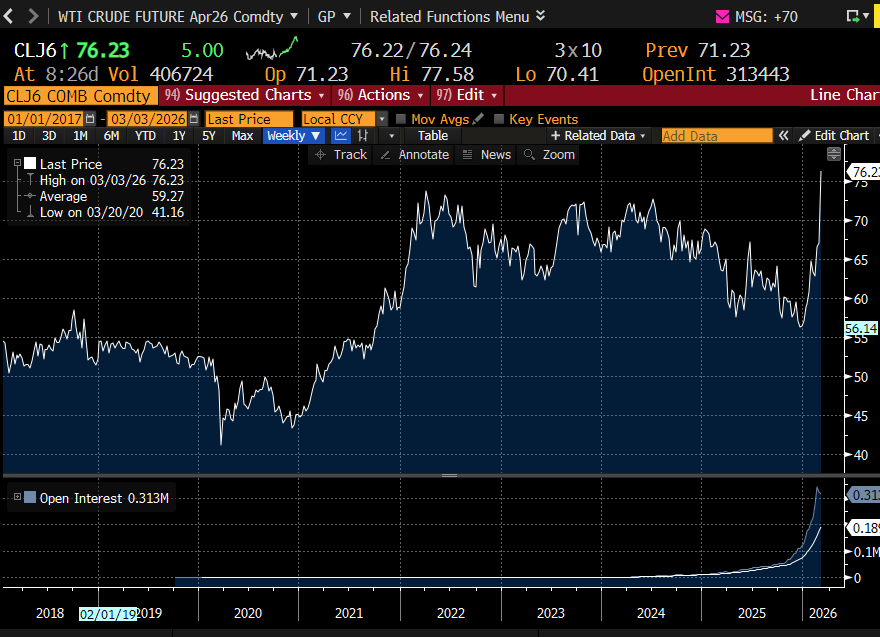
Brent has climbed 25% in three weeks to $94, four dollars off its wartime peak, and emerging-markets investor Raymond Zucaro thinks even that undersells the danger.
Three pressures are stacking on the same barrel: Hormuz is throttled to a handful of ships, the Houthis have thrown a blockade across the Red Sea and turned back Saudi tankers, and Washington is openly floating a ground move on Kharg Island.
The wild part? Prices should be higher still.
Raymond argues oil sits well below its true level, held down by China's purchasing halt, drained reserves worldwide, and futures suppression that pushed the main oil ETF's short position past 100% of its shares.
Which means the floor is artificial, holding only until refiners bidding for real barrels drag the gap into daylight.
Turns out that gap is already surfacing at the pump, with gas past four dollars and climbing while the reserve buffer that absorbed the early shock runs dry.
His read on where we are: second inning of a nine-inning game.
@RayZucaro
The U.S. Strategic Petroleum Reserve (SPR) is less than 10 days away from falling to its lowest level since August 1983- over 15,625 days ago- a level not seen since the SPR's initial fill-up that began in 1977.
February Market Thoughts (PART 2): Add on!
By Raymond Zucaro
3/7/2026
Iran follow on.
There is no way to sugarcoat this, and sorry to any boomer-cons who are on my distribution lists. There was no 4D chess—he messed up and he MESSED UP BIG.
For someone who spends so much time trying to make the White House and new ballroom look “royal,” well, you “royally screwed up” your foreign policy.
Iran didn't have to take out actual oil production—they just had to choke it off so it shuts itself down. The issue is that wells need to constantly run, and what is produced needs to be offloaded to make space for new inventory. That's the choke point: if production can't leave and the storage facilities fill up, you have to shut down production.
A recent sell-side report notes that since the end of February, 76 million barrels of crude had accumulated, with 46 million barrels on tankers, 22 million barrels at refiners, and 8 million barrels in commercial storage. That works out to about 4.5 days of regional exports.
As of today, Saturday March 7th, we've already seen Iraq have to reduce production. Kuwait appears to have nearly filled its storage capacity. The region as a whole, with rerouting, has about 26 to 33 days of storage ability before large-scale shutdowns hit. Different countries have different capacity windows, with Iraq at the low end with 7 +/- days and Saudi with 38 +/- days. Both Saudi and UAE are able to use some pipelines to bypass the Hormuz choke point, but overall capacity of those pipelines is 5 to 7 million barrels per day for Saudi and just 400k barrels per day in the case of UAE. So, while nice, it will not solve the 16 million +/- that transit the choke point on a daily basis.
While the entire world focuses on crude, we think natural gas is actually the more immediate short-term choke point. Liquefied natural gas is harder to store given the very cold temperatures needed to maintain its liquid form. The natural gas market has a very “just in time” production, shipping, and usage cycle. As such, shutdowns will happen much quicker, and restarting production will be more difficult (and time-consuming)—not from the extraction process but from the cooling/liquefaction process.
How will economies adjust to this supply (price) shock? We think you will see very quick demand destruction and industrial stoppage. More essential economic aspects will take precedence (think consumer electricity), but heavy industries will shut down as the economics of production no longer work.
With higher prices we would not be surprised to see remaining exporters restrict supply to satisfy local demands, even from such nations like the United States.
Trump insurance and oil futures
To address some of the blockage, the Administration is scrambling to deal with the choke point issue. Trump floated providing insurance (through the US Government’s Development Finance Corporation) and using the US Navy to escort ships through the passage.
We have seen reports that providing insurance for what the private market has pulled back from alone would imply coverage of approximately $350 billion. The use of Navy assets would also bring them closer and put them in harm’s way, and unlike the last time the US Navy assisted in navigating the Strait of Hormuz during a conflict (the Iran/Iraq war), the proliferation of drones and missiles has certainly changed the calculus of what US naval assets would actually provide.
Late Thursday, the Trump administration talked about using oil derivatives to help lower the price. While we are not experts, we do know the (actual) lack of underlying physical supply at time of delivery will have much more short-term impact than selling futures for markets like Japan, Singapore, and South Korea, when they are unable to power industry.
Some quick thoughts on Winners and losers. *Not investment advice, just current high level thoughts!!
Losers:
US inflation, Higher; Oil and natural gas prices feed into many parts of the inflation basket, and they flow through very quickly. Puts any incoming FED Chairman in the hot seat if they really wanted to quickly lower rates. We think at the very least it will make them pause timetable.
US Treasury rates/supply: Lots of supply will push rates higher. The Supreme Court tariff loss, the need to pay interest on collected funds, actually paying for conflict (estimated to be $1 Billion dollars per day!!!!!!!!!!!!!!!)[1], Gulf States facing lost revenues from selling reserves. We see a supply/demand imbalance.
UST add on: Weaponization coming back to bite one in the posterior region? Less demand from large producers, no longer seen as “safe” asset. Good for other stores of value?
Petro Dollar? Whether factual or not, the perception that these countries agree to sell oil in dollars in return for protection could be called into question. If not selling oil in dollars, MAYBE less demand for US Treasuries????? Maybe less investment from the Gulf Region into US securities across the board? Valuation adjustments??
Japan; As you know from our past pieces, Japan faces SO many problems (higher interest expense, higher defense spending, demographics). We now have the combination of supply/price shocks, which will add significantly to the challenges facing this nation.
South Korea; heavy energy importer
Singapore; heavy energy importer
Europe; Qatar has been an important energy resource replacement for the EU (Qatar is about 6%, US 60%, Russia 13%, Algeria 8%)—especially with the potential removal of Russian supply. Heavy industry—already suffering from much higher input costs—will face an even larger supply/price shock. While national governments provided financial buffers during past price shocks, their balance sheets are now getting more stretched. Not to mention our concern that producing nations might slow exports to ensure domestic supply or to inflict further economic pain. Read: USA and Russia.
Ukraine; The USA has bitten off a lot to chew. With name-calling like referring to Zelenskyy as “P.T. Barnum”[2]and now the need to focus any and all weapon production on current USA and core nation needs, we are pressed to see any prospect for deliveries at current levels going forward.
Airlines; Fuel expenses super-impact financial metrics, and while often hedged, hedges roll off and increased end-consumer prices will lead to demand destruction.
Mid-Term elections and remaining Trump term; As some of the world’s best political pundits note, elections are games of adding coalitions. We currently see this as alienating the Right-wing base and with a sweep of House and most likely Senate, the last two years of the current administration will be (rightly?!?!) bogged down in impeachment hearings.
Winners, *Not investment advice, just current high level thoughts!!
Many in EM. Nigeria, Angola, Argentina, Brazil, Venezuela, Colombia. Think Energy exporters.
US Shale oil: One bright spot for the USA is the higher prices will pull in production.
End of Globalization; Frankly good for Emerging Markets. More infrastructure build-out to address the fallacy of “Just in time” mentality. Nearshoring. More push to spheres of interest.
Russia: As mentioned above regarding Ukraine. (Much) higher price for exports. US rolling back sanctions[3], expand use of energy as weapon[4].
[1] https://t.co/lSUXUBRYPk
[2] https://t.co/lrFFYnu0E0
[3] https://t.co/sYP9JIvvmT
[4] https://t.co/wjvX185QCN
February Market Thoughts
By Raymond Zucaro
2/28/2026
February market thoughts
Well as avid readers know, I kind of march to my own drum. This month I would like to start off with an old joke.
A Soviet and an American are seated next to each other on a plane traveling from Moscow to Washington DC. The American says, I have to hand it to you, your propaganda is very impressive. The Soviet smiles and thanks him but replies that it's nothing compared to American propaganda. Confused, the American tells him, "but we don't have propaganda." The Soviet smiles and says "exactly"
In unrelated news, the Ellison family won their proxy battle for Paramount—Netflix gracefully backed out but pocketed a $2.8 billion breakup fee[1]. This acquisition adds some interesting pieces to Oracle founder's growing media empire, which already includes household names like CNN, CBS, 60 Minutes, and TikTok, to name a few.
We were lucky to have been asked to return on the Best Geopolitical podcaster, The Duran, the video can be found here (link)[2]
Well as another month finishes up, the “no new wars president begins another conflict”. As we closed last month’s thoughts the war drums began ringing hard. We will expand our thoughts more on this topic below.
State of the Union and state of play.
The State of the Union was really a nothingburger; frankly filled with so much false information that we were reminded of our opening joke.
The Republicans, with control of the executive, House, and Senate, have not been able to advance the SAVE Act to clamp down on voting anomalies. And the Supreme Court's dragging its feet on Voting Rights Act changes, pushing them long enough that any changes won't have enough time to be implemented ahead of the mid-term elections. We're now fully convinced that any advances this administration makes going forward will be minimal, if any.
Iran; everyone has a plan until they get punched in the mouth[3]
We do not think Iran will be anywhere near as quick and surgical as Venezuela was. We worry that with the seeming success of that operation, the administration has become swollen with hubris. Unlike the clear winners and losers of the Venezuela piece, it is too early to tell here—but the wildcard is energy. If this stays limited to episodic strikes and proxy flare-ups, we get short-term oil spikes (risk premium stuff, $5-10/bbl pops) and volatility without lasting damage. But if Iran escalates to structural disruption—say, sustained threats to the Strait of Hormuz, major hits to export hubs like Kharg Island, or prolonged outages knocking out 2-3+ million bpd consistently—then we're talking something bigger: persistent higher oil prices, global supply chain hits, and real economic drag that could fracture coalitions fast. That's the line where episodic turns structural, and hubris meets reality.
Tariff Loss; fiscal gut punch
As we've been warning, the possibility that Trump’s weaponized use of tariffs could be struck down by the Supreme Court was very real. In a split 6-3 decision on February 20th [4], the Supreme Court ruled that Trump had indeed exceeded his authority. This significant rout puts a large part of Trump's economic policy in question.
First off, this ruling puts what Fitch Ratings[5] has estimated at $240 billion already collected[6] certainly in question going forward. Fitch notes that's equivalent to 0.8% of GDP being struck down. Many companies have already started filing lawsuits to recover what was illegally collected.
So, in sum, going forward Trump cannot use that mechanism to collect tariffs, and furthermore, what has already been collected will most likely have to be paid back, creating a massive fiscal hole. A sudden reversal of revenue that was plugging gaps in the budget post-tax cuts, forcing either spending cuts, more borrowing, or scrambling for new levies. Even the Court called it a “mess,” and that's putting it mildly—this isn't just policy whiplash; it's a straight-up fiscal gut punch that could keep real yields from spiking too much and nudge the dollar softer over time.
Trump quickly pivoted, assigning blanket tariffs first at 10%[7], then over the following weekend bumping them to 15%[8]. Ironically, for large key markets, the current tariffs are well below what Trump had wanted against key economies like China and Brazil, where the net tariff will actually be lower.
Frankly, it's not even clear to us that the new tariffs Trump implemented are legal, but we'll leave that discussion for the experts and the courts. We would suggest a review of this article (link)[9].
Well we will say we had expected a short-term spike in interest rates on the back of this, but the quick implementation of new tariffs and the drumbeat of war caused a flight to quality (buying US Treasuries).
Marketing (and Asset class) observations
During the month of February, we did a lot of marketing, speaking with people in the United States and also outside the United States.
One strong observation: we noted that international clients and prospects are much more open to true global investment. Hearing comments along the lines of “I would not vacation in some of those markets, let alone invest there” left us at times speechless. Frankly, after speaking with some of the largest US-based pension funds and hearing zero—if any—emerging-market fixed-income exposure, it leaves us questioning their myopic stance.
We also recently attended a very interesting industry-focused seminar on Emerging Markets. Speakers and panelists included some very large EM-focused asset managers, as well as a mix of strategists and even one very senior director and co-head of the Americas for one of the top three rating agencies.
It was interesting for us to hear as many of them echoed our observations: that EM fundamentals and growth prospects—on their own but especially in relation to the “developed” world—have not been this robust in a long time. The rating agency noted that issuers in the Emerging Markets have had a much better upgrade-to-downgrade ratio than they are seeing in many developed markets. They pointed out that much of what is driving the current “developed” market boom—the AI industry—is interestingly pulling along many emerging markets, as much of the capex and build-out related to AI draws on resources found in abundance in Emerging Markets. And let's not kid ourselves—this isn't just about raw commodities anymore. We are talking real yields in the US that are still elevated enough to keep the dollar from completely collapsing, but any path toward softer real yields (FED easing, fiscal mess from the tariff unwind) would turbocharge EM inflows. A weaker dollar has historically been rocket fuel for EM—cheaper debt servicing, better export competitiveness, commodity tailwinds, and capital chasing higher returns outside the US. We've seen it play out in 2025 already with EM equities crushing it partly on currency effects alone. If real yields trend down and the dollar follows suit, this super cycle doesn't just start; it accelerates hard. The largest asset manager on the final panel expects this to be the first year in a five-year super cycle for EM.
Unfortunately for many of my fellow North Americans, we think the rest of the globe sees this trend before many of them do.
[1] https://t.co/B6nGpfTACX
[2] https://t.co/tu7DlilNFP
[3] https://t.co/47lWPnKDGT
[4] https://t.co/4GKCtFLFhv
[5] https://t.co/IcRQfxPE7x
[6] https://t.co/n2rp6Z1T1U
[7] https://t.co/4emju18Xg6
[8] https://t.co/NkLA7M8om4
[9] https://t.co/A3i9yYgQWT