I know you don't want to hear this but...
Before AI...
- flyers were made by Fiverr bros on Canva (and they were terrible)
- Slop was written by 18-year-old "social media experts" that were hired because "young people are good at Instagram"
- Code was still a mess, but a human mess; under the hood of every app was terrifying.
- Call centers were also still a total pain to talk to, but at least they were human beings
- YouTube Thumbnails cost $50
Let's all stop pretending that AI somehow made any of this worse...
It's just a different kind of bad, and it all comes down to the same thing...
Small businesses trying to save on budget.
The difference is that if a laundrette buys a $200 Grok @bot subscription, they can now handle all of their admin, accounting, and ordering within that.
It feels genuinely like you have a team for $200
That is an equalizer (temporary) that the small guys have never ever had, and I assure you anyone who grabs the bull by the horns has the big guys shaking in their boots right now.
Strike while you can; the gold rush won't last forever.
(i typed this by hand and it almost killed me)
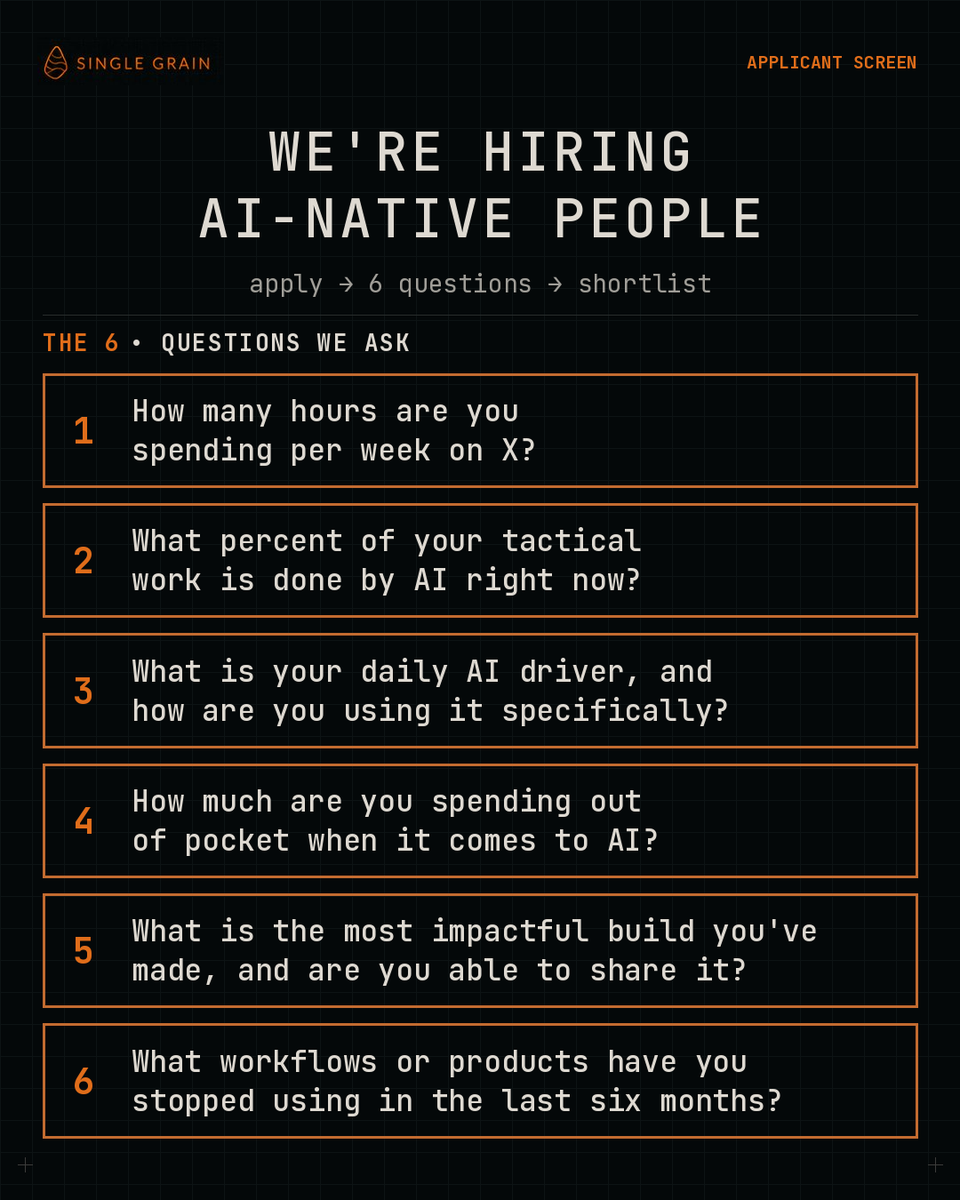
We're hiring AI-native people. If you apply, these are the six questions we'll send you.
Answer them well, and you move to the shortlist.
1. How many hours are you spending per week on X?
2. What percent of your tactical work is done by AI right now?
3. What is your daily AI driver, and how are you using it specifically?
4. How much are you spending out of pocket when it comes to AI?
5. What is the most impactful build you've made, and are you able to share it?
6. What workflows or products have you stopped using in the last six months?
Why these six:
• Hours on X: X is where the AI action is happening right now. It shows whether you're obsessed with learning this stuff.
• Tactical work done by AI: shows whether robots are doing the robot work, so you can do the human work.
• Daily driver: shows how deep your day-to-day use actually goes.
• Out of pocket: shows whether you're putting your own dollars behind it and investing in yourself.
• Best build: the rubber meets the road when you show what you've actually built and how you built it.
• Stopped using: this moves so fast that you have to keep eliminating as you add.
If that's you, apply. Link below.
claude motion is pure f*cking treasure
ex. Anthropic designer gave Claude Motion 3 different prompts on 3 different models, he couldn't contain his emotions after seeing the result:
> Opus 5.5: a hand-drawn story. a little agent wakes up at its desk, gets feedback notes, fixes them, ends on heart eyes and a green check. 53 s
> Sonnet 5.5: a kinetic type showreel. six easing curves, a morphing star, particles, blurred type, "every frame written in code". 15 s
> Haiku 5.5: a step-by-step White Russian recipe. ice, vodka, coffee liqueur, cream, with live counters and a checklist. 30 s
no video model, no AI-generated people. Claude writes the animation as code, so every word, number and timing stays editable
prompt in the comments
bookmark and share it!
these 40 lines in claude code cut the price of my opus 5.5 workflow by 20%...
----------------------------
Merge this into ~/.claude/settings.json without touching my existing hooks, permissions, or plugins. Then create the two agent files exactly as written. Show me the resulting diff.
```json
{
"model": "opusplan",
"advisorModel": "opus",
"effortLevel": "medium",
"modelSettings": {
"claude-opus-5-5": {
"effortLevel": "high",
"autoCompactWindow": 200000
},
"claude-sonnet-5-5": {
"effortLevel": "medium",
"autoCompactWindow": 200000
},
"claude-fable-5-1": {
"effortLevel": "high",
"autoCompactWindow": 200000
}
},
"autoCompactEnabled": true,
"env": {
"CLAUDE_CODE_SUBAGENT_MODEL": "haiku",
"CLAUDE_AUTOCOMPACT_PCT_OVERRIDE": "70"
}
}
```
File 1: ~/.claude/agents/explore.md
```
---
name: explore
description: read-only code locator, returns file:line, never suggests fixes
model: haiku
tools: Read, Grep, Glob
---
find what was asked. return paths and line numbers. no fixes, no opinions.
```
File 2: ~/.claude/agents/judge.md
```
---
name: judge
description: adversarial reviewer for a diff or plan, invoked before declaring a task complete
model: opus
tools: Read, Grep, Bash
---
assume the work is wrong. find the failure case. one line per finding, severity first.
```
Then restart Claude Code. Verify with:
/model → shows opusplan
/advisor → shows opus
/agents → lists explore and judge
Daily use:
- Normal work: nothing. Sonnet types, Opus plans and advises, haiku explores.
- Before merging anything: use the judge agent on this diff
- Hard problem: /model fable, back to /model opusplan after.
- Between unrelated tasks: /clear.
Agent files go in ~/.claude/agents/ so they follow you across projects. Put them in .claude/agents/ inside a repo instead if you want them per-project.
----------------------------------------
Jev is truly the "Internet" moment for the AI industry
It tells your agents and LLMs what to do next, in milliseconds and at almost zero cost
If you set it up correctly, you will have the AI engineer’s stack for 2028
Here's how to add it to your Grok Bot:
step 1 → create an API key at https://t.co/1W1H3Br61X. Keep it in your environment, never in a chat.
step 2 → put Jev behind LiteLLM first.
It’s a pass-through endpoint on /v1/decisions and /v1/systemone, not /chat/completions.
step 3 → install the router.
export TYPESAFE_API_KEY=...
git clone https://t.co/KEpe4aGWOV
cd grok-bot-jev && python3 -m venv .venv
.venv/bin/pip install -r requirements.txt
cp config.example.yaml config.yaml
step 4 → copy skill/jev-usage-router.SKILL.md into a Grok Bot skill.
step 5 → set mode: shadow in config.yaml. Jev logs verdicts, the bot keeps working as before.
step 6 → run .venv/bin/python scripts/dry_run.py on your own backlog. Read every row.
step 7 → set mode: active once you agree with the log. Kill switches: enabled: false, or bypass jev in the request.
Actions Jev returns: reuse_cache, stop_retry, run_deterministic, chat_only, research_capped, allow_subagent, ask_human.
It's not so hard. Do it today, then read the full article on Grok Bot below ↓ ↓
Important note regarding Grok @Bot:
Going forward, @SpaceX will use the best back end model for any given task, including Claude Opus 5.5, MidJourney, Suno and other leading APIs.
Whatever is most likely to give you the best outcome.