ANTHROPIC JUST DROPPED THE OFFICIAL GUIDE TO PROMPTING OPUS 5
This is the most important prompting guide for anyone using Claude.
Bookmark this before you forget.
Most people still prompt Opus 5 like older models. That's the mistake.
> give the complete task upfront — don't drip-feed instructions.
> explicitly ask for shorter responses if you want them.
> use low/medium effort by default. increase effort only when needed.
> let it finish the entire feature instead of asking for partial implementations.
> use subagents intentionally for large codebases, not every task.
Opus 5 is at its best when you stop micromanaging it and let it own the work.
Read it before writing your next prompt.
Claude → Opus 5 → Agentic Execution → Production-Ready Output → Money
🚨 BREAKING: Claude can now design logos that look like they cost $10,000.
I tested it myself.
The final result cost me exactly $0.
Here are the 7 prompts I used:
Save this for later
YOUR CODEBASE SHOULD BE ABLE TO EXPLAIN ITSELF.
Ask Claude to scan your entire app and generate two files:
A single HTML page that visually maps the architecture
A structured JSON file containing every component, dependency, data flow and API
The HTML is for you.
Open it in the browser and instantly understand how the frontend, backend, database, services and external integrations connect.
The JSON is for the next AI agent.
Before building a new feature, the agent reads it and understands the entire system without wasting half the context window exploring random files.
No more asking:
“Where is authentication handled?”
“What will break if I change this?”
“Which service owns this data?”
Your architecture becomes readable by humans and reusable by AI.
Your codebase now explains itself.
@lydiahallie I hate how I need to rely of other models when I’m out of tokens. Chat has unlimited chat. Something like that would be great. Maybe Giving me say 90% percent of my usage and locking in 10% for every day questions??
Wow! Someone open sourced 100+ full AI apps you can just clone and ship..
and it's sitting at 124,000 stars on github
it's one repo, awesome-llm-apps.
and the important part.. these aren't tutorials teaching you to build an app.
they're the finished apps themselves.
RAG systems, AI agents, multi-agent teams.. tested end to end, apache licensed, yours to copy.
a few that are actually in there:
- a fraud investigation agent that cross-references public records to flag things that don't add up - a VC due-diligence agent team that writes startup investment analysis - a financial coach that builds you a budget, debt and savings plan - "chat with anything".. your github, gmail, PDFs, arxiv papers, youtube videos - a deep research agent that runs full web research on its own
here's how to actually use it, not just star it:
clone the repo, open the one app closest to what you need
it's a working template.. swap in your data, your API key, your use case
ship it as your own thing, or bolt three of them together into one bigger product
the license literally lets you take these, customize them, and sell them.
that's not a loophole, that's the point of apache-2.0.
repo: https://t.co/kM6QPuQFZ4
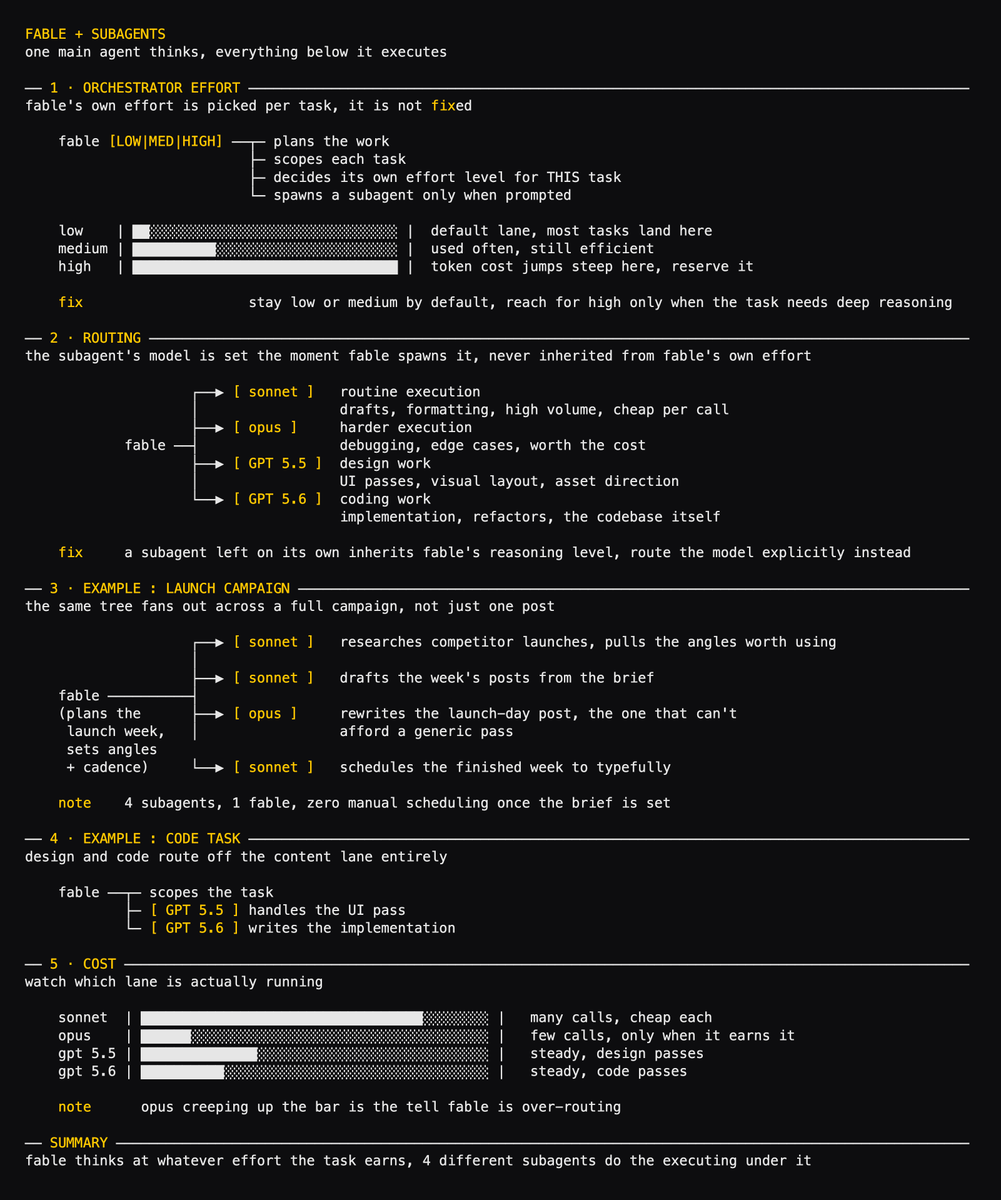
how I run Fable with subagents
fable is my main agent now, it does the planning and the judgment calls, then hands off execution to subagents
if you leave a subagent alone, it inherits fable's reasoning level, so at spawn time fable sets the model explicitly instead, based on what the task is
fable's own effort isn't fixed either, it runs low, medium or high, mostly low or medium since the jump in token cost between levels is steep
how fable routes the model:
> fable reaches for high effort when a task needs multi-step judgment, low and medium handle the rest
> routine execution, drafts, formatting, straightforward edits go to sonnet
> harder execution, debugging, anything that needs deeper reasoning goes to opus
> design work goes to GPT 5.5, coding work goes to GPT 5.6
the same setup scales up to a full campaign:
> fable plans the launch week, sets the angles and the cadence
> sonnet researches competitor launches and drafts the week's posts from the brief
> opus rewrites the launch-day post since that one sets the whole week's angle
> the week's schedule goes out through sonnet, straight to typefully
on code, fable scopes the task and hands it to GPT 5.6, sonnet and opus stay on the writing and research side
80 Claude Prompts Every Professional Should Save
• Productivity
• Problem Solving
• Critical Thinking
• Brainstorming
Follow @natan_mohart for free AI resources every week80 Claude Prompts Every Professional Should Save
• Productivity
• Problem Solving
• Critical Thinking
• Brainstorming
Follow @natan_mohart for free AI resources every week80 Claude Prompts Every Professional Should Save
• Productivity
• Problem Solving
• Critical Thinking
• Brainstorming
Follow @natan_mohart for free AI resources every week80 Claude Prompts Every Professional Should Save
• Productivity
• Problem Solving
• Critical Thinking
• Brainstorming
Follow @natan_mohart for free AI resources every week.
A SINGLE CLAUDE.md FILE JUST HIT 192,000 GITHUB STARS. GLOBAL RANK: #27. HIGHER THAN REDIS, DJANGO, AND BITCOIN.
One markdown file. No framework. No tooling. Rank 27 among every repository ever created.
The origin is a diagnosis. Karpathy described the mistakes LLMs make when writing code, and every developer recognized the list instantly: wrong assumptions it never checks, over-engineering nobody asked for, dependencies appearing out of thin air, unrelated code getting “improved” along the way.
The insight that built the repo: if the mistakes are predictable, they are preventable. You just have to write the prevention down where the agent reads it.
That is the entire product. Four behavioral principles in one CLAUDE.md, dropped at the root of your project. Think before coding: state assumptions, ask instead of guessing. Simplicity first: minimum code that solves the stated problem. Surgical changes: every modified line must trace to the request. Goal-driven execution: turn “fix the bug” into “write a test that reproduces it, then make it pass.”
Claude Code reads the file automatically on launch. Behavior shifts from the first prompt.
The detail most people miss: developers spent two years asking AI to write code, then reviewing the mess. The shift happening now is one level up — engineering the agent’s behavior so the code is worth reviewing at all. The best tool in the ecosystem right now is not software. It is well-crafted instructions.
One security note that matters at this scale: a CLAUDE.md is instructions your agent obeys, and researchers have shown malicious versions planted in cloned repos can do real damage. Install from the official repo only, and read the file — it is short by design.
https://t.co/QCj6SvxK3g
Most people are still perfecting prompts, one session at a time.
A text file that perfected the agent instead is outranking the infrastructure of the entire software industry.
I broke down the full skills economy — how files like this became the most valuable artifacts on GitHub — in the article below.
GITHUB JUST KILLED THE WORST PART OF VIBE CODING
they shipped a free tool called Spec Kit and it already crossed 120,000 stars
the fix is stupidly simple
instead of tossing vague prompts at an agent and praying it doesn't wreck your project
Spec Kit makes the AI write a full structured spec before it touches a single line of code
it works through the problem first
figures out what you want to build
asks about the gaps
lays out the project
then it starts coding
you get fewer insane bugs, cleaner output and results you can predict
the flow looks like this:
/constitution for your rules and standards
/specify for what you want to build
/clarify for the open questions before you start
/plan for architecture and stack
/tasks for the ordered work
/implement to run it
it plugs into Claude Code, Cursor, Copilot, Codex, Gemini CLI and 25+ other agents
120,000 stars, 10,000 forks, open source, shipped by GitHub itself
learning to drive agents like this is most of what separates people getting hired as AI engineers from everyone still fighting their prompts
5/ Stress Test
Got a plan you're proud of? Find the crack before reality does.
Ask the Council: "Here's my plan: [lay it out]. Assume it failed six months from now. Each of you name the most likely reason it died, then give me the fix that prevents it, ranked by what to patch first."
Become a Claude Certified Architect
Here are all the required resource in one place: (save it)
Training courses: https://t.co/kBXCuOrprM (13 free courses)
Cookbook: https://t.co/SLnSUT703t
Exam Guide: https://t.co/A2pbDcy8GC
Practice questions: https://t.co/90eXwUwL8i (free)
MCP documentation: https://t.co/SbwZI0eM61 (free)
API documentation: https://t.co/9rmnLWxRHE (free)
Partner Network: https://t.co/diT5OE5H0b (free to join)
Link to join: https://t.co/OXQyTmf4wD
Personal Playbook someone created after the exam: https://t.co/qhXan3XnBK