This was one of the stranger realizations growing up. I thought people would be more interested (engaged?) in what they were doing.
Some are, but a lot fewer than I would have ever expected.
I realized too late in my career that we all need to learn sales, irrespective of our profession or vocation.
In 2019, after more than a decade of what would be normally called a successful career track (pedigree, logos, scale, $$$), I went back to the drawing board and started self-training myself in sales (& marketing too) from scratch.
I can vouch that every point in this top @hackernews post on “How to do sales?” is true, and amazingly distilled to its simplest essence.
So much so that I have printed it out, kept it on my desk, to be reviewed each day.
Btw, it’s a real travesty that top universities and early-career jobs hardly provide any practical sales skills or training to young talent. I have seen this both in the US and India, and it’s a major gap in our learning systems.
After 61 years at MIT the most watched mathematics professor in history walked into a classroom for the last time. The engineers, data scientists, and quants who learned from him are running teams at Google, Goldman Sachs, and Renaissance Technologies. Thousands of them became millionaires. He charged nothing for any of it.
His name is Gilbert Strang. 14 million people have watched his lectures on YouTube. Comments came in from Kurdistan, Mongolia, Nigeria, Bangladesh, Croatia, and 25 other countries on his final day. MIT OpenCourseWare gets 5,000 daily visits to his courses alone.
His textbook has been used in 2,500 universities. He has published over 17 books. He was teaching 450 students in his final semester at 88 years old.
This is his last lecture of 18.06 Linear Algebra. He spent it at the blackboard doing what he always did. Three equations, three unknowns. Elimination. Rank. The null space. The most elegant theorem in the subject — that the row rank always equals the column rank — stated without proof because the proof belongs to the 400 students who came to learn it.
His former PhD student said that when life gets hard he closes his eyes and imagines sitting in Gil's office surrounded by stacks of papers that look like the final stages of Jenga. And somehow everything feels right with the world.
The department head said alumni from every discipline at MIT still remember one class above all others. They struggle to recall the name. Then they say — Gilbert Strang.
He said he would think about retiring.
The lectures are free. All 61 years of them.
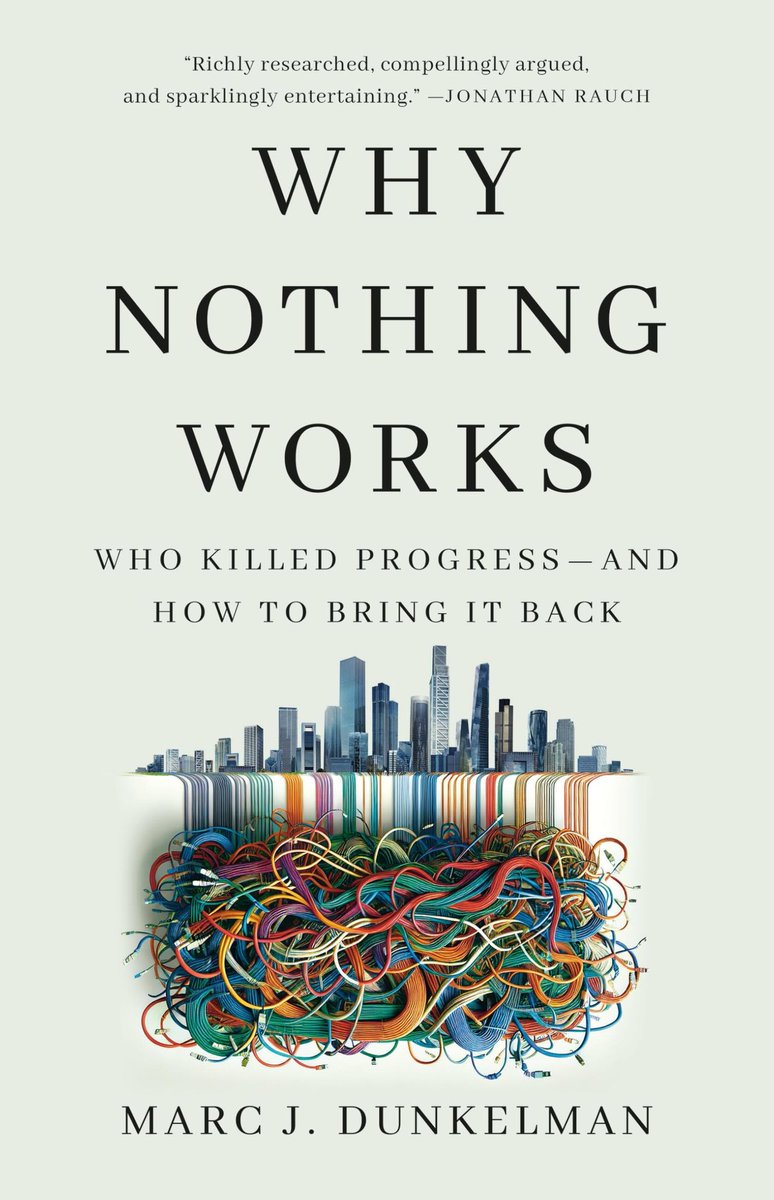
This book by @MarcDunkelman is probably the closest thing I'd describe as the anti Seeing Like A State, a pretty convincing defence of professional bureaucracies with broad remits to address societal problems
Procrastination is the phobia of discovering you're not who you think you are. So you don't start. And not starting preserves the fantasy. The fantasy is comfortable. The fantasy is killing you.
Repetition changes your brain.
Repetition changes your brain.
Repetition changes your brain.
Repetition changes your brain.
Repetition changes your brain.
Repetition changes your brain.
Repetition changes your brain.
That’s why it works.
IT IS THE DAMN PHONE. your brain is constantly adapting to the input you repeatedly give it. it’s called Neuroplasticity. it can be your biggest power and also weakness.
> the short form content literally changes your brain. you can’t finish reading two pages. your brain is foggy. you feel mentally tired too often.
> if you spend most of the time chasing low-input dopamine you become someone who can’t tolerate depth and stillness. actual long term progress seems boring.
> reset your attention span. no scroll in the morning. your brain spends the rest of the day if you start the day using your phone.
> also no short form content. read a book. go for a walk.
> build physical blockers to make it harder to pick up the phone impulsively. make the screen b/w. use app blockers. put the phone in another room when working.
What people miss isn’t the past. They miss the moment when new things were optional
An inherent property of progress is it turns options into obligations
Life can be objectively better and subjectively heavier. Why the future never feels like the future
https://t.co/bKpLutSRYG
“…vocabulary-rich children arrive at school with a hidden cognitive advantage ... They have heard “ridiculous” and “extraordinary” and “investigation” at the dinner table, in bedtime stories, in the overheard conversations of articulate adults. Their minds have been silently sketching the spellings of hundreds of words they have never read..
“Children from language-poor environments arrive without those skeletons…
“It is a gap in prediction. And it compounds: the child who reads more easily reads more, hears more words in the context of text, forms more skeletons, and reads still more easily. The child who struggles reads less, encounters fewer new words, forms fewer skeletons, and falls further behind.”
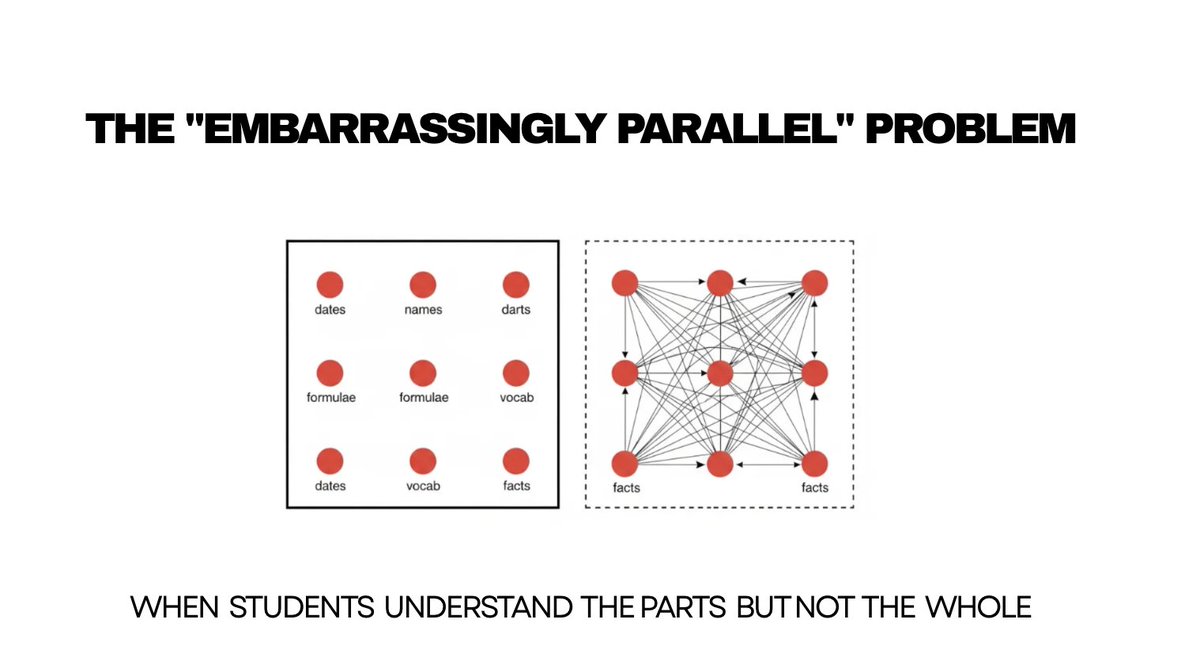
Why do students sometimes master 3,650 words but still struggle to read a novel? Because understanding is not a parallel problem. In my latest post, I explore what computer science reveals about knowledge vs understanding. Post in reply ⬇️
this physics student is right on point, intelligence isn’t something you’re born with, it’s a muscle you grow by enduring the tough unbearable moments that makes you want to quit. everyone you admire battles with frustration at some point but shuts it off.
“If you weave these sentence-level activities into your instruction on a daily basis, you'll be giving your students the tools they need to create effective paragraphs and compositions, while at the same time boosting their understanding of the content you're teaching.” 🤯📝✍️
Handwriting made it to the "Top 10 Significant Education Studies of 2025" list.
We often view handwriting as just a decoding tool for early learners, that's not the whole story. The correlation between handwriting and cognitive performance remains consistent in older students and adults.
Link below 🧵
"When everything has to be comfortable, relevant, and instantly rewarding, rigor often disappears.
Every pressure gets resolved the same way: lower demands, simplify content, avoid discomfort"
We are stacking a new habit - Bookmark Mondays. Over the week (like many I guess) we save lots of posts that we want to return to or explore in more detail. Like this amazing resources from @MrGoodwin23 and @teacherhead which we have come back to, through our bookmarks, and will share as the feature CPD snack on our whole school Monday briefing today.
@JamesClear