Basmati Without a Passport: Kenyan Court of Appeal on Registration, Recognition, and the Constitutional Limits of TRIPS in Kenyan Trade Mark Law https://t.co/zHqayOqcET
Missing Trader, a VAT-evasion scheme where a shell entity generates tax invoices to allow buyers to claim input VAT, but fails to declare or remit the corresponding output VAT.
I spoke about this matter at length with @DBusaule on @FiledPodcast by @DigiTax_Tech (be sure to follow us for more breakdowns).
Part of the reason for eTIMS embedding a stock management module (currently under stakeholder engagement) is to address the Missing Trader headache.
Kanziwa Limited vs Kandie & another KECA 2080_ answers two questions that have troubled Kenyan land law for 20 years in the affirmative.
1. Can a purchaser in possession under an incomplete sale acquire land by adverse possession?
2. Can his administrators enforce it after death?
Answer: YES.
Court of Appeal Nakuru, 2 Oct 2026, dismissed Kanziwa's appeal and gave 50.18 Ha of LR No.9726 Njoro to administrators of Aaron Kimosop Kandie by adverse possession.
BACKGROUND:
1982 purchase from Kanziwa director, LCB application signed by both parties, consent obtained, 1983 vendor letter confirming sale. Purchaser built, fenced, farmed 1982-2002 (20yrs). Family remained. 2004 owner denied sale, subdivided and advertised. Family filed OS 2007. HC Mulwa J 2020 allowed claim. CA affirmed.
FINDINGS:
Wambugu v Njuguna KLR 172 overtaken by Kasuve 1 KLR 184, Gabriel Mbui, Miki Waweru & Ouko v Kageni CA 38 of 2019. Where sale stalls through no fault of purchaser, time runs. 12yrs under S.7,17,38 Limitation of Actions Act.
Alternative pleading allowed. Interruption only by suit or effective re-entry or clear admission - Githu v Ndete, Kimani Ruchine.
Adverts and paper subdivision not enough.
Missing abstract curable under Order 37 Rule 7, Mukisa Biscuit. S.3(3) Law of Contract Act proviso saves oral sale by part performance.
NOTES FOR ADVOCATES:
Plead contract and adverse possession in alternative, cite Ouko v Kageni. Where no agreement, collect LCB Form 1 signed by both, LCB consent, vendor letter. Prove animus by fencing, buildings, trees, graves, control, not daily presence. To defeat, file recovery suit within 12yrs or physically retake with police and inventory
NOTES FOR ADVOCATES:
This case settles 20-year conflict: Purchaser in possession under incomplete sale CAN claim adverse possession.
1. Plead in alternative. Always plead contract of sale + adverse possession in alternative under Order 37. Cite Ouko v Kageni CA 38 of 2019 KECA 60 to overcome Wambugu v Njuguna KLR 172.
2. Save oral sale with part performance. No written agreement? Use proviso to S.3(3) Law of Contract Act. Collect LCB Form 1 signed by BOTH, LCB consent letter, Commissioner approval, vendor letter asking for survey/valuation. See Mwangi v Mwangi KLR 328, Yafesi Ochieng.
3. Prove animus correctly. Don't argue client slept there daily. Lead evidence of fencing, permanent buildings, graves, trees, crops, control of entry. See Mtana Lewa v Kahindi Ngala.
4. To defeat claim, act decisively. Letters, adverts, paper subdivisions do NOT stop time. Per Githu v Ndete KLR 776 & Kimani Ruchine, only suit filed or effective physical re-entry with police, inventory, witnesses, or clear admission stops time.
5. Deceased possessor. Ensure 12yrs accrued before death. Obtain Grant of Letters of Administration first, sue under S.82 Law of Succession Act. Cite Ouko v Kageni & Mbui Mukangu v Gerald Mutwiri.
6. Avoid technical traps. Always annex title/search, even if curable under Order 37 Rule 7 per Mukisa Biscuit EA 696. Raise parcel identity dispute at trial, not on appeal.
WHAT PUBLIC SHOULD NOTE:
Buying and entering land without title can make you owner after 12yrs if seller refuses to transfer.
Keep all LCB forms and seller letters.
Your estate can continue case. Show ownership by building, fencing, farming.
If you are owner, don't delay, sue within 12yrs or retake lawfully.
Citation: Kanziwa Limited v Kandie & another, CA E111/2022, KECA 2080, CA Nakuru 2 Oct 2026.
Ekaterina Handa
Partner
Gitonga, Kinyanjui & Co. Advocates
The death penalty is inadmissible because it is an attack on the inviolability and dignity of the person. The common good can be safeguarded and the requirements of justice can be met without recourse to capital punishment: effective systems of detention have been developed that protect citizens while at the same time do not completely deprive those who are guilty of the possibility of redemption. #NoDeathPenalty
In KCB Bank Kenya Ltd v Ongwete [2026] KEHC 14908 (KLR), the High Court at Busia allowed the bank’s appeal holding that:
The customer had received a call from a stranger posing as a Safaricom agent and voluntarily gave that person his National Identity Card number. The Court treated that disclosure as what enabled the later mobile-banking withdrawals.
A customer who asserts system negligence must prove it under section 107 of the Evidence Act. No compromise of the bank’s system, or collusion, was shown.
General damages need supporting evidence, and interest on them runs from judgment, not filing.
https://t.co/fHG0UUmRqq
My friends and brothers Benard, @Johnwillis018 and @kirwakiptoo2 did some commendable job in restoring justice to violation of one’s rights to privacy… our other brother @Thuranira_1 shall now take it over from here✊🏾⚖️
What a way to get into the weekend!
In Gitobu Imanyara v Ecobank Kenya Ltd & 2 others [2026] KEHC 14778 (KLR], the High Court at Milimani dismissed the plaint of Mr. Gitobu Imanyara, holding that:
The expiry of a time-limited private arrangement does not, by itself, prevent a chargee from exercising its statutory power of sale;
Failure to register a further charge does not entitle a borrower to retain funds received under an accepted offer while denying the security obligations. A party cannot approbate and reprobate;
A failed auction does not extinguish the power of sale, re-advertisement may continue the process; and
The in duplum rule under s.44A of the Banking Act places upon the party invoking the statutory ceiling the burden of showing that the claim exceeds it.
https://t.co/m8w0da3UKD
🚨 Court holds that work done under a public contract that broke procurement law cannot be paid for, even where the services were delivered and the public clearly benefited.
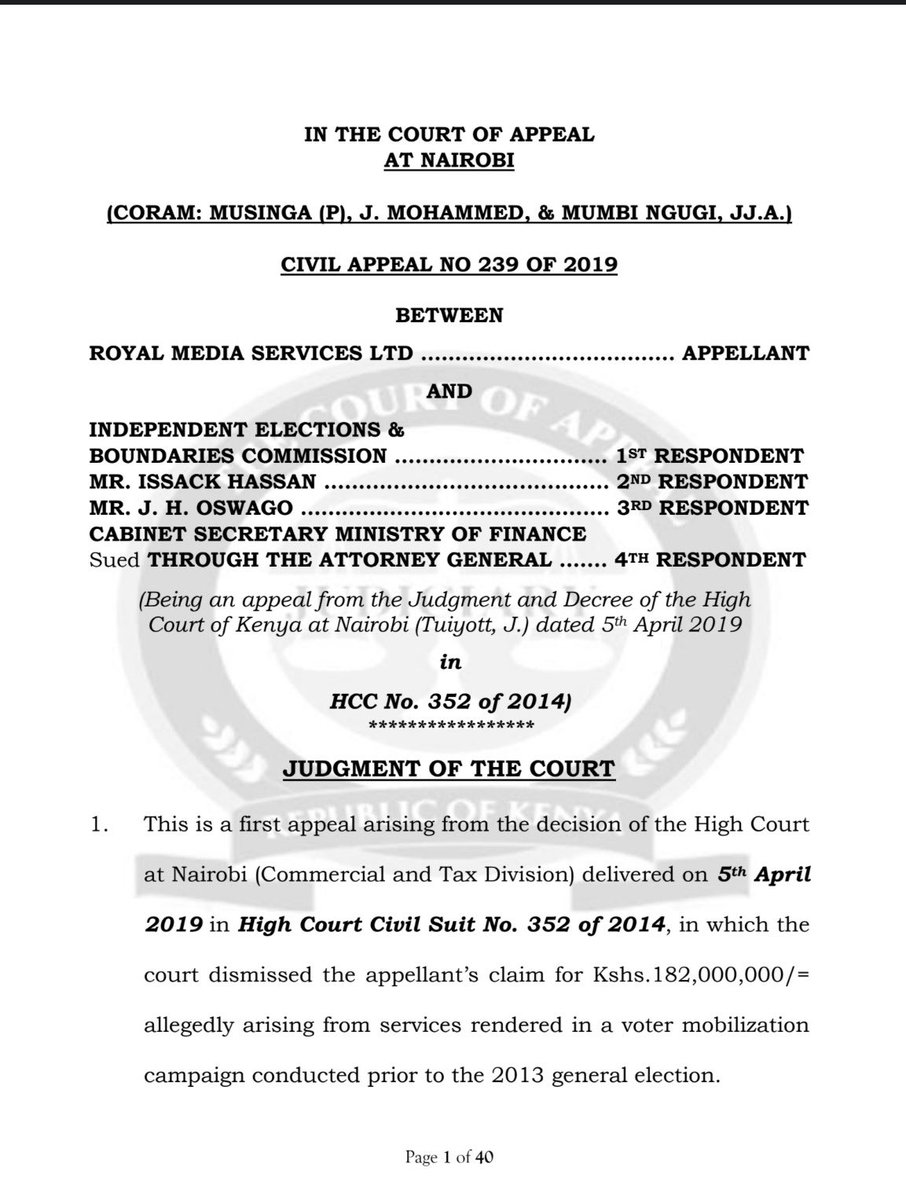
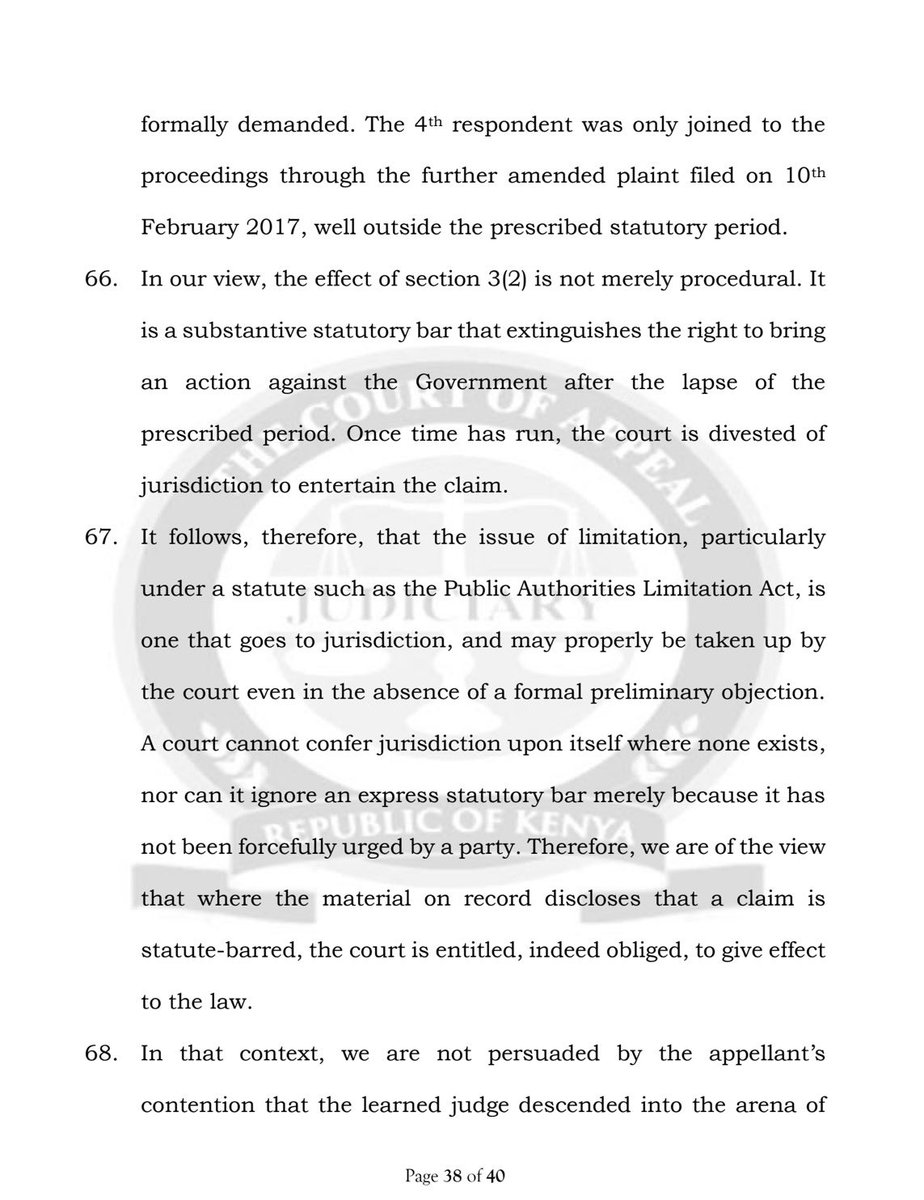
This is Royal Media Services Ltd v Independent Electoral and Boundaries Commission and 3 others, Civil Appeal No. 239 of 2019 [2026] KECA 268 (KLR). Here is what it means.
Ahead of the 2013 general election, Royal Media Services says it carried out emergency voter mobilisation broadcasts and roadshows on the strength of verbal requests, stamped booking sheets from Commission officials, and funding assurances from the National Treasury. It later sued to recover KSh 182 million. The court accepted that the services were actually rendered and benefited the public. It still dismissed the appeal in full, with costs.
There was no valid formal contract, and the engagement broke the mandatory rules of the Public Procurement and Disposal Act. In law, a contract made in breach of those rules is not merely irregular. It is illegal, void and unenforceable. And the duty to follow procurement law does not rest with the public body alone. Under section 27 of the Act, the supplier carries it too, and cannot treat the entity's non-compliance as somebody else's internal problem.
The claimant then asked to be paid on a fairer basis, for the value of the work actually done, a remedy the law calls quantum meruit. The court refused. Under the long standing rule that no one can build a claim on an illegal foundation, equitable remedies cannot rescue a transaction the statute prohibits. The claim against the Treasury was also out of time, and the court held that a limitation period against a public authority goes to its very power to hear the case, so it can raise that bar on its own. The individual officials were not personally liable either, because they acted within their official roles and not in bad faith.
On one side is the public interest in clean procurement. If courts paid out whenever work was done, the mandatory rules that guard public money would mean little, and quiet side arrangements would replace open tendering. On the other is the hardship to a party that delivered real value in good faith and now carries the whole loss, while the public keeps the benefit. The law has chosen the first, and it is a hard choice to sit with.
Key takeaway: with any public contract, the paperwork is the deal. A verbal request, a stamped booking sheet or a comfort note from a ministry is not a procurement contract, and doing the work first will not turn it into one.
Before you deliver for a public body, can you point to a procurement process that was actually followed?
👉 Follow @Lexken_EMSLaw for practical legal insights on public procurement and contracts.
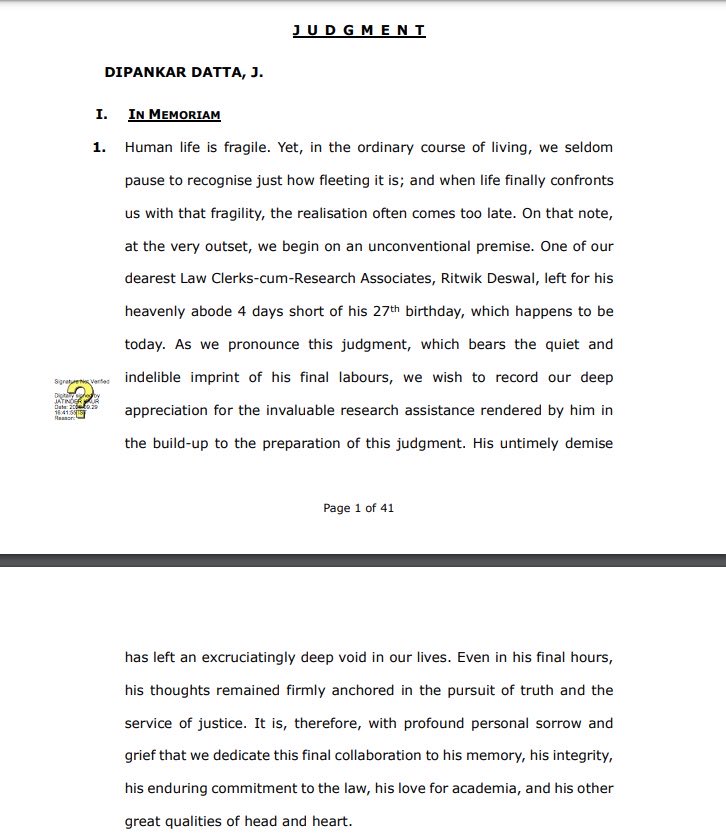
In a very unconventional way as Justice Dipankar Datta himself says, he opens his judgment by paying homage to his law clerk, Ritwik Deswal, who passed away four days ago and had done research work on the matter. May Ritwik Deswal’s soul rest in peace. Thank you, Justice Datta, not only for duly acknowledging Deswal’s work in the matter, but also for being so humane and unconventional (and one must be, when the occasion calls for it).
The court should not substitute its own assessment of the evidence for that of the DPP. However, consent to withdrawal is not automatic. The court must consider whether the decision was bona fide, lawful, properly reasoned and free from abuse of process.
#hotoffthebench
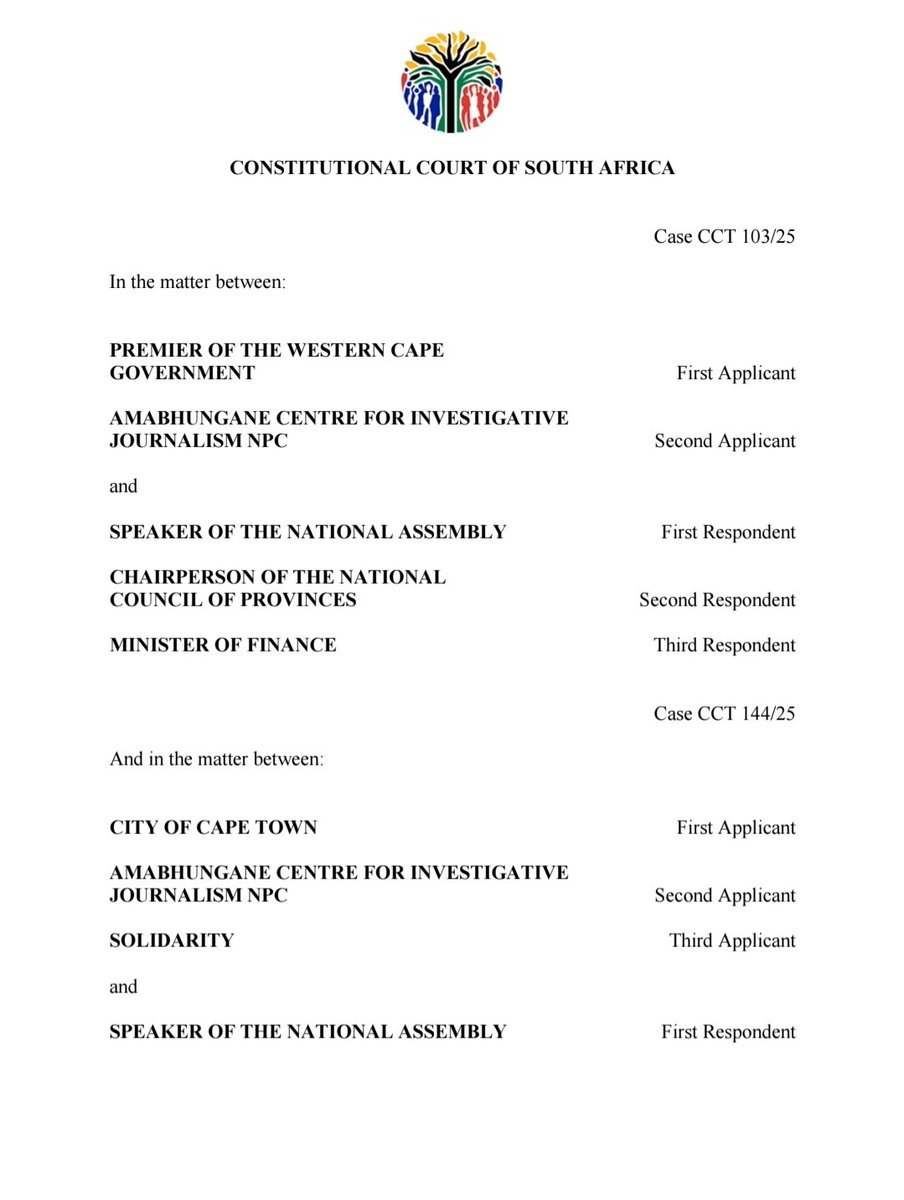
Last week South Africa's Constitutional declared the Public Procurement Act unconstitutional on public participation ground. Interesting hits:
1. Material amendment to a bill after public participation requires
further public participation.
1/6
Shoppers have been saying Quickmart is more expensive, than Naivas & C4. Well, you may trace that to the Net Profit margins FY25
Naivas
Turnover: Kes. 110billion
Profit: Kes. 2billion
Margin: 2%
Quickmart
Turnover: Kes 50 billion
Profit: Kes 1.5billion
Margin: 3%
Turnover: Kes 50billion
Profit: Kes 1.3billion
Margin 1.3%
Basically, for every 100 you pay at the till, Naivas makes 2/= (2%) in profit; Carrefour 1.30/= (1.3%); and Quickmart 3/= (3%)
Quickmart makes 1.5x more profit margin than Naivas, and 2.3x that of Carefour!! 🧵
Quickmart’s Journey From Nakuru Supermarket to NSE IPO:
● 2006 ➠ Quickmart opens its first store in Nakuru; Tumaini is separately founded in Nairobi.
● 2010 ➠ Quickmart opens its first Nairobi branch in Ruai, beginning expansion beyond Nakuru.
● 2012 ➠ Peter Kang’iri, now Group CEO, joins the business as a consultant.
● 2013 ➠ Quickmart secures its Ruaka location as its Nairobi expansion continues.
● 2016 ➠ Quickmart opens its Kiambu Road flagship store.
● 2017 ➠ Expansion to Waithaka and Kamakis takes Quickmart’s network to about 8 stores.
● 2018 ➠ Adenia Partners invests in Tumaini, beginning the private-equity-backed consolidation of the two retailers.
● 26 Aug 2019 ➠ Competition Authority approves Sokoni Retail Kenya’s acquisition of control of Quickmart.
● Sep 2019 ➠ Quickmart and Tumaini announce plans to merge their supermarket businesses.
● 2019 ➠ Sokoni invests over KSh 2Bn in Quickmart; the retailer had about 11 stores before the combination.
● 1 Jan 2020 ➠ Quickmart and Tumaini formally combine, with stores consolidated under the Quickmart brand.
● Feb 2020 ➠ Quickmart opens its 27th outlet in Roysambu.
● Jun 2020 ➠ Quickmart’s network reaches 32 stores, up from about 24 around the merger.
● Dec 2021 ➠ Quickmart reaches 45 stores as expansion accelerates across Kenya.
● 2021 ➠ Revenue reaches KSh 25.68Bn, with net profit of KSh 182.6Mn.
● 2022 ➠ Revenue rises to KSh 34.78Bn, while net profit reaches KSh 275.0Mn.
● 2022 ➠ Quickmart pays KSh 106Mn in dividends.
● 2023 ➠ Quickmart’s network reaches about 55 stores.
● 2023 ➠ Revenue reaches KSh 41.22Bn, net profit KSh 449.6Mn and dividends KSh 782Mn.
● 2024 ➠ Quickmart launches Q-SOKO, its proprietary e-commerce platform.
● Aug 2024 ➠ Quickmart marks its 18th anniversary with about 60 stores across 16 counties.
● 2024 ➠ Revenue rises to KSh 46.71Bn, while net profit reaches KSh 1.13Bn.
● 2025 ➠ Revenue crosses KSh 50Bn, reaching KSh 50.43Bn, with net profit of KSh 1.51Bn.
● 2025 ➠ Quickmart pays KSh 1.65Bn in dividends, taking distributions since 2022 to about KSh 3.74Bn.
● 30 Jun 2026 ➠ Quickmart operates 68 stores across 16 counties, covering about 1.2Mn sq. ft. of selling space.
● 30 Jun 2026 ➠ Q-Points membership reaches 2.5Mn, with members accounting for about 74% of sales.
● H1 2026 ➠ Revenue reaches KSh 27.27Bn, with net profit of KSh 872.8Mn and about 5Mn transactions per month.
● 3 Jul 2026 ➠ Two new Nakuru stores take Quickmart’s network to 70 outlets during its 20th anniversary year.
● Aug 2026 ➠ Further expansion takes Quickmart to 72 stores across 16 counties.
● 23 Sep 2026 ➠ Quickmart announces plans to list on the NSE Main Investment Market Segment.
● 23 Sep 2026 ➠ Sokoni proposes selling 2Bn existing shares, equal to 50% of Quickmart, with no new shares issued.
● 23 Sep 2026 ➠ Quickmart estimates it controls 15% of Kenya’s modern grocery retail market, ranking second by store count and turnover.
● ~30 Sep 2026 ➠ Quickmart expects its IPO to launch, subject to CMA and NSE approvals.
● 2026E ➠ Quickmart projects KSh 58.20Bn revenue, KSh 2.10Bn PAT and about KSh 2.0Bn in dividends.
● 2027E ➠ Quickmart projects KSh 67.44Bn revenue, KSh 2.85Bn PAT and about KSh 2.5Bn in dividends.
● 2026–2030 ➠ Quickmart targets 10–15 new stores annually, funded mainly from internally generated cash flows.


![netobenjamink's tweet photo. In Gitobu Imanyara v Ecobank Kenya Ltd & 2 others [2026] KEHC 14778 (KLR], the High Court at Milimani dismissed the plaint of Mr. Gitobu Imanyara, holding that:
The expiry of a time-limited private arrangement does not, by itself, prevent a chargee from exercising its statutory power of sale;
Failure to register a further charge does not entitle a borrower to retain funds received under an accepted offer while denying the security obligations. A party cannot approbate and reprobate;
A failed auction does not extinguish the power of sale, re-advertisement may continue the process; and
The in duplum rule under s.44A of the Banking Act places upon the party invoking the statutory ceiling the burden of showing that the claim exceeds it.
https://t.co/m8w0da3UKD](https://pbs.twimg.com/media/HUH8hJ4W4AA_hbK.jpg)
![netobenjamink's tweet photo. In Gitobu Imanyara v Ecobank Kenya Ltd & 2 others [2026] KEHC 14778 (KLR], the High Court at Milimani dismissed the plaint of Mr. Gitobu Imanyara, holding that:
The expiry of a time-limited private arrangement does not, by itself, prevent a chargee from exercising its statutory power of sale;
Failure to register a further charge does not entitle a borrower to retain funds received under an accepted offer while denying the security obligations. A party cannot approbate and reprobate;
A failed auction does not extinguish the power of sale, re-advertisement may continue the process; and
The in duplum rule under s.44A of the Banking Act places upon the party invoking the statutory ceiling the burden of showing that the claim exceeds it.
https://t.co/m8w0da3UKD](https://pbs.twimg.com/media/HUH8hJ0WgAE8jmI.jpg)
![netobenjamink's tweet photo. In Gitobu Imanyara v Ecobank Kenya Ltd & 2 others [2026] KEHC 14778 (KLR], the High Court at Milimani dismissed the plaint of Mr. Gitobu Imanyara, holding that:
The expiry of a time-limited private arrangement does not, by itself, prevent a chargee from exercising its statutory power of sale;
Failure to register a further charge does not entitle a borrower to retain funds received under an accepted offer while denying the security obligations. A party cannot approbate and reprobate;
A failed auction does not extinguish the power of sale, re-advertisement may continue the process; and
The in duplum rule under s.44A of the Banking Act places upon the party invoking the statutory ceiling the burden of showing that the claim exceeds it.
https://t.co/m8w0da3UKD](https://pbs.twimg.com/media/HUH8hJvWcAAStHX.jpg)



![netobenjamink's tweet photo. In Gitobu Imanyara v Ecobank Kenya Ltd & 2 others [2026] KEHC 14778 (KLR], the High Court at Milimani dismissed the plaint of Mr. Gitobu Imanyara, holding that:
The expiry of a time-limited private arrangement does not, by itself, prevent a chargee from exercising its statutory power of sale;
Failure to register a further charge does not entitle a borrower to retain funds received under an accepted offer while denying the security obligations. A party cannot approbate and reprobate;
A failed auction does not extinguish the power of sale, re-advertisement may continue the process; and
The in duplum rule under s.44A of the Banking Act places upon the party invoking the statutory ceiling the burden of showing that the claim exceeds it.
https://t.co/m8w0da3UKD](https://pbs.twimg.com/media/HUH8hJ5WIAAyNsW.jpg)