Jensen reveals he first met the Founder of TSMC by cold calling their number off Yellow Pages
"I heard about this company in Taiwan, TSMC and UMC at the time. They were of course quite poor companies themselves, and they were barely making it."
"TSMC was probably about $300 million, something like that. It's a tiny little company. I heard about Morris Chang. And so I tried to call their US office."
"Back in the old days there were yellow pages. I looked it up, TSMC. There's a number there. I called their number and it's a recording. I left my name and my number and said a few things about NVIDIA: we're a new startup company building computer graphics chips. I called several times. Nobody called me back."
"And so I finally wrote a letter to Morris Chang. Didn't hear anything for a long time, and then one day it was 6 o'clock or something, this person called and said 'this is Morris Chang from TSMC.'"
"And meanwhile, everybody outside my office was playing video games and they're all laughing and screaming. 'Hey shut up! It's Morris!' I was so happy that the founder would actually call us back, because hey, maybe we won't have to die."
"And so we talked and he invited me to Taiwan. I came back to Taiwan, and that was the start of everything. Not just that partnership, but just the whole industry."
Je ne sais pas si vous mesurez ce qui est en train de se passer.
Alex Karp, le patron de Palantir, ne va plus chercher ses talents à Harvard. Il les forme lui-même. Des jeunes de 18 ans, sans diplôme, choisis sur leur seul talent, qui codent sur de vrais projets et lisent de la philosophie politique entre deux sprints. Il appelle ça « le diplôme Palantir ». Et aujourd'hui le New York Post titre que les boîtes tech lancent leurs propres programmes parce qu'elles ne peuvent plus compter sur l'Ivy League.
Ce n'est pas une anecdote RH. C'est un basculement de civilisation.
Pendant des décennies, les entrepreneurs ont confié à l'université la mission la plus sacrée qui soit : former les esprits. Ils comprennent aujourd'hui que cette mission a été trahie. Les institutions censées produire des penseurs libres produisent des conformistes. Le mérite a été remplacé par des critères opaques. L'enseignement est devenu catéchisme. Paul Graham l'avait vu avant tout le monde.
Alors ils font ce que font les bâtisseurs quand un système les trahit. Ils ne le réforment pas. Ils en construisent un autre, à côté.
Elon n'a pas attendu que la NASA se réveille, il a fait SpaceX. Il n'a pas réformé les médias, il a racheté la place publique. Les entrepreneurs ne cherchent plus à convaincre l'État. Ils font l'État, partout où l'État a abdiqué.
Relisez La Grève d'Ayn Rand. Nous y sommes. Les bureaucrates gardent les titres, les budgets, les bâtiments. Mais ils perdent la seule chose qui compte : la confiance. Aux États-Unis, à peine 28 % des gens font encore confiance aux médias. Un plus bas historique. Plus personne ne croit ceux qui prétendent nous dire quoi penser.
On entend partout que l'école est finie. Je pense exactement l'inverse.
Ce n'est pas l'école qui est morte. Ce sont les institutions qui l'ont confisquée. L'école, la vraie, celle de l'Académie d'Athènes, des ateliers de la Renaissance, du maître et de l'apprenti, va renaître. Plus exigeante. Plus juste. Sans dette, sans dogme, sans diplôme comme rente à vie.
Une école qui ne fabriquera plus des diplômés, mais des polymathes. Des esprits libres, capables de coder, de penser, de construire et de douter. Ce sont eux qui créeront la valeur des cinquante prochaines années.
J'ai appris à coder seul à 12 ans. Aucun amphi ne m'a appris ce que j'ai appris en construisant. Je sais ce que devient un talent quand on le laisse respirer.
L'université a eu des siècles pour former les meilleurs esprits. Les entrepreneurs vont le faire en une décennie.
La grande reconstruction a commencé.
Palantir CEO Alex Karp: corporate America needs to start telling the public the same things they speak about in private
"The American people are super smart and have a very high wisdom IQ. They deserve to hear straight talk."
$PLTR
Alex Karp is a national treasure.
He’s one of the most important CEOs in the middle of the greatest tech revolution we’ve ever seen and embracing all parts of the journey!
Including the part where he coaches reporters on how to ask good questions.
So epic.
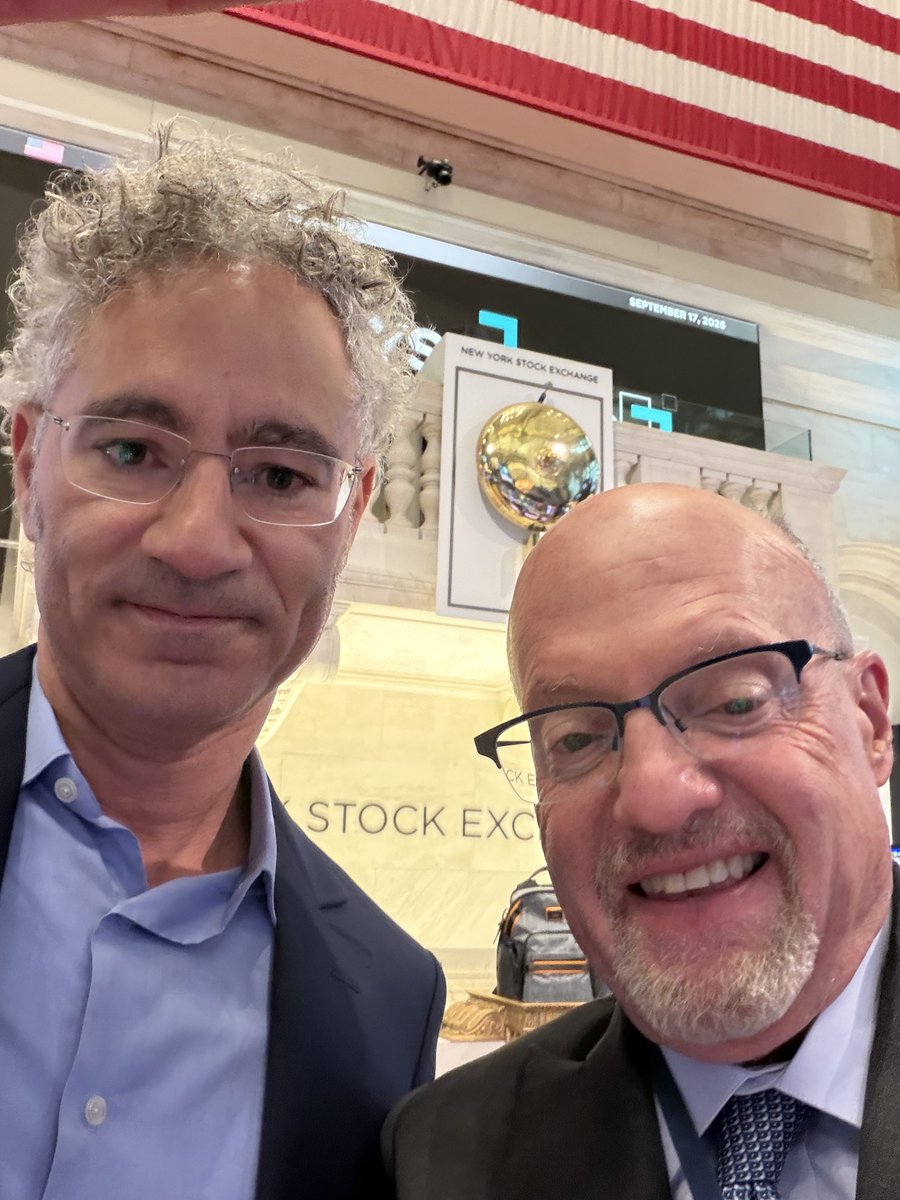
Good meeting in New York with @PalantirTech CEO Alex Karp.
Lithuania is ready to become a strong regional hub for the Baltics and NATO’s eastern flank – combining top talent, AI, data and defense technologies to develop solutions for real security needs across the Alliance.
Poland’s President Karol Nawrocki met with the CEO of Palantir, Alex Karp tonight in New York City.
Karp told the president that Palantir is interested in establishing a regional technology development center in Warsaw for NATO's eastern flank.
He also declared full support for the Polish Armed Forces.
Karp has previously stated that Palantir is Western company and that the West must remain armed with superior technology to survive and maintain peace in the world.
BREAKING: Palantir's Alex Karp says OpenAI will never IPO.
His theory: nationalization is the only real exit.
When asked what the S-1 risk factors look like, Karp's answer was simple: there is no S-1.
The liability exposure from frontier AI is so large that no public market can absorb it.
The only entity big enough to backstop it is a government.
If Karp is right, OpenAI doesn't become the next Google.
It becomes a utility. Or a weapon.
The most valuable AI company in the world may have no clean path to public markets.
Is nationalization actually the most likely outcome for frontier AI labs?
It was my honor to keynote this forum in Taiwan.
"If Taiwan can reach a durable shared view of its own future . . . Beijing will reach the conclusion that many nations have reached many times in history: This is a war that may be winnable, but it is not worth winning."
U.S. Army awards $PLTR $48M to build an ammunition management system
The platform will replace 9 separate legacy Army systems and provide a single view of ammunition
This is how you provide value
$PLTR just won a $48M U.S. Army contract to replace nine separate ammunition management systems with one enterprise platform.
The dollars are small but consolidating nine systems into one gives Palantir a much larger role in how the Army manages ammunition.
Palantir CEO Alex Karp on what model companies are really asking for when they call for regulation and why they will be nationalized.
“It's a weird twist. They're asking for societal regulation to get out of the first line of defense, which is if you build a technology that can destroy 10% of the of the world, that has civil and criminal liability attached to it.”
“The only way to deal with this kind of liability is to go to the government and say nationalize us, please.”
"Another problem we have is seemingly everyone who understands this is on some payroll."
$PLTR
Palantir CEO Alex Karp makes it very clear: frontier labs are subsidizing the cost of tokens to gain access to an enterprise's alpha.
This creates a host of liabilities if something goes wrong, which might be the real reason for this safety discussion that has emerged.
The answer? Sovereign AI, owning your own compute/data, which is something Palantir and Nvidia are helping scale across more and more enterprises.
$PLTR CEO Alex Karp says “How can they tell me not to wear a condom?” while arguing against overly broad AI regulation.
He wants “reasonable guidelines” but says the real accountability should come from holding people liable when the technology they build causes harm.
TRUMP CALLED JENSEN DURING THE ALL IN SUMMIT AND THEY PUT HIM ON SPEAKER PHONE:
Trump: "I'm telling you it's all a hoax. The data centers are great. They make people wealthy. They make states wealthy. AI is bigger than the internet. These people are playing right into the hands of China. We're not going to let that happen."
Jensen: "You're right, we're not going to let that happen sir."
This is quite the timeline we are living in folks.