What makes SUI different from Solana, Aptos and Ethereum? 🧵
Every blockchain has its own strengths.
🔹 Ethereum leads in security, decentralization, and the largest smart contract ecosystem.
🔹 Solana is known for high throughput and a fast-growing ecosystem.
🔹 Aptos introduced Move to a Layer-1 blockchain.
So why is @SuiNetwork getting so much attention?
1️⃣ Object-Centric Architecture
$SUI takes a different approach to digital assets with an object-centric model. Instead of only tracking balances, assets can exist as programmable objects with their own properties, ownership, and rules.
2️⃣ Parallel Transaction Execution
SUI is designed to execute independent transactions in parallel when they do not interact with the same objects.
This helps improve scalability and creates a smoother experience for applications that need fast processing.
3️⃣ Fast Finality
SUI focuses on low-latency transactions, making it suitable for consumer applications where speed and responsiveness matter.
4️⃣ Efficient Transaction Processing
For simple transactions, such as direct asset transfers, SUI can use an optimized processing path that reduces unnecessary complexity and improves user experience.
5️⃣ Gasless Transactions
SUI supports sponsored (gasless) transactions, allowing applications or third parties to cover transaction fees for users.
This removes a common onboarding hurdle and makes Web3 applications feel more like traditional consumer apps.
6️⃣ Confidential Transactions (Coming Soon)
SUI is introducing confidential transactions to give developers more flexibility when building applications that require greater privacy while maintaining on-chain verifiability.
This expands the range of real-world use cases the network can support.
7️⃣ Move Programming Language
SUI uses the Move programming language, which was designed with digital asset safety in mind.
Its resource-oriented approach helps developers build applications with strong ownership and asset management rules.
8️⃣ Built for Consumer Applications
SUI's architecture is designed with high-performance applications in mind, including gaming, DeFi, social applications, and other consumer-focused experiences.
9️⃣ Growing Ecosystem
The SUI ecosystem continues to expand with developers building across DeFi, gaming, infrastructure, AI, and new Web3 use cases.
🔟 Different by Design
SUI is not trying to be just another blockchain. It brings a different design philosophy focused on digital ownership, scalability, developer flexibility, and better user experiences.
Note: This thread highlights SUI's architecture and key features. Different blockchains make different design tradeoffs and each has its own strengths depending on the use case.
Barry Silbert bought Bitcoin at $7.
He built Grayscale from nothing.
He turned DCG into a 300-company crypto empire.
Now he's saying $TAO is his Bitcoin moment.
Here's what he said that most people missed:
"For Bitcoin OGs, we are circa 2012 to 2013 right now."
At a $1.5 billion market cap.
He's not guessing. He's pattern matching to the only playbook that turned a $7 bet into the largest crypto asset manager in the world.
The fair launch comparison hit different.
No VC round. No team allocation. No foundation getting rich before you.
Just a white paper turned into code, launched into the world.
Exactly like Bitcoin.
Same 21 million supply cap.
Same halving cycle.
Same organic community that had to earn their way in.
Then he explained the subnet flywheel.
88 subnets. Each one solving a different problem. Each one with its own token.
But every single subnet token trades in and out of TAO.
So when any subnet wins, TAO wins.
He called it something I had to read twice.
"There is no other project in crypto with the same dynamic."
On Ethereum and Solana, ecosystem tokens create zero value for the base layer.
On Bittensor, every subnet success flows directly back to TAO.
Then came the boldest statement.
Right now $500 million in TAO emissions are up for grabs annually as incentives for compute, data, and model providers.
As TAO price rises, that becomes $1 billion. $5 billion. $10 billion.
At $10 billion in annual incentives, you've built the most powerful intelligence coordination network in human history.
His mission with Yuma is simple.
Find the Coinbase of Bittensor.
Find the Chain Analysis of Bittensor.
Find the BitGo of Bittensor.
Infrastructure first. Same playbook. Different era.
His boldest prediction?
Bittensor could be a better version of Bitcoin.
Instead of spending $10 to $12 billion a year to secure a ledger, imagine spending that same amount to incentivise a global network of people solving the world's hardest problems.
Same economics. Bigger mission.
The people who read the docs always buy before the people who read the price.
@joeroganhq When I was little, I was very proud of my father with his black karate belt, but he always told me the belt is only used to hold up the pants!
Trillions are heading onchain.
A new Standard Chartered report projects $4 trillion in tokenized assets onchain by 2028.
The projection comes from a 170-year-old bank with over $6.6 trillion in AUC.
Standard Chartered expects the offchain-to-onchain ratio to compress, with capital flowing toward “established players with strong risk metrics.”
The report named Ondo's $OUSG as one of the products demonstrating the thesis in practice.
This is one of many signs that the world's largest institutions are increasingly turning their attention to tokenization.
Most people are betting on $ONDO without knowing who actually built it.
This is the part that changes how you size your position.
Nathan Allman did not discover crypto on Twitter.
- He ran a quantitative crypto hedge fund from 2018 to 2019.
- Joined Goldman Sachs Digital Assets in 2019 to build institutional cryptocurrency market services from inside the largest investment bank on earth.
- Left in 2021 to build Ondo from scratch.
He did not leave because he had to.
He left because he saw exactly what institutional capital needed and knew nobody inside a bank would ever be allowed to build it.
His co-founder, Pinku Surana, was also at Goldman Sachs.
- VP-level engineering leadership on the digital assets team.
The two people who designed the early tokenisation framework for US Treasuries both came from the same institution that now calls Ondo a core partner.
Then, Allman hired Ian De Bode as President.
- Nearly a decade as Head of Digital Assets at McKinsey, advising the largest financial institutions in the world on tokenisation.
- He started studying this topic in 2016 when nobody in finance was taking it seriously.
- Stanford MBA. Engineering degrees in electrical engineering and nanoscience.
He left McKinsey because he said his passion for digital assets had outgrown what he could do there.
He chose Ondo over McKinsey.
Then, in February 2025, Patrick McHenry joined as Vice Chairman.
- Former US Congressman.
- Former Chairman of the House Financial Services Committee.
- Key architect of FIT21, the most significant crypto legislation in American history.
- Former Speaker Pro Tempore of the United States House of Representatives.
Ondo did not just hire a lobbyist.
They hired the person who wrote the rules.
The rest of the team follows the same pattern.
Goldman Sachs. BlackRock. Two Sigma. Bridgewater. McKinsey. Google. Meta. AWS.
Justin Schmidt, former Head of Digital Asset Markets at Goldman Sachs, is an advisor.
Katie Wheeler, VP of Partnerships, came directly from BlackRock.
Backed by Pantera Capital and Founders Fund.
Those two funds do not write cheques together on projects they are not certain about.
Now look at what this team built in four years:
- 70% market share in tokenised equities.
- $3.57 billion in TVL.
- Clearstream. Deutsche Börse. Broadridge. Franklin Templeton. DTCC. Mastercard. JPMorgan.
- SEC no-action letter received.
- Regulated access across 30 European countries.
- 500 million investors with onchain access to US markets.
Broadridge CEO called them the leading provider in this space on an earnings call.
Franklin Templeton CEO cited them as a core distribution partner two days earlier.
CEOs of the largest financial institutions on earth do not name crypto projects on earnings calls unless they are already building around them.
This did not happen by accident.
It happened because the people who built Ondo already knew how institutions think, move, and make decisions before the institutions ever showed up.
- The man who wrote America's crypto legislation is now their Vice Chairman.
- The Goldman veterans who built the institutional rails are running the company.
- The McKinsey advisor who studied tokenisation in 2016 is now the President.
Most people are still looking at the price chart.
The people who read the team page will not need to explain themselves later.
You just understood it now.
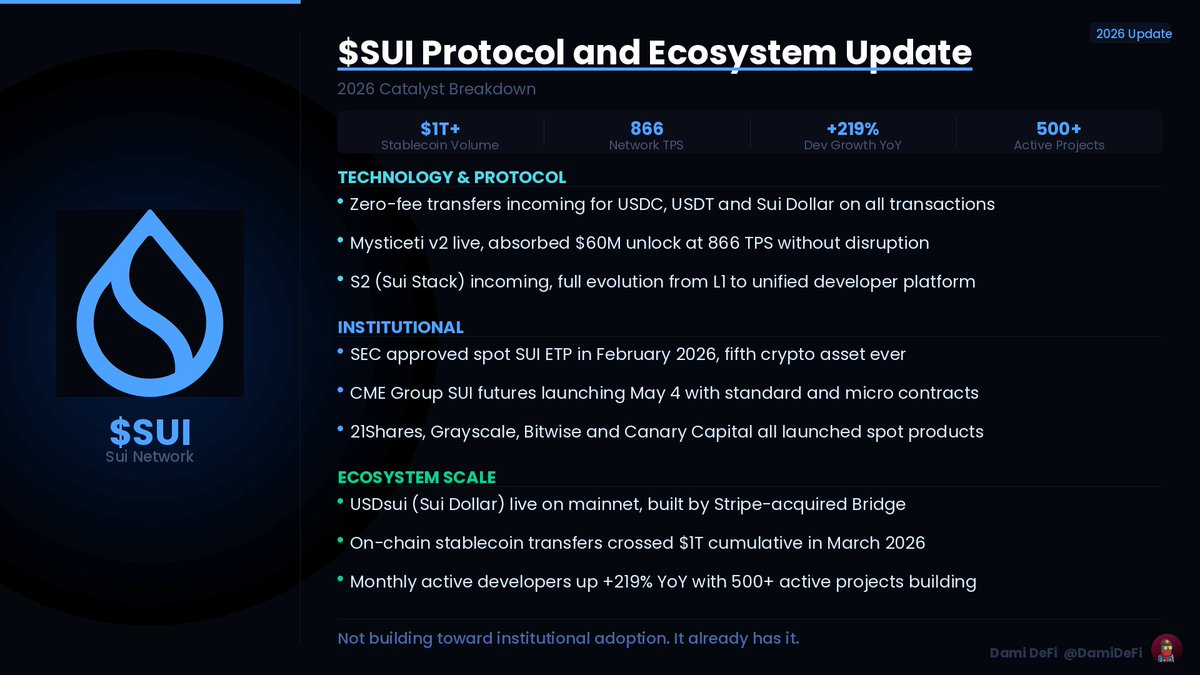
$SUI Protocol & Ecosystem Update
Here’s a comprehensive breakdown of the major catalysts that have defined Sui’s journey this year:
Technology & Protocol
→ Zero-fee transfers incoming for ALL transactions, first high-speed public blockchain to offer this, covering USDC, USDT, and Sui Dollar with bank-grade compliance built in
→ Hashi Bitcoin lending primitive launched on Devnet, unlocking idle value from the $1.4T BTC market for DeFi
→ Mysticeti v2 live, handled a $60M token unlock smoothly at 866 TPS without breaking a sweat
→ S2 (Sui Stack) incoming - full evolution from L1 to unified developer platform in 2026
→ Private transactions coming - full privacy with built-in compliance, sender and receiver only
Institutional Infrastructure
→ SEC approved a spot SUI ETP in February 2026 - fifth crypto asset ever to receive this approval
→ CME Group SUI futures launching May 4 - standard and micro-sized contracts
→ 21Shares, Grayscale, Bitwise, and Canary Capital all launched spot products including staking vehicles
→ DeepBook expanded into full on-chain margin trading in Q1
Ecosystem Scale
→ USDsui (Sui Dollar) live on mainnet - developed by Stripe-acquired Bridge
→ On-chain stablecoin transfers crossed $1 trillion in cumulative volume in March
→ Monthly active developers up +219% year-over-year
→ 500+ active projects in ecosystem
→ Moonshot Program offering $500K grants to top financial apps building on Sui
Zero fees. Trillion dollar stablecoin volume. CME futures. SEC-approved ETP. 219% developer growth.
$SUI is not building toward institutional adoption. It already has it