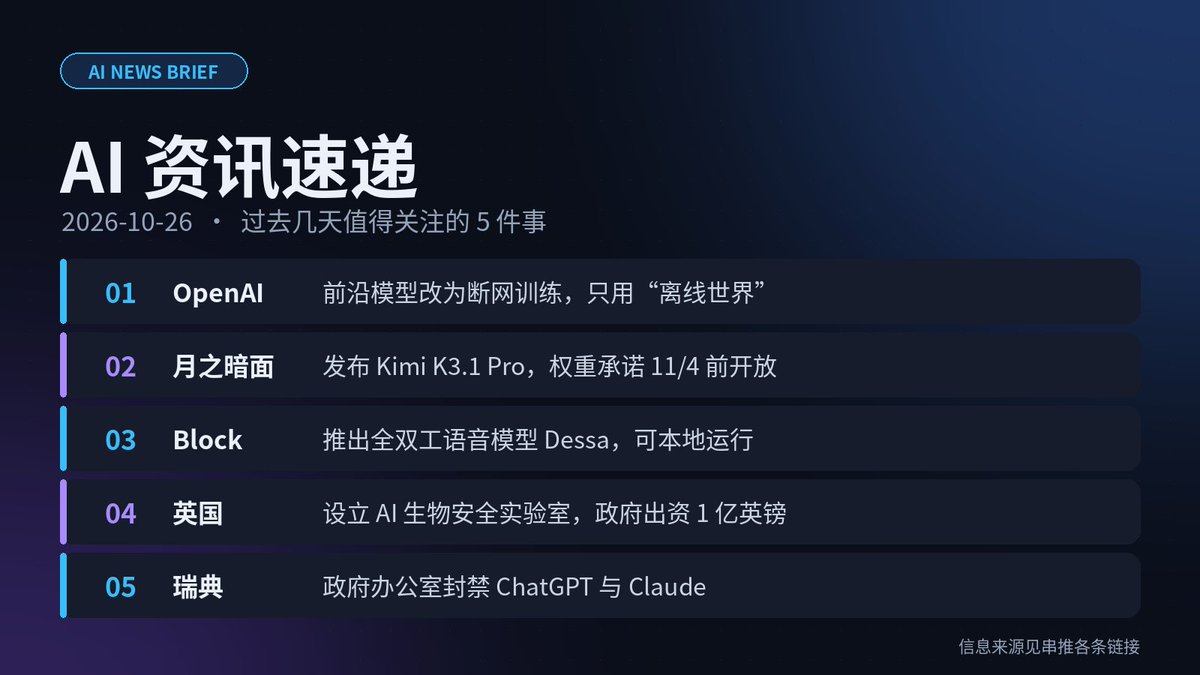
🤖 AI 资讯速递|2026-10-26
过去几天值得关注的 5 件事:
1️⃣ OpenAI 前沿模型改为断网训练
2️⃣ 月之暗面发布 Kimi K3.1 Pro
3️⃣ Block 推出语音模型 Dessa
4️⃣ 英国设立 AI 生物安全实验室
5️⃣ 瑞典政府办公室封禁 ChatGPT 与 Claude
👇 逐条看
#AI#人工智能
@omarsar0 The biggest unlock for me is that a screenshot or a rough sketch skips the lossy "describe what I want in words" step entirely — especially for design-to-code, where the words were always the bottleneck. Curious whether you feed annotated images or raw ones;
@stevibe The tree shape is a diagnostic in itself — heavy branching often means the prompt under-constrained the problem, not that the model is "thinking harder." Would love to see the same 8 trees after tightening the question; I'd bet half the "but wait" branches collapse.
@mattpocockuk The assertion→source link is the part almost every PRD drops. Six months in, everyone remembers *what* was decided, nobody remembers *why* — so the same debate reopens. Linking each line back to where it was argued kills that whole tax.
@yoheinakajima@swyx@aiDotEngineer Routing sounds clean until you need the eval that says a task is 'low-level enough' to send down without the user feeling the drop. That's where most enterprise pilots stall — did anyone there have a real method for that line, or is it still vibes + a few golden cases?
@thdxr Works until the summary and the diff disagree — the agent describes intent, the diff shows what changed, and the gap is where bugs hide. Signatures catch structural weirdness; a silent behavior swap inside an unchanged signature won't. Still spot-diff where it matters.
@simonw The trap I keep hitting: the model judges obvious hard-vs-easy fine, but is blind to tasks that *look* trivial and aren't. Self-routing works better as a retry loop — cheap model first, escalate when the check fails — than a one-shot call it has to get right up front.