Why can some clubs spend £200m in one summer while others struggle to spend £50m?
The answer lies in the Squad Cost Ratio (SCR).
SCR = Squad Cost ÷ Revenue
It measures how much of a club’s revenue can be committed to squad costs.
Clubs competing in Europe are capped at 70% of revenue under #UEFA regulations, while clubs outside Europe can spend up to 85% under #PremierLeague rules.
This is why revenue matters. Clubs that rely heavily on matchday income have less financial flexibility, making it harder to compete for elite players and wages.
#THFC are one of the biggest beneficiaries, operating at an SCR of roughly 43% on revenues exceeding £518m, leaving significant headroom to strengthen their squad.
#MUFC also remain in a healthy position at around 55%, giving the club considerable room to invest while staying comfortably within the regulations.
SCR isn’t about who is richest, it’s about how much of your revenue you can legally invest in your squad.
#FootballFinance #Transfers #FootballAnalytics
Jeff Bezos asked a room to imagine going back a hundred years.
When almost everyone was a farmer.
And telling those farmers that in 2018 there’d be a job called “massage therapist.”
Bezos: “They would not have believed you.”
Then a friend took it further.
Bezos: “Forget massage therapist, there are dog psychiatrists.”
He looked it up.
Bezos: “Sure enough, you can easily hire a psychiatrist for your dog.”
The room laughed.
The point under the laughter wasn’t funny at all.
Every time a major technology shift hits, we do the exact same thing.
We count the jobs it will destroy.
We never count the ones it will create.
Because we can’t.
They don’t have names yet.
The fear is always specific.
AI will replace accountants. AI will replace radiologists. AI will replace drivers.
The fear has job titles and timelines and projections.
The opportunity has none of those things.
Because you can’t name what doesn’t exist yet.
A farmer in 1920 could understand losing his job to a tractor.
He could not understand gaining a career as a social media strategist.
Not because he lacked intelligence.
Because the entire chain of inventions between his world and that job hadn’t been built yet.
Radio. Television. The internet. Smartphones. Social platforms. Creator economies.
Every single link in that chain had to exist before “social media strategist” could even be a sentence.
That’s where we are with AI right now.
Everyone is staring at the tractor.
Nobody can see the thing seven inventions away that doesn’t have a name yet.
The fear is loud because it fits inside language we already have.
The opportunity is silent because it doesn’t.
Every technological revolution in history created more jobs than it destroyed.
Every single one.
Not because anyone planned it.
Because human needs expand faster than machines can fill them.
We didn’t need massage therapists when we were breaking our backs on farms.
We needed them after machines freed our backs and stress replaced labor.
The demand didn’t disappear.
It migrated somewhere no one was looking.
That is exactly what’s happening right now.
The jobs AI creates won’t make sense to us yet.
They’ll sound as absurd as “dog psychiatrist” would’ve sounded to a farmer in 1920.
Until someone is running a $200 hourly practice with a six-month waitlist.
The entire conversation right now is about what we’re about to lose.
Nobody is talking about what we’re about to gain.
Because the gains don’t have vocabulary yet.
A hundred years from now, someone will stand on a stage and describe the jobs we couldn’t imagine today.
And the audience will laugh.
The same way we just did.
God is very intentional. Nothing about your life is random. Not the delays, not the detours, not even the waiting. He knows exactly what He's doing. Please learn to trust him more this year.
The end of an era at Apple...
Tim Cook is stepping down as CEO, and John Ternus is taking over.
Cook had one of the hardest roles in modern business, stepping into the shadow of Steve Jobs, a founder who didn’t just build a company but defined an entire culture around creativity, taste, and obsession with product.
The expectation was never just to run Apple, but to somehow continue the feeling Jobs created, which was always going to be impossible in the exact same way.
What Cook did instead was different, and in many ways just as difficult. He turned Apple into the most valuable company in the world, scaled its operations globally with precision, built one of the strongest services ecosystems in tech, and made Apple a machine that runs with consistency at a level very few companies in history have reached.
At the same time, the conversation around Apple slowly shifted, from breakthrough moments to incremental updates, from magic to optimization, from surprise to predictability.
Now Tim is moving into the role of executive chairman starting September 1, 2026, and John Ternus is taking over as CEO.
John Ternus comes from the product side, leading hardware engineering, which means he has been close to the core of what made Apple what it is in the first place.
This transition feels more like a quiet handoff, from the operator who scaled the empire to someone who might try to reshape what it builds next.
Now, what version of Apple comes out of it. A company that continues refining what it already dominates, or one that finds a new kind of boldness again.
We are about to find out.
There's a physicist at Stanford named Safi Bahcall who modeled this exact principle and the math is wild.
He calls it "phase transitions in human networks." When you're stationary, your probability of a lucky event is limited to your existing surface area: the people you already know, the places you already go, the ideas you've already been exposed to. Your opportunity window is fixed.
When you move, your collision rate with new nodes in a network increases nonlinearly. Double your movement (new conversations, new cities, new projects) and your probability of a serendipitous encounter doesn't double. It roughly quadruples. Because each new node connects you to their entire network, not just to them.
Richard Wiseman ran a 10-year study at the University of Hertfordshire tracking self-described "lucky" and "unlucky" people. The single biggest differentiator wasn't IQ, education, or family money. Lucky people scored significantly higher on one trait: openness to experience. They talked to strangers more, varied their routines more, and said yes to invitations at nearly twice the rate.
The "unlucky" group followed the same routes, ate at the same restaurants, and talked to the same 5 people. Their networks were closed loops. No new inputs, no new collisions.
Luck isn't random. Luck is surface area. And surface area is a function of movement.
The lobster emoji is doing more work than most people realize. Lobsters grow by shedding their shell when it gets too tight. The growth requires a period of total vulnerability. No protection, no armor, soft body exposed to the ocean.
That's the cost of movement nobody posts about. You have to be uncomfortable first. The new shell only hardens after you've already moved.
The point you have made here is fundamentally sound, and history supports it.
Societies are not transformed by wishful thinking about human nature, they are shaped by the structures that govern incentives, accountability, and consequences. A well-crafted constitution is not merely symbolic, it is an operating system for national behavior. Where it embeds strong checks and balances, it constrains excess, disciplines leadership, and protects the collective from the impulses of a few.
You do not need a different people to produce better outcomes, you need a system that makes bad behavior costly and good behavior rewarding. That is precisely why enduring democracies invest so heavily in institutional guardrails, separation of powers, independent judiciaries, and enforceable rights. These are not luxuries, they are the architecture of stability and fairness.
When constraints are weak or selectively applied, even well-intentioned actors can drift, and bad actors thrive. But when rules are clear, enforced, and difficult to circumvent, behavior adjusts over time. This is how trust is built, how arbitrariness is reduced, and how an egalitarian society begins to take shape, not by accident, but by design.
In that sense, constitutional reform is not about imagining “better Nigerians,” it is about engineering a system that consistently brings out the best in Nigerians while restraining the worst. That is the real foundation of progress.
What we are witnessing today is not accidental, it is the predictable outcome of a weak constitutional and structural framework. When institutions lack clarity, restraint, and enforceable limits, the system naturally produces its worst tendencies. The quality of outcomes in any society is directly proportional to the strength of its rules and the integrity of the structures that uphold them.
The Economics of the Super Bowl
“Last year’s Super Bowl LIX in New Orleans generated an estimated $1.25 billion in total economic output across the state, a Louisiana State University study found
A study by the Bay Area Host Committee estimated that the event will generate between $370 million and $630 million in earnings across the area, largely fueled by more than 90,000 visitors expected from outside the Bay Area.
This year’s game will also create around 5,000 jobs in the Bay Area across various industries, according to the host committee’s study.
It is estimated that as part of its broader economic impact in the area, the event will generate roughly $300 million in labour income.
The Bay Area Host Committee estimated that those governments will see about $16 million in fiscal revenue.
Tax revenue from last year’s game in New Orleans, for instance, reached a total of more than $80 million,
With more than 60,000 football fans set to watch Sunday’s big game in person, Andrew Zimbalist, an economics professor at Smith College, estimated to CNBC that the NFL will make close to $400 million in revenue from ticket and luxury box sales alone.
According to Bloomberg, a 30-second Super Bowl commercial spot reached $10 million this year, up from $ 7.8 million last year.”
Each player on the winning team will receive $178,000, while each player on the losing team will receive $103,000.”
High agency shows up in two simple ways: doing things, and asking for things.
I’ve seen this play out many times with people I’ve worked with.
One was Tope. I gave him a task on a Tuesday. By the next Monday, he showed me the completed work, ahead of schedule. Then he casually showed me another version he built over the same weekend using a different stack he’d been advocating for. Both worked. His version was faster, lighter, and done in a shorter time, with about a third of the code. That one weekend changed our thinking, and we adopted some of his ideas. He’s now thriving in the UK, and we still work together occasionally.
Another was Ben. About ten years ago, while still in school, he sent me a cold email asking for an internship and sharing what he had done so far as an Android developer. I was impressed by his boldness and clear evidence of his skill, which was rare at that time. He joined us, became one of our best developers, and today he’s also thriving in Germany.
A high agency mindset is simply believing you can influence your own life and environment. People like this don’t wait to be invited. They try things, ask for things, and take responsibility.
And the funny thing is, you don’t start with confidence. You become confident by acting this way repeatedly, just as skills are built in sports or music. You practice first, and belief follows.
🇨🇲 Beck-Ray Enoru has had quite the 12 months in football:
📅 January 2025: He was a Zara shop assistant doubling up as a non-league footballer, warming up ahead of a live FA Cup clash against Tottenham Hotspur.
📅 January 2026: Making his first steps into the EFL after sealing a two-and-a-half-year contract with the world’s oldest Football League club — Notts County.
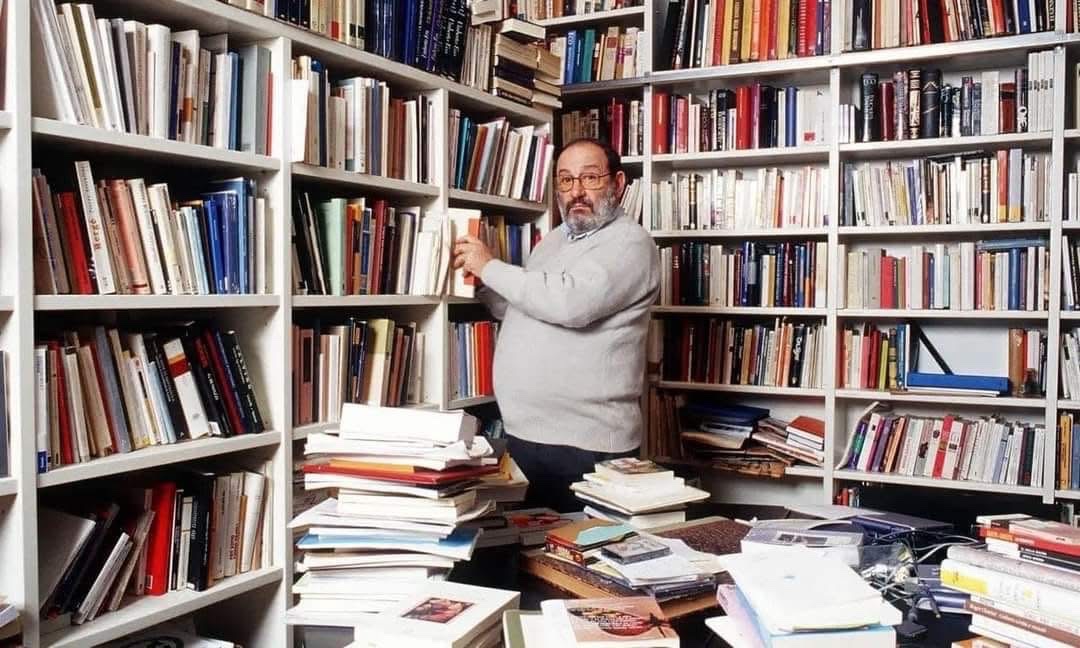
Umberto Eco, who owned 50,000 books, had this to say about home libraries:
“It is foolish to think that you have to read all the books you buy, as it is foolish to criticize those who buy more books than they will ever be able to read. It would be like saying that you should use all the cutlery or glasses or screwdrivers or drill bits you bought before buying new ones.
“There are things in life that we need to always have plenty of supplies, even if we will only use a small portion.
“If, for example, we consider books as medicine, we understand that it is good to have many at home rather than a few: when you want to feel better, then you go to the ‘medicine closet’ and choose a book. Not a random one, but the right book for that moment. That’s why you should always have a nutrition choice!
“Those who buy only one book, read only that one and then get rid of it. They simply apply the consumer mentality to books, that is, they consider them a consumer product, a good. Those who love books know that a book is anything but a commodity.”
For 2026, you need to embrace a can do perspective about all things. Many times; the COST of entry is simply AUDACITY. Be bold. Be audacious. Life will respond to you differently. Wishing you all an Amazing 2026.