Writer, editor, war-correspondent, ex-lawyer. Author of "Aiding and Abetting". Ex-editor The Indian Quarterly. Former film critic. Retweets ≠ endorsement
37 years ago today, the Chinese government brutally crushed peaceful protesters in and around Tiananmen Square who were demanding an end to corruption, freedom of speech, and democratic reform. The massacre revealed a truth the world should never forget: the Chinese Communist Party will do whatever it takes to preserve its grip on power. If it did not value the lives of its own citizens, why would it value the lives of others?
@DrChrisParry@RoyalNavy@RoyAnavy Stalin supposedly pointed out that with regard to ships, tanks etc ‘quantity has a strength all its own.’ As the UK is discovering, the opposite is also true: lack of quantity can spell absolute weakness. Maybe someone shld explain this to the UK’s admirals, defence planners etc
“There is an increasingly thin - indeed ever more fragile and sometimes nigh invisible - line between ‘security concerns’ and institutional pusillanimity”#BritishMuseum
This matters.
An obscure London event on the history of the ancient Jewish kingdoms in Judea and Israel is cancelled because of ‘security concerns’ and it turns out this was a reaction to a campaign to fill and then undermine the event by activist disrupters.
How strange! Why would a posse of aggressive activists be interested in the arcane details of bullae and steles and ostraca and inscriptions and numismatics in some small South Levantine kingdoms in the Iron Age?
Well, it is a little more than that which is why it is both disturbing and important. And it matters because at its least it is a threat to history in Britain’s - but also the world’s - greatest temple of History @britishmuseum - and its scholarly integrity.
The BM and its leadership are decent and well-meaning and have explained that they wished to save an event from disruption by bullying vandals but I am sure the BM realizes it is essential to announce a new event fast lest it give the impression that the permission of tiny cadres of aggressive bullies are required before it hold events. But the significance is wider than an event about the Moab and Tel Dan steles in a great museum.
British cultural life is the right and exercise of civic and cultural freedom – a privilege of our liberal democracy - that does not require the permission of gangs of ideological activists nor can it cancelled or postponed nor endured at their beck and sufferance nor permitted with a bend of the knee to their permissions or veto. But that is what this appears to be.
Across the cultural world in the West, though the bewildered middleaged managers of our institutions that are confronting and often submitting to a wave of self-righteous blackmail and mob threat, there is an increasingly thin – indeed ever more fragile and sometimes nigh invisible – line between ‘security concerns’ – and institutional pusillanimity.
Then there is the history itself.
This event concerns the study of the ancient kingdoms of Judah and Israel that existed between roughly 1100BC and 586BCin the Levant. It is not a coincidence that this was chosen for disruption. The history of the Judean kingdoms and the Jewish Temple in Jerusalem that stood for most of the time between 1000BC and 70ADetc is important and fascinating history in its own right, supported by complex and growing archaeological finds.
These small kingdoms and the subsequent Temple priestly mini-state (restored by the Persian kings Cyrus and Darius 539BC) and then the larger Judean kingdoms of the Hasmoneans and Herodians – between 167BC and 135AD chronicle the long indigenous history of Jews in the region – which the protesters are keen to erase. This is a political project of ideological erasure and malicious incitement of course concerned with the complex, brutal Israel-Palestine conflict that has now gone on for a hundred years and is unlikely to be solved in a small lecture theatre in the British Museum. But it also attempts to deny or erase Jewish history itself – and by implication the heritage of British Jews who live here in Britain, a small community that is now under cultural and sometimes physical threat.
Incidentally - but it is worth saying, this history does not deny anyone else’s history, nor the many other small realms in this region through ancient times nor the many names of the region and its entities and the historical origins of those names (Canaan, or Philistia or Peleset, Phoenicia, Aram Damascus or Moab or later Nabatea and the provinces of Palaestina Prime, Seconda and Tertia and the Ghassanid kingdoms and so on etc etc). The history of one can not be used to erase the history of the other and does not need to do so. The pursuit of knowledge which is one of the delights of human life and is the mission of the BM and indeed anyone who writes, reads or enjoys history, can celebrate and recognize all of these.
Yet this protest and the many like it deployed across Britain nowadays is the opposite of that - an attack on history using the methods of intimidation and vandalism. Much of this involves distorting or dismantling actual history or often lying to replace it with a fabricated ideological structure that nourishes no one and helps no one but degrades our culture and civic life not to speak of history itself. By the way, the frequent claims that these histories or names are ‘denied’ or ‘noone knows them’ is nonsense: anyone and everyone who is interested knows this history. (Much of it appears for example in my book Jerusalem a history of the Holy Land.)
And this is relevant not just to those of us who write study or enjoy the history of the region but also to those who believe that cultural life and civic society is a right that must not be submitted to the aggressions and plots of loud well-organized much-indulged ideologues who take advantage of the freedoms of our society to undermine its principles and the very freedoms they are designed to guard.
Just as vital is a rule of history itself that concerrns the rise and fall of civilizations: the society that ceases to allow to free discussion of ideas and stops respecting and recognizing the value of scientific and historical sources and facts is a society that will fail.
@simon_schama Torn between Casablanca; High Noon; Citizen Kane; Best Years of Our Lives; La Dolce Vita; Some Like it Hot; How Green Was My Valley; Dr Strangelove....
There are lots of films suitable for Memorial Day, but perhaps none more so than 'Taking Chance'. The trailer alone does it for me:
https://t.co/lWjEK7T1rO
@rorysutherland It’s remarkable how many UK consulting & branding companies find that their research produces results that align closely with the political, cultural & social views that predominate in the ‘cool’ parts of London where their staff live.
@CheckmateEA@UNmigration Actually #Somaliland has another airport at Berbera, (famously with one of the longest runways in Africa). It has daily flights to Addis.
@ktdrozdowski@unherd Fascinating. It would be interesting to know where particular inflows tend to concentrate. Eg. Barcelona seems to have relatively high immigration from South Asia rather than North Africa.
@prestonstew_@KomissarWhipla For a long distance air campaign of that size, length, intensity & complexity, against an enemy with modern AA systems, those aren’t high losses by historical standards. Still, there’s little excuse for USAF’s failure to adequately protect its airbases against missile & drones
@Mr_Andrew_Fox Camel burgers for lunch; camel steaks for dinner; camel milk at breakfast. #https://spectator.com/article/britain-must-recognise-somaliland/?edition=us
@TheCinesthetic Interestingly the HBO version of Rome season 1 is better than the BBC’s. The latter was worried that there was too much politics & history & wanted to emphasise the sex & violence so combined the first two episodes into one.
@TheCinesthetic One reason that ‘Rome’ felt and looked so movie-like in the best way, was that early episodes were directed by the late, great Michael Apted.
1/3
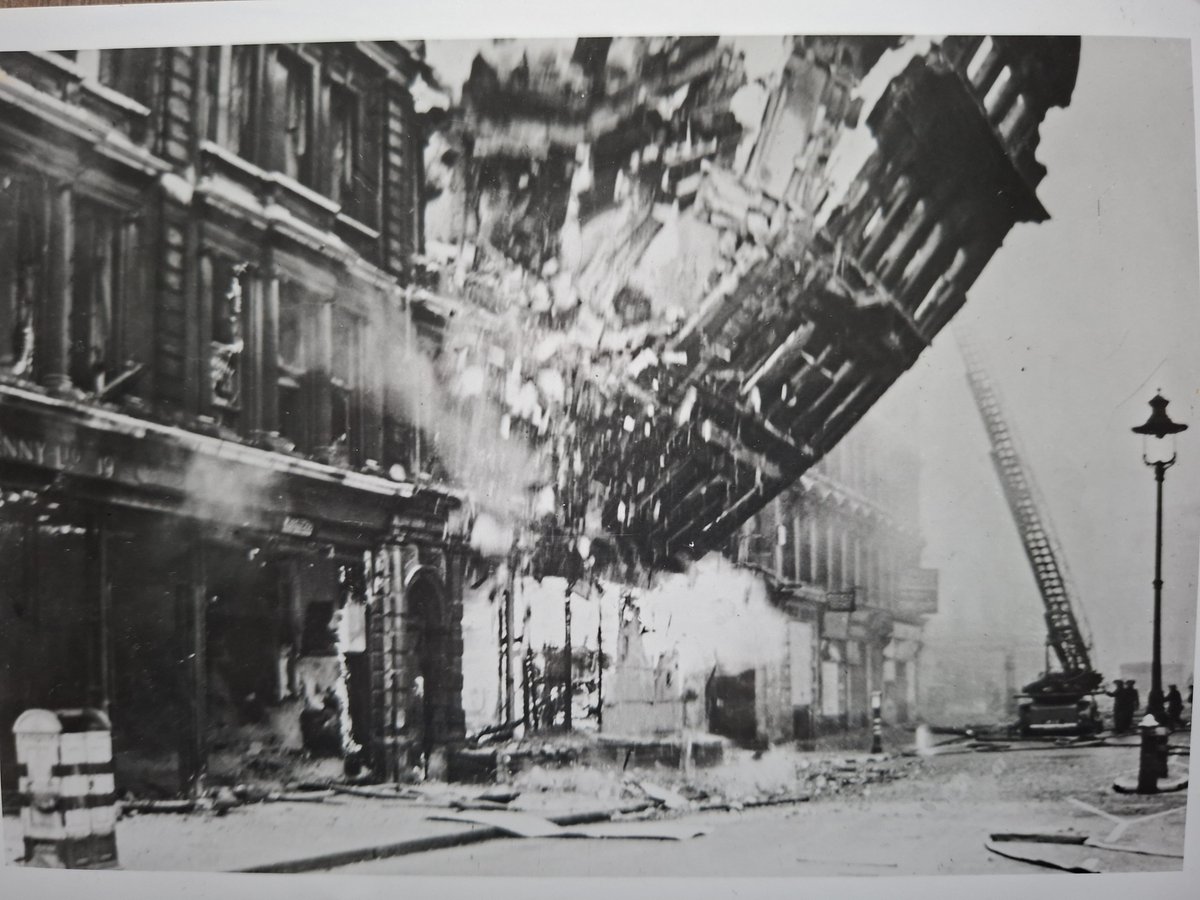
May 10 1941.
At this hour 85 years ago 400 German bombers were preparing to attack London in what would be the capital's deadliest raid of the Blitz.
It was Cup final day – Arsenal v Preston at Wembley.
1,436 Londoners would be killed.
1,800 wounded.
12,374 left homeless.
@KateClanchy1 Well, that was a depressing & infuriating breakfast read (what terrible people - the publishers as well as the vicious twitter activists). It was mitigated a bit by the knowledge that you weren’t permanently cancelled. Was the book ever republished in proper form?
@Kathleen_Tyson_@cchukudebelu@WSJ The reason is that the WSJ article is not actually about the presence in Erbil, but a new temporary base set up in the Iraqi desert a long way to the south of the KRG (as reported in a number of places this week)
@mattwridley I think it made a lot of sense to assign l’Étranger because it’s such an adolescent book. It doesn’t seem at all cool or clever to me now, but it did when I was 16, and therefore got me reading in French with enthusiasm.