“Religious socialism, Christian socialism, are contradictory terms; no one can be at the same time a good Catholic and a true Socialist.” (Pope Pius XI, Encyclical Quadragesimo Anno, May 15, 1931. n. 120)
🚨BLACK TUESDAY in the South Korean stock market:
The Kospi index CRASHED -10% on Tuesday, its 3rd-largest single-day decline in history, also triggering a 20-minute trading halt after falling more than -8% intraday.
The Kosdaq index also plunged -8%, falling below the 900 mark for the first time this year.
Samsung and SK Hynix both dropped -12%, while Hanmi Semiconductor fell -14.4%, with every major sector closing in the red.
Meanwhile, foreign investors and institutions sold a combined ~8.6 trillion won ($5.6 billion) of Kospi shares during the session.
Sentiment turned negative after SK Hynix was reported to be slowing its HBM4 mass production expansion, while broader tech weakness in US markets overnight added to selling pressure.
Massive forced liquidations added to the pressure, with retail margin debt at a record 38.5 trillion won ($25 billion).
The world's best-performing market is turning into the worst-performing.
Is the South Korean BUBBLE BURSTING?
RFK JR: “Today, a compliant child must take between 69 and 92 vaccines to stay in school... and NOT ONE of them has been safety tested in a pre-licensing placebo-controlled trial."
"That is just MALPRACTICE."
⚠️China is tightening its grip on rare earths as a geopolitical weapon:
China has placed MP Materials and USA Rare Earth, the two leading US rare earth producers, on its export control list, prohibiting them from accessing Chinese-origin dual-use materials and equipment, according to Bloomberg.
Both companies say they have already largely cut off supplies of equipment and materials from China.
The move is a direct response to the Pentagon's decision to add major Chinese companies to its list of firms accused of supporting the Chinese military.
MP Materials operates the only major rare earth mine in the US and received a $400 million equity investment from the Department of Defense last year, while USA Rare Earth recently secured $1.6 billion in funding from the Department of Commerce.
This comes days after G7 nations agreed to cap imports of rare earths and permanent magnets from any single country outside the bloc at below 60% by 2030, in an effort to reduce dependence on China.
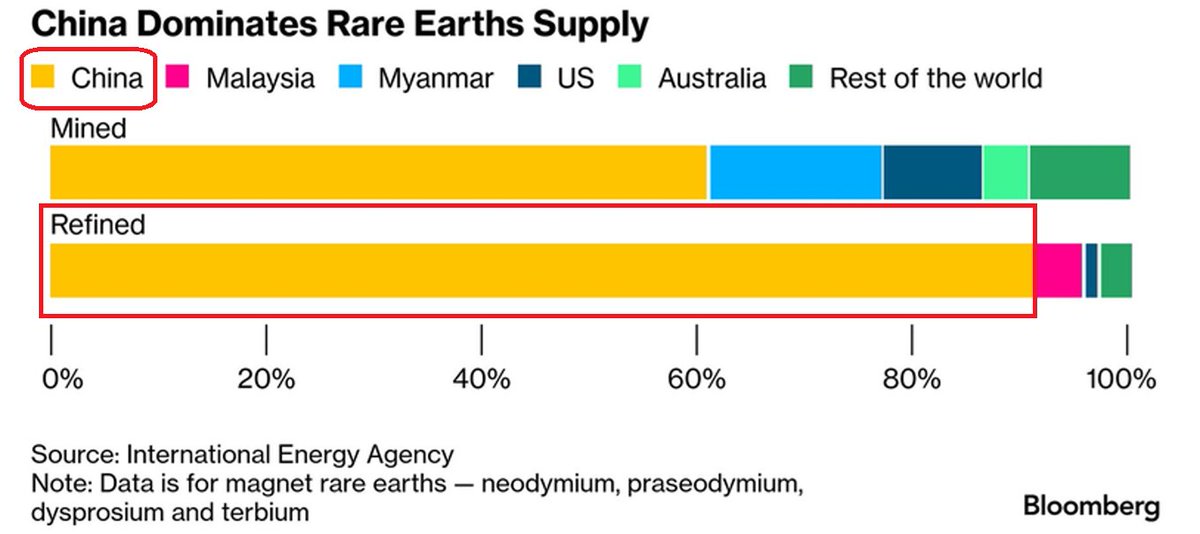
China accounts for ~60% of global mined production of magnet rare earths and over ~90% of global refining capacity, giving Beijing near-total control over a supply chain critical to everything from iPhones and EVs to fighter jets and missiles..
Beijing is using its rare earth dominance as a strategic lever, while the US remains years away from building a credible alternative.
PAUL OFFIT: COVID shot heart damage in teenagers "a very small price to pay."
"I just think people have to realistic expectations of the fact that you're going to learn as you go."
This guy was actually on the FDA panel that green-lit mRNA shots for teens...
🔴Investors are chasing US technology stocks more than EVER.
US tech funds recorded $19.2 billion in inflows last week, the largest single-week total on record, according to Goldman Sachs Global Investment Research.
Over the last 4 weeks, cumulative inflows have surged to ~$25 billion, far above any prior 4-week period since data began in 2022.
At the current pace, 2026 is on track to record $154 billion in total tech fund inflows, more than DOUBLE the prior annual record set in 2025, according to BofA Global Research.
The tech trade has never been more crowded.
🔴The US stock market has never been this expensive across so many metrics simultaneously:
The Trailing P/E ratio stands at ~30x, the highest since the 2000 Dot-Com Bubble.
The Shiller P/E, or CAPE ratio, stands at ~40x, also the 2nd-highest on record behind only the 2000 peak of ~44x.
The Forward P/E stands at ~21x, near its highest level outside of the 2000 and 2021 peaks.
The Price-to-Book ratio has reached ~6x, the highest on record, surpassing even the 2000 Dot-Com Bubble peak.
The Dividend Yield, shown on an inverse basis, has reached its highest EVER, meaning dividend yields are at their lowest on record, reflecting extreme investor willingness to pay for growth over income.
The US stock market is at or near its most expensive level in history.