British author whose work has been called 'acidic', 'highly distinctive', 'fresh', 'catchy', 'dark and delightful' and other not so nice words. CPFC #I Not AI
Only 2 weeks until Father’s Day! Becoming a dad for the first time is a voyage into the unknown. But with this book in their pocket or on their phone, every dad will be ready for the new roles they’ll be expected to play. https://t.co/vyE5Np8buj
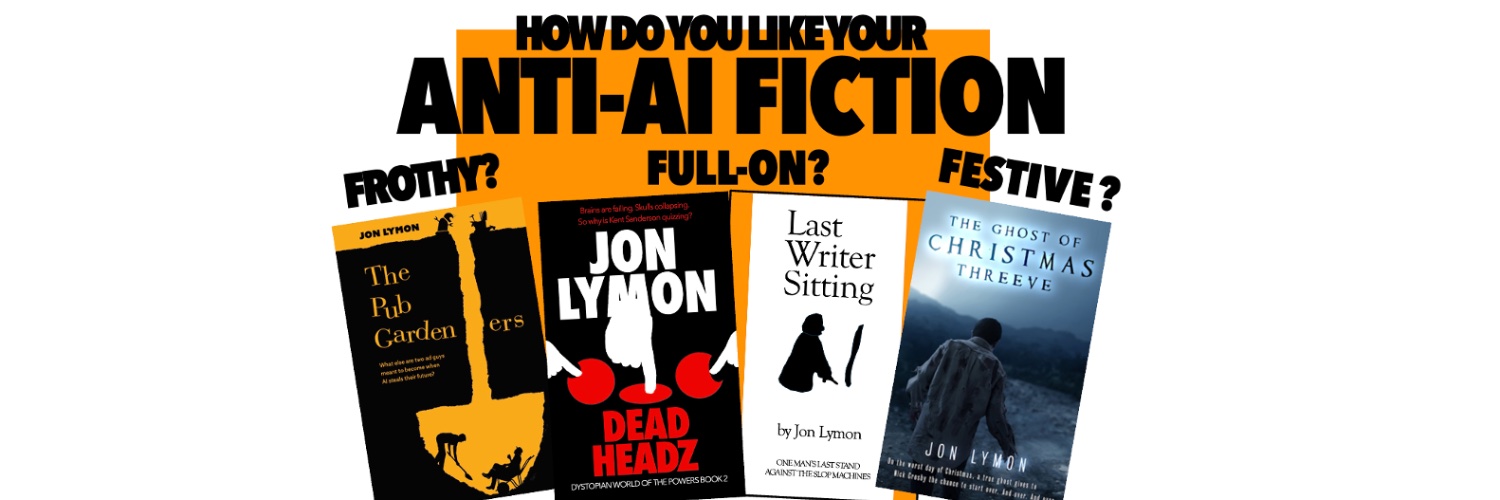
They’re off to the pub! Well, where else are two recently unemployed Englishmen meant to go?
This darkly humorous short novel is free to download on 3rd June.
UK
https://t.co/paHCZWwpSr
AUS
https://t.co/wdCPzbxxiM
USA
https://t.co/opG93uvs5O
Saying AI is just a tool in the creative process is misleading - because this isn’t the AI companies’ aim for it.
The aim of the (big) AI company is to automate more are more. There is no hard limit at which point they will say ‘ok, that’s enough automated now’. Their goal is for their systems to be able to create autonomously, to generate entire creative works with essentially zero input. If there is a part of the process they haven’t successfully automated, they will work on automating it.
The word ‘automation’ comes from the Greek ‘automatos’ - self-moving, self-acting. Automation, in its truest form, acts on its own. And there is little pretense from AI companies that they are not trying to build the ultimate automating system.
If AI were truly intended to be ‘just a tool’, AI companies wouldn’t let it write entire stories, or generate entire artworks, or compose entire songs. They could easily stop their products doing those things. They don’t.
AI is not ‘just a tool’. It is designed to replace something human - this is in its name. And there is no incentive for AI companies to stop short of full automation. From their perspective, the more that can be automated, the better.
Tools help with part of the creative process. AI, in its fully-realised form, replaces all of it. AI is not ‘just a tool’.
Fun, full colour puzzle book for kids aged 7 and under. Will also provide a challenging cognitive workout for regular AI users.
https://t.co/hVyxCcBJD9
@bbcquestiontime@BBCiPlayer@BBCNews Shameful. When it comes to these slop generators, supposedly intelligent adults are acting like kids with a new toy.
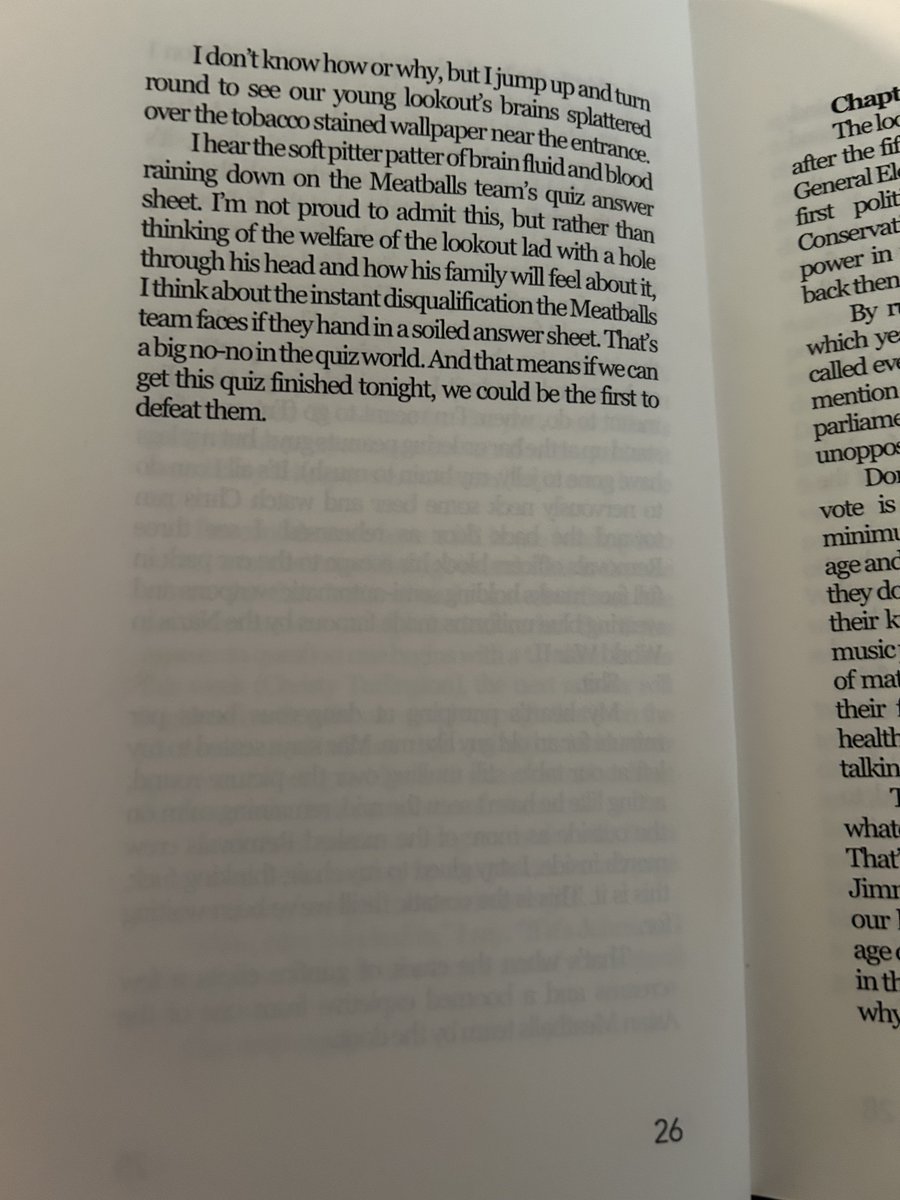
I'm posting a pic of page 26 of my latest novel Dead Headz. Because I can. And because it's 2026. And because I posted page 25 of my last novel last year. And you can post a page 26 if you want to join in this impromptu page 26 party...
@thematrixb0t It used to be the case that to wield the kind of power to change society that some tech billionaires seem to be enjoying right now, you had to be democratically elected by the majority of the population. What happened?
Let me trace the timeline here because nobody's connecting it.
Step 1: Scrape the entire internet. Every book, every article, every conversation, every piece of art, every forum post. Do it without asking. Do it without paying.
Step 2: Train a model on all of it. Call it "artificial intelligence."
Step 3: Go to BlackRock's Infrastructure Summit and announce: "We see a future where intelligence is a utility, like electricity or water, and people buy it from us on a meter."
Step 3 is where you sell people's own knowledge back to them. On a meter.
They took the collective output of human thought, compressed it into a model, and now they want to charge you by the token to access a version of what you and everyone you know already created.
One Reddit user put it perfectly: "They stole all this data from us, the people, our life's work, creativity, art, by devouring the internet and blowing through all copyright laws. Now they want to sell it back to us in the form of a utility."
Imagine if someone photocopied every book in the public library, burned the library down, and then opened a subscription service for the copies.
That's the metered intelligence business model.
And they're pitching it to infrastructure investors as though they invented water.
Stop using AI for basic questions. Just Google things. Read an article. Use your dictionary. Touch grass. Open a book. Ask God. I don’t know but stop using AI for everything.
Reading the Papal Encyclical again, it strikes me that not only is there no mention of the theft of creative work behind AI - there is no acknowledgement that pre-training data includes people’s creative work at all.
This is an unfortunate omission.
It mentions data several times, but mostly referring to things like health data and personal data. There is no recognition that the pre-training data on which much of the AI industry is built is people’s books, music and art.
This reinforces a common misunderstanding of ‘training data’ as something anonymous, technical and obscure, when in fact it is people’s life’s work - their novels, their paintings, their songs. Readers of the encyclical who are new to AI will, I think, misunderstand what ‘training data’ actually is.
This is a coup for the AI industry, which greatly benefits from rebranding ‘people’s creative work’ to ‘training data’, since the rebranding makes it less likely that governments will protect creators’ rights.
It is hard to reconcile this omission with a letter that elsewhere, admirably, reiterates the need to “promote the dignity of every person”, and that says “justice concerns every phase of economic activity, [including] resource acquisition”.
We must remember that training data is not ‘data’ in the sense most people understand it. It is the work of people - often highly creative work.
A struggling writer discovers that his filing cabinet has a magical power that could bring him the literary success he has so far skilfully avoided.
https://t.co/V4ZiShFmsR
It’s no longer just AI companies & their founders being sued over AI training - individual researchers are now being sued, too.
In a new lawsuit, two authors allege that Guillaume Lample, while an AI researcher at Meta, torrented 70 terabytes of pirated books for training Llama. (He later co-founded Mistral.) They also accuse Joelle Pineau, a former VP of AI Research, of being involved.
Suspect we will see more researchers sued in this way as the discovery process in other lawsuits reveals who was involved in getting copyrighted work for training.
I submitted an FOI request, and found out that the UK's Sovereign AI Fund doesn't check whether the companies it backs adhere to copyright law.
Sov AI's Chair, James Wise, has said publicly that they will "only invest in companies that follow [copyright law]" - but we now know they don't check this.
They may be tempted to say that asking companies specific questions on copyright would be overkill. But it would not be. Copyright is one of the most contentious legal issues around AI. We know that many AI companies exploit copyrighted work without permission, and it is widely believed that some British companies skirt the edges of UK law on this. This is an issue of critical importance, and ignoring it risks funneling public funds to exploitative companies.
Sov AI should specifically ask companies whether they adhere to copyright law before investing public money in them. But they should go further - they should ask whether the company trains on copyrighted work without a licence. These are different questions, since you could potentially adhere to UK law while training on copyrighted work in the US.
Asking these questions would add virtually no overhead to Sov AI's investment process, but would filter out companies that exploit copyrighted work without permission.
If the UK really wants to promote responsible AI, as the AI minister has said it does, Sov AI should add these checks asap.
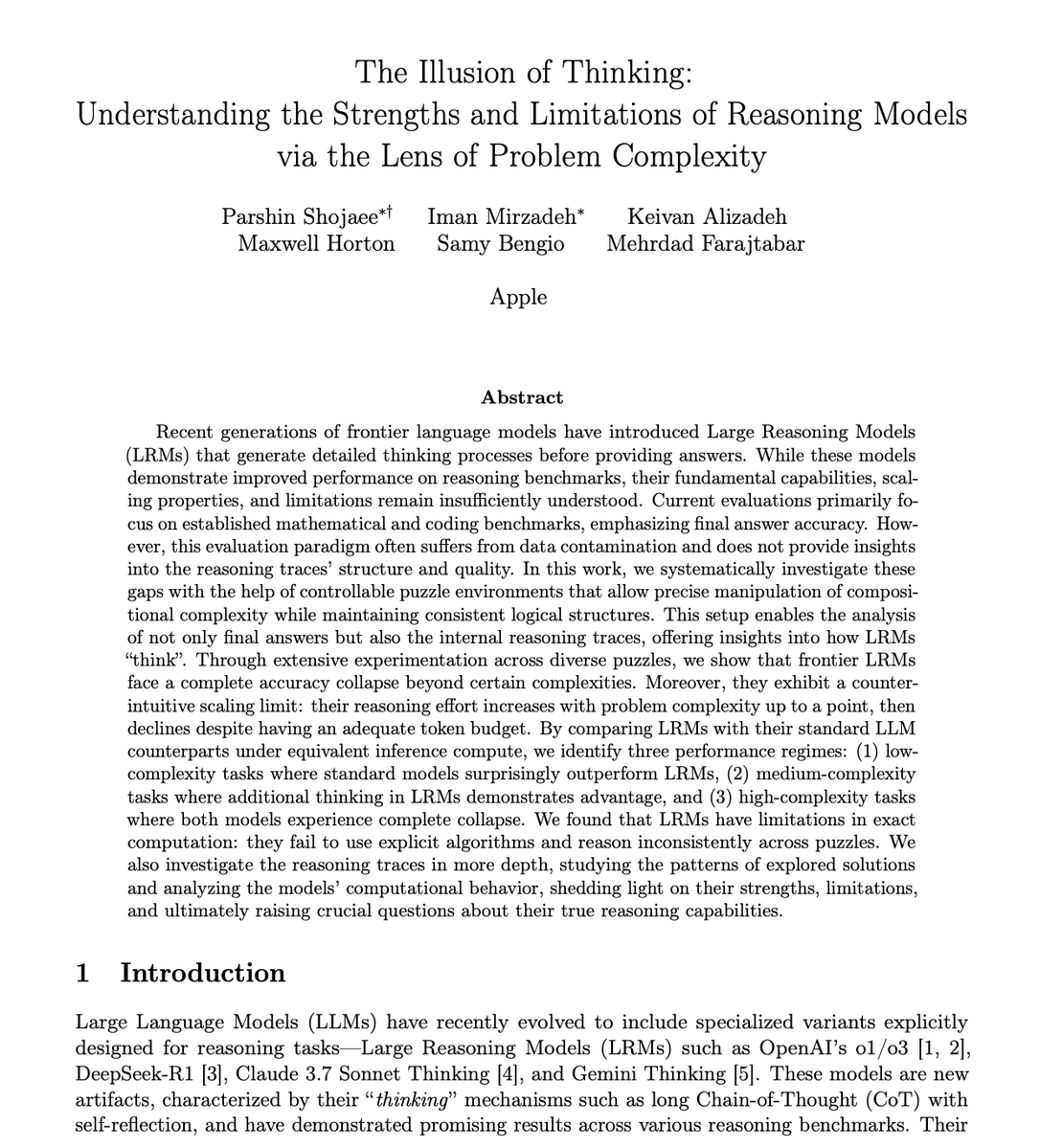
Apple has published a paper with a devastating title: “The Illusion of Thinking”
It argues that AI models, no matter how brilliant they may seem, do not understand what they are doing.
They do not solve problems. They do not reason. They merely generate text word by word, trying to sound coherent.
Apple tested the most advanced reasoning models in the world on controlled puzzle environments. They tore open the internal "thinking" traces.
What they found shatters the narrative that we are getting closer to AGI.
Current models don't scale with complexity. They have a hard mathematical cliff. And they do not degrade gracefully. They collapse.
But here is the most unsettling part.
When a problem gets too complex, the AI doesn't use its remaining compute to try harder.
It just gives up.
Its reasoning effort actually declines. It stops thinking and starts guessing.
Then Apple ran the experiment that closes the casket on the reasoning debate.
They gave the AI the exact, step-by-step algorithm to solve the puzzle. The cheat codes.
All the AI had to do was follow the instructions.
It couldn't do it.
Performance didn't improve at all.
When the complexity gets high enough, these models fail because they cannot actually execute a logical sequence.
They are not reasoning. They are just pattern matching.
When you give them a simple problem, they overthink. When you give them a hard problem, they collapse.
Paper: The Illusion of Thinking, Apple, 2025











![ednewtonrex's tweet photo. I submitted an FOI request, and found out that the UK's Sovereign AI Fund doesn't check whether the companies it backs adhere to copyright law.
Sov AI's Chair, James Wise, has said publicly that they will "only invest in companies that follow [copyright law]" - but we now know they don't check this.
They may be tempted to say that asking companies specific questions on copyright would be overkill. But it would not be. Copyright is one of the most contentious legal issues around AI. We know that many AI companies exploit copyrighted work without permission, and it is widely believed that some British companies skirt the edges of UK law on this. This is an issue of critical importance, and ignoring it risks funneling public funds to exploitative companies.
Sov AI should specifically ask companies whether they adhere to copyright law before investing public money in them. But they should go further - they should ask whether the company trains on copyrighted work without a licence. These are different questions, since you could potentially adhere to UK law while training on copyrighted work in the US.
Asking these questions would add virtually no overhead to Sov AI's investment process, but would filter out companies that exploit copyrighted work without permission.
If the UK really wants to promote responsible AI, as the AI minister has said it does, Sov AI should add these checks asap.](https://pbs.twimg.com/media/HI1EbECXYAAgHXh.png)