Hot take: I think it's still important to understand the code that our agents write!
In this mega thread (based on my AIE talk today), I will explain why that's the case, and show some ideas for how to efficiently understand code. Alright, let's dive in. 1/
Microsoft just got CAUGHT lying to every Fortune 500 company.
At Build 2026, Satya Nadella announced 7 brand new AI models built entirely in-house.
Microsoft's own technology trained on what they called "enterprise grade, clean and commercially licensed data."
That pitch was aimed directly at the biggest buyers in regulated industries: Banks, hospitals, insurance companies, and government agencies that need to know EXACTLY where their AI's training data came from because of active federal copyright lawsuits.
Procurement teams across Wall Street and Washington heard "clean and commercially licensed" and started writing checks.
There was just one problem:
Microsoft published the technical paper alongside the models, and a developer named Simon Willison actually READ it...
The MAI-Thinking-1 preprint describes a data pipeline that starts with 1.2 TRILLION pages scraped from the open web using a proprietary crawler. After filtering out piracy and adult content, that number drops to 794 billion pages.
On top of that, Microsoft fed in another 24.2 billion pages from Common Crawl, which is a massive open archive of web-scraped content that carries ZERO licensing guarantees and ZERO author consent mechanisms.
Common Crawl is the exact data source sitting at the center of multiple active federal copyright lawsuits against AI companies right now.
Microsoft told regulated industries the data was clean. But their own paper says it started with 1.2 trillion unverified web pages and a repository that's currently being sued over in federal court.
Those two things cannot both be true.
And here's where it gets worse:
This wasn't even an accident or a miscommunication.
Microsoft built this entire pitch around data provenance ON PURPOSE because they knew that was the number one concern for enterprise legal teams in 2026.
The DeepSeek scandal earlier this year made every compliance department in America paranoid about where AI training data actually comes from. Microsoft saw that fear and sold directly into it with a claim their own documentation contradicts.
As of today, Microsoft hasn't issued a single public statement addressing the contradiction between what Nadella said on stage and what the technical paper actually shows.
The reason Microsoft did all of this is what really matters though...
They are DESPERATE to break free from OpenAI.
In April 2026, the two companies renegotiated their partnership, ending Microsoft's exclusive license to OpenAI's technology and removing revenue-sharing obligations. Microsoft can now build competing models, and OpenAI can shop its compute to Google, Amazon, and Oracle.
The divorce papers are signed. Microsoft needed to prove it can survive without OpenAI, so they rushed 7 models to market, made claims about data cleanliness they couldn't back up, and got exposed by their own published research within 72 hours.
Every enterprise customer who signed a deal based on that "commercially licensed data" pitch now has a legal question on their hands. Every procurement team in finance, healthcare, and government that used data provenance as a deciding factor just learned the provenance was just marketing copy.
The EU AI Act requires providers of general-purpose AI to publish a detailed summary of training data content. So if Microsoft tries to sell MAI-Thinking-1 in Europe with the same pitch they used in San Francisco, they'll be walking straight into a regulatory mess.
What do you think?
Je vois beaucoup passer de vidéos sur Peter Thiel.
Soit c'est "le génie libertarien", soit c'est "le milliardaire fasciste".
Les deux sont faux. La réalité est beaucoup plus intéressante.
Voici pourquoi il pense ce qu'il pense.
1/ Peter Thiel n'est pas un idéologue de salon.
C'est un mec qui a :
- Cofondé PayPal
- Mis 500K dans Facebook (→ 1 milliard+)
- Cofondé Palantir (valorisation ~100Mds)
- Transformé 2 000$ en 5 milliards via un Roth IRA
Fortune actuelle : ~27,5 milliards.
Il a une track record. Ça change la conversation.
2/ Tout son système intellectuel tient en une phrase de René Girard, un philosophe français :
"On ne désire jamais par soi-même. On désire ce que les autres désirent."
Thiel a étudié sous Girard à Stanford. C'est la clé de TOUT ce qu'il pense.
Compétition = mimétisme = destruction de valeur.
3/ Application directe → Zero to One :
"La compétition est pour les losers."
Ne construis pas le 10ème réseau social. Trouve un secret que personne ne voit. Crée un monopole.
La plupart des gens trouvent ça choquant parce qu'on leur a appris que "la concurrence c'est bien".
Thiel dit : la concurrence, c'est de la destruction mimétique.
4/ Ensuite vient la Grande Stagnation :
Depuis ~1970, les bits avancent, les atomes stagnent.
Les avions ne vont pas plus vite qu'en 1960.
La guerre contre le cancer dure depuis 50 ans.
Le nucléaire est bloqué par la régulation.
"On voulait des voitures volantes, on a eu 140 caractères."
C'est pas du déclinisme. C'est un constat mesuré.
5/ Et c'est là que ça devient controversé.
Pour Thiel, la cause de la stagnation = la démocratie + la bureaucratie.
"Je ne crois plus que la liberté et la démocratie soient compatibles." (2009)
Le processus démocratique crée structurellement plus de régulation, plus de blocage, plus d'inertie.
Son modèle : il faut créer en DEHORS du système.
6/ D'où ses investissements dans :
→ Le seasteading (villes flottantes autonomes)
→ SpaceX (sortir de la Terre)
→ Les cryptos (monnaie hors contrôle étatique)
→ Anduril/Palantir (souveraineté tech)
Chaque investissement est un acte philosophique.
7/ Le dernier étage de la fusée : l'Antéchrist.
En 2025-2026, Thiel donne des conférences (San Francisco, Cambridge, Vatican) où il affirme :
"L'Antéchrist du 21e siècle est un luddite qui promet paix et sécurité pour justifier le contrôle total."
Ceux qui veulent réguler l'IA et stopper le nucléaire au nom du risque existentiel → préparent un État mondial.
8/ La contradiction massive ?
Palantir est littéralement un outil de surveillance de masse.
Thiel dit craindre l'État totalitaire tout en construisant son infrastructure technique.
Mais c'est justement cette tension qui rend le personnage fascinant — il n'est réductible à aucune case simple.
9/ Ce qu'il faut retenir :
Thiel n'est ni un prophète ni un villain.
C'est un philosophe-investisseur qui opère avec un framework cohérent :
Girard (mimétisme) → Monopole → Stagnation → Sortie du politique → Eschatologie chrétienne
On peut être en désaccord. Mais il faut comprendre la logique.
10/ Et concrètement, son influence est massive :
- J.D. Vance (vice-président US) est son protégé
- Zero to One est la bible du VC
- Palantir/Anduril redéfinissent la défense tech
- Son réseau (PayPal Mafia) a engendré YouTube, LinkedIn, Tesla
Ignorer Thiel, c'est ne pas comprendre la Silicon Valley de 2026.
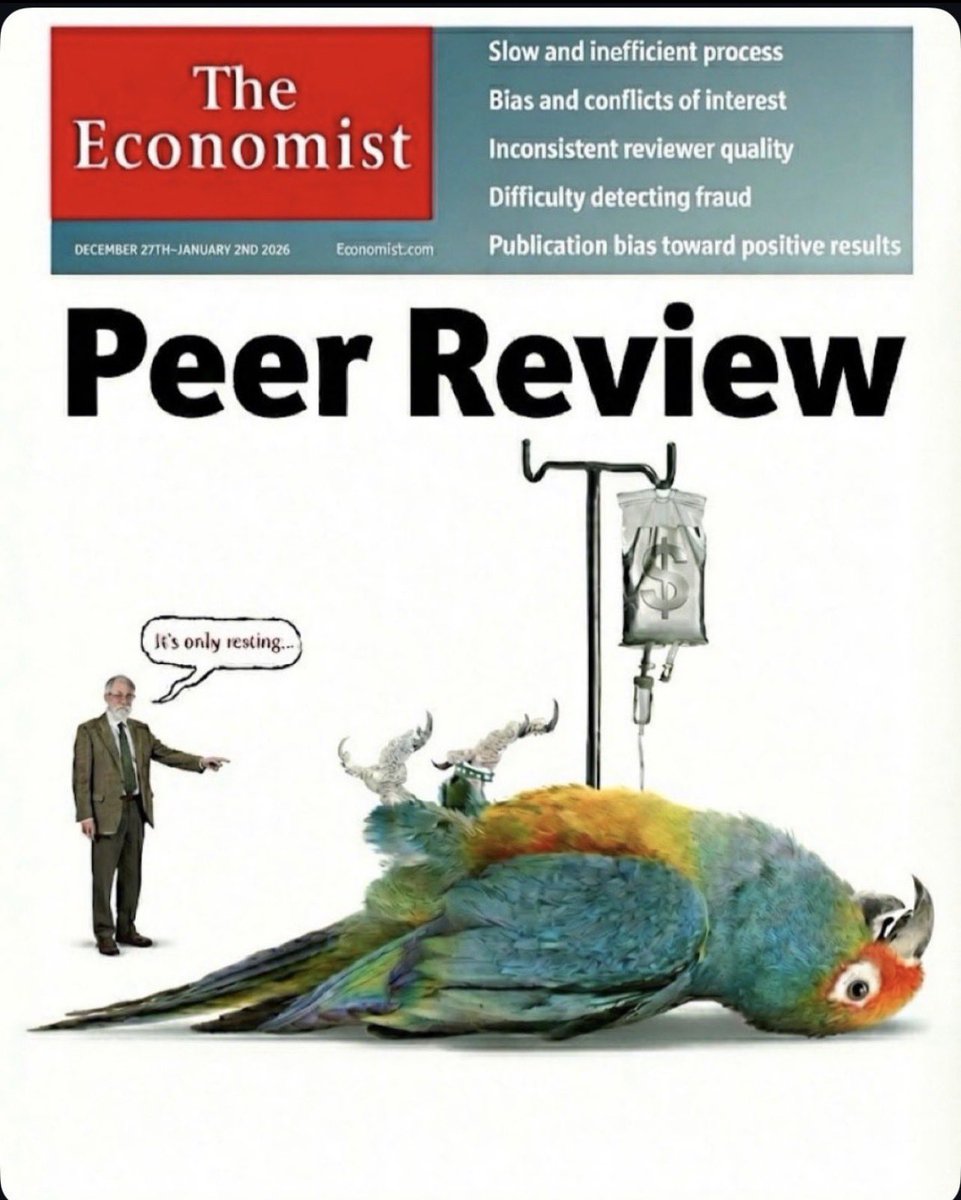
Peer review was supposed to be science’s quality filter, but somewhere along the way it started acting more like a bouncer who only lets in the regulars. It’s slow, it tends to favor established labs and familiar names, and it gets uncomfortable around anything too unconventional. Papers loaded with mountains of data tend to cruise through, while bold ideas that actually challenge the consensus get stuck in limbo or turned away at the door.
The irony is that where a paper gets published almost never determines its real worth. What actually matters is what the scientific community does with it afterward, whether people cite it, argue with it, build on it, or use it to blow up a long-held assumption. That’s where the value lives, not in the journal’s logo.
A major survey a few years back found that roughly 70% of researchers think the current system is fundamentally broken, and it’s not hard to see why. Publicly funded research hides behind paywalls, editors chase whatever topic is hot that month, and the whole incentive structure pushes toward safe bets over genuinely risky and potentially important work.
Science has always been complicated and deeply human and full of ego and inertia, but the conversation is shifting.
The reason why RAM has become four times more expensive is that a huge amount of RAM that has not yet been produced was purchased with non-existent money to be installed in GPUs that also have not yet been produced, in order to place them in data centers that have not yet been built, powered by infrastructure that may never appear, to satisfy demand that does not actually exist and to obtain profit that is mathematically impossible.
@gchampeau@JulienTechInvst il a clairement été choisi, je pense que Julien demande si c'est pour de bonnes raisons. Comme autre exemple du même genre, Carney au Canada a aussi été élu parce que considéré pouvoir faire face à Trump, sinon dur à dire si il aurait été élu
@levelsio I tried netdata which is great, but I recently switched to beszel (https://t.co/FksoNq4pGS), that is simpler, I just want to have simple metrics and alerts