A startup in China packed roughly 1,000 Mac Mini M4 computers into a single data center to run AI workloads without paying ongoing cloud fees. The base Mac Mini M4 starts at $599 and draws just 10 to 30 watts under load, a fraction of the 300 to 500 watts a traditional GPU server pulls.
Peter Lynch famously said there's a "100% correlation" between earnings and stock price over time.
If that's true...
These 10 stocks may be screaming opportunity.
1. $NFLX - Netflix
The new Google Finance is coming out of beta this week with new capabilities and a new @Android app.
Explore three ways it can help you better track and understand financial investments 🧵
$META is now at 16x forward earnings because the market sees AI capex as a risk.
Bill Ackman: “If a company is increasing growth capex while earning above average returns, you should applaud.”
And Jensen says nobody uses AI better than $META.
That’s all you need to know.
If you die without a plan...
- The government takes 40% in tax
- Probate court costs $100k+
- Your kids get the scraps
If you love your family, here's every document you need to protect them:
(from a CPA & father of two)
1) Emergency Access List
This should include:
-> All bank account numbers
-> Investment account logins
-> Life insurance policies
-> 401k/IRA beneficiaries
-> Safe deposit box location
-> Password manager master code
Keep a digital & physical version for safety...
And make sure your spouse has access.
2) Legal Documents
-> Will (name guardians for kids)
-> Durable Power of Attorney
-> Healthcare Power of Attorney
-> Living Will/Healthcare Directive
Setting all of this up costs about $500...
($1,500 with an attorney)
But without them, the state decides everything.
3) Money Protection
Your family will need time to mourn.
Make sure they can do it without going broke:
-> Term life insurance (10x income)
-> Emergency fund (6-12 mo in a HYSA)
-> Retirement accounts with spouse access
4) The "First 48 Hours" Sheet
Write down clear instructions for your family:
Call this attorney: [Name/Number]
Call this CPA: [Name/Number]
File life insurance claim here: [Details]
Don't touch investments for 6 months
All bills are on autopay from [Account]
Grief destroys decision making.
This protects them.
5) Business Owner Addition
If you have a business, set up:
-> Buy sell agreements
-> Key person insurance
-> Business succession plan
-> Separate LLC owned by trust
If your company can't survive without you...
It's a 9-5 with extra steps.
6) Trust Setup
A proper trust can save your family $400k+ in probate costs.
But 90% of them are set up wrong:
-> Assets never get transferred in
-> Beneficiaries aren't updated
-> Pour-over will is missing
Here's how to fix that:
"Bulletproof" Trust System:
1) Revocable Living Trust
-> Avoids probate completely
-> Keeps finances private
-> Protects kids' inheritance
2) Pour-Over Will
-> Catches forgotten assets
3) Guardian Designation
-> Who raises your kids
-> How they get paid
Setting this up takes a weekend...
But ignoring it could cost your family everything.
So start before you're ready...
Because no one plans on dying.
Hope this helps!
Share with your spouse if you want to set this up...
And follow me for more 🤝🏻
🚨BREAKING: Google just dropped Google skills.
A new platform where anyone can learn ai, coding, and tech from scratch with certificates.
Here is everything you need to know:
30 security rules for AI VIBE CODING :
1. Set session expiration (JWT max 7 days + refresh rotation)
2. Never use AI-built auth. Use Clerk, Supabase Auth, or Auth0
3. Never paste API keys into AI chats. Use process.env
4. .gitignore is your first file in every project, not the last
5. Rotate secrets every 90 days minimum
6. Verify every package the AI suggests actually exists before installing
7. Always ask for newer, more secure package versions
8. Run npm audit fix right after building
9. Sanitize every input. Use parameterized queries always
10. Enable Row-Level Security from day one
11. Remove all console.log statements before shipping
12. CORS should only allow your production domain. Never wildcard
13. Validate all redirect URLs against an allow-list
14. Apply auth + rate limits to every endpoint, including mobile APIs
15. Rate limit everything from day one. 100 req/hour per IP is a start
16. Password reset routes get their own strict limit (3 per email/hour)
17. Cap AI API costs in your dashboard AND in your code
18. Add DDoS protection via Cloudflare or Vercel edge config
19. Lock down storage buckets. Users should only access their own files
20. Limit upload sizes and validate file type by signature, not extension
21. Verify webhook signatures before processing any payment data
22. Use Resend or SendGrid with proper SPF/DKIM records
23. Check permissions server-side. UI-level checks are not security
24. Ask the AI to act as a security engineer and review your code
25. Ask the AI to try and hack your app. It will find things you won't
26. Log critical actions: deletions, role changes, payments, exports
27. Build a real account deletion flow. GDPR fines are not fun
28. Automate backups and test restoration. An untested backup is nothing
29. Keep test and production environments completely separate
30. Never let test webhooks touch real systems
Ship fast. But ship secure.
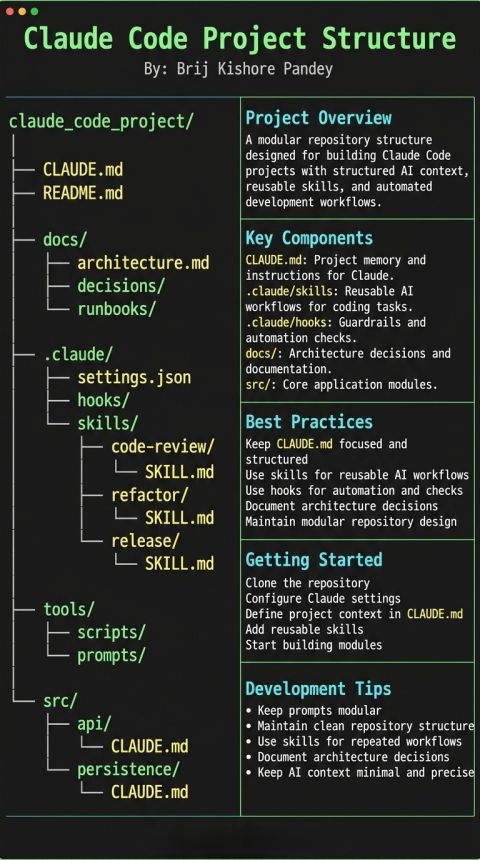
Most people treat Claude Code like a smarter chat window.
That works… until your project grows.
This structure highlights something deeper: once you move beyond single prompts, you need separation of concerns. The same principles we use in software engineering apply here, too.
Look at the layout carefully.
CLAUDE.md is not just a note file. It becomes project memory.
It defines:
→ Standards
→ Constraints
→ Tone
→ Non-negotiables
→ Guardrails
Instead of repeating instructions in every prompt, you centralize them. That reduces token waste and behavioral drift.
Then you see skills/.
This is where things get powerful. A skill is essentially a reusable workflow.
If you’re repeatedly doing:
-Code reviews
-Refactoring
-Output formatting
-Structured analysis
It should not live in an ad-hoc prompt. It should live as a reusable capability.
That shifts you from prompting to system design.
Next, hooks/.
Hooks are underrated. They let you enforce checks:
→ Clean tool output
→ Validate structure
→ Log commands
→ Transform JSON
If you’re not using hooks, you’re manually correcting outputs that could have been automated.
Then the repository itself stays modular:
-docs/ for architecture decisions
-src/ for actual logic
-tools/ for scripts and utilities
This prevents your AI layer from bleeding into your application layer.
When I started organizing projects this way, three things improved:
-Fewer repeated instructions
-More predictable outputs
-Easier collaboration
Especially once you add:
→ Subagents
→ MCP integrations
→ GitHub Actions automation
→ Plugin development
Without structure, context becomes clutter. With structure, Claude operates within clear boundaries.
This is not about making things complex. It’s about treating AI workflows like first-class engineering components instead of temporary chat experiments.
If you're learning Claude Code and want to see how I implement this step by step, from installation to CLI usage, skills, hooks, subagents, MCP, GitHub Actions, and plugins, I’ve recorded the full process while building real workflows.
This is the Claude Code Full Course Link- https://t.co/YSFcevvO4q
Image Credit- Brij Kishore Pandey
Happy Learning!
#claudecode #claudeai
Best YouTube Channels To Learn in 2026
1. Cybersecurity – John Hammond
2. Artificial Intelligence – Andrej Karpathy
3. AI Research Breakdown – Yannic Kilcher
4. Web Development – The Net Ninja
5. Python Programming – Corey Schafer
6. DevOps – TechWorld with Nana
7. Cloud Computing – AWS re:Invent
8. Data Analytics – Luke Barousse
9. System Design – Gaurav Sen
10. Databases – Hussein Nasser
11. Low-Level Programming – The Cherno
12. Linux – Learn Linux TV
13. Networking – David Bombal
14. Math for ML – 3Blue1Brown
Software engineers are going to love this!
I found an open-source error monitoring agent that scans production logs, finds the root cause, and sends a Slack message with full context before you even notice something broke.
Cuts down production downtime by 95%!
Check this:
Claude Code tips:
(Add these to your CLAUDE .md file)
1. Before writing any code, describe your approach and wait for approval.
2. If the requirements I give you are ambiguous, ask clarifying questions before writing any code.
3. After you finish writing any code, list the edge cases and suggest test cases to cover them.
4. If a task requires changes to more than 3 files, stop and break it into smaller tasks first.
5. When there’s a bug, start by writing a test that reproduces it, then fix it until the test passes.
6. Every time I correct you, reflect on what you did wrong and come up with a plan to never make the same mistake again.
Most people treat Claude Code like a smarter chat window.
That works… until your project grows.
This structure highlights something deeper: once you move beyond single prompts, you need separation of concerns. The same principles we use in software engineering apply here, too.
Look at the layout carefully.
https://t.co/YF2dqGxlFx is not just a note file. It becomes project memory.
It defines:
→ Standards
→ Constraints
→ Tone
→ Non-negotiables
→ Guardrails
Instead of repeating instructions in every prompt, you centralize them. That reduces token waste and behavioral drift.
Then you see skills/.
This is where things get powerful. A skill is essentially a reusable workflow.
If you’re repeatedly doing:
-Code reviews
-Refactoring
-Output formatting
-Structured analysis
It should not live in an ad-hoc prompt. It should live as a reusable capability.
That shifts you from prompting to system design.
Next, hooks/.
Hooks are underrated. They let you enforce checks:
→ Clean tool output
→ Validate structure
→ Log commands
→ Transform JSON
If you’re not using hooks, you’re manually correcting outputs that could have been automated.
Then the repository itself stays modular:
-docs/ for architecture decisions
-src/ for actual logic
-tools/ for scripts and utilities
This prevents your AI layer from bleeding into your application layer.
When I started organizing projects this way, three things improved:
-Fewer repeated instructions
-More predictable outputs
-Easier collaboration
Especially once you add:
→ Subagents
→ MCP integrations
→ GitHub Actions automation
→ Plugin development
Without structure, context becomes clutter. With structure, Claude operates within clear boundaries.
This is not about making things complex. It’s about treating AI workflows like first-class engineering components instead of temporary chat experiments.
If you're learning Claude Code and want to see how I implement this step by step, from installation to CLI usage, skills, hooks, subagents, MCP, GitHub Actions, and plugins, I’ve recorded the full process while building real workflows.
This is the Claude Code Full Course Link- https://t.co/vyorOTkdVs
Image Credit- Brij Kishore Pandey
Happy Learning!
#ClaudeCode #claudeai
Peter Lynch on what drives stock prices over the long-term…
I remind myself of this principle time and time again.
Definitely worth a minute of your day.
Google isn’t trying to win the AI race.
They’re trying to own the entire AI Agent ecosystem.
While everyone argues ChatGPT vs Claude, Google quietly built:
Models → Gemini Pro, Flash, Deep Think, Gemma
Design → Stitch, Whisk, Imagen
Research → NotebookLM, AI Mode
Video → Veo, Flow, Google Vids
Coding → Antigravity IDE, Gemini CLI, Jules
Agents → A2A, ADK, FileSearch API
The scary part?
All of these tools talk to each other.
That means:
10x faster prototypes
End-to-end AI workflows
Production-ready agents on GCP
The next AI war won’t be model vs model.
It’ll be ecosystem vs ecosystem.
I mapped this stack out here:
https://t.co/G3hahQclKI
Save. Share. Build.
Stanley Druckenmiller on what he learned from George Soros:
“𝘐𝘯 𝘣𝘢𝘴𝘦𝘣𝘢𝘭𝘭 𝘵𝘦𝘳𝘮𝘴, 𝘐 𝘩𝘢𝘥 𝘢 𝘷𝘦𝘳𝘺 𝘩𝘪𝘨𝘩 𝘣𝘢𝘵𝘵𝘪𝘯𝘨 𝘢𝘷𝘦𝘳𝘢𝘨𝘦. 𝘏𝘦 𝘩𝘢𝘥 𝘢 𝘮𝘶𝘤𝘩 𝘩𝘪𝘨𝘩𝘦𝘳 𝘴𝘭𝘶𝘨𝘨𝘪𝘯𝘨 𝘱𝘦𝘳𝘤𝘦𝘯𝘵𝘢𝘨𝘦… 𝙒𝙝𝙖𝙩 𝙄 𝙡𝙚𝙖𝙧𝙣𝙚𝙙 𝙛𝙧𝙤𝙢 𝙎𝙤𝙧𝙤𝙨 𝙞𝙨: 𝙬𝙝𝙚𝙣 𝙮𝙤𝙪 𝙝𝙖𝙫𝙚 𝙘𝙤𝙣𝙫𝙞𝙘𝙩𝙞𝙤𝙣, 𝙮𝙤𝙪 𝙨𝙝𝙤𝙪𝙡𝙙 𝙗𝙚𝙩 𝙧𝙚𝙖𝙡𝙡𝙮 𝙗𝙞𝙜.”
The idea isn’t to always be active.
It’s to size up when the odds are most in your favor.
The quote frequently attributed to Soros:
“𝘐𝘵’𝘴 𝘯𝘰𝘵 𝘸𝘩𝘦𝘵𝘩𝘦𝘳 𝘺𝘰𝘶’𝘳𝘦 𝘳𝘪𝘨𝘩𝘵 𝘰𝘳 𝘸𝘳𝘰𝘯𝘨 𝘵𝘩𝘢𝘵’𝘴 𝘪𝘮𝘱𝘰𝘳𝘵𝘢𝘯𝘵, 𝙗𝙪𝙩 𝙝𝙤𝙬 𝙢𝙪𝙘𝙝 𝙢𝙤𝙣𝙚𝙮 𝙮𝙤𝙪 𝙢𝙖𝙠𝙚 𝙬𝙝𝙚𝙣 𝙮𝙤𝙪’𝙧𝙚 𝙧𝙞𝙜𝙝𝙩 𝙖𝙣𝙙 𝙝𝙤𝙬 𝙢𝙪𝙘𝙝 𝙮𝙤𝙪 𝙡𝙤𝙨𝙚 𝙬𝙝𝙚𝙣 𝙮𝙤𝙪’𝙧𝙚 𝙬𝙧𝙤𝙣𝙜.”
This ties closely to Warren Buffett’s punch card concept: if you only had a limited number of investment decisions in your lifetime, you’d reserve them for your very best ideas.
Which makes today interesting.
Aggressive selloffs across many high-quality businesses — alongside justified but severe multiple compression and muted expectations — are creating a growing menu of potential high-conviction opportunities.
Not a call to swing at everything.
But a reminder to be selective… and size up when your conviction is highest.
$FICO $SPGI $MCO $MSFT $CSU $NDAQ $ICE $NOW $INTU $TDG $NFLX $NVDA
___
Video: In Good Company | Norges Bank Investment Management (11/06/2024)