@alexcdot@GoogleDeepMind@Meta@MIT@Cambridge_Uni You can't blame peer review entirely, the principal blame lies with the supervisors and PIs that either (a) allow use of genAI in this way or (b) fail to read their own papers carefully!
A new, long paper on evolution - natural induction - split into 2:
https://t.co/dgfYDZ63Ip
https://t.co/85vYn7uKqh
@RichardWatson90 and Tim Lewens
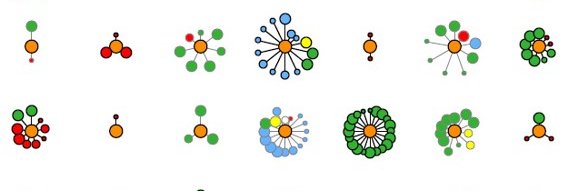
"It is conventionally assumed that all evolutionary adaptation is produced, and could only possibly be produced, by natural selection. Natural induction is a different mechanism of adaptation. It occurs in dynamical systems described by a network of interactions, where connections give way slightly under stress and the system is subject to occasional perturbations. This differential adjustment of connections causes reorganization of the system’s internal structure in a manner equivalent to associative learning familiar in neural networks. This is sufficient for storage and recall of multiple patterns, learning with generalization and solving difficult constraint problems (without any natural selection involved). Various biological systems (from gene-regulation networks to metabolic networks to ecosystems) meet these basic conditions and therefore have potential to exhibit adaptation by natural induction. Here (and in a follow-on paper), we consider various ways that natural induction and natural selection might interact in biological evolution. For example, in some cases, natural selection may act not as a source of adaptations but as a memory of adaptations discovered by natural induction. We conclude that evolution by natural induction is a viable process that expands our understanding of evolutionary adaptation."
@LongCovidHell It's common for most health systems to do further PCR tests to determine type/subtype of influenza (H1N1,H3N2,B), and anything that is negative for those would be investigated further particularly if causing severe disease. This is how most human avian influenza are picked up.
🚨 Workshop Alert at #RSS2025
📅 Tues 2 Sept, 14:00–16:00
🗺️ Model-based Geostatistics for Public Health in R
With Emauele Giorgi & myself
Learn to go from spatial data to predictions with RiskMap using real case studies.
👉 https://t.co/fctd4QxPBU
#RStats#Geostat
@DrCJ_Houldcroft Extremely interesting, and useful knowledge, but what a strange study. The subjects must be known to, related to, or are paper authors?