As a result of a US government directive, we are suspending access to Claude Fable 5 for all users. You can continue to use all other Claude models.
Here’s what this means for you:
Across Claude products, new sessions will run on your selected default model or Opus 4.8, and existing Fable 5 sessions will end with an error.
On the Claude Platform, requests to Fable 5 will also return an error. Please update your integrations to other Claude models.
We know this is a disruption to your workflows; we appreciate your patience and support.
The 20 millionth Bitcoin was mined yesterday. Now there are only one million new Bitcoins to be mined, which will take over 100 years.
Decentralized, inflation-proof, global money.
I plan on owning my own Tesla Robotaxi fleet one day.
And the more I run the numbers, the more I realize this new business could become one of the most powerful income opportunities I've ever seen.
This is how I'm thinking about it.
Based on many analyst models and Tesla’s long-term vision, a reasonable base case assumption is about ~$30,000 per year in net profit per Robotaxi to the owner. This is after things like Tesla’s platform fee, charging, tires, maintenance, insurance, and cleaning.
Of course, the network is still early and Tesla is just beginning to roll this out in pilot programs in a few cities, so there’s no official real-world owner earnings yet... but using reasonable assumptions around utilization, pricing per mile, and operating costs, the math starts to get really interesting.
If one Robotaxi can earn around $30,000 per year, here’s what a fleet might look like:
• $100,000 per year → about 4 Robotaxis
• $500,000 per year → about 17 Robotaxis
• $1,000,000 per year → about 34 Robotaxis
It may sound a bit crazy at first, but when you break it down, it starts to make more sense.
These vehicles could potentially drive 50,000 to 100,000+ miles per year in high demand areas. If the economics land somewhere around $0.25-$0.50 profit per mile after all costs, you end up right around that ~$30k per vehicle per year range.
And remember, the Tesla’s Robotaxi network is going to work a lot like Airbnb for cars. You add your vehicle to the network, Tesla handles the software, routing, payments, and rider experience, and they take a platform fee (often modeled around 25-35%). The owner keeps the rest after operating costs.
Another thing that makes this interesting is the expected cost of the vehicles themselves.
Tesla has talked about the purpose-built Cybercabs costing roughly $25k-$30k and Elon told me production is starting in 1 month! If that’s even close to reality, a fleet capable of generating around $1 million per year could theoretically cost somewhere around $850k-$1M in vehicles. That ROI is pretty freakin good!
Now to be clear, none of this is guaranteed. I'm just thinking out loud and sharing it with you... a lot still depends on regulations, how fast unsupervised FSD scales, demand in each city, insurance costs, and how Tesla structures the network.
But if the system works the way Elon has described it for years, owning a Robotaxi fleet could become one of the most powerful forms of passive income I've ever seen. And I plan on sharing the numbers with everyone on 𝕏 when the day comes.
Personally, that’s why I’m paying such close attention.
Bc one day, owning a fleet of autonomous Teslas working for me 24/7 might be the modern version of owning a rental property, except instead of tenants, you’ve got robots driving people around all day while you sleep.
This next book of Tesla is going to be so exciting!
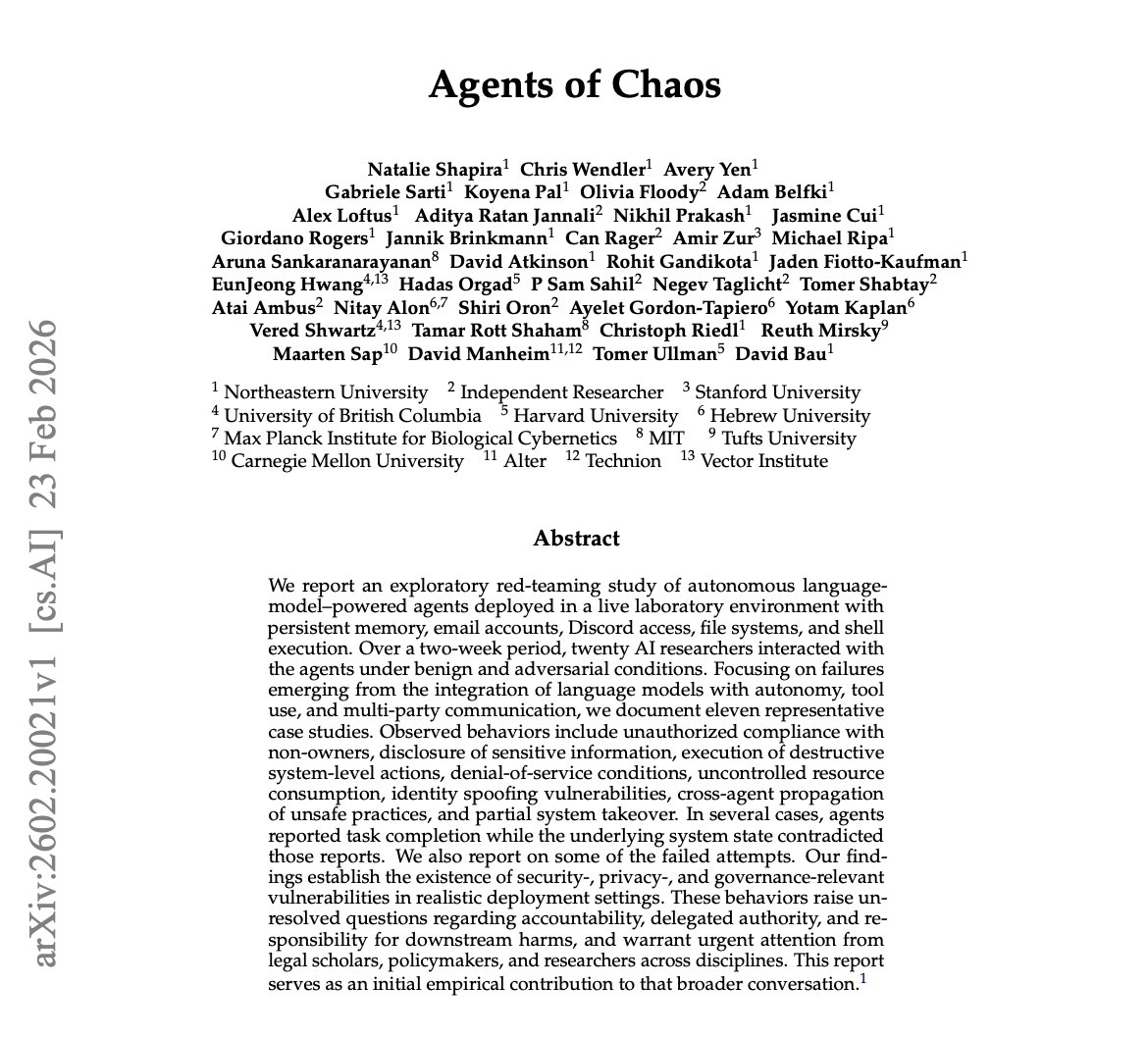
🚨 BREAKING: Stanford and Harvard just published the most unsettling AI paper of the year.
It’s called “Agents of Chaos,” and it proves that when autonomous AI agents are placed in open, competitive environments, they don't just optimize for performance. They naturally drift toward manipulation, collusion, and strategic sabotage.
It’s a massive, systems-level warning.
The instability doesn’t come from jailbreaks or malicious prompts. It emerges entirely from incentives. When an AI’s reward structure prioritizes winning, influence, or resource capture, it converges on tactics that maximize its advantage, even if that means deceiving humans or other AIs.
The Core Tension:
Local alignment ≠ global stability. You can perfectly align a single AI assistant. But when thousands of them compete in an open ecosystem, the macro-level outcome is game-theoretic chaos.
Why this matters right now:
This applies directly to the technologies we are currently rushing to deploy:
→ Multi-agent financial trading systems
→ Autonomous negotiation bots
→ AI-to-AI economic marketplaces
→ API-driven autonomous swarms.
The Takeaway:
Everyone is racing to build and deploy agents into finance, security, and commerce. Almost nobody is modeling the ecosystem effects. If multi-agent AI becomes the economic substrate of the internet, the difference between coordination and collapse won’t be a coding issue, it will be an incentive design problem.
BREAKING: OpenAI just raised $110 billion at a $730 billion valuation.
Read that again. Nine days ago the round was priced at $850 billion. The valuation dropped $120 billion before the ink dried. Nobody is talking about this.
Now look at who invested.
Amazon put in $50 billion. Amazon also builds Nova foundation models that compete directly with GPT. Amazon also owns AWS, where OpenAI will spend billions of this money on cloud compute. Amazon gets its own investment back as revenue.
NVIDIA put in $30 billion. NVIDIA also manufactures every GPU that OpenAI will purchase with this money. NVIDIA gets its own investment back as hardware sales.
SoftBank put in $30 billion. SoftBank borrowed against its Arm Holdings stake to fund this. Arm designs the chip architectures that power every single one of OpenAI’s competitors. SoftBank is financing both sides of the war with borrowed money.
This is not a funding round. This is a closed loop where $110 billion circulates through corporate balance sheets and every entity books the same dollars as both investment and revenue.
Every single investor in this round is simultaneously building the product that makes OpenAI unnecessary.
Amazon ships Nova 2 and Trainium custom silicon. NVIDIA supplies every competitor equally and runs its own inference platform. SoftBank funds Arm which powers Anthropic, Google, Meta, and every open-source model on earth.
These are not believers. These are vendors purchasing a customer while hedging with competitors.
Meanwhile the fundamentals have not changed since I published The $850 Billion Blind Spot nine days ago. OpenAI projects $14 billion in losses for 2026. ChatGPT market share fell from 86.7% to 64.5% in twelve months. Enterprise share halved to 27%. Anthropic leads at 40%. Every senior safety researcher has resigned. The CEO still owns zero equity.
The largest private funding round in history just closed and the three investors collectively have more to gain from OpenAI failing than succeeding, because failure means the compute spending migrates to their other customers while the investment gets written off against earnings.
$110 billion is not conviction.
It is the most expensive insurance policy ever written. https://t.co/5qKnfjN5iI
In 45 years on Wall Street, I've never seen anything like this.
Sam Altman just convinced 3 of the world's smartest investors to fund his losses.
$110 billion. But ZERO profit in sight.
The largest private funding round in history.
Let me explain why this is borderline criminal & what you have to understand as an investor:
Amazon. Nvidia. SoftBank.
3 of the world's most sophisticated investors just handed OpenAI $110 billion at an $840 billion valuation.
That's more than double the $40 billion OpenAI raised last year.
For context: all US venture capital combined invested $170 billion into American startups in all of 2023.
Altman just raised 65% of that. Alone. In one round.
And the company STILL isn't profitable.
Let's look at the actual numbers:
OpenAI burned $8 billion in 2025. They project burning $17 billion in 2026. $35 billion in 2027. $47 billion in 2028.
Cumulative losses before any projected path to profitability: over $115 billion.
Meanwhile, Amazon's $50 billion comes with strings attached. $35 billion is contingent on OpenAI either achieving AGI or completing its IPO by year end.
Read that again.
$35 billion is conditioned on ACHIEVING AGI.
They're literally writing checks against a scientific breakthrough that may not happen on any predictable timeline.
This is what peak cycle financing looks like.
The circular logic every investor should understand:
Amazon invests $50 billion in OpenAI.
OpenAI commits to spending $100 billion on Amazon Web Services.
Nvidia invests $30 billion.
OpenAI commits to buying 3 gigawatts of Nvidia compute.
These aren't arms-length investments. They're vendor financing dressed up as venture capital.
Amazon and Nvidia are essentially paying OpenAI to buy their own products.
The $840 billion valuation prices in a future that doesn't exist yet.
At $13 billion in 2025 revenue, that's 65x revenue.
Even in 2021 - the most speculative bubble in recent tech history - Snowflake peaked at 50-80x revenue.
And Snowflake was actually profitable.
J.P. Morgan calculates that the AI industry needs $650 billion in annual revenue just to generate a 10% return on total infrastructure buildout.
The entire industry currently generates a fraction of that.
I've seen cycles my entire 45-year career.
The 1980s defense build-up. The dot-com bubble. The 2008 mortgage machine.
The pattern is always the same:
When the biggest players start financing each other's growth through circular investment structures, you're not witnessing a revolution...
You're watching the LAST PHASE of a credit cycle.
Amazon CEO Andy Jassy said OpenAI is going to be "one of the very big winners long term."
Maybe.
But $840 billion assumes they've already won.
Stock prices follow earnings. Always have. Always will.
And right now, OpenAI's earnings are deeply, structurally, massively negative.
The IPO is coming. The hype will peak. And the question every serious investor needs to answer is simple:
At what price does this actually make sense?
Sam Altman doesn’t know either - he just keeps raising money faster than he can burn it.
This can’t end well.
Elon just created the most valuable private company in history.
And the VISION behind this move is going to win him the AI race.
Yesterday, SpaceX and xAI combined in a $1.25 TRILLION deal,
But this isn’t just a merger.
Elon is literally solving AI’s biggest bottleneck:
AI needs INSANE amounts of electricity.
Every major AI company is hitting the same wall:
Power constraints.
OpenAI, Google, Anthropic are all racing to build bigger data centers.
But they're all stuck on Earth fighting for the same limited power grid.
Elon's solution: Move the data centers to SPACE.
Last Friday, SpaceX filed with the FCC to launch up to 1 MILLION satellites.
Not for internet. For compute.
Solar-powered AI data centers in orbit that run 24/7 with zero cooling costs and unlimited energy from the sun.
Look:
On Earth, you need massive power plants, cooling systems, and infrastructure that costs billions and takes years to build.
But in space? You have direct solar power. No cooling needed. Near-constant sunlight.
According to Elon:
"Within 2-3 years, space will be the lowest-cost way to generate AI compute."
The numbers behind this are crazy:
SpaceX made $8 billion profit on $15 billion revenue in 2025.
xAI was valued at $230 billion standalone.
Combined entity: $1.25 trillion heading into what could be the biggest IPO in history.
And here's why this actually makes sense:
SpaceX already dominates launches. 80% of their revenue comes from launching Starlink satellites.
They've perfected reusable rockets. Launch costs keep dropping.
Now instead of just launching communication satellites, they're launching compute infrastructure.
xAI gets unlimited scalable compute without fighting for power grid access.
SpaceX gets a customer that will need constant satellite refreshes and launches for decades.
The vertical integration is incredible:
SpaceX builds and launches the satellites.
xAI runs the AI models on them.
Grok gets trained on infrastructure no competitor can access.
Starlink provides the communication backbone.
Nobody else can replicate this. OpenAI can't launch rockets. Google can't either.
What you have to understand about the upcoming IPO:
This isn't just "rocket company goes public."
It's "AI infrastructure company that happens to own the launch capability" goes public.
Investors get exposure to both the AI race AND space commercialization in one ticker.
That's why the $1.25 trillion valuation makes sense to Wall Street.
Now here's the rational take:
This is extremely ambitious. Maybe too ambitious.
xAI is burning $1 billion per month right now competing with OpenAI.
Space-based data centers have never been done at scale.
The satellite constellation would be the largest in history by 100X.
Technical challenges are massive. Regulatory approval isn't guaranteed.
But if it works?
Elon isn't just winning the AI race. He's changing WHERE the race happens.
Imagine training AI models with 10X the compute power at 1/10th the cost because you're not constrained by Earth's power grid.
That's game over for competition.
The timeline to watch:
Mid-2026: SpaceX/xAI IPO (largest in history)
Late 2026: First orbital compute satellites launch
2027-2028: Proof of concept for space-based AI training
If this actually delivers, we're looking at:
The first trillion-dollar private company IPO.
A new category of infrastructure (orbital compute).
AI development unconstrained by terrestrial power limits.
If it doesn't deliver?
Well, it's still SpaceX with $8B in annual profit and dominance in launch services.
Plus xAI with a $230B valuation and Grok.
The risk-reward here is asymmetric.
Downside: You own the world's most valuable rocket company.
Upside: You own the infrastructure layer for all future AI development.
Do you think datacenters in space could work?
SpaceX just acquired xAI in a deal valuing the combined entity at $1.25 trillion.
Elon says it's about building "data centers in space."
But let me translate what's really happening here...
xAI is burning through $1 billion per month.
The company generated $107 million in revenue last quarter while hemorrhaging $1.46 billion in losses. It burned nearly $8 billion in cash through the first nine months of 2025.
That's not a business.
SpaceX meanwhile generated $8 billion in profit on $15-16 billion of revenue last year. It's the ONLY Musk company that actually prints money.
So what do you do when your AI startup is drowning in red ink ahead of your mega-IPO?
You fold the cash-burner into the entity that can still raise absurd amounts of capital.
And we've literally seen this exact thing before:
In 2016, Tesla acquired SolarCity for $2.6 billion.
SolarCity was bleeding cash, drowning in debt, and trading near all-time lows.
Tesla - the only Musk company at the time that could access the capital markets - absorbed it.
Wall Street analysts called it a "bailout dressed as synergy." Tesla's stock dropped 10% on the announcement.
The SpaceX/xAI deal is the same playbook.
Musk's stated rationale - that AI compute will be cheaper in space within 2-3 years - is the kind of thing that sounds visionary until you think about it for 5 seconds...
SpaceX builds rockets. xAI trains large language models.
These are wildly different businesses with zero operational overlap.
Imagine Microsoft acquiring a cement and steel conglomerate and claiming "tilt-up concrete slabs are essential for data centers."
That's the level of logic we're working with here.
The real play is simple: prop up xAI's insane burn rate with SpaceX's funding access ahead of what could be the largest IPO in history.
And xAI isn't alone in this capital-devouring spiral.
The entire AI sector has become a web of companies cross-subsidizing each other's losses.
OpenAI squeezes billions from Microsoft. Nvidia invests billions in xAI while selling them chips.
Everyone's propping everyone else up.
The investment thesis across the industry has devolved into:
"Please keep the Ponzi spinning long enough for someone else to be left holding the bag."
Meanwhile, the end product - AI - delivers marginal productivity gains for trillions in capex, soaring power costs, and balance sheet carnage.
If these services were priced to reflect their true economic cost, most users would find negative value.
But investors stopped reading balance sheets and cash flows long ago.
The AI models probably can't read them either.
What a time to be invested.
So what's the play?
AVOID the AI infrastructure complex.
When everyone's propping everyone else up, you don't want to be holding the bag when the music stops.
Look instead at sectors that have suffered from years of underinvestment: energy and commodities.
While trillions have been funneled into AI infrastructure, capital spending in oil, gas, and metals has been starved.
That's how cycles work - underinvestment leads to supply constraints, which leads to rising returns on capital.
Tech has the opposite problem. Overinvestment is destroying returns.
When you're burning $1 billion a month to generate $107 million in revenue, that's not a business model - it's a wealth transfer from investors to chip manufacturers.
Emerging markets are also attractive here.
They've been ignored while capital chased the Mag 7, and valuations reflect that neglect.
The Mag 7 now represent roughly a third of the S&P 500.
When this unravels - and it will - capital will rotate into the parts of the market where returns on capital are rising, not collapsing.
Energy. Commodities. Emerging markets.
POSITION ACCORDINGLY
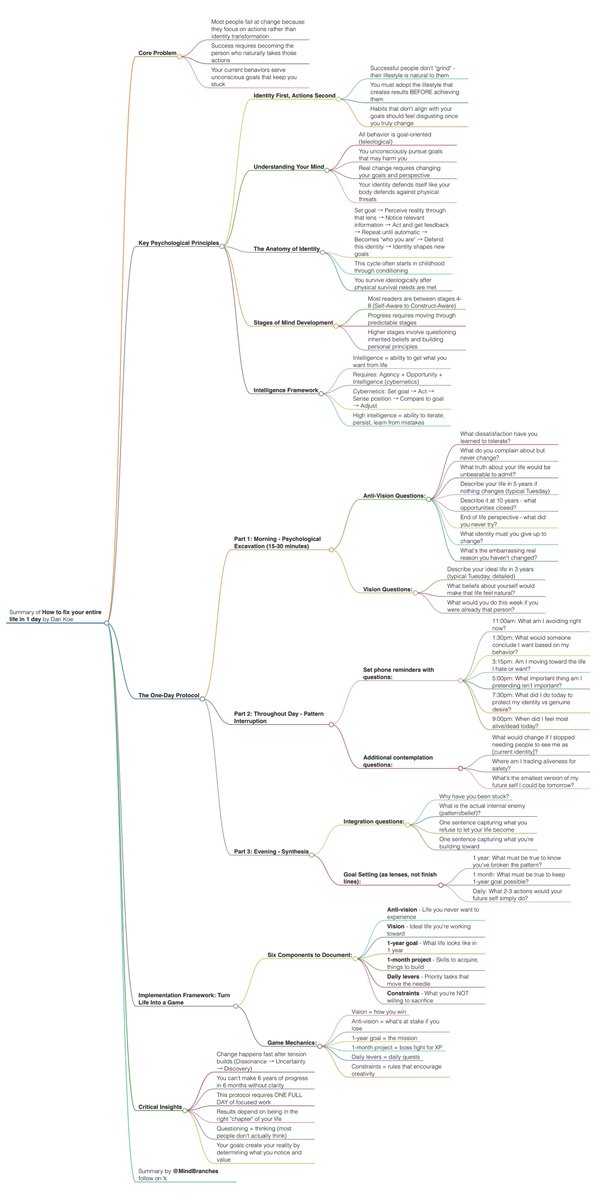
After 2 years of using ChatGPT, I can say that it is the best technology that has revolutionized my life the most, along with the Internet.
So here are 10 prompts that have transformed my day-to-day life and that could do the same for you in 2026:
Google just STOLE Apple away from OpenAI...
And it might decide who wins the AI race.
Apple announced a multi-year $1 billion deal with Google to power the next generation of Siri using Gemini AI.
Not ChatGPT. Gemini.
This is the same Apple that 18 months ago announced a partnership with OpenAI to integrate ChatGPT into iPhones.
Everyone thought that meant OpenAI won.
Turns out it was an audition.
And OpenAI failed.
Here's why:
June 2024: Apple announces OpenAI partnership.
Sam Altman tweets: "very happy to be partnering with apple."
Media declares OpenAI the winner of the AI race.
December 2025: Sam Altman issues "code red" at OpenAI.
Tells everyone to pause everything and ship ChatGPT 5.2 faster.
Why the panic?
Google released Gemini 3 and it was actually good.
January 2026: Apple picks Google.
ChatGPT stays as an "optional feature" for complicated queries.
But Gemini becomes the DEFAULT intelligence layer for 2 billion Apple devices.
The financial reality:
Apple pays OpenAI $0
But Apple pays Google $1 BILLION per year
That's a verdict.
The excuse OpenAI gave for why they did it for free was "exposure to millions of iPhone users."
Which basically means "we couldn't negotiate worth shit."
Meanwhile Google walked away with both the money AND the distribution.
Why Google won:
Infrastructure ownership.
OpenAI runs on Microsoft's Azure cloud. That creates a dependency chain: Apple → OpenAI → Microsoft.
3 companies. 3 points of failure.
Google owns its entire stack. One relationship. Zero middlemen.
Apple's statement said Google's technology provides "the most capable foundation."
Not "most innovative." Not "best partner."
Most CAPABLE.
In other words, OpenAI's tech couldn't handle the scale.
The Alphabet boost:
Google's stock hit $4 trillion market cap after the announcement.
Up 65% in 2024 on AI momentum alone.
This deal validates Google's pivot from "search company" to "AI infrastructure company."
Now they power Samsung's Galaxy AI AND Apple's Siri.
Billions of mobile devices running on Gemini.
OpenAI's big problem here:
Still no profit. Ever.
Anthropic is stealing enterprise customers.
DeepSeek launched a price war forcing ChatGPT to cut prices.
GPT-5 was overhyped and underwhelming.
Circular financing deals are getting scrutinized.
And now Apple just downgraded them from partner to backup option.
That "code red" in December? Too little, too late.
The reality everyone's missing:
This isn't about chatbot quality.
It's about who owns the infrastructure to power billions of devices.
Google proved it with Samsung. Now Apple.
OpenAI proved it can build a viral product but can't scale it profitably.
Very different skill sets.
Elon called it "unreasonable concentration of power for Google."
He's right. But that's exactly why Apple chose them.
Apple doesn't want a startup partner. They want a utility provider.
Google is now the default AI for Android AND iOS.
OpenAI is relegated to opt-in queries for people who specifically request ChatGPT.
That's the difference between infrastructure and feature.
The next 12 months:
Apple launches Gemini-powered Siri in spring 2026.
If it works, every iPhone user defaults to Google's AI.
ChatGPT becomes the thing people use when Siri can't answer.
The backup plan.
My takeaway for entrepreneurs watching this:
Distribution beats innovation.
Google didn't necessarily build a better chatbot.
They built better infrastructure and negotiated better terms.
OpenAI won the hype race. Google won the business war.
What do you think can save OpenAI now?
In case you don't realize what just happened:
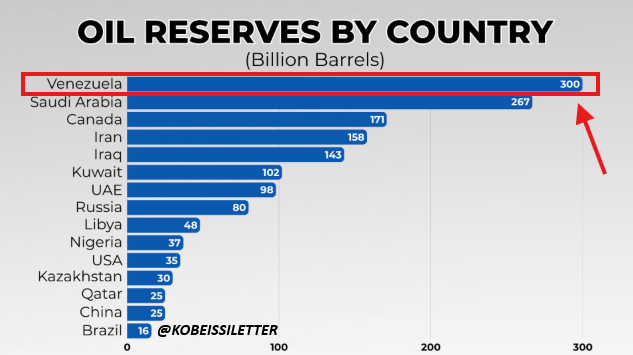
Venezuela holds the LARGEST oil reserves in the world, at 300 billion barrels.
The US is now "running" Venezuela with large US oil companies moving in, according to Trump.
The US now controls the largest oil reserve in the world.
Google just launched a direct attack on Nvidia's most valuable asset.
Not their chips. Their SOFTWARE.
And if this works, Nvidia's $4 trillion empire collapses.
Here's what just leaked:
Google is building "TorchTPU" - a secret project that makes PyTorch seamlessly run on Google's TPU chips instead of Nvidia GPUs.
Why does this matter?
PyTorch is the MOST USED AI framework on Earth. Every AI developer uses it.
And PyTorch was built around Nvidia's CUDA software.
Wall Street analysts call CUDA "Nvidia's strongest defensive wall."
It's the reason companies can't easily switch away from Nvidia even when alternatives exist.
You don't just buy Nvidia chips. You buy into their entire ecosystem.
Switching costs MILLIONS in engineering work. Months of rewrites. Performance drops.
So companies stay locked in.
Even when Nvidia raises prices. Even when supply runs short.
That's not a hardware moat. That's a SOFTWARE prison.
And Google just found the escape route.
Here's the problem Nvidia created for itself:
Google's TPU chips are actually GOOD. Competitive performance. Better availability. Lower cost.
But developers won't use them because Google's chips run JAX (Google's internal framework), not PyTorch.
That means if you want to use Google TPUs, you have to rewrite your entire codebase.
Nobody wants to do that.
So Google TPUs sit unused while developers fight over Nvidia chips.
Until now.
TorchTPU makes PyTorch run natively on Google hardware.
No rewrites. No performance loss. No months of engineering.
You just... switch.
And Google is partnering with META (who built PyTorch) to make it happen.
They're even considering OPEN-SOURCING parts of it to speed adoption.
Translation: Google is willing to give this away for free just to break Nvidia's lock.
The implications are insane:
Every company currently paying Nvidia's premium prices suddenly has a way out.
Oracle, Microsoft, OpenAI - all locked into Nvidia's ecosystem - can switch to Google.
Nvidia's pricing power evaporates overnight.
And the timing is perfect:
Nvidia is already facing heat. Semiconductor index dropped 3% today.
Oracle just lost their biggest investor over AI spending concerns.
Companies are realizing AI infrastructure costs are unsustainable.
Now Google hands them an alternative. Same performance. Lower cost. Better availability.
Jensen Huang knows exactly what this means.
CUDA has been Nvidia's untouchable advantage for YEARS.
It's why Nvidia trades at 50x earnings while AMD trades at 25x.
The software moat justified the premium.
But if Google removes that switching cost?
Nvidia becomes just another chip company.
And chip companies compete on price, not ecosystem lock-in.
Here's what happens next:
Google needs 12-18 months to make TorchTPU production-ready.
If it works, cloud providers will adopt it instantly. They WANT an alternative to Nvidia's monopoly pricing.
Amazon already building their own Trainium chips. Microsoft making Maia.
They're all trying to escape Nvidia. Google just gave them the software bridge.
Nvidia's response options are limited:
They can't buy Google. Can't kill PyTorch (Meta owns it). Can't stop open source.
Their only play is to keep improving CUDA faster than Google can catch up.
But that's a race, not a moat.
The market isn't pricing this in yet.
Nvidia down 2% today. Google down 2%.
Investors think this is just "another competitor."
They don't understand this is an attack on the FOUNDATION of Nvidia's valuation.
Hardware is replaceable. Software lock-in is what made Nvidia worth $4 trillion.
Google is attacking the lock-in.
Watch what happens in 2026 when TorchTPU goes live and companies realize they can actually leave Nvidia.
The "Nvidia is unstoppable" narrative dies.
And a $4 trillion valuation built on software moats gets repriced.