Yo fui ingeniero en Meta, y siempre seguía FAIR desde adentro. Lo que acaban de publicar es la versión que les dejan publicar.
Pero con eso, es más que suficiente para decirles exactamente que es lo que está pasando.
TRIBE v2 predice, vértice por vértice sobre la corteza cerebral, qué zonas activa cualquier video.
Sin escáneres. Sin humanos.
Subes el contenido, obtienes el mapa neural (activación emocional, supresión de razonamiento crítico, modulación prefrontal) antes de que el video lo vea un solo usuario.
Ahora considera la posición de Meta:
1. Tiene años de datos de Reels sobre qué contenido retiene atención, genera enojo, provoca compartir.
2. Saben empíricamente qué funciona. TRIBE v2 les da el mecanismo causal de por qué funciona (a nivel de tejido cortical) Eso convierte correlación histórica en capacidad predictiva sobre contenido nuevo.
3. Internamente hay herramientas que se llaman Gatekeepers y Quick Promotions que sirven para inyectar contenido en el feed de poblaciones arbitrarias a escala.
4. Simulador de respuesta cerebral + conocimiento empírico de contenido efectivo + maquinaria de distribución selectiva. El pipeline está completo.
Y luego está Thiel. Inversor y amigo personal de Zuck. Fundador de Palantir, cuyo negocio es análisis de poblaciones a escala para gobiernos e inteligencia.
NO es descabellado observar que confluyen los incentivos de plataformas construidas por las mismas personas.
La licencia CC BY-NC dice que Meta retiene los derechos comerciales del predictor de respuesta cerebral más preciso jamás construido.
Y recuerda, esto es lo que decidieron hacer público.
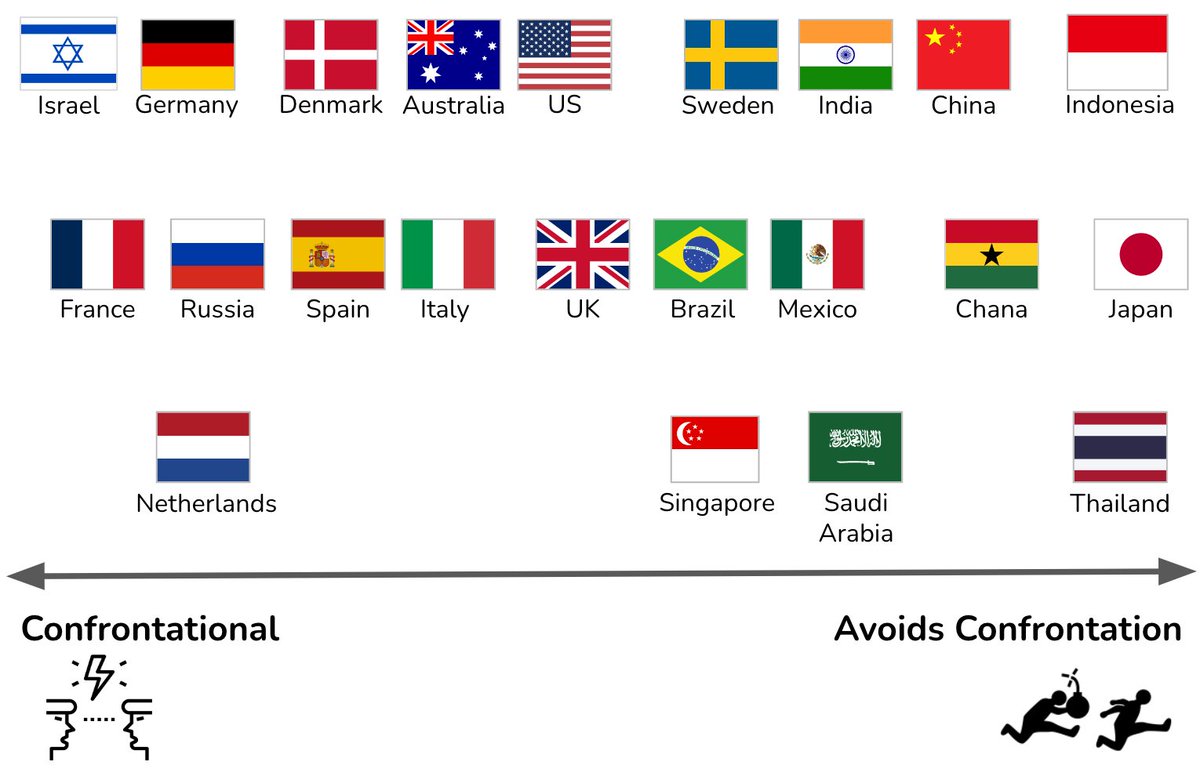
Viajar por Asia no es lo mismo que vivir y trabajar con asiáticos. En el sudeste asiático, uno de los mayores choques culturales es adaptarse al entorno laboral.
Hago un pequeño hilo🧵sobre valores culturales y confrontación, aunque este tema da para mucho.
«Leyes como modelos/código ejecutables»
Hola, quiero compartir un hilo en español para compartir aquí lo que aprendí hace dos semanas.
Vengo del futuro y quiero contaros lo que he visto...
IBM MQ -> RabbitMQ -> Kafka ->Pulsar, How do message queue architectures evolve?
🔹 IBM MQ
IBM MQ was launched in 1993. It was originally called MQSeries and was renamed WebSphere MQ in 2002. It was renamed to IBM MQ in 2014. IBM MQ is a very successful product widely used in the financial sector. Its revenue still reached 1 billion dollars in 2020.
🔹 RabbitMQ
RabbitMQ architecture differs from IBM MQ and is more similar to Kafka concepts. The producer publishes a message to an exchange with a specified exchange type. It can be direct, topic, or fanout. The exchange then routes the message into the queues based on different message attributes and the exchange type. The consumers pick up the message accordingly.
🔹 Kafka
In early 2011, LinkedIn open sourced Kafka, which is a distributed event streaming platform. It was named after Franz Kafka. As the name suggested, Kafka is optimized for writing. It offers a high-throughput, low-latency platform for handling real-time data feeds. It provides a unified event log to enable event streaming and is widely used in internet companies.
Kafka defines producer, broker, topic, partition, and consumer. Its simplicity and fault tolerance allow it to replace previous products like AMQP-based message queues.
🔹 Pulsar
Pulsar, developed originally by Yahoo, is an all-in-one messaging and streaming platform. Compared with Kafka, Pulsar incorporates many useful features from other products and supports a wide range of capabilities. Also, Pulsar architecture is more cloud-native, providing better support for cluster scaling and partition migration, etc.
There are two layers in Pulsar architecture: the serving layer and the persistent layer. Pulsar natively supports tiered storage, where we can leverage cheaper object storage like AWS S3 to persist messages for a longer term.
Over to you: which message queues have you used?
–
Subscribe to our weekly newsletter to get a Free System Design PDF (158 pages): https://t.co/uc5M7CdXXC
Whenever I get interrupted, it takes me 15 - 30 min to recover my zone.
Do you ever have one of those days when you end up exhausted but can't list the things you finished?
I bet money that day was full of meetings or full of interruptions.
This is how I get things done:
I block my calendar.
It could be for 25 minutes or 1 hour, whatever works for you. I find my sweet spot at 2 hours; during that time, my only mission is my task.
I created an Emergency Channel.
Shoulder taps are not the only interruptions; you have Slack, Teams, you name it, and all those notifications can take you off track in seconds.
But if there is a production issue, you have to fix it no matter what. So, I created a chat for priority issues, and I get notified if I get tagged.
𝗜 protect my space
I work from home 90% of the time, so I have a Do Not Disturb sign on my door. I also set my chat status to "Do Not Disturb."
𝗜 𝗯𝗮𝘁𝗰𝗵 𝗜𝗻𝘁𝗲𝗿𝗿𝘂𝗽𝘁𝗶𝗼𝗻𝘀.
You need to make yourself available for your team.
I have slots during the day to handle:
- emails
- calls
- other minor tasks to
Less context switching, more things done!
I write Quick Notes.
Before switching focus, write down a few quick notes about:
- where you are in your current task
- who you get there
Quick notes can act as "bookmarks" to help you resume your original task.
Are you good at context-switching? Really?
Share some other tricks to protect your time and get things done!
It doesn’t matter if your API uses restful verbs or not.
It doesn’t matter if you return an empty array or null if you’re consistent.
It doesn’t matter if you never use PUT or PATCH.
But god have mercy on your soul if you return 200 with a not found message.
I will find you.
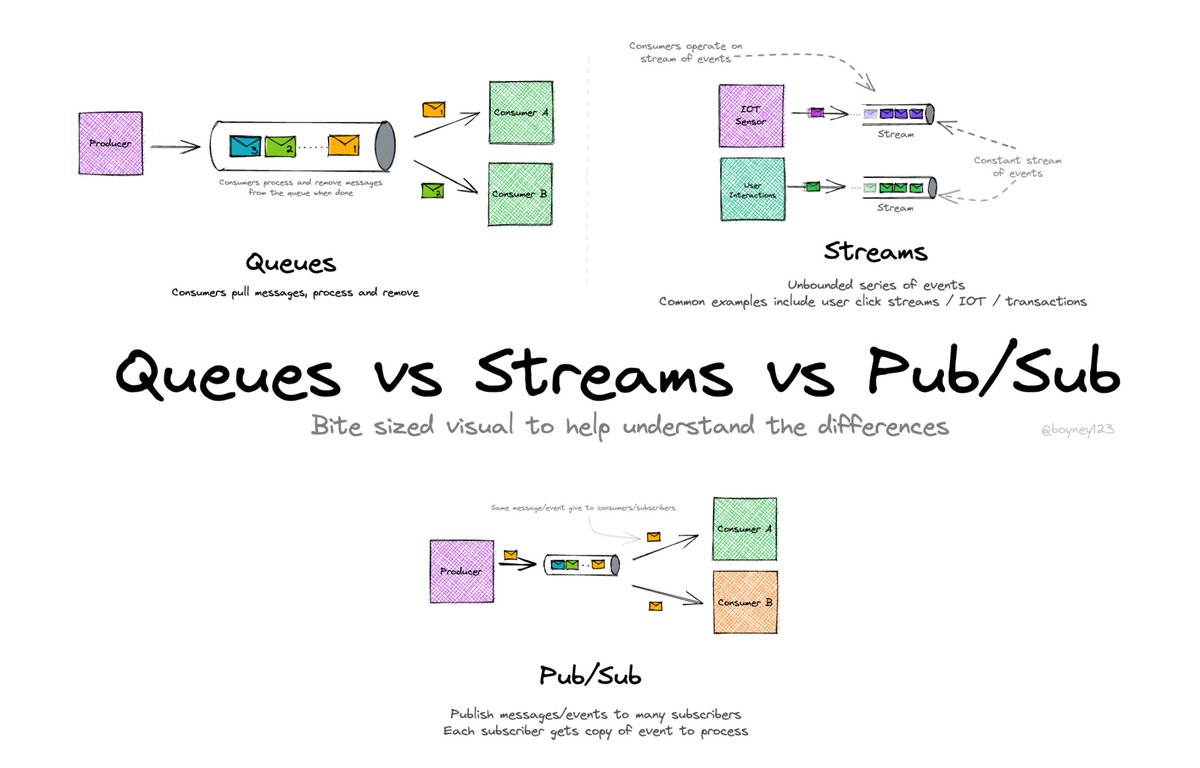
Whats the difference between queues, streams and pub/sub messaging patterns?
New visual here to help you dive deeper, with resources to learn the difference between them.
Queues
1. Messages are put onto a queue
2. Consumers pull and process them
3. Multiple consumers can help process the messages.
Streams
1. Process data as it happens. Continuous flow
2. Unbounded events (events that never end)
3. Typically can be ordered (partition/topic)
Pub/Sub
1 . Publish events to downstream consumers
2. Consumers get own copy of message/event
3. Subscribers come and go, decoupled from producer.
These three concepts are important to know when building event-driven architectures, I have collected a ton of resources to help you too.
If you want to dive deeper (with resources), you can find the new visual here 👇
https://t.co/VVKEhqr9aa
Hope it helps! Enjoy 🚀❤️
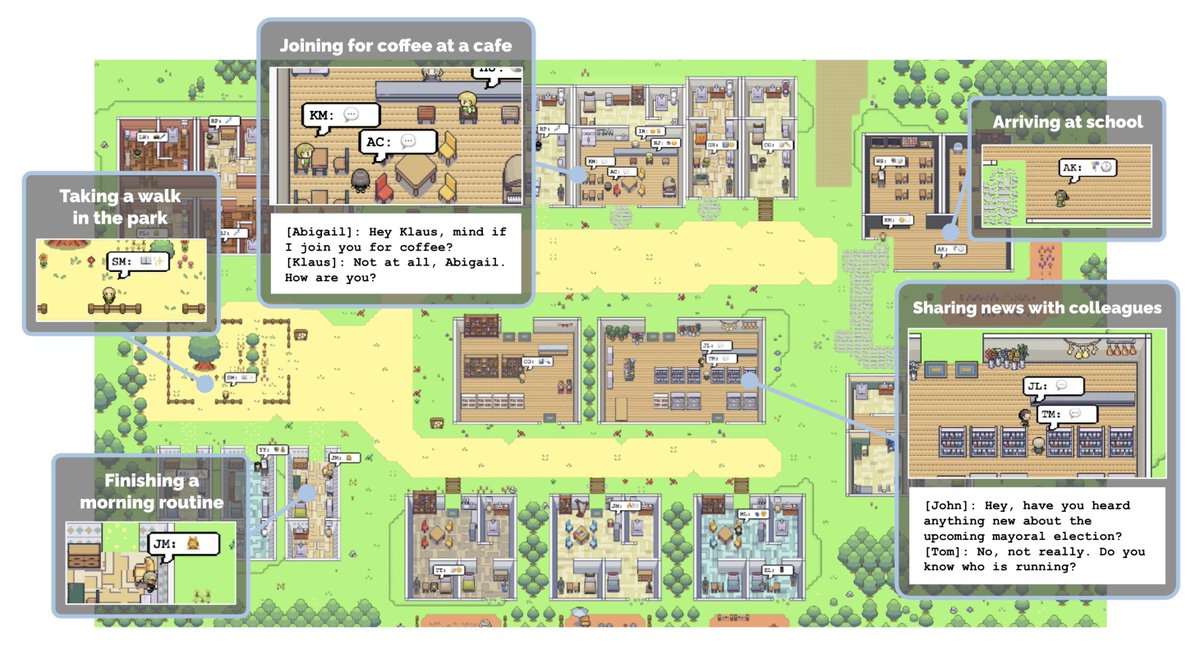
The famed Stanford Smallville is officially open-source!
25 AI agents inhabit a digital Westworld, unaware that they are living in a simulation. They go to work, gossip, organize socials, make new friends, and even fall in love. Each has unique personality and backstory.
Smallville is among the most inspiring AI agent experiments in 2023. We often talk about a single LLM's emergent abilities, but multi-agent emergence could be way more complex and fascinating at scale. A population of AI can play out the evolution of an entire civilization.
Endless new possibilities ahead. Gaming will be the first to feel the impact.
Github: https://t.co/xUll7KaaTp
Paper: https://t.co/PMDQysrOz9
Authors: @joon_s_pk@joseph_c_obrien@carriejcai@merrierm@percyliang@msbernst
OK, I just learned about port reuse in MacOS, and it is a bit wild. 🦓🐺🦏
Here's what happened:
1. Start NextJS app on port 3000.
2. Point browser to localhost:3000. Next looks good.
3. Start Rails app on port 3000.
4. Refresh. Rails looks good.
WTF?
¿Cómo te quedas si te digo que la curva hacia la izquierda que ves en esta carretera demuestra que la tierra es redonda? Y que, si hubiera sido plana, esa curva no existiría. ¿No te lo crees? Pues prepárate para ver el mundo de otra forma, una alucinante. ⬇️¡Hilo!⬇️
I've seen a lot of people asking "why does everyone think Twitter is doomed?"
As an SRE and sysadmin with 10+ years of industry experience, I wanted to write up a few scenarios that are real threats to the integrity of the bird site over the coming weeks.
Many developers severely underestimate the complexity involved with microservices.
While there are many books/articles about the topic, they often miss sharing intuition about the huge level of complexity involved.
Will try to share my understanding in this thread...
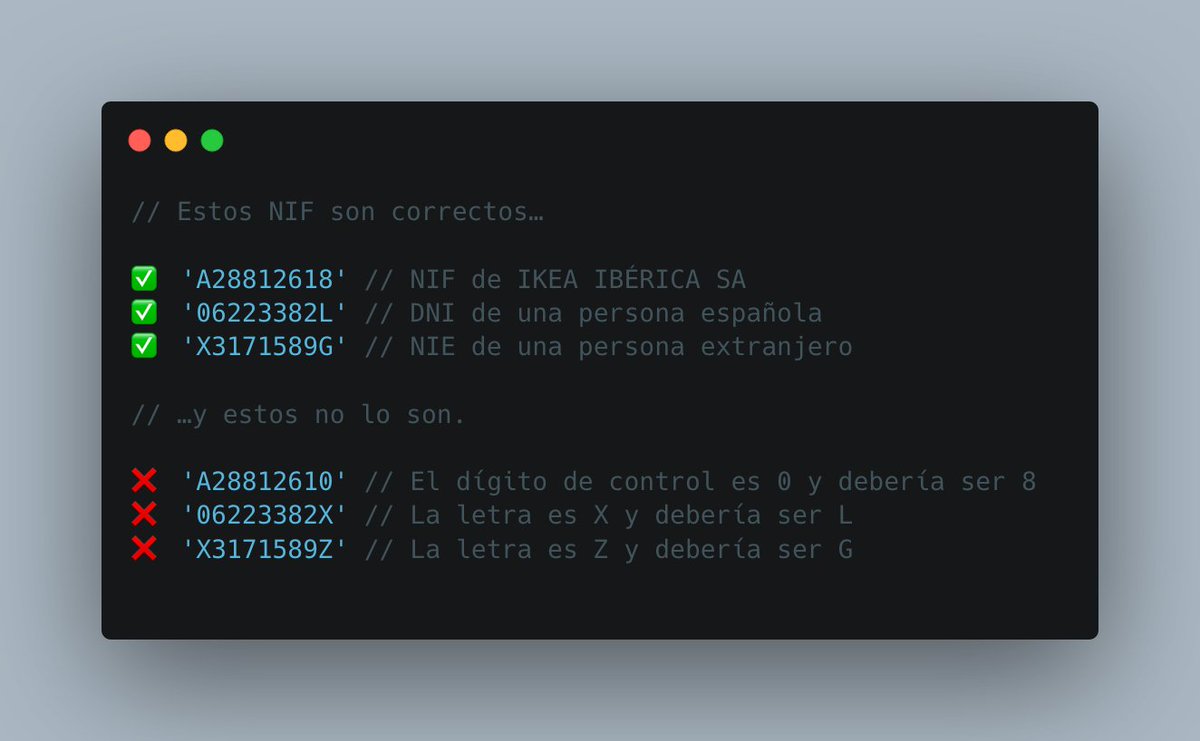
Hoy he dedicado mi día a perfeccionar el método de extracción del NIF de los contratistas que encuentro en los datos oficiales. A priori parece fácil. Basta con utilizar el dígito de control (o la letra) para comprobar la validez de cada NIF.
Chupado, ¿verdad? Pues no.
Decálogo del líder que empodera a sus compañeros en vez de limitarse a ordenarles qué deben hacer:
- Delegar Autoridad
- Promover Autonomía
- Mentorizar
- Compartir información abiertamente
- Pedir opinión al tomar decisiones