@goldnewb@KingKong9888@GraphCall What matters more in the short run is that China probably kept very large strategic oil reserves, so that halving the crude imports for many months was manageable. Smart! 30% EVs in the fleet by 2030 will also make a big difference, and 50% EVs by 2035 even more so.
@KingKong9888@K_dandu@GraphCall Some gulf states make electricity from oil. But they already have the oil domestically, and it varies little over time, so that does not impact the global market price much at all.
@gnievchenko I looked at the numbers for the biggest UK projects (EGL 1-3, each a 2 GW HVDC cable Scotland-England) and realized batteries can not replace them. Existing transmission is not enough for that. I was wrong. 😑
@gnievchenko Clarification: all transmission expansion projects in mature grids. I agree with you about microgrids’ problems. The point is, in a mature grid like in the UK, widespread transmission already exists. But most of it has very low utilization, as far as I know. But I’m no expert.
The coming phaseout of lead batteries in cars will impact the mine supply of silver, because around 30 % of silver is mined in primary lead and/or zinc mines. Lead mining could more than half in about 5 years. A thread 1/
@gnievchenko Good for them. Batteries will render all transmission projects useless. That is my thesis. If they constantly grow more expensive, and BESS cost continues to improve, then it is just a matter of time before I am right. NIMBYists also favor BESS over large overhead power lines.
@7Kiwi May I ask a stupid question? Why expand the transmission grid at all? Why not just install batteries at the point of consumption that charge at night during low transmission grid usage? That must be much cheaper, faster and easier, no?
@gnievchenko And no, the recency of the BESS price fall is not a good argument for not considering massive night-to-day shifting of electricity. Rather, it is the reason for asking my question today and not 2 years ago.
@gnievchenko May I ask a stupid question? Why expand the transmission grid at all? Why not just install batteries that charge at night during low transmission grid usage? That must be much cheaper, faster and easier, no?
@johnrhanger This is of course excellent! However, from an economic standpoint, when the cost of capital is included, any production after such a long time has a very low net present value.
@_JohnMerchant@JessePeltan@grok Yes, at least on the hull. To cover also the shipping containers would be more impractical. Then rotary sails make more sense.
@MattVeenker@JessePeltan Technically, all container ships could be battery powered. But hydrogen makes more economic sense for the longest routes. https://t.co/gLgipCPYj0
https://t.co/f42E7desj9
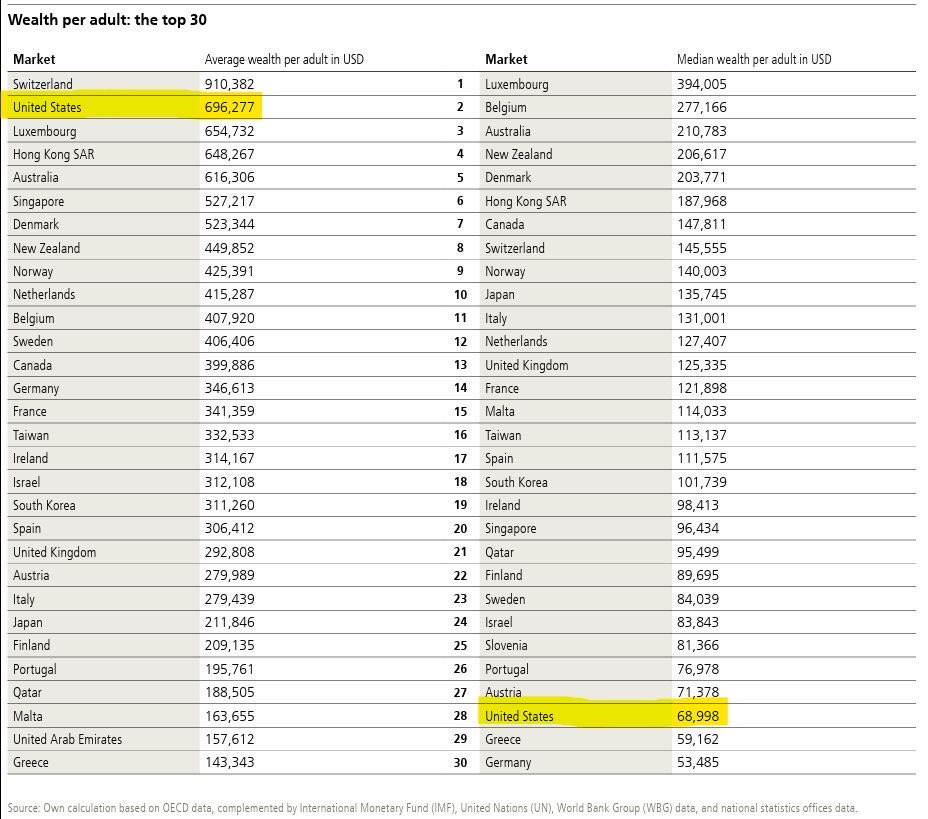
Surprising (not really) stat from the new UBS Global Wealth Report 2026.
The US ranks #2 when you look at average (mean) wealth per adult, but drops to #28 when you look at the median.
https://t.co/W0SNWwTQi4