We designed Hark Pro to think a step ahead, live in one simple thread, and spin up custom interfaces for your needs. It lets you offload tasks with the press of a button.
We set out to make an experience that works on your behalf approachable to everyone. Proud to be working with the crew at Hark every day.
https://t.co/ARloOOCL4r
A bit more about what’s under the hood.
The background isn’t a video or a generated image. It’s a live simulation of your sky, rendered in real time on device.
We compute where the sun and moon actually are based on your location, so sunrise and sunset happen when yours do. Then live weather layers in: cloud cover, directional wind that shifts the clouds, humidity, haze, air quality, even how much your city glows at night, pulled from NASA satellite data.
The colors come from a physical model of how sunlight scatters through the atmosphere. On top of that, real optical phenomena from Lynch & Livingston’s Color and Light in Nature: halos, sundogs, coronas, purple light after sunset, and clouds going gray and then reigniting pink at dusk. Each one shows up only when real conditions call for it.
As a final pass, we grade the image with a color LUT and a polarizing-filter effect that deepens the blues and pulls out the contrast.
A random seed fills in what no forecast measures, so no two days look the same.
We were inspired by the skies here in the Bay Area. Some evenings they don’t look real. We wanted to bring that feeling to wherever you are.
One of the first questions we asked ourselves when designing Hark Pro was - what is the material that personal intelligence is made from?
Thinking about materials is a natural question when building physical products - but it felt just as natural when building software for this new era of AI. It felt clear to us that the interface should start as a reflection of you, but how did that actually manifest itself?
This idea started as solid colours but quickly became using inputs about you, as prompts for a blurry, moody generated image. It was cool, the material for AI was AI. It took a lot of tweaks to actually get something good, and even still it was inconsistent, lacked interesting detail and we never managed to get it truly feeling like it had life.
Then we had a new idea, spearheaded by @Jonathan_Ravasz a dynamic ambient background that reflects your personal context, at any moment evolving throughout your day, represented as a live simulation of your sky. It was beautiful. Personal. Extraordinarily detailed, the way the clouds moved, how the product feels in the day and the night, how sunrise felt like an awakening and how sunset is the last burst before winding down. A dozen real-time signals randomised so you never get two the same - a moment in time personal for every single person on Hark.
It’s super cool, and yet another example of where interfaces are heading, personalised for each one of us.
We designed Hark Pro to think a step ahead, live in one simple thread, and spin up custom interfaces for your needs. It lets you offload tasks with the press of a button.
We set out to make an experience that works on your behalf approachable to everyone. Proud to be working with the crew at Hark every day.
https://t.co/ARloOOCL4r
When Kelsey ordered gifts for her niece's birthday, all she had to do was tell Hark exactly what she wanted. Here's a real-time recording of Handoff ordering it from start to finish.
Today we're introducing Hark Handoff
Handoff has been independently verified as the best internet-use model ever built, outperforming ChatGPT 5.4 & Opus 4.8
While others focus on coding, we focus on everyday life: ordering food, booking flights, shopping, & navigating the web
visionOS 27 keeps making the Mac experience feel more seamless.
Being able to jump into Mac Virtual Display without having your Mac right beside you is a huge quality of life improvement, Just sit down with your keyboard and mouse, and you're ready to work.
This is a glimpse of where personal computing is headed.
Today I'm excited to share that Hark has raised $700M at a $6B valuation
When I use these AI models today, they feel basic. They should be able to listen and talk naturally, understand vision, retain persistent memory, and become deeply personalized over time. They should be able to see the world, interact with it, and take action
To build that future, the capital we raised today will be used to:
→ scale our GPU infrastructure
→ accelerate future AI model development
→ grow the Hark team from ~70 to 200 engineers
→ design and build the next generation of AI hardware
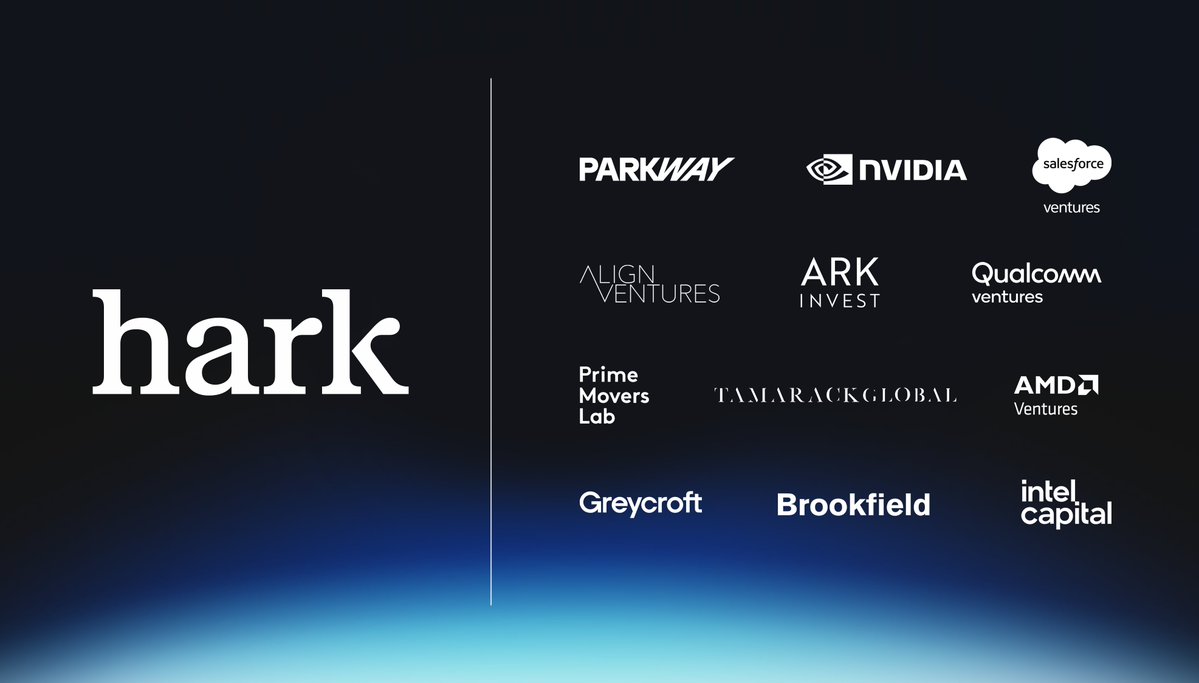
The Series A round was led by Parkway Venture Capital with participation from NVIDIA, Align Ventures, AMD Ventures, ARK Invest, Brookfield, Greycroft, Intel Capital, Prime Movers Lab, Qualcomm Ventures, Salesforce Ventures, and Tamarack Global
At Hark, we are building the most advanced personal intelligence in the world. Intelligence that begins to think like you and sometimes, ahead of you to offload your mental workload
Hark just crossed 70 people and we’re hiring another 100.
40 jobs are posted, some of the new ones:
→ Pretraining
→ Training Infra
→ Speech Infra
→ Finance Lead
→ Marketing Lead
→ Hardware (many)
→ Backend / Fullstack SWE
https://t.co/ZLqb3oUBZ9
Today I'm excited to introduce Hark, a new artificial intelligence lab building the most advanced, personal intelligence in the world
We've been in stealth for 8 months, assembling one of the greatest AI and hardware teams on the planet
I want to explain why I started Hark and what we're focused on
I've spent the last 3 years working on the hardest AI challenge imaginable: giving AI a humanoid body. On the digital side, I've been using all the existing LLM chatbots - and I have to say, they feel incredibly dumb to me
AGI, in the limit, should feel like a sci-fi movie. It should be able to listen and talk. It should have persistent memory and be highly personalized. It should see and touch the world. But we're far from this today
We are crafting a new interface to AGI. Intelligence that lets you offload your mental workload into a system that begins to think like you and sometimes ahead of you
We started Hark with one goal: build the world's most advanced personal intelligence - paired with next-generation hardware designed to serve as a universal interface between humans and machines
https://t.co/MqTW7gRATN
.@Apple enters a new chapter in Human Interface Design as Steve Lemay becomes the new leader of the team, working alongside Molly Anderson, head of Industrial Design at Apple. A veteran at the company since 1999, Lemay has shaped every major interface evolution from the original #iPhone to macOS, iOS, iPadOS, watchOS and, most recently, visionOS.
Tim Cook calls him “an extraordinarily high bar for excellence,” noting his depth of understanding in platform technologies and his gift for shaping intuitive, human-centred digital experiences.
With Lemay now at the helm, Apple’s design bench continues to push forward, refining the interactions, systems and visual languages that define the world’s most recognisable devices.
Put together a new WWDC video all about designing animations on visionOS that react to where you look! Including a new way to scroll just with your eyes.
widgets are coming to visionOS — with a new three-dimensional style.
check out our session with @moritzvv to bring your existing widgets to visionOS and design native ones to take full advantage of the platform’s spatial and visual capabilities.
https://t.co/Ajtg7j9HOi
#WWDC25
Just discovered that in visionOS 26, you can actually pin or lock any window to a wall 😱
Simply long-press the window bar, and it will snap to the nearest wall with a new “locked” icon at the bottom. It stays fixed until you pull it back with force with a super smooth animation.
It's also perfectly aligned with the wall — basically turning any window into an iPad-like experience.
This is one of my most-wanted features, and I haven’t seen it mentioned anywhere, so I’m super excited to have stumbled upon it by accident!
We're excited to announce major updates to the Mac Virtual Display experience on visionOS. We're adding normal, wide, and ultrawide aspect ratios, as well as curved display support. #WWDC