The Top Three Culprits Behind Viral Foodborne Illnesses | Food safety and quality | Food and Agriculture Organization of the United Nations https://t.co/4QDiBQed49 via @FAO
My colleague Dr. Martin D'Agostino has put together a poll on whether fresh produce should be monitored for enteric virus contamination at primary production. All votes welcome.
https://t.co/NW7qxy47au
Real-Time PCR-Based Methods for Detection of Hepatitis E Virus in Pork Products: A Critical Review https://t.co/n8SJKMq28k #mdpimicroorganisms via @Micro_MDPI
Hopefully this review will be of use as background information for ongoing standardisation activities.
We've published a new report on a Thermal Inactivation Model for Hepatitis E Virus (HEV).
The risk to consumers remains low and we continue to work with stakeholders to investigate HEV.
Download the report: https://t.co/thDDmMThFP
A properly designed, and properly performed, PCR-based method should have minimal risk of false positives or false negatives. "Properly" being critical.
https://t.co/piFKcg3Bt6
Timely review detailing the persistence of coronavirus on surfaces in Table 1. Would have liked to see log reduction values though. https://t.co/hWfEspOIoI
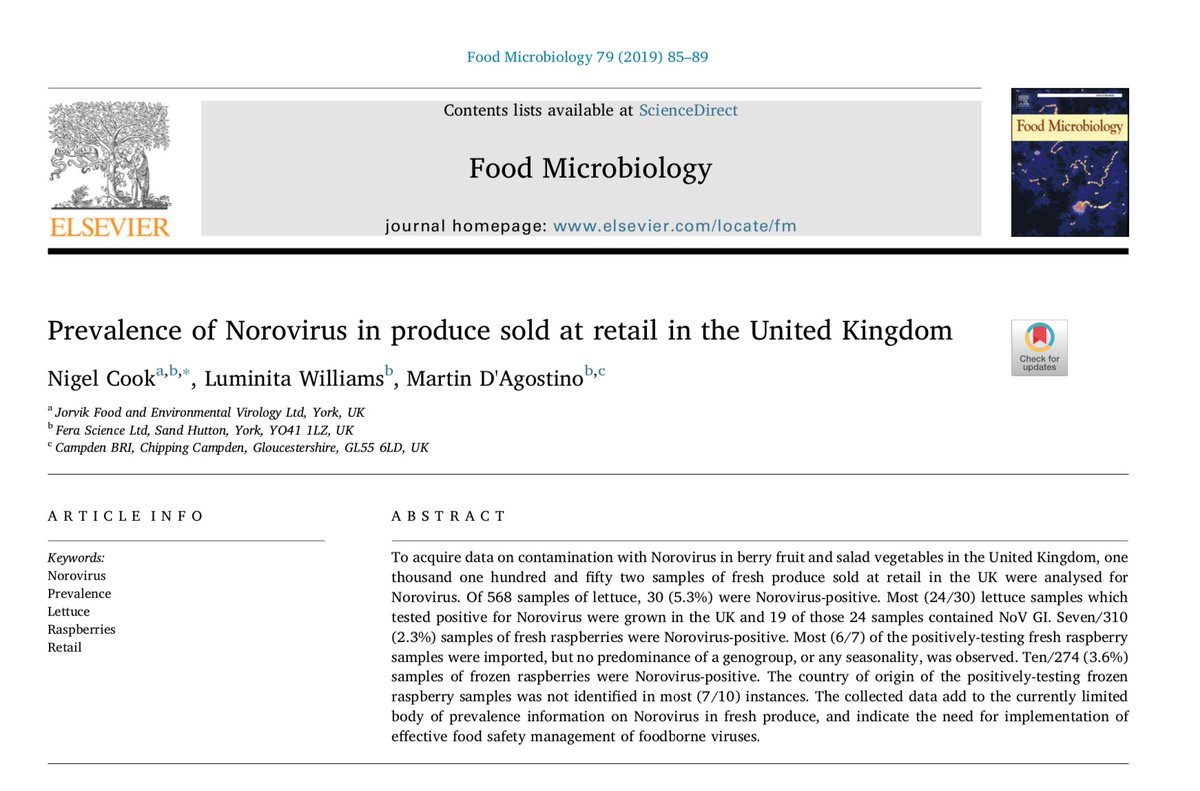
When the UK norovirus in lettuce / raspberry data was presented in September 2018, a representative of @kraftfoodsuk01 announced that the information was “nothing new”. So @kraftfoodsuk01, if you knew about the contamination, what steps were you taking to protect the UK consumer?
New estimates from @foodgov indicate approx. 114,000 norovirus cases per annum from consumption of open-headed lettuce on retail sale, and approx. 15,000 cases from eating raspberries on retail sale.