Excess erodes meaning.
The more you have of something, the less any of it matters.
Yet the modern world floods us with:
- Open access
- Infinite content
- Endless choice
- Limitless supply
- Constant availability
If you seek meaning, keep life simple and minimal.
I wrote the cover story of the February issue of The Atlantic. It builds on a lot of reporting I did throughout 2024, and I'm really proud of it.
It’s called: THE ANTI-SOCIAL CENTURY
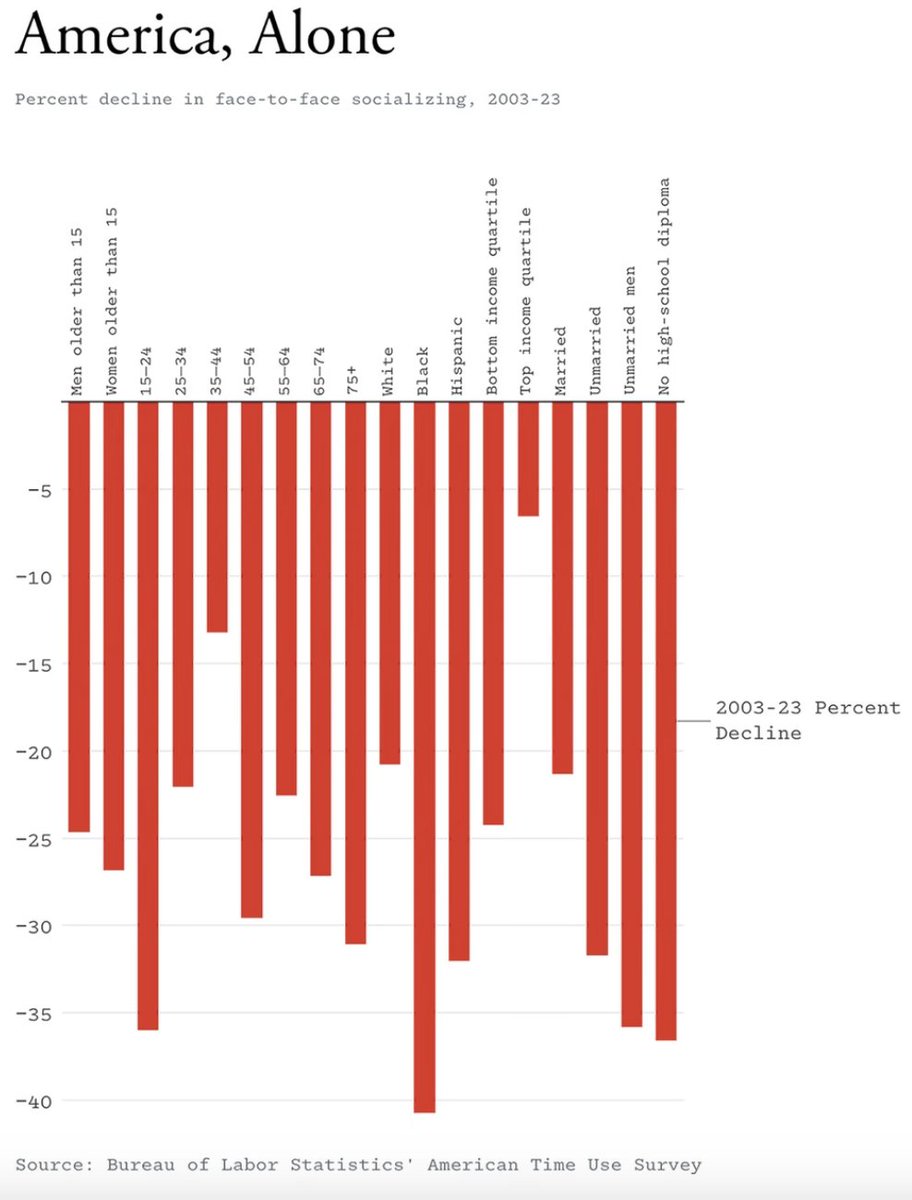
The thesis: Rising solitude is the most important social fact in American life today. The historic amounts of time that Americans spend alone and in their homes is reshaping the consumer economy—from dining to entertainment to delivery—warping our politics, alienating us from the realities of our neighbors and villages, and changing our very personalities.
Here are the basic facts:
1. In the last few years, in-person socialization has declined, for every demographic group, to its lowest point on record
2. The typical American is now alone more than in any period where we have decent data, going back to at least 1965
3. Americans now spend an extra 99 minutes in their homes compared to 2003—a trend that crept up slowly before the pandemic, before exploding and remaining at a seriously elevated level. As Princeton’s Patrick Sharkey wrote in a 2024 paper, the homebound trend isn't just about remote work. Homebound life has “risen for every subset of the population and for virtually all activities” from eating to praying.
4. America's social depression is far-reaching. The share of adults having dinner or drinks with friends on any given night has declined by more than 30% in the past 20 years. The share of boys and girls who say they meet up with friends almost daily outside school hours has declined by nearly 50%.
I don’t think these trends are simple. In many cases, they’re not even simply bad. (Ordering delivery: totally fine! Eating more meals alone, year after year after year: not so great!) But to see these trends—and their effects on American society—more clearly, I thought this phenomenon needed an anchoring, a naming, a media artifact for people to talk about, even if only to point out that I’m wrong. So, I wrote this.
A very odd thing we uncovered in our personality research: people like MBTI-style (Jungian) personality test results better than Big Five test results and perceive them as more accurate, even though the Big Five test was about twice as accurate for making predictions.
In a distracted world, the most underrated leadership skill is listening.
144 studies, 155k people: Good listeners have deeper bonds and better results. We feel valued, and they get smarter.
Great leaders are devoted learners. A key to learning is to listen more than you talk.
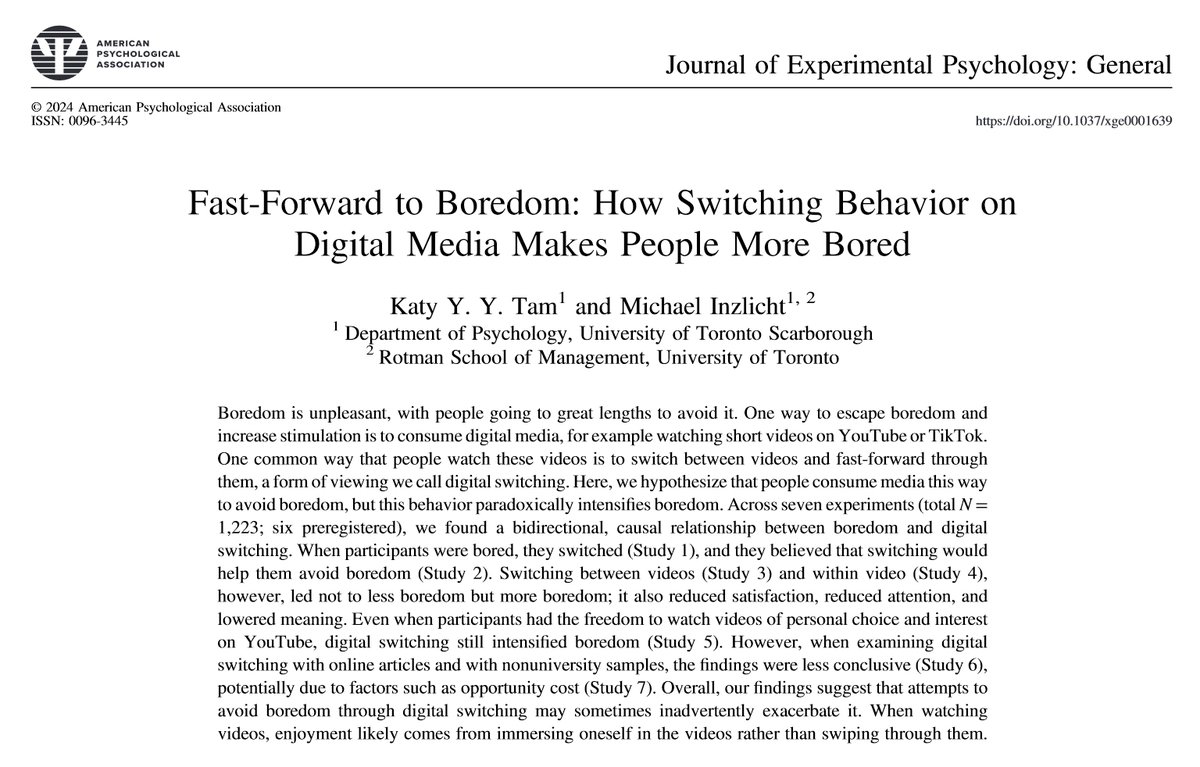
Switching quickly between digital media doesn't reduce boredom. It intensifies it.
7 experiments: Skipping and swiping through segments to sustain interest backfires. Divided attention thwarts satisfaction and meaning.
Enjoyment depends on full immersion in one task at a time.
Sometimes, groups are genuinely found to differ a bit, on average. For instance, it may be found that men are a bit more dishonest than women or that Chinese kids outperform Americans at math.
At this point, people tend to go off the rails in one of 2 ways:
🧵
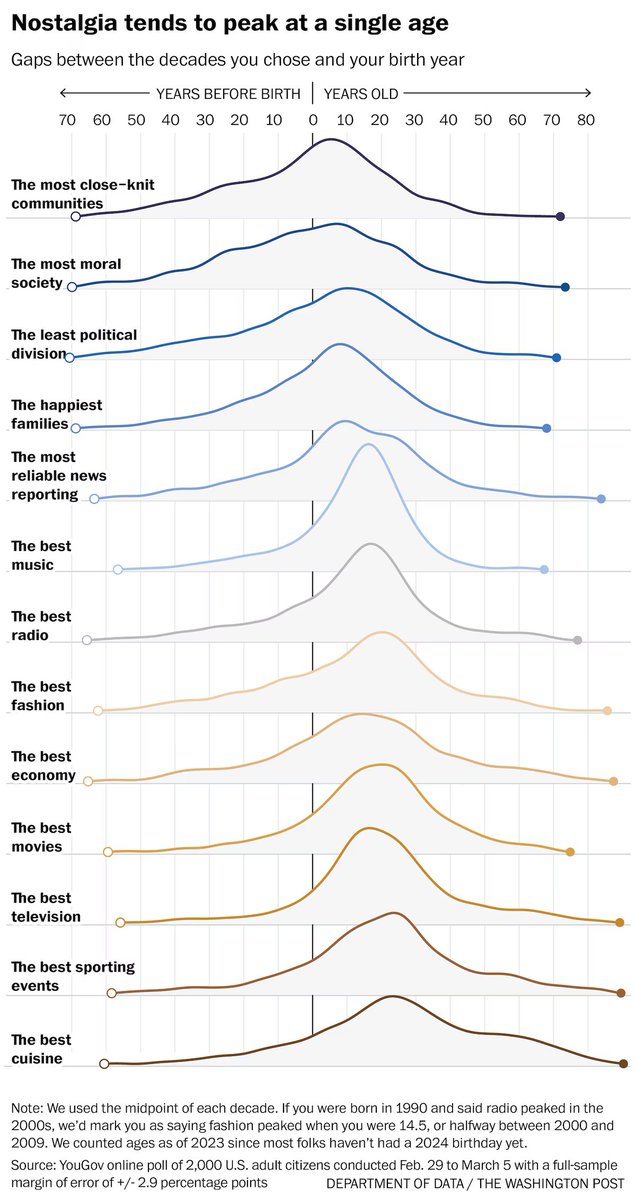
It turns out music, movies, entertainment, and society in general peaked during the exact time period when you, the person reading this, were a teenager.
One casual comment:
- 900+ likes
- 100+ retweets
- 100 bookmarks
Clearly, people resonated with and wanted to know more about...
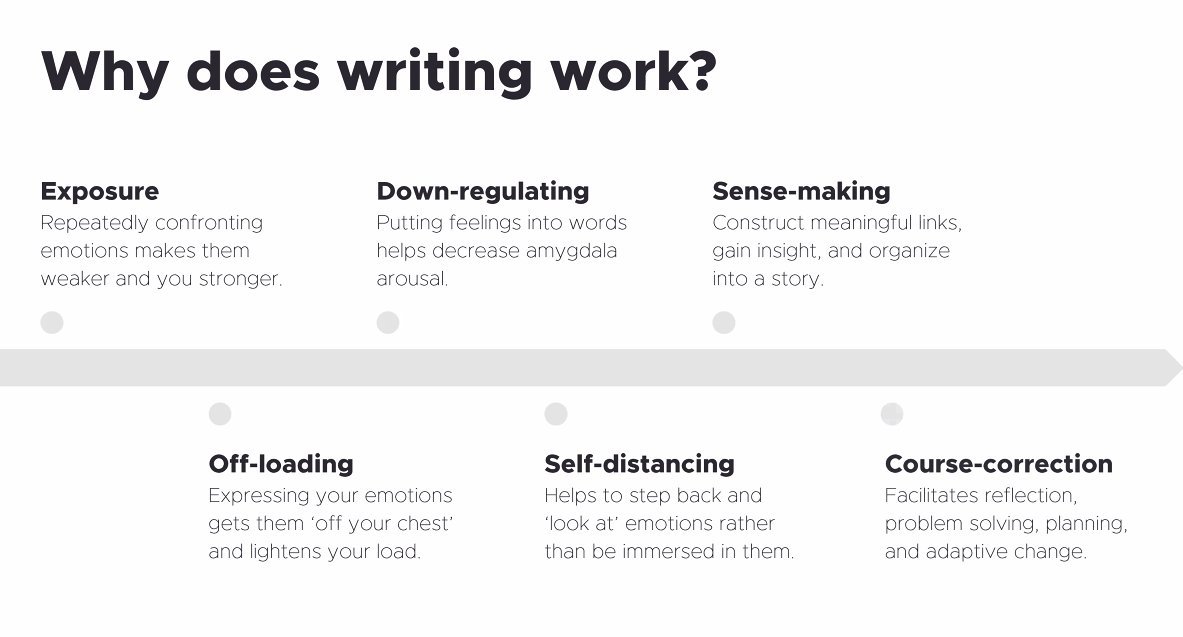
Depression as 'behavioral shutdown'.
A thread🧵
@khalilian_sajad I think it's perfectly reasonable to play the long game. Sometimes, you have to take a step back to regroup and refresh before the next leg. But, if you trust you'll get there eventually, these pauses aren't seen as failures.
Embody the tortoise.
"Mastery is the best goal because the rich can't buy it, the impatient can't rush it, the privileged can't inherit it, and nobody can steal it.
You can only earn it through hard work.
Mastery is the ultimate status."
— Derek Sivers
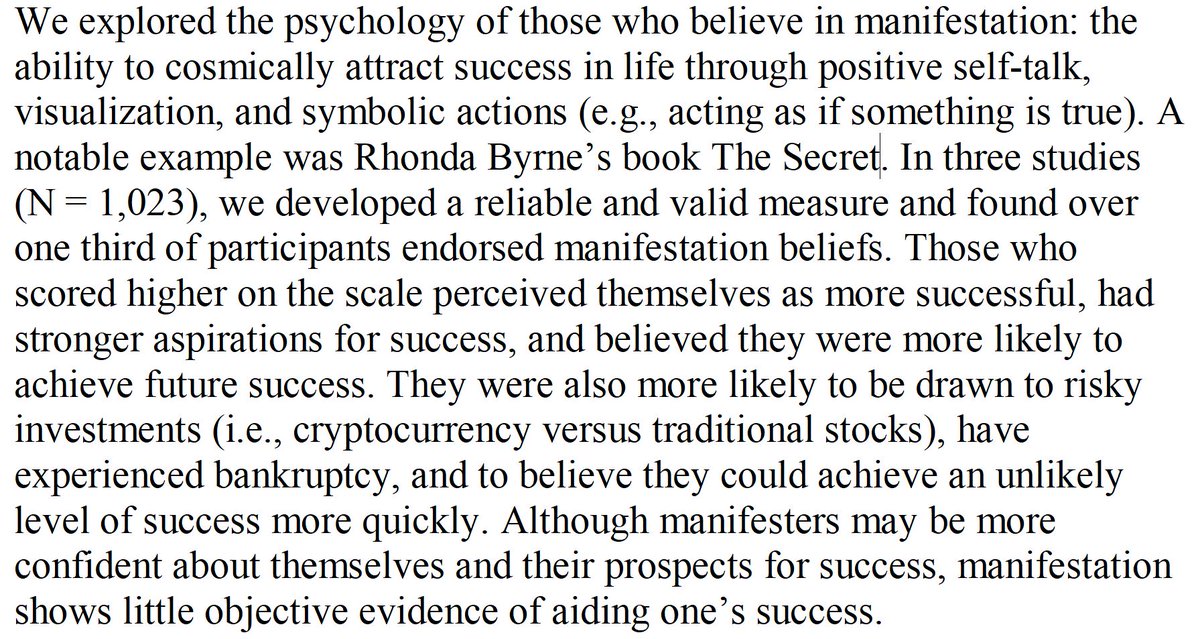
People who believe in "manifestation", the possibility of mentally summoning success in life, are more likely to have experienced bankruptcy. https://t.co/f8bx25UFfq